
Widow Gave Two Copper Coins to The Treasury
Our study is about a widow who gave money to the temple treasury in Jerusalem. It is a most interesting event as you will soon discover. Many think that the application of the account is that believers are to give a tremendous portion of their money to God, and then God will bless them. Others think there is a different meaning to this account. This is not the only time that Jesus spoke about money during His ministry. On one occasion He sent the twelve disciples on a mission and told them to not take anything with them, including money (Luke 9:1-3). He repeated the same command when He sent out seventy disciples (Luke 10:1-4). Later in Luke 22:35-36, Jesus told them to take money and other items when He knew He was going to be betrayed. Also, He condemned the Pharisees for loving money (Luke 16:14). On another occasion, Jesus told Peter to give to Caesar what belonged to Caesar and to give to God what belonged to Him (Mark 12:13-17). Early in His ministry, Jesus warned us to store up treasure in heaven and not here on earth (Matthew 6:19-21). The parable of the rich man who stored up treasure on earth is a warning to not depend upon money, but upon God (Luke 12:13-21). Now we are going to study the account about the poor widow from Mark 12:41-44 and Luke 21:1-4.
Watching People Give Money
Several studies ago, Jesus had warned the crowds that the Pharisees were not righteous men, but hypocrites and spiritually blind. They had a culture of being religious, but they were far from being spiritual men. Then in the last study (Matthew 23:34-39), Jesus had lamented the future destruction of Jerusalem and the temple, and prophesied that His second coming was sometime in the future. When the nation of Israel said, “BLESSED IS HE WHO COMES IN THE NAME OF THE LORD!” then He would come! That was the last study.
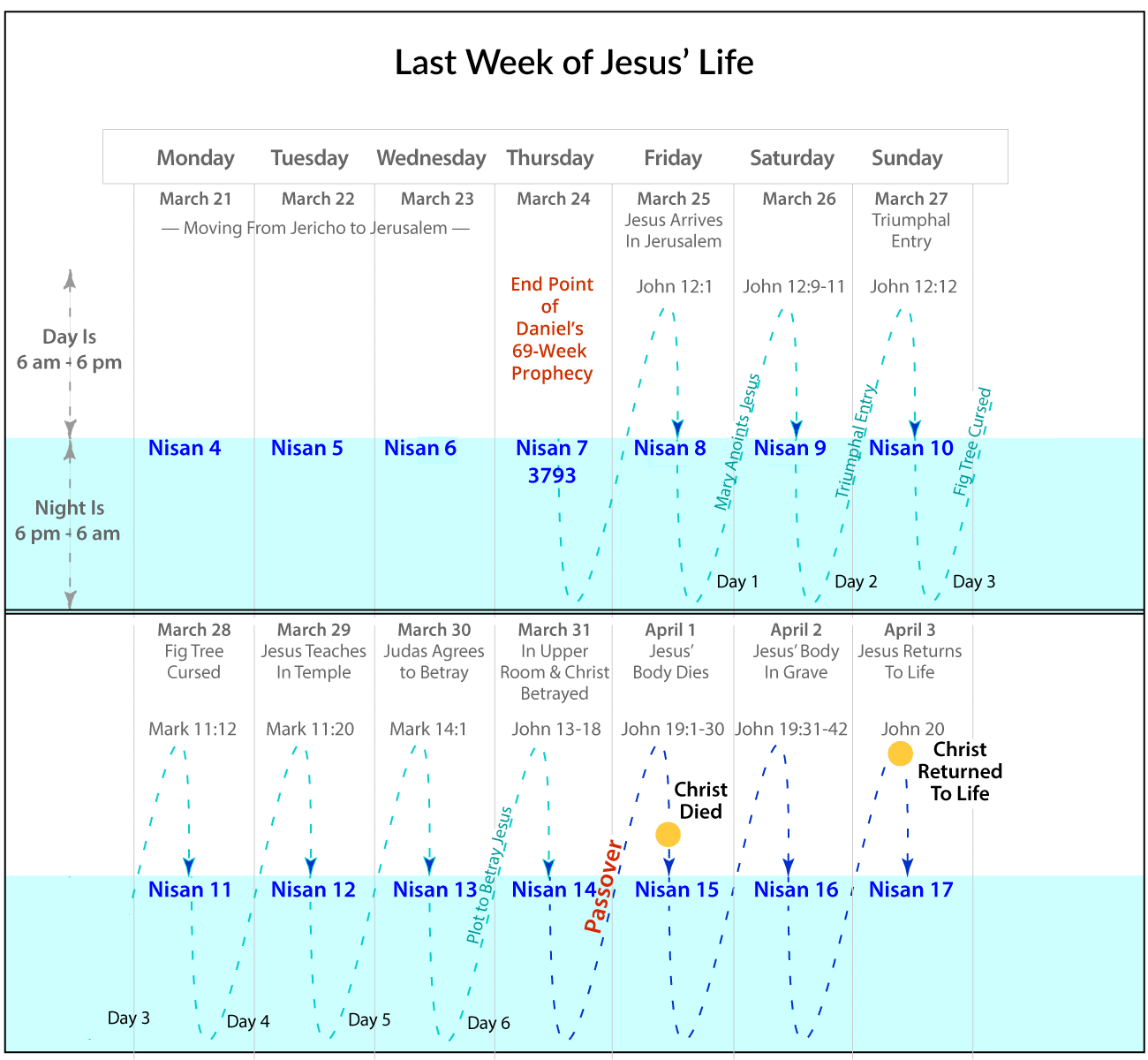
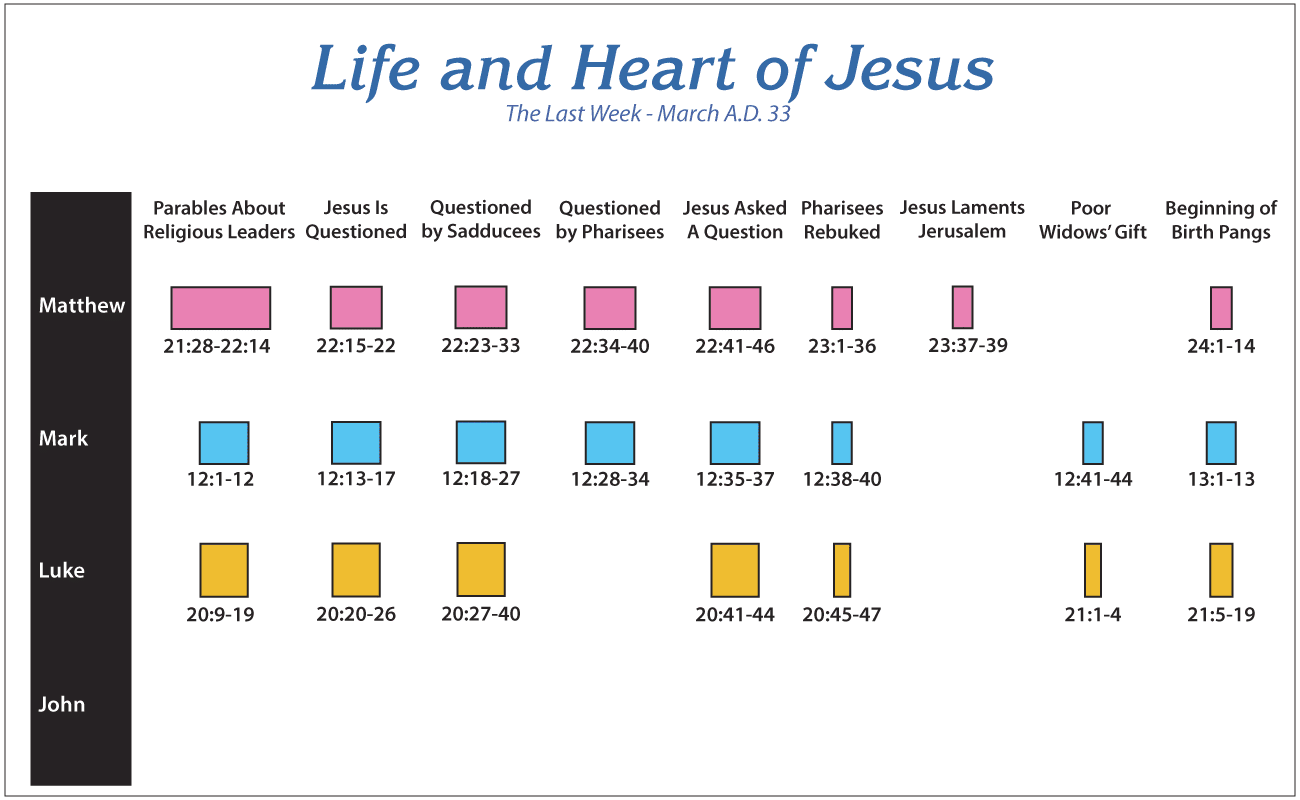
Now by comparing all four gospels we discover that the next event is located in Mark 12:41-44 and Luke 21:1-4. We discover that the event occurred on Tuesday, 29 March A.D. 33. Many of the past studies and this one have occurred on that Tuesday. That reveals it has been a long day for Jesus and the disciples. We will discover in the next study that it is late in the afternoon and near the evening meal. This conclusion is supported by the fact that the first verse of our study says that Jesus sat down. We have not been told that Jesus did this earlier. Here is first part of Mark 12:41.
And He sat down opposite the treasury, and began observing how the people were putting money into the treasury . . . Mark 12:41a (NASB)
Apparently, Jesus was tired and so He sat down to rest. We are told that He sat down opposite the treasury in the temple and watched people donate money. It appears that He had been speaking in the Court of the Gentiles, which was outside the temple and its courts. The primary entrance to the temple was the East Gate, which was also called the Beautiful Gate (Acts 3:2). It is possible that Jesus walked through this gate or one of the side gates—the South Gate or the North Gate. So, Jesus would have walked from the Court of the Gentiles and onto the Court of Women and sat down. Immediately He would have seen the treasurys which were located on the left and right walls.
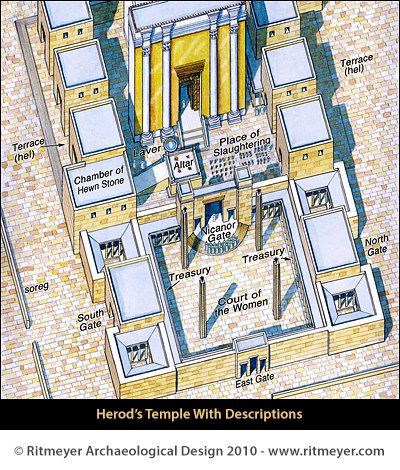
The left and right walls were lined with Roman-style double colonnades. Alfred Edersheim describes the treasury in his mammoth work The Life and Times of Jesus the Messiah as follows,
All along these colonnades were the thirteen trumpet-shaped boxes (shopharoth); somewhere here also we must locate two chambers: that of the “the silent,” for gifts to be distributed in secret to the children of the pious poor, and that where votive vessels were deposited.
. . .
As they passed to this or that treasury-box, it must have been a study of deep interest, especially on that day, to watch the givers.1
His message is that the treasury consisted of thirteen trumpet-shaped boxes placed along the two rows of columns. These trumpet-shaped bronze boxes had funnels that guided the coins into the boxes. One can imagine the sound that was created after the giver dropped their coins into the funnel and they tinkled against the bronze metal as they descended into the box. People would have been able to hear how many or how few coins were given. The boxes were labeled in some way to indicate what type of gift could be placed in each box. Alfred Edersheim indicates that the giver was to place the gift in the correct trumpet-shaped box.
Now imagine Jesus watching the givers walking past some boxes and finally stopping and dropping their money into a box. Perhaps the individual dropped their gift into a box labeled for delinquent gifts, or one of a series of boxes for a specific amount of money. However, the trumpet-shaped boxes were labeled, Jesus was watching them drop their money into these different boxes. Jesus would have known the labels on the boxes and heard if many or few coins were given. Paper money did not exist in Roman times.
Watching the Rich Give Money
The last part of verse 41 tells us Jesus was watching the rich people put in large amounts of money.
. . . and many rich people were putting in large sums. Mark 12:41b (NASB)
Sadly, the Pharisees taught that the rich were more likely to get into heaven because they could give money and gain favor. For example, when the rich young ruler spoke with Jesus, he asked Jesus what he must do in order to have eternal life. That reveals he did not believe his money was enough to assure him of eternal life. So, he wanted to know what else he must do. Then after the rich man and Jesus finished speaking, Jesus said this to the disciples,
Again I say to you, it is easier for a camel to go through the eye of a needle, than for a rich man to enter the kingdom of God. Matthew 19:24 (NASB)
The next verse reveals the disciples were amazed that Jesus said is was extremely hard for a rich man to enter the kingdom of God.
When the disciples heard this, they were very astonished and said, “Then who can be saved?” Matthew 19:25 (NASB)
This reveals the disciples believed the rich had an advantage to getting into heaven or of being saved. Therefore, the rich people had an advantage by giving or dropping large sums of money into the boxes, and so they did.
The Greek word for “observing” is in the imperfect tense, implying that Jesus kept watching this happen repeatedly. He watched one person after another drop coins and heard the sound of the coins of the wealthy. If there was a special box for them placed close to a gate and not at a distance, they could just give and leave thinking they were closer to eternal life.
Watching a Poor Widow Give Money
Then we are told that Jesus saw a poor widow give some money.
A poor widow came and put in two small copper coins, which amount to a cent. Mark 12:42 (NASB)
This widow dropped two copper coins into one of the trumpet-shaped boxes. The Greek word for copper coin is leptos. Other translations refer to this coin as mite. So, this account is sometimes called the story of the widow’s mite. The copper coin was the smallest Roman coin. Sixty-four of the copper coins equaled a denarius, the wage of a day-laborer. Therefore, when the poor widow gave two copper coins, she gave the amount of money that would have equaled 15 minutes of work. That was the value of one cent.
So, I wonder into what trumpet-shaped box did the poor widow drop her two coins? Was it a tiny trumpet-shaped box? Was the box located at the far end of the colonnade? Was she a young widow with children, or an older woman who lived by herself? I wonder why she gave that sum of money?
Jesus’ Commentary
Then we are told Jesus spoke to the disciples,
Calling His disciples to Him, He said to them, “Truly I say to you, this poor widow put in more than all the contributors to the treasury; for they all put in out of their surplus, but she, out of her poverty, put in all she owned, all she had to live on.” Mark 12:43-44 (NASB)
He told them that this poor widow put more into the treasury than all of the wealthy donors. Obviously, she did not put more money into the treasury than the literal amount of that given by wealthy donors. Jesus was speaking figuratively. He was referring to the percentage of how much the wealthy people had given of what they had versus that which she had given. Jesus explained that the wealthy gave from their surplus, but she gave everything that she had! She even had less money than a day-laborer. She only had money for fifteen minutes of labor, but she gave that away.
So, what is the application of this account? It is important to notice that Jesus does not give us an application. He just tells us what happened! So, why did Jesus make His comment? As we think about the possible applications, it becomes clear that the usual applications violate the teaching of Scripture.
For example, one possible application says that believers are to give all of our money to God. If that is true, then a husband will violate 1 Timothy 5:8 which says,
But if anyone does not provide for his own, and especially for those of his household, he has denied the faith and is worse than an unbeliever. 1 Timothy 5:8 (NASB)
This verse states that godly husbands and fathers are to provide for their family. So, if they are to give all of their money to God, how they fulfill this warning? They would not be able to provide for their families. Also, in 2 Thessalonians 3:7-12, every believer is warned to work quietly and not beg for food from others. So, the correct application cannot be to give all of our money to God!
A variation of that application would be that we must give a major portion of our money to God. But Jesus did not say that, and it does not fit the account for the poor widow gave everything she had.
Another possible application is that we should not give from our surplus but from what we need for our daily needs. That is, we are to exercise self-denial. While that is commendable, where do we find that principle in Scripture or in this account?
Another possible application is a common one in our times. We hear some preachers urge people to sacrificially give to their ministry and claim that God promises them great rewards if they do. They often quote from Mark 10:28-30 which they state promises a one hundred fold return. If that were true, why does not the preacher just repeatedly give ten thousand dollars and keep getting his return until he reaches one billion dollars? The truth is they distort the teaching of that passage. Once again, Jesus did not give us any application about the poor widow giving everything to God.
However, we do have a principle from Luke 5:1-11 that reveals the disciples finally gave themselves completely to Christ. They gave their lives. They sacrificed themselves, but Jesus never told them to become poor, for how then could they live and care for their families?
So, is the application that believers are to sacrificially give to God but not everything? Even that conflicts with 2 Corinthians 9:6-9 which encourages us to give much to the Lord willingly, but not under compulsion. Notice what the passage says,
Now this I say, he who sows sparingly will also reap sparingly, and he who sows bountifully will also reap bountifully. Each one must do just as he has purposed in his heart, not grudgingly or under compulsion, for God loves a cheerful giver. And God is able to make all grace abound to you, so that always having all sufficiency in everything, you may have an abundance for every good deed;
as it is written,“HE SCATTERED ABROAD, HE GAVE TO
THE POOR,
HIS RIGHTEOUSNESS ENDURES
FOREVER.
2 Corinthians 9:6-9 (NASB)
Here God states that if we sow little, we reap little. God wants us to give because we desire to give our money and not because we feel obligated. Then we are told that God loves a cheerful giver. We should not worry about having enough money for God can and will provide what we need. This means that God may have supplied the needs of the poor widow, assuming she gave for the correct reason. It is a biblical principle that applies to every believer. The principle is repeated in Galatians 6:7. We reap what we sow. But God does not ask to give up all of our money.
Imagine God supplying for our daily needs, and then we give it all away? That is not logical. The message of this passage is that believers are to give much to the Lord, but that does not mean to give everything. Even in the Old Testament, God only asked for ten percent of one’s income and not everything. So, what is the application of the passage?
Conclusion
The answer is we are not told. However, let me guess. We know the religious leaders taught that money helped the giver to gain favor with God and improve their possibility of entering heaven. Therefore, it appears that is the reason the poor widow gave everything. She also wanted to improve her possibility of going to heaven. What a tragedy since God has made it much easier for people to go to heaven. He does not require money or any works. In fact, if anyone tries to go to heaven by works or money alone, they will go to hell. The way anyone goes to heaven is by believing in Jesus Christ that only He can forgive our sins (John 3:16; Ephesians 2:8-9). So, if you would like to have your sins forgiven and go to heaven, then ask Him to forgive your sins and then obediently follow Him. (Romans 10:9-11).
In addition to my closing comment, there is one principle that we should not miss from this account. Our God notices everything that we do, including how much money we give to Him. Hebrews 6:10 also tells us that God knows how we minister to others.
For God is not unjust so as to forget your work and the love which you have shown toward His name, in having ministered and in still ministering to the saints. Hebrews 6:10 (NASB)
I love this verse because it teaches us that God would be unjust if He forgot what we do for others.
In Galatians 6:7-10 God tells us that we reap what we sow. Then He encourages us to sow to the Spirit, do good, and love others, especially fellow believers.
Do not be deceived, God is not mocked; for whatever a man sows, this he will also reap. For the one who sows to his own flesh will from the flesh reap corruption, but the one who sows to the Spirit will from the Spirit reap eternal life. Let us not lose heart in doing good, for in due time we will reap if we do not grow weary. So then, while we have opportunity, let us do good to all people, and especially to those who are of the household of the faith. Galatians 6:7-10 (NASB)
Notice that God promises that we will reap what we sow. While there is a negative side to this principle, I want to focus on the positive side. God sees what we do, and He rewards us accordingly. While Jesus did nor give us this principle as an application from Mark 12:41-44 and Luke 21:1-4, it does fit the passage. He saw what the poor widow did. He knew more than that she had dropped money in the trumpet-shaped box. He knew her heart, how much she gave, and why she gave.
So, God knows everything that the followers of Christ do and their motivation. He will reward the followers of Christ accordingly.
References:
1. Alfred Edersheim. The Life and Times of Jesus The Messiah. Eerdmans Publishing Co., 1973. Part Two, p. 387.