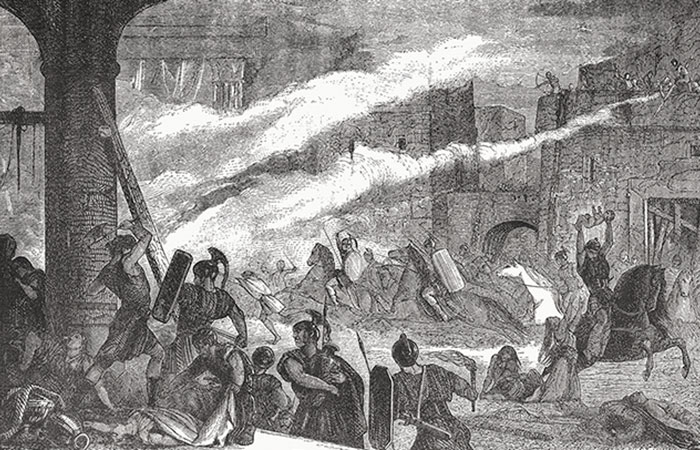
Destruction of Jerusalem by Titus
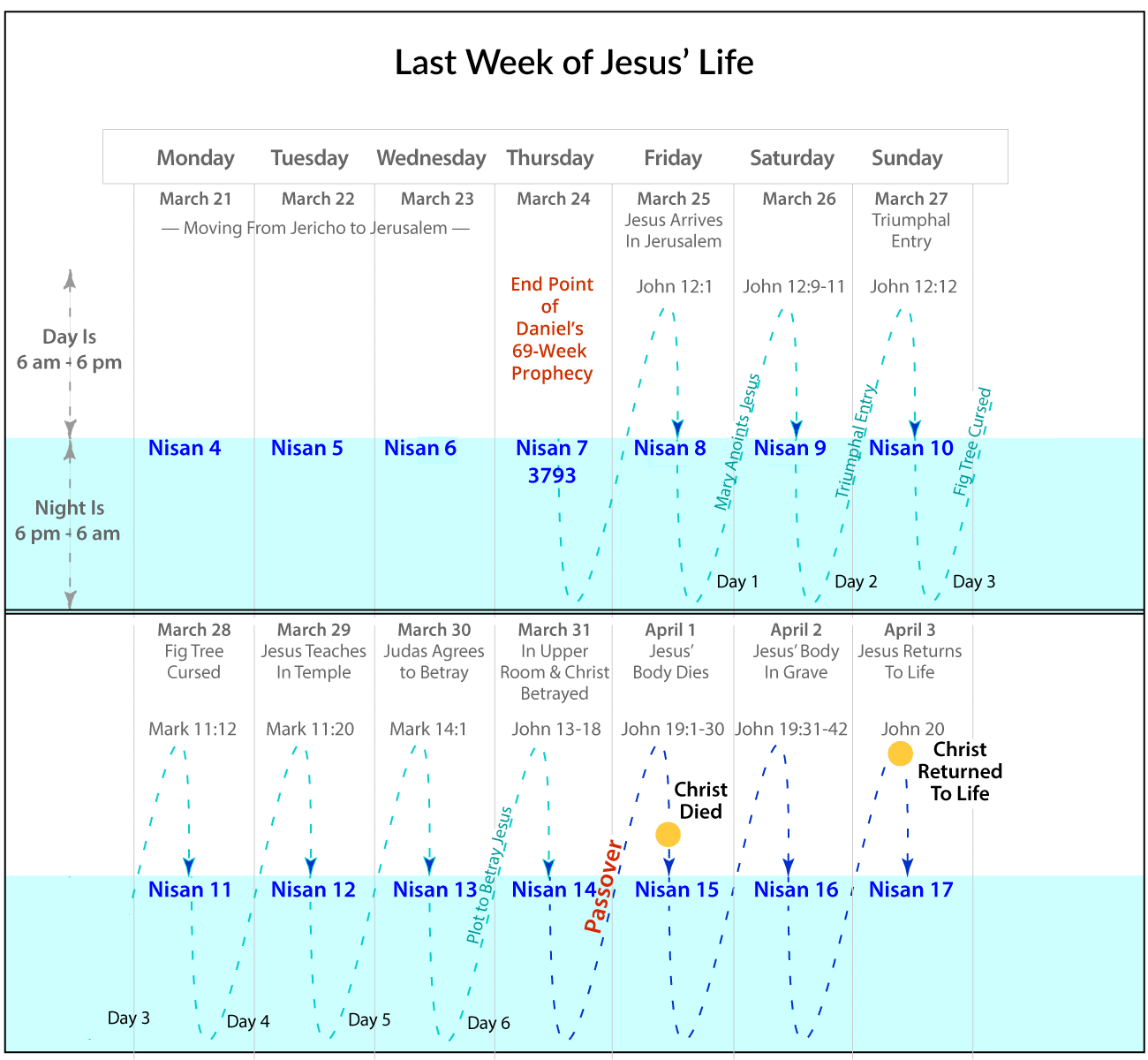
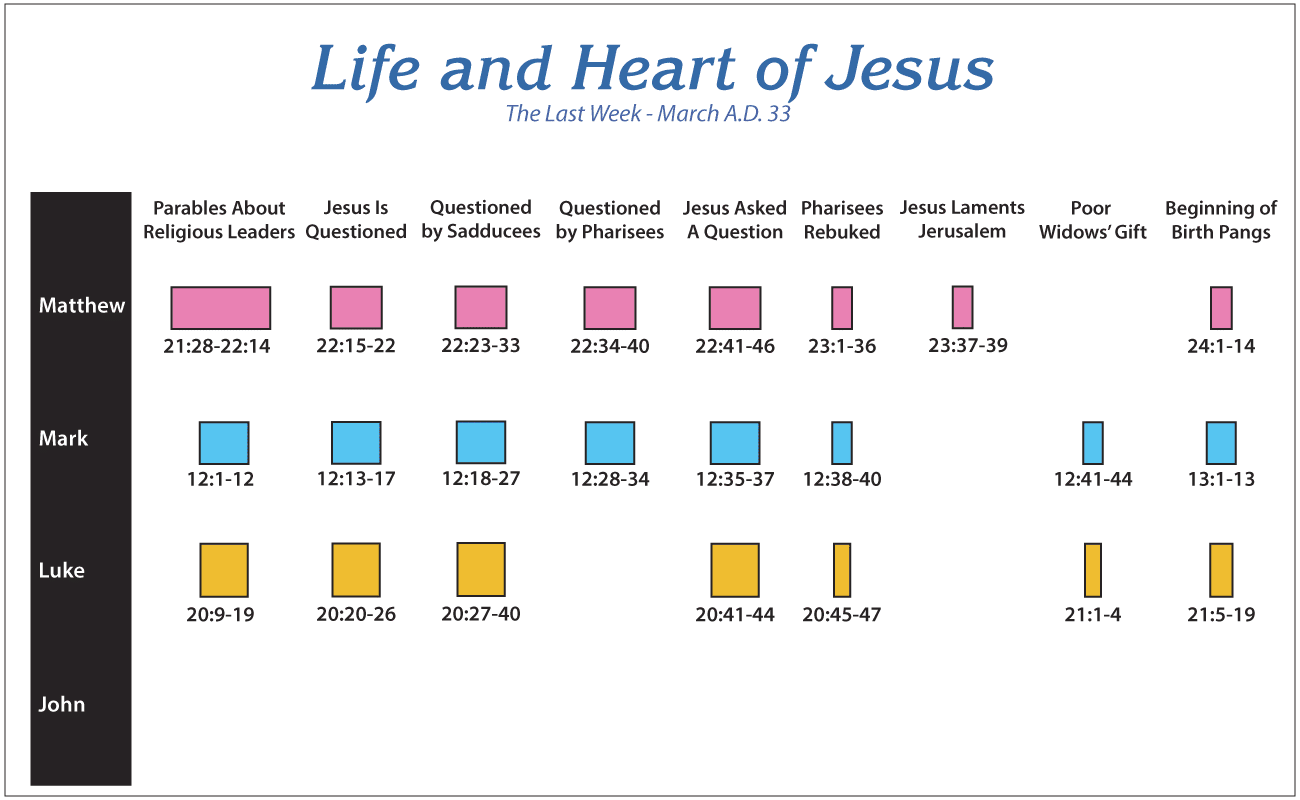
Once again our study occurs on Tuesday, 29 March A.D. 33, before Jesus was crucified. The day was a busy and important day. The three gospels of Matthew, Mark, and Luke report that on this day Jesus had more conversions and performed more teaching than on any other day in the last week of Jesus’ life – except for Friday. We discovered in our last two studies that after the Pharisees had challenged Jesus with a series of questions, that Jesus then asked them a question. He warned the crowd of people about these hypocritical religious leaders. First, He described five characteristics of a Pharisee and then announced eight woes or curses upon them. Jesus did that as a warning for us too! The warnings and curses were given because the religious leaders had completely rejected Jesus. Also, their questions revealed their complete and final rejection of Jesus. Tomorrow morning the chief priests and scribes will plot with Judas how to quietly arrest Jesus so that they may have Him crucified. From the beginning of Jesus’ ministry, the Pharisees wanted to kill Him (John 5:18). After Jesus had raised Lazarus from the tomb three months ago, they renewed their plan to kill Him. Tomorrow they will finally take the next step required to get rid of Him. Our study is from Matthew 23:34-39.
Divine Wrath Was Deserved
It must be the later part of Tuesday afternoon due to everything that is recorded about Jesus’ activities on this day. Jesus has just finished announcing His woes or curses on the scribes and Pharisees. Now we will discover in this study that He announces what will happen to Jerusalem next according to God’s future timeline. Jesus is speaking in Matthew 23:34-35.
“Therefore, behold, I am sending you prophets and wise men and scribes; some of them you will kill and crucify, and some of them you will scourge in your synagogues, and persecute from city to city, so that upon you may fall the guilt of all the righteous blood shed on earth, from the blood of righteous Abel to the blood of Zechariah, the son of Berechiah, whom you murdered between the temple and the altar. Matthew 23:34-35 (NASB)
Jesus’ announcement reveals six important facts. The first important fact is that only God could cause this prophecy to be fulfilled. The second important fact is that Jesus is God. For Jesus said, “I am sending . . .” Only a sovereign God could send prophets, wise men, and scribes. God had to plan what would happen, and then He had to cause or motivate those men to come to Jerusalem.
This is an important example of the sovereignty of God. God decides and men decide too! We know that God sent the prophets Isaiah, Jeremiah, and Ezekiel as well as the other prophets. He appointed all forty-eight prophets that are mentioned in Scripture. All of them except for Jonah wanted to please God. This reveals that God’s prophecies will be fulfilled. He motivates men to accomplish His will (Ezra 1:1; Proverbs 21:1; Isaiah 6:8-13; Jeremiah 1:10; Ezekiel 2:1-7). So, Jesus said that He would send prophets, wise men, and scribes.
The third important fact we must not miss is that Jesus knew some of the prophets, wise men, and scribes would be killed, crucified, scourged in the synagogues, and persecuted. He knew what would happen to the individuals He sent. This gives us a principle that we must not miss. It might be God’s will for any believer to be killed, crucified, scourged, persecuted, slandered, suffer sickness, and be humbled by unbelievers and people in a church in order to accomplish God’s will. Our suffering is necessary sometimes for God’s glory.
The fourth important fact explains why God allowed His righteous ones to suffer. Verse 35 says the righteous would be allowed to suffer so that the guilt of all the righteous blood shed on earth, from the blood of righteous Abel to the blood of Zechariah, the son of Berechiah would fall upon Jerusalem. The nation of Israel had killed the righteous throughout its history. Tradition says that Isaiah was murdered or was sawed in half. Jeremiah, the weeping prophet, was beaten (Jeremiah 37:15-16 ) and tradition says he was stoned to death by the Jews. God caused the wife of the prophet Ezekiel to die as an illustration to the Israelites in captivity. Hebrews 11 gives us a long list of Israel’s abuse to the righteous from Abel to the blood of Zechariah, the son of Berechiah.
We know that Abel was the first son of Adam and Eve, and that he was killed by his brother Cain according to Genesis 4:8. But who is Zechariah, the son of Berechiah? There is some confusion about the identity of this man. Some say that this Zechariah is actually Zechariah, son of Jehoiada the priest in 2 Chronicles 24:20-22. He was a priest who was killed in the temple according to 2 Chronicles. But Jesus said Zechariah, the son of Berechiah. This Zechariah was the prophet who wrote the book of Zechariah. There he is called Zechariah, the son of Berechiah, the son of Iddo. According to rabbinic tradition, the Targum Lamentations states that this Zechariah was killed in the temple on the Lord’s Day.1 Since this rabbinic tradition is not Scripture, this statement may be wrong. But we do know that 2 Chronicles 24:20-22 is truth.
Yet if Targum Lamentations is correct, then we have support for a solution to Jesus’ reference to Zechariah, the son of Berechiah. Therefore, referred to all of the righteous men who been murdered from Abel to Zechariah, the son of Berechiah. He referred to all the righteous who died in the Old Testament.
The fifth important fact is that all in Jerusalem who rejected Christ would suffer the guilt of persecuting the righteous from Abel to Zechariah, the son of Berechiah. But the ultimate guilt would be the murder of Jesus Christ. They deserved to have the guilt of all the righteous fall upon the leaders and all who did not believe in Him.
The sixth important point is that God usually gives us time to repent and turn from our sins before punishing us. In this situation, God had given the Pharisees and people of Israel time to respond to Jesus’ call to repent of their sins, but they did not. In this situation because they had received full light about Jesus and rejected Him, they would suffer for the sins of their forefathers. Exodus 20:5 explains why Jesus said they would suffer the guilt of persecuting the righteous from Abel to Zechariah.
You shall not worship them or serve them; for I, the LORD your God, am a jealous God, visiting the iniquity of the fathers on the children, on the third and the fourth generations of those who hate Me. Exodus 20:5 (NASB)
Exodus 20:5 applies to those who hate God. Another principle given to us in Ezekiel 18:5-20 reveals that God does not punish us for our forefather’s sins if we love God and practice righteousness.
Divine Wrath Was Coming
Consequently, Jesus added,
Truly I say to you, all these things will come upon this generation. Matthew 23:36 (NASB)
The context before Jesus’ message reveals that He is speaking to the crowds in Jerusalem. Thus the “generation” refers to the people who were living in Jerusalem at the time Jesus was speaking. The Greek word for generation is genea and has the meaning of birth, descent, descendants, family, and race. That is, generation refers to a race of people. Therefore, Jesus promised that the guilt of past generations for the murder of the righteous would fall upon the leaders and people of Jerusalem.
Therefore, we must not miss the incredible fact that a righteous man, a prophet named Zechariah, the son of Berechiah. had been killed in the temple by the leaders of Israel. It is difficult to imagine how so-called righteous leaders would do that, but righteous men are abused and persecuted in our churches even today due to envy, jealousy, distorted theology, and hatred. Those who do, will be punished just as Jesus said for Romans 12:19 says,
Never take your own revenge, beloved, but leave room for the wrath of God, for it is written, “VENGEANCE IS MINE, I WILL REPAY,” says the Lord. Romans 12:19 (NASB)
Divine Compassion for Jerusalem
Since God’s justice demanded that the guilt of Jerusalem’s evil be avenged, Jesus revealed that vengeance was coming upon Jerusalem. Verse 37 says,
Jerusalem, Jerusalem, who kills the prophets and stones those who are sent to her! How often I wanted to gather your children together, the way a hen gathers her chicks under her wings, and you were unwilling. Matthew 23:37 (NASB)
Now Jesus summarized Jerusalem’s guilt from Matthew 23:34-35. But He did not mention His own crucifixion. But we can add His name to the list of the righteous whom Jerusalem and the religious leaders murdered. We know from Acts 7:54-60 that after Jesus’ ascension to heaven, the religious leaders of Jerusalem killed another righteous person named Stephen. He was the first Christian martyr. Acts 8:1-3 reveals that they persecuted the early church.
Even though vengeance was deserved and was coming, Jesus had compassion on them. He reveals that He had wanted to protect Jerusalem. The message of His illustration was “the way a hen gathers her chicks under her wings” Anyone who lived on a farm with chickens knows that when danger occurs, a hen calls to her chicks and they run and hide under her wings. It is primarily an act of protection. It is obvious that it is also an act of caring. In Ezekiel 18:23, God tells us,
“Do I have any pleasure in the death of the wicked,” declares the Lord GOD, “rather than that he should turn from his ways and live?” Ezekiel 18:23 (NASB)
This is a significant statement because throughout chapters 3-24 of the book of Ezekiel, God warned Israel to stop sinning and repent or He would destroy them. That was His message, chapter after chapter, through the prophet Ezekiel in parables, illustrations, and messages. At the same time, God told Israel in Ezekiel 18:23, 32 that He did not want to destroy them. But Israel refused to repent. Finally in Ezekiel 25, God used the Babylonian Empire to destroy Jerusalem, the temple, and to kill a massive number of Israelis. God did that only because Israel stubbornly refused to repent. Afterward, He repeated that in Ezekiel 33:11.
There are two principles we can learn from Ezekiel. First, God must punish us at some point if we continue sinning and do not repent. His holiness demands punishment. The second principle is that God has not determined everything in my life or your life. While it is not His will that we disobey Him or reject Him, we are free to do both. James 4:3 also communicates the same principle.
The last part of Matthew 23:37 illustrates both principles when Jesus said, “You were unwilling.” God called and they refused. So, they were going to suffer for their own guilt. We will suffer for our guilt when we refuse to repent.
These are important lessons for us. Even when someone deserves to be punished, we should be compassionate. We should warn and yet love them. While Proverbs 29:15 encourages us to discipline our children, Lamentations 3:33 urges us to have compassion. Jesus demonstrated the principle as He spoke to the crowd. Our God does not enjoy punishing people.
For He does not afflict willingly
Or grieve the sons of men.
Lamentations 3:33 (NASB)
He revealed divine compassion even though divine wrath was coming upon Jerusalem.
Divine Wrath Poured Out
Verse 38 reveals that the destruction of Jerusalem was certain and would be total.
“Behold, your house is being left to you desolate! Matthew 23:38 (NASB)
This occurred in A.D. 70 when the Roman army destroyed Jerusalem and the temple. Millions of Israelis were killed by the Roman soldiers. The city was looted, burned, and the leveled to the ground. The previous study “Jesus Wept — The Destruction of Jerusalem Prophesied” provides much detail about the Roman army’s destruction of Jerusalem. That study was from Luke 19:41-44.
When Jesus said “your house,” He may have referred to the city or to the temple. It seems that most likely, it refers to the temple. Matthew 21:13 told us that on Monday, Jesus had quoted Isaiah 56:7 when He called the temple “My house.” Now He called it “your house.” If it refers to the city, the same point is made. The people had corrupted the city and the temple within the city. Jesus said that just as God had destroyed Jerusalem and the temple previously, He was going to do it again in A.D. 70.
Jerusalem was destroyed because it had built up a weight of guilt for killing the righteous, especially the Righteous One called Jesus Christ. The punishment of A.D. 70 was horrible. But it is nothing compared to the punishment that will occur during the great tribulation.
Israel’s Conversion Prophesied
Then Jesus ended His message to the crowd with this amazing comment,
For I say to you, from now on you will not see Me until you say, “BLESSED IS HE WHO COMES IN THE NAME OF THE LORD!” Matthew 23:39 (NASB)
Jesus’ comment is very important for us. The first important point to notice is that He revealed the crowd would “not see Him until they said, “BLESSED IS HE WHO COMES IN THE NAME OF THE LORD!” This is a quote from Psalm 118:26. Those very words were shouted by the crowd during Jesus’ Triumphal Entry (Matthew 21:9; Mark 11:9; Luke 19:38). In Luke 19:38, we are told the crowd inserted the word “king.” “Blessed is the King who comes in the name of the Lord.” All of Israel understood that Psalm 118:26 and Zechariah 9:9-10 referred to their Messiah-King coming to establish His kingdom. During the Triumphal Entry, they shouted those words in honor of Christ. These words were shouted in connection with the prophecy of Zechariah 9:9-10 which is a Messianic passage. Risto Santala states,
Further, Psalm 118:24, a hymn which according to the Rabbis will be sung to the Messiah when he comes, says “From the house of the LORD we bless you.”2
Psalm 118:24 is a Messianic prophecy of the second coming of Christ. Zechariah 9:9 is a prophecy about the Messiah’s first coming or first advent. Verse 10 is about His second coming. So, the first important point is that Jesus was saying that He was returning some day as the Messiah. When He quoted Psalm 118:26, everyone would have understood He was claiming to be the Messiah.
The second important point is that when Jesus said they would “not see Me until . . .” He told them that His second coming was some time in the future. But it did not occur in A.D. 70 as some claim, for Christ did not establish His kingdom and no one was shouting “BLESSED IS HE WHO COMES IN THE NAME OF THE LORD!” We should also remember that Jesus told the disciples in Luke 17:22 that they would not see His coming. So, He did not come in A.D. 70 as amillennialists, postmillennialists, and preterists claim because the apostle John was still alive. Therefore, His coming is yet future.
Conclusion
Jesus started His ministry by preaching,
“Repent, for the kingdom of heaven is at hand.” Matthew 4:17 (NASB)
But the religious leaders and people rejected Him and consequently, His kingdom. The religious leaders rejected Him when they accused Him of being demon-possessed. They accused Him multiple times. The vast crowds of people rejected Him. A crowd will call for His crucifixion on Thursday. On Friday His body will die and be resurrected on Sunday. Thus, Jesus became our Savior.
Now we are waiting for His second coming as the Messiah -King. Israel will continue to suffer until He comes. At some point they will trust the future antichrist who will betray them and persecute the nation. When the armies of the nations of the world surround Jerusalem at the battle of Armageddon, then Christ will arrive. Every living Israelite at that time will see Him, believe in Him, and be saved (Zechariah 12:8-10; Romans 11:25-26).
Then Christ will establish His millennial kingdom and every believer since Adam and Eve will enter the kingdom. They will shout, “BLESSED IS HE WHO COMES IN THE NAME OF THE LORD!” Christ will be honored and reign over His kingdom which has been prophesied to Israel. Praise the Lord.
I am coming quickly! Revelation 3:11 (NASB)
References:
1. Targum Lamentations on Lamentations 2:20 states, “See, O Lord, and observe from heaven against whom you have turned. Thus is it right for the daughters of Israel to eat the fruit of the ir wombs due to starvation, the lovely boys wrapped in fine linen? The Attribute of Justice replied, and said, “Is it right to kill priest and prophet in the Temple of the LORD, as when you killed Zechariah son of Iddo, the High Priest and faithful prophet in the Temple of the Lord on the Day of Atonement because he admonished you not to do evil before the Lord?” (targuman.org/targum-lamentations/tglam-in-english/)
2. Risto Santala. The Messiah In the Old Testament. Karen Ahvah Meshihit. Jerusalem. 1992. p. 103.