
Man Who Loves God
There are many commandments with which believers in Jesus Christ are concerned. We are concerned that our husbands and wives obey the commands of wives submitting to husbands (1 Corinthians 11:3-4; Ephesians 5:22-24; Colossians 3:18; Titus 2:3-5; 1 Peter 3:1-6:), husbands loving their wives (Ephesians 5:25-33; Colossians 3:19), showing respect to each other (Ephesians 5:33), and fulfilling their sexual responsibility to their spouses (1 Corinthians 7:4-7). As children we heard that we were to honor and obey our parents (Ephesians 6:1-2; Colossians 3:20). Romans 13:1-4 and 1 Peter 2:13-16 told us to obey our government. We were commanded repeatedly to not sin. One of the notable passages is 1 Peter 1:15-16, where we are commanded to be holy for our God is holy. I remember learning the Ten Commandments in Exodus 20:1-17, such as do not steal, do not murder, or lie about one’s neighbor. We learned many other commandments. So, if someone asked you, “What is the greatest commandment? What would you say? That was a question someone asked Jesus. Do you know how He answered? Our study will reveal how Jesus replied to the question on the Tuesday before He was crucified on Friday, April 1, A.D. 33. It comes from Matthew 22:34-40 and Mark 12:28-34.
The Scribe’s Challenge
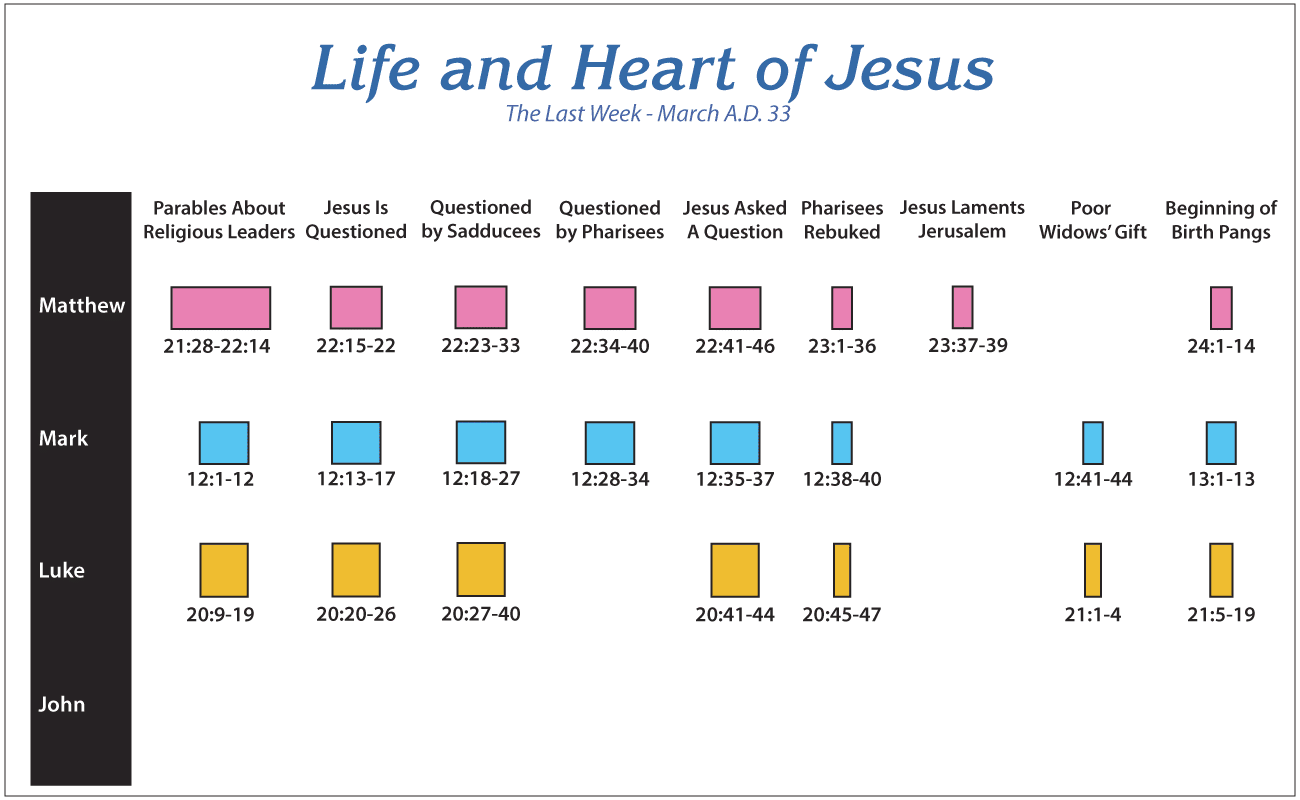
The Pharisees and Sadducees had already tried to trap Jesus into answering something that they could use against Him on Tuesday. The Pharisees had asked if it was lawful to give a poll-tax to Caesar, or no.?” Then the Sadducees described an elaborate levirate marriage about a woman who theoretically had seven husbands on earth. Then they asked, “In the resurrection, therefore, whose wife of the seven will she be?” Each time Jesus surprised them with His answer. They were trying hard to cause Jesus to make a mistake, but they had failed so far.
Now in this study we will learn about their third attempt. We will be following the account of this event primarily from the gospel of Mark since it provides more information than the gospel of Matthew.
But we begin our study with Matthew 22:34-35 which says,
But when the Pharisees heard that Jesus had silenced the Sadducees, they gathered themselves together. One of them, a lawyer, asked Him a question, testing Him. Matthew 22:34-35 (NASB)
Immediately, we are told that the Sadducees had been silenced or defeated by Jesus. So, the Pharisees had a meeting and one, who was a lawyer, was chosen to question Jesus. But in Mark 12:32 we are told that this lawyer was also called a scribe. Why? The answer is that a lawyer was a teacher of the Law (Luke 5:17). Today, we would call him a theologian. Lawyers were considered an authority of the Law. They studied, interpreted, taught, and applied the Law. They were teachers in the synagogues and acted as judges in judicial cases since they knew the details of the Law. The nation was committed to following the Mosaic Law.
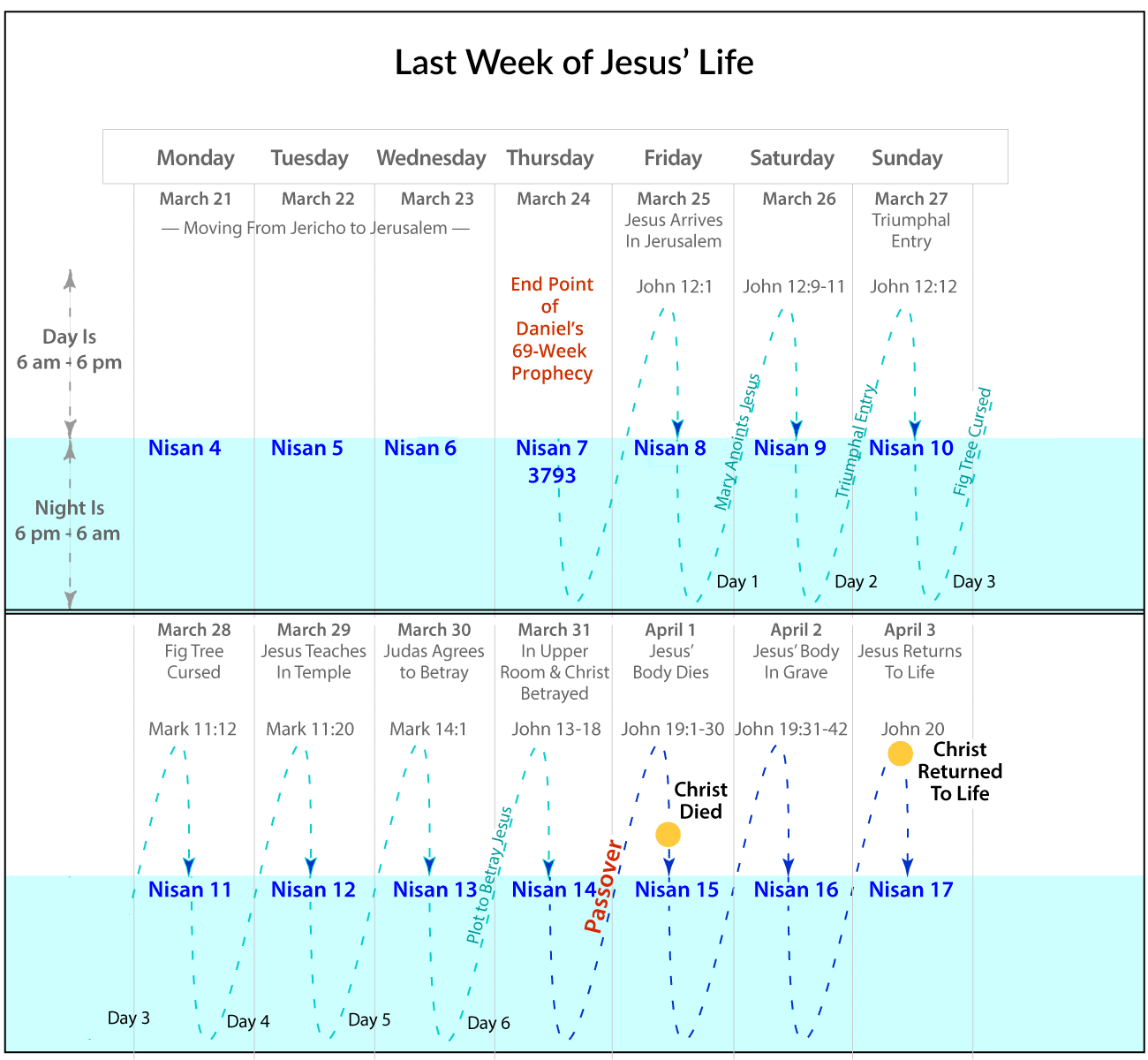
So, the Pharisees sent this scribe, who was also a Pharisee, to attack Jesus one more time. Mark 12:28 gives us a fuller account of the question the scribe asked Jesus. Verse 28 says,
One of the scribes came and heard them arguing, and recognizing that He had answered them well, asked Him, “What commandment is the foremost of all?” Mark 12:28 (NASB)
The question that Jesus had to answer was of all the commandments in the Tanakh or the Old Testament, which commandment was the foremost? The literal Greek of “foremost of all” is “first of all,” since the Greek word for “foremost” is protos. That word means “first,” “first in rank,” or “first in importance”. So, Jesus was asked of all the commandments in Scripture which commandment is first in rank? Matthew 22:36 records the scribe as asking for the “greatest commandment.” The Greek word for “greatest” is megas, which means the most significant of all the commandments. Most likely, the scribe repeated his question with alternate wording. I often do that to make sure the hearer understands me.
According to rabbinic tradition there are 613 statues in the law. Of these, 365 commandments were positive and 248 were negative. So, the rabbis tried to determine which of these commandments were “heavy” or “light,” and which were “great” or “little.” Thomas Lindsay adds,
They distinguished between greater and lesser, and had many disputes about the greatest. Among the greater commandments they reckoned Sabbath observance, circumcision, rules of sacrifice and offering, and rules about fringes and phylacteries.1
Most likely Jesus had heard discussions about which commandments were greater or lesser. Maybe He had heard such discussions when He was twelve years of age and sitting in the temple asking and answering questions. Luke 2 tells us that after Mary and Joseph had left for Nazareth, Jesus did not join them in the trip home. Instead, He remained at the temple in Jerusalem. So, Jesus’ parents returned to Jerusalem in an attempt to find Him. We are told,
Then, after three days they found Him in the temple, sitting in the midst of the teachers, both listening to them and asking them questions. And all who heard Him were amazed at His understanding and His answers. Luke 2:46-47 (NASB)
I wonder what discussions did Jesus hear? What questions did He ask? Was this question a matter of debate on that occasion or later? I wonder what Mary and Joseph discussed at meal times? What did Jesus hear in the synagogue? Did He speak up on such occasions? Frankly, it does not matter because He knew every word in the Scriptures.
Before we discover Jesus’ answer to this question, we should notice that Mark 12:28 reveals this scribe thought that Jesus answered the Sadducees’ question well. I believe the Holy Spirit revealed this to give us insight into this man. He correctly believed in the resurrection, angels, and spirits or demons, but not the Sadducees. At least he accepted or believed what Scripture stated, even if he did not understand it.
Jesus’ Authoritative Answer
Jesus’ answer to the scribe’s question must have been a surprise to everyone. The gospel of Mark gives us all of Jesus’ answer to the scribe’s question.
Jesus answered, “The foremost is, ‘HEAR, O ISRAEL! THE LORD OUR GOD IS ONE LORD; AND YOU SHALL LOVE THE LORD YOUR GOD WITH ALL YOUR HEART, AND WITH ALL YOUR SOUL, AND WITH ALL YOUR MIND, AND WITH ALL YOUR STRENGTH.’ The second is this, ‘YOU SHALL LOVE YOUR NEIGHBOR AS YOURSELF.’ There is no other commandment greater than these.” Mark 12:29-31 (NASB)
Jesus quoted two different passages of Scripture. The first was the Shema, which is recorded in Deuteronomy 6:4-5. The word Shema means “to hear.” Only Mark includes Deuteronomy 6:4, which is “HEAR, O ISRAEL! THE LORD OUR GOD IS ONE LORD.” Matthew does not include it in His account. As a result, Mark’s record points us to the God we are to love in Deuteronomy 6:5.
Deuteronomy 6:4 tells us that there is only one God. The Hebrew word for “one” is ehad. It refers to “unity” or “diversity within one.” For Christians this clearly speaks of the trinity. Yahweh of the Old Testament is one and is also our triune God. Our God is one, and yet three (Isaiah 43:10-13; 44:6; 45:5-6, 21-22; 46:9; 48:12, 16).
Then the rest of Jesus’ reply reveals that it is Yahweh we are to love and Him only. Consequently, we are to love God the Father, Jesus Christ, and the Holy Spirit. How are we to love Yahweh? Deuteronomy 6:5 says that we are to love Him with all our heart, soul, mind, and strength. Years ago I did an exhaustive study about the meaning of the “heart” in the Bible. I discovered that “heart” in Scripture does not have the meaning we associate with it. In the Scriptures “heart” refers to mind. For example, Proverbs 6:18 says,
A heart that devises wicked plans. Proverbs 6:18 (NASB)
Here in Hebrew poetry the heart is considered to be the place where we think (see Proverbs 14:10; 16:23; 31:11). The soul refers to the place of emotions (see Matthew 26:38; Mark 14:34; Hebrews 10:38). The mind is the place of will (see Exodus 32:14; Psalm 110:4; Proverbs 16:9). Also, strength refers to physical capability or energy. The Hebrew word for “strength” is mod. It has the sense of “muchness”, and” abundance.” I love the definition of muchness. That is, the believer is to love God by devoting our every thought, emotion, will or decision to Him, and to do it with muchness—with everything that you have. When this is true, God has all of you. We will be completely devoted to Him in all that we think, and feel, and do.
Then Jesus added Leviticus 19:18.
YOU SHALL LOVE YOUR NEIGHBOR AS YOURSELF. Leviticus 19:18 (NASB)
The message is that our entire person is to be committed to loving God and those around us. The parable of the good Samaritan illustrates this commandment. It teaches us that our neighbor includes those who hate us. Philippians 2:1-5 speaks of love toward others in a different way,
Therefore if there is any encouragement in Christ, if there is any consolation of love, if there is any fellowship of the Spirit, if any affection and compassion, make my joy complete by being of the same mind, maintaining the same love, united in spirit, intent on one purpose. Do nothing from selfishness or empty conceit, but with humility of mind regard one another as more important than yourselves; do not merely look out for your own personal interests, but also for the interests of others. Have this attitude in yourselves which was also in Christ Jesus. Philippians 2:1-5 (NASB)
These two commands teach us that we are not the most important person in the world. God is more important and we are to treat others as we would want to be treated.
Scribe’s Compliment
Then Mark 12:32-33 tells us how the scribe responded to Jesus.
The scribe said to Him, “Right, Teacher; You have truly stated that HE IS ONE, AND THERE IS NO ONE ELSE BESIDES HIM; AND TO LOVE HIM WITH ALL THE HEART AND WITH ALL THE UNDERSTANDING AND WITH ALL THE STRENGTH, AND TO LOVE ONE’S NEIGHBOR AS HIMSELF, is much more than all burnt offerings and sacrifices.” Mark 12:32-33 (NASB)
Now the scribe summarizes Jesus’ reply and adds that how we love God and others is “much more than all burnt offerings and sacrifices.” Other Scriptures also tell us God delights in our loyalty and our desire to know Him. That is, we long to be faithful or loyal and to know Him as a friend knows a friend. Hosea 6:6 says.
For I delight in loyalty rather than sacrifice,
And in the knowledge of God rather than burnt offerings. Hosea 6:6 (NASB)
Another verse that reveals God’s desire is Jeremiah 9:23-24.
Thus says the LORD, “Let not a wise man boast of his wisdom, and let not the mighty man boast of his might, let not a rich man boast of his riches; but let him who boasts boast of this, that he understands and knows Me, that I am the LORD who exercises lovingkindness, justice and righteousness on earth; for I delight in these things,” declares the LORD. Jeremiah 9:23-24 (NASB)
We must remember that God is more interested in how we feel, think, plan, and our commitment to Him than in what we actually do. But that does not mean He does not care about what we do for Him. It is an issue of degree!
Does this describe your heart toward God? If it does, then you will also love others as yourself for that is His desire too!
Scribe Was Close To Being Saved
Then Jesus said,
When Jesus saw that he had answered intelligently, He said to him, “You are not far from the kingdom of God.” After that, no one would venture to ask Him any more questions. Mark 12:34 (NASB)
I love Jesus’ comment that he had answered intelligently. This reveals that God expects us to use our minds and think as we study the Bible and think about Him. Christianity is not a blind faith just for the ignorant, for the stupid, or for children, as we sometimes hear! Christianity can be logically understood, but it also requires the Holy Spirit to help an individual ultimately believe in God.
For example, in Luke 1:1-4, the author Luke said he wanted to document the life of Christ in consecutive order for Theophilius. So, that he would believe in Jesus Christ. Near the end of the gospel of John we are told,
“But these have been written so that you may believe that Jesus is the Christ, the Son of God; and that believing you may have life in His name.” John 20:31 (NASB)
The point is that our God is real. We are to love the real God with our entire being, and love others. That is His desire. He has objectively proven He exists and that He delights in this. Those who finally understand the Bible do so because the Holy Spirit is helping them understand. So, Jesus said that this scribe was near the kingdom of God. That is, he was close to going to heaven.
Then we are told that no one would ask Jesus any more questions. Neither the Pharisees, Sadducees, or a scribe of the Pharisees could trap Jesus into making an error.
Conclusion
As I was thinking about Jesus’ statement I remembered a man who was being interviewed by a reporter one day about a war in the Middle East between Israel and Iran. During the conversation, the man said that love was missing in the Middle East. His view was that love would solve the problem of war. Now it was not clear how he defined love. Our modern world usually defines love as romantic love. But this time it appeared that his definition of love referred to a heart attitude that cared about others and as a result would not attack, injure, and kill others. So, if that was his definition of love, then he was correct. But he was also wrong. For love is not missing in this world because God displayed His love for us when Jesus Christ took on human form and willingly allowed Himself to be crucified for our sins. John 3:16 reminds us that God loves the world.
Those who believe Jesus Christ is God, that He died in order that our sins can be forgiven, and willingly want Him to change their lives will go to heaven. Our response is to love Him with all our heart, soul, mind, and do it with “muchness.” As a result, they will naturally love others. Are you near heaven?
Suggested Links:
Searching for God — In Search of God — Go To HeavenHow To Walk In Love
Parable of the Good Samaritan