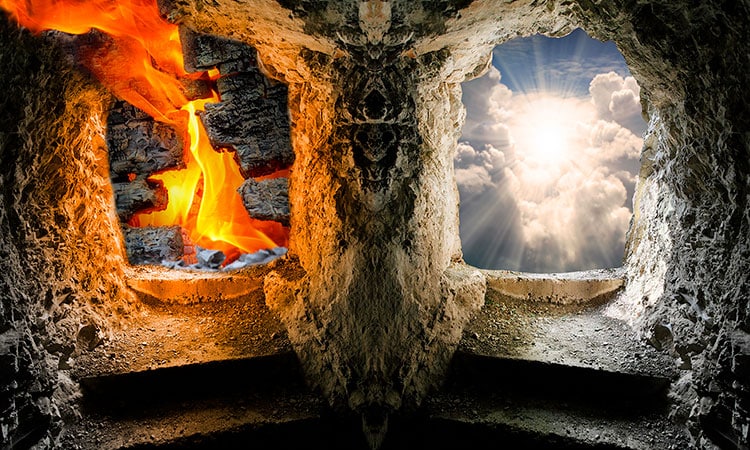
Heaven or Lake of Fire
In our last two studies, we should remember that previously Jesus had left a group of Gentiles and hidden Himself (John 12:36). They wanted to speak with Jesus, who then told them in a figurative way how to have eternal life. He told them that just as a grain of wheat must die and be planted in order to produce fruit, so He must die so that they can have their sins forgiven (John 12:23-26). He explained that they must hate their lives in order to gain eternal life. Then He said in a figurative way that He was the Light and they must believe in the Light in order to become sons of Light. Then they would have eternal life. Then we were told that many of the religious leaders did not believe in Christ. Isaiah the prophet had prophesied that they would reject Him. So, some Gentiles were told how they could obtain eternal life and then we were told that most of the religious leaders rejected Jesus. Now in this study, we are going to learn about the benefits of believing in Christ and the tragedy of rejecting Him. As we read how Jesus gave the gospel in this study, it is important for us to notice that He presented the gospel both positively and then negatively. This occurred on Monday, March 28, 33 A.D. Our study is from John 12:44-50.
The Benefits of Belief
The first two verses of our study are 44-45,
And Jesus cried out and said, “He who believes in Me, does not believe in Me but in Him who sent Me. He who sees Me sees the One who sent Me.” John 12:44-45 (NASB)
Jesus’ statement is not new information. It is a clear and crisp summary of statements that He had made before about His deity (John 8:24, 58; 10:38). Later in John 14:8-10, Jesus will make a stronger statement that anyone who has seen Him has seen the Father (John 15:24). Once again, He claimed to be God Himself. As He shared the gospel or the good news about Himself, He stated that we cannot separate Him from the Father. True believers agree that Jesus is God. To believe in Jesus includes also believing in the Father. To see Jesus is to see the Father. Believing in Jesus means a person also believes Jesus is God. So, to believe in Christ includes more than believing He died to forgive our sins, was buried, and was resurrected (1 Corinthians 15:1-8). It includes believing that He is God.
Then Jesus made a statement that reminds us of John 1:5 which teaches us that He said He is the Light who shines in the darkness. Here is verse 46.
I have come as Light into the world, so that everyone who believes in Me will not remain in darkness. John 12:46 (NASB)
This gives us the first benefit to believing in Christ. That is, a believer does not remain in darkness for they become children of God and are no longer children of the devil.
There is also another benefit that we need to explore because it helps us understand the verses that will follow. The benefit is that not only are the sins of believers forgiven, but we will never have to stand before Him and give an account of our past, present, and future sins. Scripture is clear about this as we will soon discover. Yet, there are some who teach that one day every believer will stand before God and hear their sinful thoughts, motives, and deeds listed before they discover if they will receive a reward at the Bema Seat Judgment of Christ. So, here is the second benefit of believing in Christ.
When we read in verse 46 that Jesus said, “I have come as Light into the world “ we need to remember that Jesus had previously said, “I am the Light of the world” (John 8:12; 9:5). But the world did not understand Him because it is in darkness (John 3:19). Now listen to Jesus in John 3:19-20. He said,
This is the judgment, that the Light has come into the world, and men loved the darkness rather than the Light, for their deeds were evil. For everyone who does evil hates the Light, and does not come to the Light for fear that his deeds will be exposed.” John 3:19-20 (NASB)
That is, men do not want their sins exposed, and be embarrassed. 1 Corinthians 4:5 can be a terrifying verse for believers at first glance. It reads,
Therefore do not go on passing judgment before the time, but wait until the Lord comes who will both bring to light the things hidden in the darkness and disclose the motives of men’s hearts; and then each man’s praise will come to him from God.1 Corinthians 4:5 (NASB)
This verse cannot mean that the sins of believers will be reviewed by Christ at the Bema Seat Judgment because the last part of the verse reveals each man will be praised.
Further, Romans 8:1 says that believers will no longer experience condemnation. That reveals we will never be judged for our past sins. We will never be humiliated at the judgment before others because of our past sins.
Also, John 12:46 says that those who believe do not remain in darkness. Therefore, believers have no reason to fear their deeds being exposed for Jesus told us that believers are no longer in darkness. So, the sins of the righteous will not be exposed at the judgment for believers.
Throughout the New Testament we are told that Christians are children of Light (Ephesians 5:8; Colossians 1:12; 1Thessalonians 5:5). Because Jesus is the Light of the world, believers become children of light when they believe in Him.
Since believers are no longer in darkness, there are eight benefits we receive. First, we have already discovered that the person should no longer have fear of their sins being exposed at the Bema Seat Judgment. Jeremiah 31:34 says,
For I will forgive their iniquity, and their sin I will remember no more. Jeremiah 31:34 (NASB)
There are a number of other verses that teach the same principle (Psalm 103:12; Isaiah 1:18; 38:17; 43:25; Micah 7:19; 2 Corinthians 5:17). Second, believers can understand spiritual truth contained in Scripture (John 1:4, 9). Third, believers will understand what is occurring around them and in the world (1 Corinthians 2:12-16; 2 Corinthians 4:4-6; Ephesians 5:13). Fourth, they understand what is truth and what is error. Fifth, they are no longer blinded by the evil one. Sixth, as they walk in the Light, they become more righteous. (Ephesians 5:9, 13). Seventh, believers can see the truth because their lives have been transformed. Eighth, they are new creatures in Christ who are indwelt by the Holy Spirit who now helps them understand spiritual truth and guides them. That is an encouraging list of positive reasons to believe in Christ.
Tragedy of Unbelief
Then Jesus described the judgment that awaits those who do not believe in Him.
If anyone hears My sayings and does not keep them, I do not judge him; for I did not come to judge the world, but to save the world. He who rejects Me and does not receive My sayings, has one who judges him; the word I spoke is what will judge him at the last day. John 12:47-48 (NASB)
There are four important points for us to learn from this passage. The first point is to notice that Jesus began by speaking about the person who does not keep His sayings. He said, “If anyone hears My sayings and does not keep them.” So, who are these people? They are not Christians; they are the unbelievers. For only believers want to keep Jesus’ words. For example, 1 John 2:3-6 says that believers are those who strive to please Jesus.
A stronger statement is given to us in Romans 8:13-14 which teaches that the sign of a true believer is that they strive to put the deeds of their flesh to death. That is, they strive to stop sinning. That is the sign a person is indwelt by the Holy Spirit and are a believer. So, those who are not sinning less and less are unbelievers who are going to hell. They may be busy in the church being a preacher or a leader of some ministry but they are not going to heaven. So, the first point is that Jesus is talking about the person who does not keep His sayings.
The second point is that Jesus did not come as a judge to condemn us. Instead, He came to save us from our sins (Matthew 1:21; Luke 3:3). He came to warn in order to save us. He is like a life guard on the beach. But He came to rescue us from drowning in the guilt of our sins. He came to save those who believe in Him. Jesus Himself said,
For the Son of Man has come to seek and to save that which was lost. Luke 19:10 (NASB)
He did not come to save the righteous, the good person, but sinners (Mark 2:17). So, the second point is that Jesus did not come as a judge to condemn us.
The third important point that we must not miss is that Jesus revealed what will happen to those who do not keep His sayings. When He said, “He who rejects Me,” He used the present participle tense for rejects (John 12:48). That is, the person who continually rejects Jesus will be judged. A person can reject Jesus once, twice, three times, a number of times, but the person who will be judged on the last day is the one who never believed Jesus, the one who continually rejected Jesus. They will have hardened hearts due to repeated rejections of Jesus.
The fourth important point is that the unbeliever will be rejected by what the Father told Jesus to say. For notice verse 49.
For I did not speak on My own initiative, but the Father Himself who sent Me has given Me a commandment as to what to say and what to speak. John 12:49 (NASB)
So, those who rejected what Jesus said are also rejecting what God the Father said. Scripture teaches that after the unbelievers die, they will not be judged by the Father on Judgment Day. We must remember that Jesus has already told us that the Father has given all judgment to Him, to the Son (John 5:22; 3:35). So, it will be Christ who will judge every unbeliever on the judgment day at the Great White Judgment (Revelation 20:11). Christ will use the words that the Father gave to Him as the criteria for sentencing each unbeliever to hell or the lake of fire. Technically, it is the Father who will condemn them. The Father makes the laws and Jesus will pronounce the sentence. At that point, there will be no opportunity to change one’s eternal destiny. The tragedy of rejecting Jesus is incredibly serious. It is not reversible after death and the individual must answer to Jesus. The Christ-rejectors will have to answer to the One whom they rejected.
In the Sermon on the Mount, Jesus shared with us that on the judgment day some will complain that they are being sentenced to an eternity in hell. For Mathew 7:21-23 tells us,
“Not everyone who says to Me, ‘Lord, Lord,’ will enter the kingdom of heaven, but he who does the will of My Father who is in heaven will enter. Many will say to Me on that day, ‘Lord, Lord, did we not prophesy in Your name, and in Your name cast out demons, and in Your name perform many miracles?’ And then I will declare to them, ‘I never knew you; DEPART FROM ME, YOU WHO PRACTICE LAWLESSNESS.’” Matthew 7:21-23 (NASB)
This passage clearly reveals that Jesus will be our judge at the Great White Throne Judgment (Revelation 20:11).
Another important passage is given to us in Matthew 13:41-42. It tells us that the Son of Man, that is, Christ, will throw the tares or the unbelievers into the furnace of fire that is also known as hell.
“The Son of Man will send forth His angels, and they will gather out of His kingdom all stumbling blocks, and those who commit lawlessness, and will throw them into the furnace of fire; in that place there will be weeping and gnashing of teeth.” Matthew 13:41-42 (NASB)
Also, Matthew 25:31-41 reveals that Jesus will be the judge who sends unbelievers to hell. For He tells us that He will say to them at the Sheep and Goat Judgment in verse 41,
“Then He will also say to those on His left, ‘Depart from Me, accursed ones, into the eternal fire which has been prepared for the devil and his angels.” Matthew 25:41 (NASB)
Throughout the gospel of John, we have been told that Jesus came to do the Father’s will. Philippians 2:8 tells us that Jesus humbled Himself to the Father.
The words He spoke were the words the Father had commanded Him to speak. So, the unbeliever will be forced to stand before Christ as their judge. The unbeliever will be forced to admit that they disobeyed Jesus and rejected Him. Imagine having to stand before the Judge Almighty after you had rejected Him and refused to believe what Him. Jesus had a different approach to the gospel than we do. We sugar coat the gospel because men do not like to hear that God might send them to hell. Men like to hear encouraging reasons for believing in Jesus. Jesus told both the good and the horrible truths that are in the gospel of salvation. We should also.
Conclusion
Jesus’ last comment reminds us of the Father’s commandment that we must believe in Christ.
“I know that His commandment is eternal life; therefore the things I speak, I speak just as the Father has told Me.” John 12:50 (NASB)
Jesus ended His presentation of the gospel by stating that God the Father commands everyone to believe in Jesus and have eternal life. 1 John 3:23-24 gives us that commandment,
This is His commandment, that we believe in the name of His Son Jesus Christ, and love one another, just as He commanded us. The one who keeps His commandments abides in Him, and He in him. We know by this that He abides in us, by the Spirit whom He has given us. 1 John 3:23-24 (NASB)
So, woe to the unbeliever who repeatedly rejects Jesus. Eventually, Christ may permanently harden their hearts. Then on the last day, Christ will sentence them to an eternity in hell for rejecting the words the Father gave Jesus Christ to speak.
But that will not happen to those who have come to the Light by believing in Jesus Christ, whom the Father sent. Those who believe in Christ will be given eternal life in heaven. This serious warning was given just days before Jesus became the Savior of the world. So, do you believe in Jesus?
Suggested Links:
Benefits of the ResurrectionFour Benefits of Christ’s Humble Submission to the Father