
Passover Seder Meal
Our study is about the feasts that are given to Israel by God. The reason why I said it this way is that the Jewish people today actually celebrate nine feasts. There are only seven feasts that were actually given to the Israelites, but two additional feasts have been added. The seven feasts that God gave the Israelites are found in Leviticus 23. The feasts are: the Passover, Unleavened Bread, Firstfruits, Pentecost, Trumpets, the Day of Atonement, and The Feast of Tabernacles.
In the gospels, the Feast of Tabernacles is often referred to as the Feast of Booths. Even in the Minor Prophets, Tabernacles is often referred to as the Feast of Booths. There are seven feasts that the Lord asked the Israelites to keep in the Mosaic Law, and to be specific, in Leviticus 23.
Additional Feasts: Purim and Hanukkah
The two additional feasts that have been added are Purim and Hanukkah. This is a total of nine feasts; but you will not find Purim, and you will not find Hanukkah mandated by God. They are not technically the feasts of the LORD and you will not find those two in the book of Leviticus or Deuteronomy; nor will you find them in the Mosaic Law. You might ask, “Why do the Jewish people celebrate Purim and Hanukkah?”
Origins of Purim
There is a good reason why Purim has been added. You will find Purim described in Esther 9:20-21, where we are told,
Then Mordecai recorded these events, and he sent letters to all the Jews who were in all the provinces of King Ahasuerus, both near and far, obliging them to celebrate the fourteenth day of the month Adar, and the fifteenth day of the same month, annually. Esther 9:20-21 (NASB)
Mordecai sent out a letter and he directed the people to celebrate all the events that had happened. The celebration was held on the fourteenth day of Adar, and on the fifteenth day of the same month, and they were to do this every year.
Verses 22-23 state:
“Because on those days the Jews rid themselves of their enemies, and it was a month which was turned for them from sorrow into gladness and from mourning into a holiday; that they should make them days of feasting and rejoicing and sending portions of food to one another and gifts to the poor. Thus the Jews undertook what they had started out to do, and what Mordecai had written to them.” Esther 9:22-23 (NASB)
This is the origin of the Feast of Purim. You might say, “Well, these verses have not mentioned Purim.” Yes, but if you look all the way down to verse 26, you will find the name of the feast, Purim.
“Therefore they called these days Purim after the name of Pur. And because of the instructions in this letter, both what they had seen in this regard and what had happened to them, the Jews established and made a custom for themselves and for their descendants and for all those who allied themselves with them, so that they would not fail to celebrate these two days according to their regulation and according to their appointed time annually. So these days were to be remembered and celebrated throughout every generation, every family, every province and every city; and these days of Purim were not to fail from among the Jews, or their memory fade from their descendants.” Esther 9:26-28 (NASB)
And so that has been fulfilled, and today Purim has been added to the feasts of the LORD.
Origins of Hanakkah
Where did Hanukkah come from? You will not find it in Scripture . You find Purim in Scripture. Hanukkah celebrates the rededication of the temple after the Maccabees defeated the Greeks, and that rededication of the temple occurred in 164 B.C. As a result, Jewish people celebrate Hanukkah. This explains the addition of Purim and Hanukkah. I wanted to explain that in the beginning of this lesson, because what we are really interested in are the seven official feasts of the LORD. And the seven official feasts of the LORD, as I have already said, can be found in Leviticus 23.
Spring Feasts in Nisan and Sivan
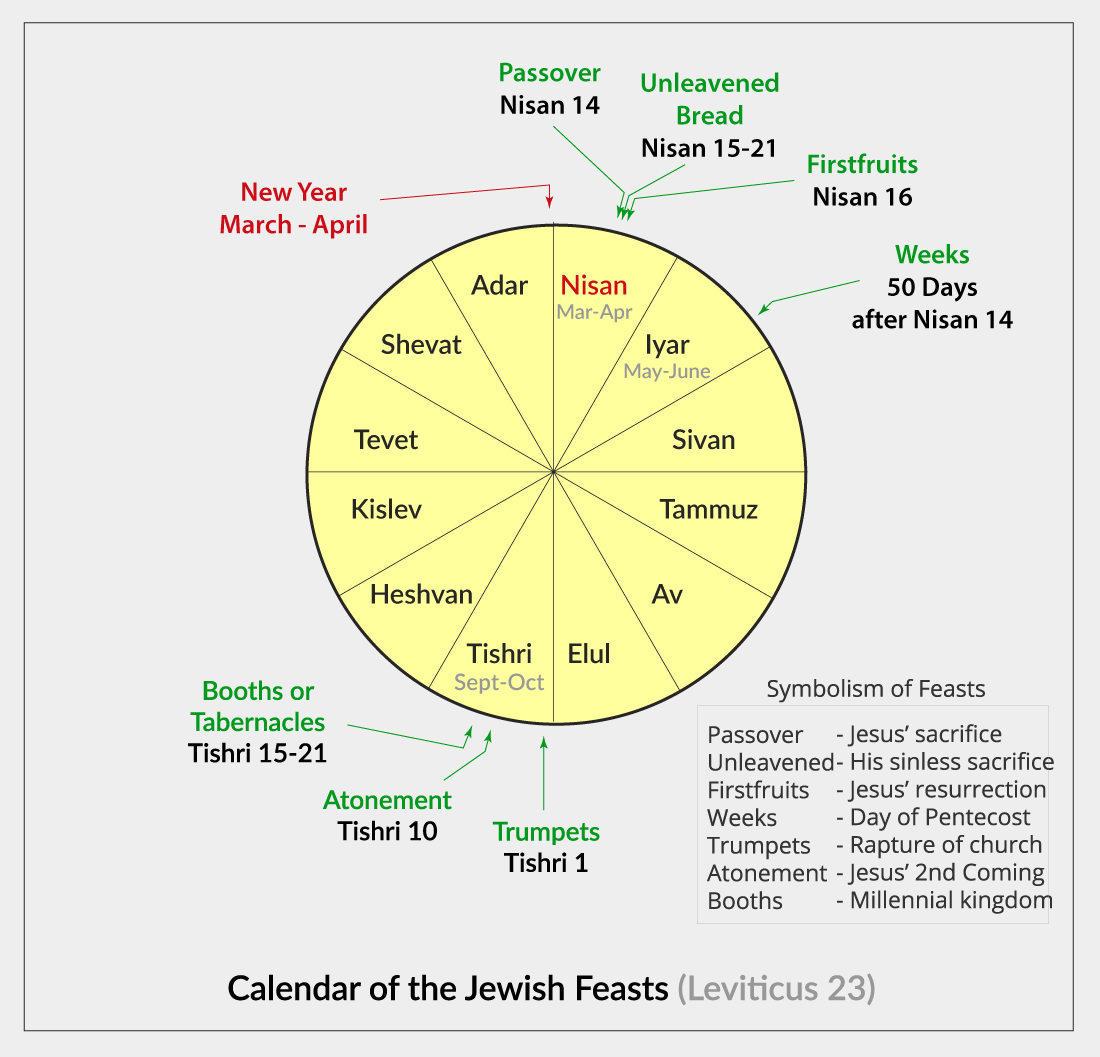
These feasts can be broken up into spring and fall. In the spring there are four feasts, in the fall there are three feasts. Interestingly enough, the feasts of Passover, Unleavened Bread, and Firstfruits occur in the month of Nisan; and they all occur within three days of each other. The feast of Pentecost is in the month of Sivan. The last three fall feasts, Trumpets, Day of Atonement, and Tabernacles or Booths, occur in the month of Tishri .
Jewish Calendar vs Gregorian Calendar
Nisan is the first month in the Jewish calendar. The Jewish calendar is a lunar calendar that is based on the rotation of the moon. We have the Gregorian calendar that depends on the rotation of the sun. The Gregorian calendar is not quite accurate, so every four years we add an extra day, giving us a leap year. The Jewish, lunar calendar is technically 354 days.
That means that every year the calendar is off by eleven days, and periodically a whole month must be added. There is an algorithm that helps to determine when to add the extra month, but the point is that every once in a while, a whole month needs to be added! A second month of Adar, called Adar II is added to the Jewish calendar.
Relating the Jewish Calendar to the Gregorian Calendar
f you think about the feasts of the LORD, the first three feasts are in the month of Nisan (see the diagram). That is the first month of the Jewish year. And then Trumpets, the Day of Atonement, and Tabernacles, or the last three fall feasts, occur three months later, in Tishri, in the middle of the Jewish year. That is a cycle . Then, there is the feast of Pentecost, which occurs in the month of Sivan. We will talk about this in a little while.
When does Nisan occur in our calendar? We do not have a month called Nisan in our Gregorian calendar. The Gregorian calendar is a solar calendar based on 365.2 days (or whatever the fraction is of a day per year). Nisan occurs in March or April. It spans those two months. Tishri spans from September to October.
If the calendar is not updated with the extra month, everything is off by eleven days and this variation occurs. What happens? Resurrection Sunday occurs in March one year, and in another year it occurs in April. Sometimes it is in late April, and sometimes it is almost mid-March. The day moves around, and the reason why is because Resurrection Sunday or Easter is based on the Jewish calendar.
We previously learned that some of the feasts are in spring, and some are in the fall. We are going to look at the spring feasts. We will look at the fall feasts in the next study. It would be a challenge if we tried to study all seven of the feasts in one lesson. Therefore, the spring feasts are described in this study, and the fall feasts in the next study.
The LORD’s Appointed Times
Let us turn to Leviticus 23. We are going to start with verse 1 and talk about a couple of important items in verses 1 and 2 before we actually start talking about the Feast of Passover. Verses 1 and 2 state:
The LORD spoke again to Moses, saying, “Speak to the sons of Israel and say to them, ‘The LORD’s appointed times which you shall proclaim as holy convocations—My appointed times are these: Leviticus 23:1-2 (NASB)
You might notice the Scripture says “appointed times” The Hebrew for “appointed time” is moed and it means “meeting” or “appointment” or “feast.” In this case we are talking about feasts. How this verse really should read is, “the LORD’s feasts.” Therefore, I have called this lesson the feasts of the LORD.
“… which you shall proclaim as holy convocations.” Leviticus 23:2 (NASB)
The phrase, “holy convocations” just means a holy meeting or assembly. So God is instituting some feasts that He wants—that is the point—and Jews were supposed to communicate that to their children, and then to their children’s children, and it was to be something that continued on forever.
The Sabbath (Leviticus 23:3)
So you might be interested in what feasts.
‘For six days work may be done, but on the seventh day there is a sabbath of complete rest, a holy convocations. You shall not do any work; it is a sabbath to the LORD in all your dwellings. Leviticus 23:3 (NASB)
In this case, we are told that God is instituting the Sabbath, and it is a sabbath of complete rest. It is interesting to note that with the command of complete rest, the word “rest” is in the imperfect in the Hebrew. It has the idea that the rest is continual, ongoing, and complete. So when the Sabbath arrives, it is supposed to be a time of rest. It does not mean that on some occasions it might not be, but the intent is that it is complete rest. So God is instituting a Sabbath, and we understand that the Sabbath is important as part of the Ten Commandments.
The Passover (Leviticus 23:4-5)
Verse 4 is essentially a repeat of verse 2, identifying the appointed times and holy convocations:
These are the appointed times of the LORD, holy convocations which you shall proclaim at the times appointed for them. Leviticus 23:4 (NASB)
Verse 5 is the first feast, the Feast of Passover. It begins:
“ In the first month, …” Leviticus 23:5 (NASB)
What is the first month? Nisan.
In the first month, on the fourteenth day of the month at twilight is the LORD’s Passover.” Leviticus 23:5 (NASB)
So what we are told in verse 5 is that the Israelites are to remember this feast on Nisan 14th. And if you were to go back to Exodus and look at the Passover event, you would find that there is a different name for this month (Abib); but later on it is called Nisan. And what we are told is that there is the day, and there is the month, and there is the time; and the time is at twilight. What is twilight? Past sundown and just before it gets dark.
What is the purpose? The purpose is to remember the redemption that occurred in Egypt. So let us do that. Let us go to Exodus 12. Let us remember how this got started, and as we read this, you will see that there is a connection to Jesus Christ. Exodus 12:1-2 states,
Now the LORD said to Moses and Aaron in the land of Egypt, “This month shall be the beginning of months for you; it is to be the first month of the year to you. Exodus 12:1 (NASB)
So what does verse 2 say? Exodus 12:2 tells us that the month that they are in is going to be the first month of the year. And we have already made the point that it is Abib, A-B-I-B, if you are interested in the English spelling.
Verses 3 to 5 say:
Speak to all the congregation of Israel, saying, ‘On the tenth of this month they are each one to take a lamb for themselves, according to their fathers’ households, a lamb for each household. Now if the household is too small for a lamb, then he and his neighbor nearest to his house are to take one according to the number of persons in them; according to what each man should eat, you are to divide the lamb. Your lamb shall be an unblemished male a year old; you may take it from the sheep or from the goats.” Exodus 12:3-5 (NASB)
So we are told right up front in verses 3, 4, and 5, that they are to take a lamb, and they take it on the tenth day of the month. And you say, “Well, wait a minute, it is not Nisan 14.” We are going to get to the 14th, but we must start on the 10th. On the tenth of Nisan, they take this animal and make sure that it is unblemished. Verse 5 says:
Your lamb shall be an unblemished male a year old; you may take it from the sheep or the goats. Exodus 12:5 (NASB)
The lamb can be from the sheep or the goats, but it has to be unblemished.
You shall keep it until the fourteenth day of the same month, then the whole assembly of the congregation of Israel is to kill it at twilight. Exodus 12:6 (NASB)
What were they to do? Pick a lamb on the tenth day of Nisan and examine it to see if it is unblemished; and then on the fourteenth day they were to kill it at twilight.

Lintel Above the Door
Moreover, they shall take some of the blood and put it on the two doorposts and on the lintel of the houses in which they eat it. They shall eat the flesh that same night, roasted with fire, and they shall eat it with unleavened bread and bitter herbs,
Do not eat any of it raw or boiled at all with water, but rather roasted with fire, both its head and its legs along with its entrails. And you shall not leave any of it over until the morning, but whatever is left of it until morning, you shall burn with fire. Now you shall eat it in this manner: with your loins girded, your sandals on your feet, and your staff in your hand; and you shall eat it in haste—it is the LORD’s Passover. For I will go through the land of Egypt on that night, and will strike down all the firstborn in the land of Egypt, both man and beast; and against all the gods of Egypt I will execute judgments—I am the LORD. The blood shall be a sign for you on the houses where you live; and when I see the blood I will pass over you, and no plague will befall you to destroy you when I strike the land of Egypt. Exodus 12:7-13 (NASB)
This is fabulous. This is an amazing account. And this is the last of the ten plagues. If you recall, when Moses went into Egypt, he performed ten plagues. Obviously, God did it through him; but the purpose was to motivate Pharaoh to let the Israelites leave Egypt. The first plague was water turned to blood, then frogs, then it was gnats, then it was flies, then the livestock were diseased, then boils, and then hail, and then locusts, and then darkness; and the last plague was killing the firstborn of animals and the firstborn of humans.
And so what God told Moses to do was take a lamb on the tenth day. You have a number of days to examine the lamb to make sure it is unblemished. On the fourteenth day you will kill it, and you will take the blood and put the blood on the lintel. What is a lintel? A lintel is the bar, or the piece of wood, or a piece of concrete, or something just over the door. And so they were to take blood from the animal and put it on the lintel.
And God said, “When I see the blood on the lintel, I will pass over you”. God will not kill the firstborn in your family. You will be saved. You will be protected. That is what God is telling them.
The Meaning of Passover
Do you know what the Passover is? Passover is a symbol of redemption in Egypt. God rescued them, God saved them. And who does the lamb symbolize? Jesus Christ. From the Old Testament the lamb was a symbol of redemption and occurred in Egypt. Notice the fact that God would pass over them. For us today when we put our faith in Jesus Christ, our sins are forgiven. He does not count our sins against us. He passes over our sins, and we are redeemed.
The Passover Meal
How many of you have ever attended a Passover meal? While attending Loyola University and performing Christian service, the opportunity to work for the American Board of Missions to Jews arose for this author. Working during the Passover in March and April, one could smell the lamb and all the good foods cooking in the kitchen. The Jewish lady who was our chef cooked a scrumptious lamb, and made an incredible Passover meal.
The Passover is actually organized around four cups. Before the first cup is taken, there is a blessing that is given. The blessing is,
Blessed are you, O Lord our God, King of the Universe, who have set us apart by His word, and in whose name we light the festival lights.
The lights were lit before this blessing is given. The blessing is given, and then there is a cup that is taken.
First Cup of the Passover Meal: Sanctification
The first cup is the cup of sanctification. The attendees at the meal take a sip from the cup. In Luke 22:17, the cup is actually referenced. After the first cup is sipped, the leader of the Passover is given a linen bag. There are three matzah crackers in the linen bag.
The leader takes the middle cracker out and breaks it in half, puts half of it back, takes the half matzah cracker and wraps it with a linen napkin and then goes and hides it. When Christians think about three matzah crackers in a linen bag, the first thing we think of is the trinity of God the Father, the Son, and the Holy Spirit; and the bag being one God—not three Gods, but God the Father, Son, and Holy Spirit are one God.
One might ask, “Why do the Jews follow this practice?” There is lots of debate as to why they do it. But is it not interesting that they have this practice? Remember this half matzah cracker, called an afikomen, is wrapped in a linen napkin and hidden someplace. We will return to this hidden matzah during the second cup.
Second Cup of the Passover Meal: Deliverance
Then the second cup is taken. The second cup is the cup of deliverance, and the attendees tell the story of the Exodus, and how the Israelites left Egypt. We will not tell the story here. Next, the attendees read Psalms 113 through 118, which are known as the Hillel Psalms. We get the word, “hallelujah,” from Hillel, so they are like the hallelujah Psalms.
The feast celebrates the fact that they were delivered and brought out of Egypt, and then they have dinner. This is a short summary of the dinner, since the meal is lengthy, and can last hours. After the meal is finished, the children go off to find the afikomen.
Remember the afikomen is the half matzah cracker that was hidden after the first cup. The children have a lot of fun running around, trying to find the afikomen. All of a sudden you hear somebody saying, “I got it! I got it! I got it!” The children are really excited, they are rejoicing, and they come running back with the afikomen.
The leader then unwraps the napkin, takes the matzah cracker and starts breaking it off, ; and everyone is supposed to eat a piece of the matzah cracker. What does that sound like? It sounds like what we call communion or the Lord’s Supper. That is exactly what Jesus instituted at the time of the Lord’s Supper or communion. And He said, “This is my body…” What is it? “…my body.”
While they were eating, Jesus took some bread, and after a blessing, He broke it and gave it to the disciples, and said, “Take, eat; this is My body.” Matthew 26:6 (NASB)
Passover symbolizes the death of Jesus Christ.
The Third Cup of the Passover Meal: Redemption
The third cup is the cup of redemption, and that follows next. Do you know what we believe happened? We believe the cup of redemption is the cup that Jesus then had the disciples pass around and drink from. Is that not interesting? Cup of redemption. We are redeemed from our sins, we are bought back from our sins, we are given new life. You can verify that in Matthew 26:27-28:
And when He had taken a cup and given thanks, He gave it to them, saying, “Drink from it, all of you; for this is My blood of the covenant, which is poured out for many for forgiveness of sins. Matthew 26:27-28 (NASB)
You can also verify the cup of redemption in Luke 22:20:
And in the same way He took the cup after they had eaten, saying, “This cup which is poured out for you is the new covenant in My blood. Luke 22:20 (NASB)
The Fourth Cup of the Passover Meal: Hope and Praise
The fourth cup is the cup of hope or the cup of praise, and that is found in Matthew 26:29-30.
But I say to you, I will not drink of this fruit of the vine from now on until that day when I drink it new with you in My Father’s kingdom. After singing a hymn, they went out to the Mount of Olives. Matthew 26:29-30 (NASB)
Then they sang a hymn and they left. And that is the summary of the first feast. It symbolizes the death of Christ.
The Feast of Unleavened Bread (Leviticus 23:6-8)
Let us look at the Feast of Unleavened Bread. Go back to Leviticus 23 6 says:
Then on the fifteenth day of the same month, there is the Feast of Unleavened Bread…Leviticus 23:6 (NASB)
When is the feast of Passover? What month, what day? Nisan 14. So when is the feast of unleavened bread? The next day. Scripture says:
Then on the fifteenth day of the same month there is the Feast of Unleavened Bread to the LORD. And for seven days you shall eat unleavened bread. Leviticus 23:6 (NASB)
What is unleavened bread? Unleavened bread is bread without yeast. Leavened bread is bread with yeast. In fact, the word unleavened here in the Hebrew is matzah Does that sound familiar? That is actually the Hebrew name for unleavened bread.
So what the Jews were told to do is on the fifteenth of Nisan they were to commence a feast called the Feast of Unleavened Bread, or the Feast of Matzot. And what does matzah symbolize? No sin. You can verify that in Galatians 5:9 (Galatians 5:9), where Paul actually makes the comment that a little leaven leavens the whole lump.
Leaven (or yeast) is a symbol of sin. 1 Corinthians 5:6 (I Corinthians 5:6) also describes leaven as sin. So this feast is a feast of what? No sin, or no evil. You can actually include the idea of no evil here. And then Leviticus 23:7 says:
On the first day you shall have a holy convocation; you shall not do any laborious work. Leviticus 23:7 (NASB)
You can do some work, but not anything that is really stressful.
But for seven days you shall present an offering by fire to the LORD. On the seventh day is a holy convocation; you shall not do any laborious work. Leviticus 23:8 (NASB)
So the first day and the last day you could not do any laborious work, and throughout the seven days there are sacrifices and feasting. And the sacrifices are listed here. The sacrifices are given in verse 8. But the message is this, that the Feast of Unleavened Bread begins on the fifteenth day.
And what does the feast of Unleavened Bread symbolize? It symbolizes the perfect sacrifice, and as a result there is no decay in Christ’s body. Is it not interesting that the feast began after Christ died? Because Christ died on what day? Nisan fourteenth, Passover. The very next day would have been the beginning of the Feast of Unleavened Bread, which would have been Friday evening, going into Saturday; and it symbolizes Christ and the grave. There was no sin. There was no decay of His body.
Feast of Firstfruits (Leviticus 23:9-14)
The next feast is the Feast of Firstfruits. Verses 9 and 10 say:
Then the LORD spoke to Moses, saying, “Speak to the sons of Israel and say to them, ‘When you enter the land which I am going to give to you and reap its harvest, then you shall bring in the sheaf of the first fruits of your harvest to the priest. Leviticus 23:9-10 (NASB)
This is talking about a crop that is growing, and they are told to bring in the sheaf of the first fruits of the harvest. We understand what the first fruits is. The first fruits would be the first part of the crop that is ready for harvest. So the idea is that you would harvest this part of the crop, and then bring it in to the priest. Thus, they are to take the first fruit of this barley harvest, and give it to the priest. Scripture says:
He shall wave the sheaf before the LORD for you to be accepted; on the day after the sabbath, the priest shall wave it. Now on the day when you wave the sheaf, you shall offer a male lamb one year old without defect for a burnt offering to the LORD. Its grain offering shall then be two-tenths of an ephah of fine flour mixed with oil, an offering by fire to the LORD for a soothing aroma, with this drink offering, a fourth of a hin of wine. Until this same day, until you have brought the offering of your God, you shall eat neither bread nor roasted grain nor new growth. It is to be a perpetual statute throughout your generations in all your dwelling places. Leviticus 23:11-14 (NASB)
So the Feast of Firstfruits symbolizes what? Well, it occurred the next day after the beginning of the Feast of Unleavened Bread, so it began on the sixteenth. And what is first fruit? First fruit is the first part of the crop. It is the first part of the crop, and only the first part of the crop. What was Jesus? Turn to 1 Corinthians 15:20. Paul is talking about the resurrection. Verse 20 says,
But now Christ has been raised from the dead … I Corinthians 15:20 (NASB)
And what does it say?
… the first fruits of those who are asleep. I Corinthians 15:20 (NASB)
What does that mean? Jesus is the first fruit to new life. Do you know what the Feast of Firstfruits symbolizes? The resurrection of Jesus Christ. That is what it symbolizes.
He is the first fruit. Talking about the resurrection of Christ, you say, “Does it really refer to the resurrection of Jesus?” Yes! Think about this: When did Jesus die? Nisan 14. Saturday would have been Nisan 15. Sunday would have been Nisan 16. These feasts were actually looking to Jesus Christ—looking to His death, looking to His burial, looking to His resurrection. The first three feasts are actually looking forward to Christ. These feasts are fascinating and prophetic, Christ fulfilled God’s required feasts!
Feast of Pentecost (Leviticus 23:15-22)
Let us look at the last feast that we are going to study in this lesson The last of the spring feasts is the fourth feast, the Feast of Pentecost. You can see a description of this in Leviticus 23, starting with verse 15 to verse 22. There is a better description of it in Deuteronomy 16:9-12, but – we will stay in Leviticus, and fill in what Deuteronomy might add. Leviticus 23:15-16 says,
You shall also count for yourselves from the day after the sabbath, from the day when you brought in the sheaf of the wave offering; there shall be seven complete sabbaths. You shall count fifty days to the day after that seventh sabbath; then you shall present a new grain offering to the LORD. Leviticus 23:15-16 (NASB)
Now this is another crop, this is a wheat crop. The first one was the barley crop (at Firstfruits), and this is a wheat crop. So they are to bring in something from the wheat crop this time, but when does this occur? This occurs fifty days after the Sabbath that occurred just before the Feast of Firstfruits. And what does this symbolize? The arrival of the Holy Spirit. And why do we know that? When did the Holy Spirit come? At Pentecost, in Acts 2:1-4.
So we have described the first four feasts: the death of Christ, His burial, His resurrection, and then fifty days later Pentecost. Actually, the Greek word for fifty is pentkonta. Pentecost occurred fifty days later, and that is when the Holy Spirit came. How long did Jesus remain in the world after His resurrection? How long did He remain talking with the disciples? What does Scripture say? Forty days.
So Jesus was with the disciples for forty days, and then Jesus told them to do what? To wait for the arrival of the Spirit. That occurred ten days later.
Conclusion
So these feasts look forward to Jesus Christ and the Holy Spirit. Now I have a question for you: Do you think we are going to be celebrating those feasts in the millennial kingdom? The answer to that question will be answered in the next study.
Suggested Links:
What is the meaning of the Passover foods?Should Christians observe the Passover?
Prophecy of Daniel’s Seventy Weeks – Daniel 9:24-27