
Happy Rosh Hashanah — Traditional Jewish New Year Food
We pointed out in our last study that the feasts that God had asked Israel to observe are listed in Leviticus, chapter 23, and so we will begin there. In verse 2 we are told,
“Speak to the sons of Israel and say to them, ‘The LORD’s appointed times which you shall proclaim as holy convocations—My appointed times are these: Leviticus 23:2 (NASB)
Notice the phrase, “holy convocations”. They are holy meetings or holy times. Verse 3 says,
‘For six days work may be done, but on the seventh day there is a sabbath of complete rest, a holy convocation . . . Leviticus 23:3a (NASB)
The phrase “holy convocation” in verse 3 refers to the sabbath as a holy convocation. The verse continues,
…You shall not do any work; it is a sabbath to the LORD in all your dwellings. Leviticus 23:3b (NASB)
Verse 4 states,
These are the appointed times of the LORD, holy convocations which you shall proclaim at the times appointed for them. Leviticus 23:4 (NASB)
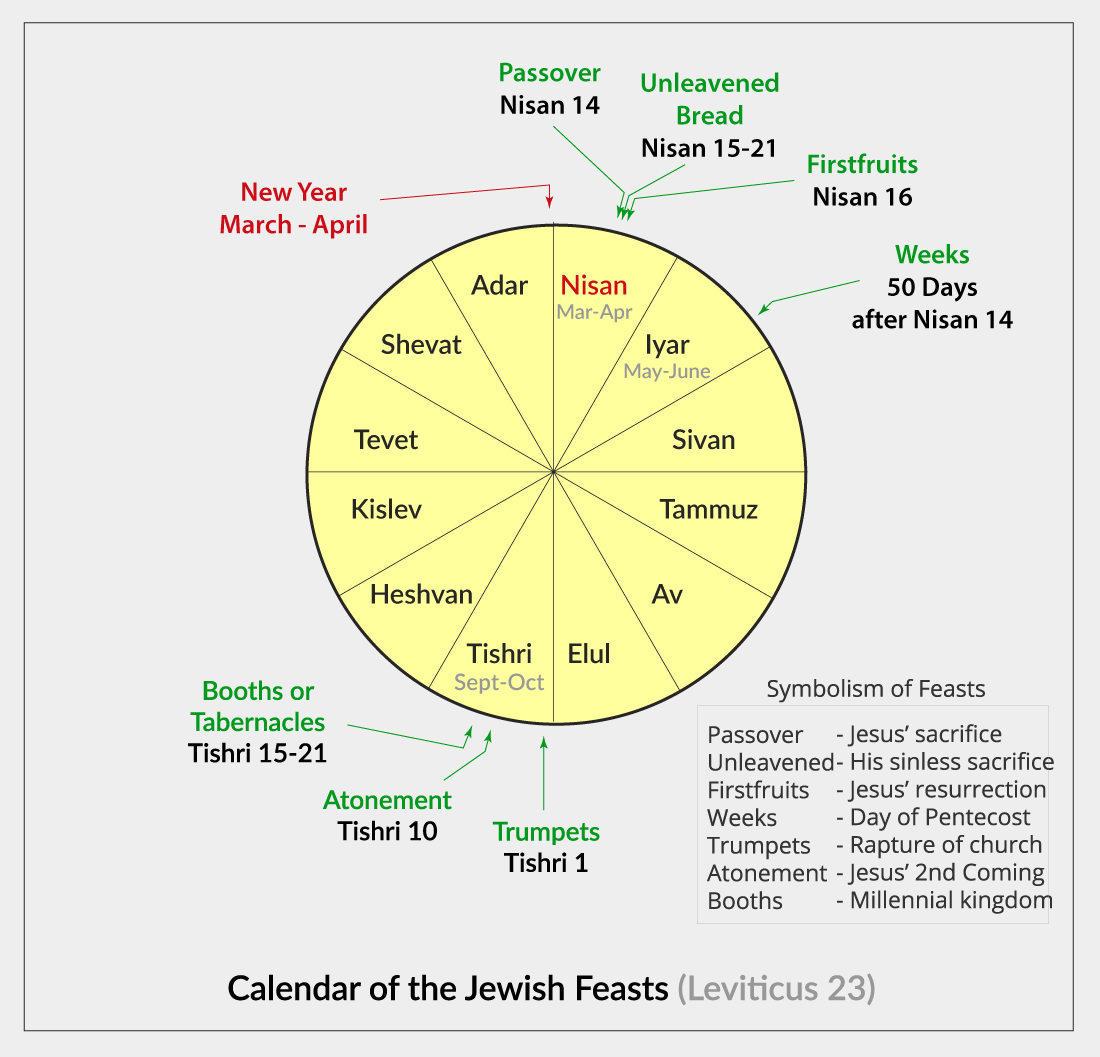
In verse 4 we are being told that God is going to share with us some holy convocations. The rest of the chapter describes seven different holy convocations. We saw last time that there are four spring feasts. They are the Feast of Passover, the Feast of Unleavened Bread, the Feast of Firstfruits, and the Feast of Weeks, which is also known as the Feast of Pentecost.
We saw last time that the Feast of Passover pointed to the death of Christ. The Feast of Unleavened Bread spoke about His holiness. The Feast of Firstfruits is about the fact that He would be resurrected, and He ascended the week before Pentecost. The Feast of Pentecost is the day the Holy Spirit came.
This study is about the Fall Feasts which are the Feast of Trumpets, the Day of Atonement, and the Feast of Tabernacles or Booths. Typically in both the New Testament and the Old Testament, the Feast of Tabernacles is referred to as the Feast of Booths (Zechariah 14:18; John 7:2). We pointed out last time that the first four feasts occur in the month of Nisan. We verified the months as we read through Leviticus 23. Verses 4-5 were about the Feast of Passover. Verses 6-8 described the Feast of Unleavened Bread which was also in the month of Nisan. The Feast of Firstfruits, in Leviticus 23:9-14, was in the month of Nisan. The Feast of Weeks or Pentecost continued into the month of Sivan.
The Fall Feasts
We are going to find in this study that the Feast of Trumpets, the Day of Atonement, and the Feast of Tabernacles all occur in the month of Tishri. Nisan and Tishri mean nothing to most Christians because we are not Jewish. The Hebrew calendar has a civil calendar with Tishri as the first month and a religious calendar with Nisan as the first month. It can be very confusing until one understands there are two different Hebrew calendars.
Our calendar is called the Gregorian calendar. How would it be if we had both a Gregorian calendar and a religious calendar, and they were offset and not synchronized together? That would be confusing to most people. So, it is necessary to determine if the Bible is using the civil calendar or the religious calendar. Most study Bibles help to point this out.
Civil and Religious Calendars Are Offset
So in the Hebrew calendar, the civil year starts in Tishri, which is either late September or early October. The point was made last time that the months on the Hebrew calendar vary. In other words, the month Tishri will sometimes start in the latter part of September or in the first part of October. The month varies because the Hebrew calendar is based on the moon and follows a lunar cycle. We have a solar calendar based on the sun. Immediately, that means our calendar is stable.
The religious calendar starts in the month of Nisan, which is roughly March or April. That is when we celebrate Resurrection Sunday or Easter in commemoration of when Christ was put to death and then resurrected. So the civil calendar and the religious calendar are offset by about six months. Nisan is the first month in the religious calendar. Then we count six more months to the start of the civil year.
Bible Uses The Civil Calendar
For the most part, 1 and 2 Samuel, 1 and 2 Kings, 1 and 2 Chronicles, Ezra, Nehemiah, Esther, the major and minor prophets usually are using dates from the civil calendar. But the feasts are celebrated according to the religious calendar.
If you look at Leviticus 23:5, it says,
In the first month, on the fourteenth day of the month at twilight is the LORD’s Passover. Leviticus 23:5 (NASB)
We have pointed out already that the first month is the month of Nisan in the religious calendar. When we are talking about the feasts, we are not looking at the civil calendar.
Feast of Trumpets (Rosh Hashanah)
The Feast of Trumpets is the first fall feast. Leviticus 23: 23-25 states,
Again, the Lord spoke to Moses, saying, “Speak to the sons of Israel, saying, ‘In the seventh month, on the first of the month you shall have a rest, a reminder by blowing of trumpets, a holy convocation. You shall not do any laborious work, but you shall present an offering by fire to the LORD.’” Leviticus 23:23-25 (NASB)
That is all it says about the feast. If we look at verse 24, it is the feast of blowing trumpets. The New American Standard Bible says “of trumpets” because what else are we going to do but blow trumpets? The two words, “of trumpets”, are added as a word of explanation. It is the feast of blowing—a very interesting feast. The Feast of Trumpets occurs on the first day in the month of Tishri.
This feast is also called Rosh Hashanah. You might hear Rosh Hashanah instead of the Feast of Trumpets. The terms are interchangeable, referring to the same feast. Technically, Leviticus says it is the Feast of Blowing. If you are wondering what the feast is about, 2 Chronicles 29:27 gives an example that helps us understand.
Then Hezekiah gave the order to offer the burnt offering on the altar. When the burnt offering began, the song to the LORD also began with the trumpets accompanied by the instruments of David, the king of Israel. While the whole assembly worshiped, the singers also sang and the trumpets sounded; all this continued until the burnt offering was finished. 2 Chronicles 29:27-28 (NASB)
Now that describes the Feast of Trumpets. You were to bring an offering to be sacrificed. A hundred priests were required to be available to help the people offer these sacrifices. When the first sacrifice was offered, trumpets were blown.
There were two kinds of trumpets. One was a long trumpet that had a flared opening. They were made of silver and had a short sound. There were many of them. There was another trumpet called the shofar. The shofar was a ram’s horn. It was to be blown long and loud. That was the blowing of the trumpets.
People sang. It was a time of rejoicing amidst a feast of trumpets. Can you imagine what that was like? After a while the people were probably tired of hearing all the trumpets blow. All these trumpets were blowing to commemorate the Feast of Blowing. That is what God asked them to do.
Meaning of the Feast of Trumpets
You might wonder, “What is significant about the Feast of Trumpets? Why would God want this to happen?” The real question is: what is the meaning? What does it symbolize? It symbolizes the Second Coming of Christ. Look at Matthew 24:29. It states:
“But immediately after the tribulation of those days, THE SUN WILL BE DARKENED AND THE MOON WILL NOT GIVE ITS LIGHT, AND THE STARS WILL FALL from the sky,… Matthew 24:29 (NASB)
The main idea is that the lights go out! Verses 29 to 30 add:
… and the powers of the heavens will be shaken. And then the sign of the Son of Man will appear in the sky, and then all the tribes of earth will mourn, and they will see the SON OF MAN COMING ON THE CLOUDS OF THE SKY with power and great glory. Matthew 24:29-30 (NASB)
Now watch. Verse 31 states:
And He will send forth His angels with A GREAT TRUMPET, and THEY WILL GATHER TOGETHER His elect from the four winds, from one end of the sky to the other. Matthew 24:31 (NASB)
So at the Second Coming of Christ a great trumpet blows. The Feast of Trumpets is looking forward to Christ’s Second Coming. What will happen? Look at Zechariah 9. Zechariah is the revelation of the Old Testament.
Verses 14 through 17 state:
Then the Lord will appear over them,
And His arrow will go forth like lightning;
And the Lord GOD will blow the trumpet,
And will march in the storm winds of the south.
The LORD of hosts will defend them.
And they will devour and trample on the sling stones;
And they will drink and be boisterous as with wine;
And they will be filled like a sacrificial basin,
Drenched like the corners of the altar.
And the LORD their God will save them in that day
As a flock of His people;
For they are as the stones of a crown,
Sparkling in His land.
For what comeliness and beauty will be theirs! Zechariah 9:14-17a (NASB)
This is talking about God rescuing Israel. If we look at Zechariah 14, we see that God actually rescues the nation. Chapter 12 talks about God rescuing them, but in chapter 14:1-4 we see Christ descending at His second coming. We are told:
Behold, a day is coming for the LORD when the spoil taken from you will be divided among you. For I will gather all the nations against Jerusalem to battle, and the city will be captured, the houses plundered, the women ravished and half of the city exiled, but the rest of the people will not be cut off from the city. Then the LORD will go forth and fight against those nations, as when He fights on a day of battle. In that day His feet will stand on the Mount of Olives, …Zechariah 14:1-4 (NASB)
Second Coming Occurs
So, Christ descends down to the earth to rescue Israel. The Feast of Trumpets is looking forward to the blowing of the trumpets when Christ comes at His Second Coming and saves Israel. The rapture is not mentioned here. We learn about the rapture in 1 Thessalonians 1:9-10. Verse 9 says:
For they themselves report about us what kind of a reception we had with you, and how you turned to God from idols to serve a living and true God, and to wait for His son from heaven, whom He raised from the dead, that is Jesus, who rescues us from the wrath to come. 1 Thessalonians 1:9-10 (NASB)
What is that talking about? It says we are going to wait for Jesus to come back and rescue us. The middle of the verse says, “whom He raised from the dead.” The He is the Father. The idea is that Christ has already been raised and He is up in heaven. We are waiting for Him to return to earth.
Remember what the angel told the disciples as they saw Jesus going up in the air? The angel told the disciples that He will return in the same way that you saw Him go up. (Acts 1:11) What does the last part of 1 Thessalonians 1:9-10 say? “… who rescues us from the wrath to come.” What is that wrath? You are not going to go through the wrath. What is the wrath? The wrath is the last part of the tribulation period! If you want to know if we are going to go through the tribulation, this verse says no! At the rapture, believers are removed from this earth. 1 Thessalonians 4:15 says:
For this we say to you by the word of the Lord, that we who are alive and remain until the coming of the Lord, will not precede those who have fallen asleep. 1 Thessalonians 4:15 (NASB)
Verse 15 is talking about the many believers who have already died. Apparently, some believers in the church in Thessalonica were wondering who would be raptured and when? So Paul said, “we will not precede those who have fallen asleep.” The dead believers will be resurrected first, and then the believers who are alive will follow them. Verses 16 to 18 state:
For the Lord Himself will descend from heaven with a shout, with the voice of the archangel and with the trumpet of God, and the dead in Christ will rise first. Then we who are alive and remain will be caught up together with them in the clouds to meet the Lord in the air, and so we shall always be with the Lord. Therefore comfort one another with these words. 1 Thessalonians 4:16-18 (NASB)
So some people were apparently wondering, worried, and struggling. What is the key statement in this passage? The trumpet of God. I believe the Feast of Trumpets could or might include the rapture because it was not foreseen in the Old Testament. This completes our study of the Feast of Trumpets.
Day of Atonement (Yom Kippur)
The second fall feast is the Day of Atonement. Leviticus 23:26 – 27 state:
The Lord spoke to Moses, saying, “On exactly the tenth day of this seventh month . . . Leviticus 23:26-27 (NASB)
What is the seventh month? Tishri. What is the day? The tenth. So, the date of this feast is the 10th of Tishri. We just finished talking about the Feast of Trumpets which occurs on the first day of Tishri. This feast occurs nine days later. Just stop and think about this. If you are a Jewish person, the month of Tishri is a wonderful month of celebration. This is another great month, just like the month of Nisan. Three feasts are celebrated in Nisan. So Nisan and Tishri were great times of joy for the Jewish people.
Verse 27 says,
. . . ”On exactly the tenth day of this seventh month is the day of atonement; Leviticus 23:27a (NASB)
This is the Feast of Atonement.
… it shall be a holy convocation for you, and you shall humble your souls and present an offering by fire to the LORD. You shall not do any work on this same day, Leviticus 23:27b-28a (NASB)
The book of Leviticus is very interesting. The offerings and the sacrifices are described in the early chapters of the book. Later on, as we see here in chapter 23, the feasts are described.
So the offerings were described in the early part of the book. The feasts are described in the latter part of the book. The reader must go back to the first part of the book to understand what offerings occur during each feast.
We started with the feasts in this study. When we finish this study, we will describe the offerings or sacrifices. Maybe we should have done them in the reverse order, but the request came in the order in which we are describing them. So we will examine this complicated offering for the Day of Atonement in our next study.
As a quick summary, a bull is offered as part of the Day of Atonement. It is a sin offering for the high priest and for the priesthood. The high priest puts his hand on the bull as identification. He pronounces the name of God three times on the head of the bull and then confesses his own sins.
There are also two goats. One goat was selected by using the lot. A scarlet thread was tied around one of his horns. The selected goat was named azazel. The second goat was later sacrificed as a sin offering for the people.
Then the high priest returned to the bull, laid his hands on the animal, and confessed the sins of the priesthood. Then the bull was killed and its blood was collected in a golden bowl. Incense was burned in the Holy Place outside the Holy of Holies. Then the blood of the bull was taken to the Holy of Holies and blood was sprinkled on the Ark of the Covenant. The bull was the sin offering for the high priest and the priesthood.
Then the high priest laid his hands on the azazel and confessed the sins of Israel. Then he sent the goat away or let it escape. It represented all the sins of Israel, and the other goat is sacrificed for the forgiveness of sins. What is important for us to understand is that this is the Day of Atonement which was about the forgiveness of sins.
The Day of Atonement is also called Yom Kippur. The Jewish people typically call the day Yom Kippur. It is a day for fasting and repentance. Yom Kippur actually means “fasting”. Therefore, this feast is associated with fasting and repentance. The theme and meaning of the day is the putting away of sin.
From an Old Testament perspective, the Day of Atonement represents confession and the repentance of Israel. Zechariah 12:10 describes Israel’s confession and repentance that will occur at the very end of the Tribulation when Christ returns at the Second Coming of Christ. Verse 10 says:
“I will pour out on the house of David and on the inhabitants of Jerusalem, the Spirit of grace and of supplication, so that they will look on Me whom they have pierced;… Zechariah 12:10a (NASB)
Who is the “Me”? Me refers to God. God says, “They will look on Me . . .” It was in Israel that Jesus was pierced and crucified. This is a great indication that Jesus is God.
. . . and they will mourn for Him, as one mourns for an only son, and they will weep bitterly over Him like the bitter weeping over a firstborn. In that day there will be great mourning in Jerusalem, like the mourning of Hadadrimmon in the plain of Megiddo. Zechariah 12:10b-11 (NASB)
What will happen? Israel will repent when they see Christ descending at His second coming. If we look at Zechariah 13:1, it says:
“In that day a fountain shall be opened for the house of David and for the inhabitants of Jerusalem, for sin and for impurity. Zechariah 13:1 (NASB)
This is about Israel’s future repentance at the second coming of Christ. Every living Jew at the battle of Armageddon will repent of their sins (Romans 11:25-26). As Christ descends with an army of angels and the believers from ages past, the Israelites will repent.
Isaiah 43:25 and Jeremiah 31:34 prophesied that God will forgive their sins. The Day of Atonement is terrific! This day is about repentance and the forgiveness of sin. The Feast of Trumpets is about the Second Coming of Christ. The Day of Atonement is a day of repentance and forgiveness of sins. Israel is now back under God’s protective care.
Feast of Tabernacles (Sukkot)
The next fall feast is the Feast of Tabernacles or Booths (Sukkot). The Feast of Tabernacles is the third and last feast in the fall. We will turn back now to Leviticus 23, and look at verses 33-34, which state:
Again the LORD spoke to Moses, saying, “Speak to the sons of Israel saying, ‘On the fifteenth of this seventh month is the Feast of Booths for seven days to the LORD. Leviticus 23:33-34 (NASB)
This is a seven-day feast. Today the Jews call this feast Sukkot. This feast begins on Tishri 15th. The Day of Atonement occurs on the tenth. The Feast of Booths is on the fifteenth, only five days later. This feast is typically called the Feast of Booths in both the Old Testament and New Testaments. It is a seven-day feast.
Can you think of another seven-day feast that occurs in the spring? It is the Feast of Unleavened Bread. Numbers 29:12-38 gives us a lengthy description of the day-to-day activities that are to occur during the Feast of Booths. So the question is, what does it symbolize?
In the Old Testament era, it symbolized and remembered Israel leaving Egypt and moving into the land of Palestine and living in booths. As they moved through the wilderness they were living in tents or booths. They were not living in houses. They were living in something that was portable. This feast name is descriptive of their exodus from Egypt and journey to the Promised Land.
A Jewish group once invited our church to partake in their celebration of the Feast of Tabernacles, or the Feast of Booths. They set up a booth out in the parking lot that had a thatched top and thatched sides. You could go inside the booth, sit, and talk to people. The Feast of Booths, or the Feast of Tabernacles is about living in booths.
In John 7:2 we are told,
Now the feast of the Jews, the Feast of Booths, was near. John 7:2 (NASB)
And then we are told in verse 3,
Therefore His brothers said to Him, “Leave here and go into Judea, so that Your disciples also may see Your works which You are doing.” John 7:3 (NASB)
Next we are told that Jesus went down to Jerusalem for the feast.
This feast symbolizes the millennial reign of Christ. Zechariah 14:9 tells us:
And the LORD will be king over all the earth; in that day the LORD will be the only one, and His name the only one. Zechariah 14:9 (NASB)
What is being described is Christ reigning as king. The millennial kingdom is set up, and He is in Jerusalem. Verse 10 says:
All the land will be changed into a plain from Geba to Rimmon south of Jerusalem; but Jerusalem will rise and remain on its site . . . Zechariah 14:10a (NASB)
Jerusalem will sit on a mountain that will be elevated up high, and everything else will be flat. Jerusalem will be the capital of the millennial kingdom. God will be there.
The second coming of Christ is described in the first part of the chapter. Christ will come (verse 5) and defeat all the nations. Verses 7 and 8 describe the final defeat of all the nations of the world. Then in verse 16 the millennial kingdom is mentioned and God is sitting in Jerusalem. He is the king over all the earth. Verse 16 says,
Then it will come about that any who are left of all the nations that went up against Jerusalem will go up from year to year to worship the King, the LORD of hosts, and to celebrate the Feast of Booths. Zechariah 14:16 (NASB)
What does it say?
And it will be that whichever of the families of the earth that does not go up to Jerusalem to worship the King, the LORD of hosts, there will be no rain on them. If the family of Egypt does not go up or enter, then no rain will fall on them; it will be the plague with which the LORD smites the nations who do not go up to celebrate the Feast of Booths. Zechariah 14:17-18 (NASB)
The Feast of Booths is mentioned three times! The Feast of Booths occurs again in the millennial kingdom. Every believer will be celebrating the Feast of Booths or the Feast of Tabernacles in the millennial kingdom.
In that day there shall be inscribed on the bells of the horses, “HOLY TO THE LORD.” And the cooking pots in the LORD’s house shall be like the bowls before the altar. Every cooking pot in Jerusalem and in Judah will be holy to the LORD of hosts. Zechariah 14:20-21 (NASB)
I love that the millennial kingdom will be characterized by holiness. There will be an incredible transformation in the world during the millennial kingdom. Jesus Christ will be in Jerusalem, ruling as king.
When Israel left Egypt, they escaped from bondage and went into the Promised Land. When Jesus Christ comes at the Second Coming, He will transform the world from bondage to the millennial kingdom. This time and the return of God’s people to Israel – to the Promised Land – has been promised for a long time! The Feast of Booths symbolizes the millennial kingdom of Christ.
Feasts Celebrated In the Kingdom
If you are asking if we will be celebrating in the millennial kingdom, the answer is given in Ezekiel 45:18-25. There we are told that three feasts will be celebrated in the millennial kingdom. The feasts are the Passover, Unleavened Bread, and Tabernacles.
Notice what is not celebrated. The Feast of First Fruits will not be celebrated. Why? It symbolizes Christ’s resurrection. Jesus was resurrected already after His death on the cross. We will be not be celebrating the Feast of Pentecost because the Holy Spirit has already come. We will not be celebrating the Feast of Trumpets either. That symbolizes the Second Coming of Christ which has already happened. The Day of Atonement is about the salvation of Israel and Gentiles at the beginning of the kingdom.
So what feasts will remain? The Passover will be celebrated for the same reason we celebrate the Lord’s Supper. It celebrates Christ’s death. The Feast of Passover and the Feast of Unleavened Bread are combined in the millennial kingdom. Ezekiel 45:21-24 tells us these feasts are actually combined together. The Passover will be celebrated in the millennial kingdom for the same reason we celebrate the Lord’s Supper – to remind us of Christ’s sacrificial death.
Ezekiel 45:25 tells us that the Feast of Tabernacles or the Feast of Booths will be celebrated in the kingdom because we will already be in the Promised Land.
Ezekiel 45:18-20 introduces us to a new feast. It is the feast of the king.
Conclusion
I thought it was interesting that the two feasts that are left (Passover/Unleavened Bread and Tabernacles) are seven-day feasts. Now I do not know if we are going to be celebrating one in the month of Nisan, the other one in the month of Tishri. We will find that out later on when we are living in the millennial kingdom. But I thought that was interesting. Two seven-day feasts.
Now notice that in the millennial kingdom, God has included feasts. Our God is going to have feasts! It is going to be a time of great joy. God has great things planned for us! Let us pray.
Suggested Links:
Topical Bible Study SeriesFeasts of the Lord
Feasts of the Lord – Spring Feasts