
Ruth and Boaz in a Barley Field
As we continue in the book of Ruth, I would like to share an illustration from my own life. I left my hometown after graduating from high school and moved to Los Angeles to attend Biola College. Biola is now known as Biola University. (B-I-O-L-A stood for the Bible Institute of Los Angeles). My goal was to become a pastor. While I was there, I had some unexpected experiences. All of us have unexpected experiences as we go through life. When you finish this Bible study, you may not know what is going to happen next. The unexpected can take place any day of the week, adding to the events in our lives.
One of the unexpected lessons for me was the consequences of not brushing my teeth! As a nineteen-year-old college student, I decided I did not need to brush my teeth. When I eventually went to a dentist, he had to fill many of my teeth with fillings because I had so many cavities. That was another unexpected experience I had.
Another one happened in the cafeteria when some of my fellow students decided to surprise me on my birthday. They brought in a cake, and I was thinking, “Wow, this is really special!” But when they encouraged me to eat the cake, I took a slice of it and discovered they had put shaving cream all over the cake! They did not expect me to eat a piece, but I did just to spite them. That was another interesting experience!
An unexpected experience was that I met my wife. I did not go to Biola to find a wife, but I met Rachel there. It was not long before we were engaged, but then waited three years before getting married.
Ruth’s Unexpected Experience
This study of Ruth is an interesting and unexpected love story. We have already seen in chapter 1 that Ruth left her family in Moab. We pointed out that Moab is on the east side of the Dead Sea. She left Moab to go all the way over to Bethlehem, which is six miles south of Jerusalem. It was probably a five- to seven-day journey of 50-70 miles. When she left Moab, she left not only her family; she left the worship of her gods.
Ruth was a young widow who had then left her country, her family, and her gods to go to Bethlehem. In Bethlehem she encountered the worship of Jehovah God, the one true God. That was a big change for this young widow.
This study follows what happened to Ruth when she arrived in Bethlehem. Now in chapter 2, Ruth is in Bethlehem with her mother-in-law, Naomi.
Chapter 2 has four major divisions.
• Verses 1-3 describe Ruth going to the field of Boaz.
• Verses 4-7 describe Boaz meeting Ruth and his response.
• Verses 8-16 describe Boaz providing grain for Ruth.
• Verses 17-23 end the chapter as Naomi explains to Ruth that Boaz is their relative.
That is the summary of what we are going to study.
Ruth Gleaned in the Field of Boaz
In Ruth 2:1, we will learn some information about the family. It says,
Now Naomi had a kinsman of her husband, a man of great wealth, of the family of Elimelech, whose name was Boaz. Ruth 2:1 (NASB)
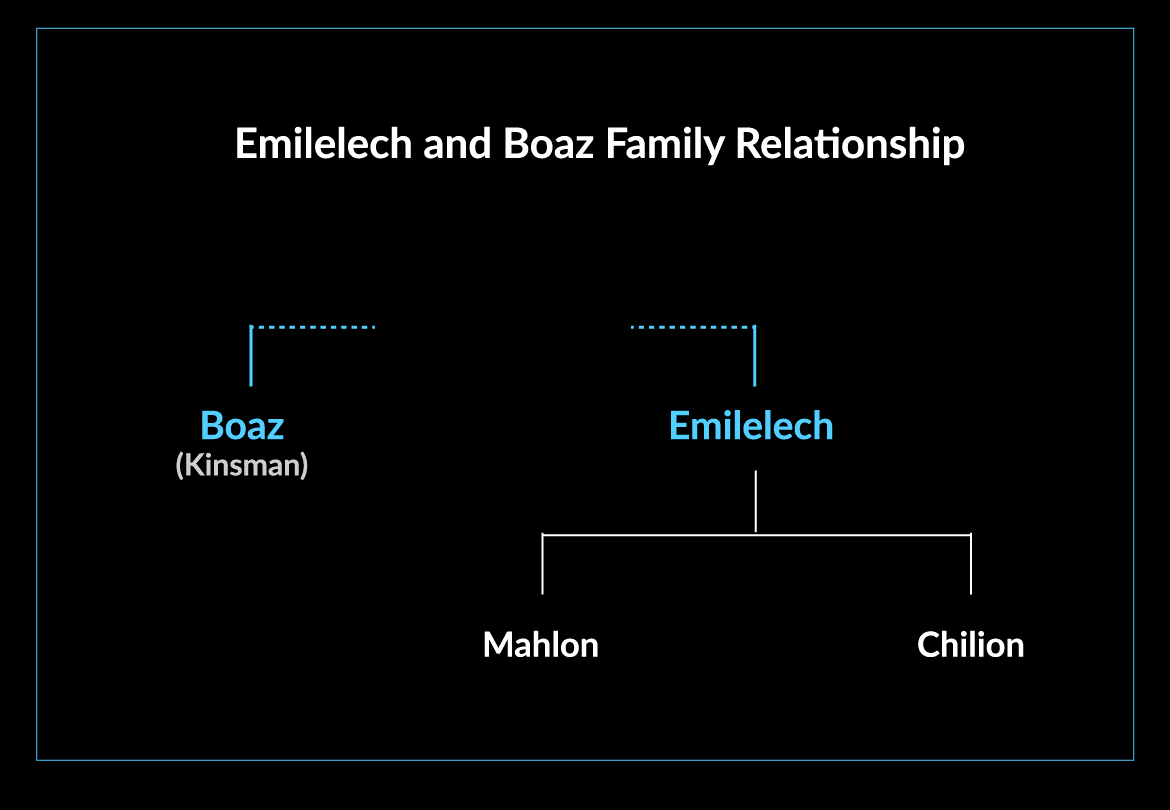
We have already seen in chapter 1 that Elimelech took his wife, Naomi and their two sons from Bethlehem to Moab. Ruth 1:2 said the names of his sons were Mahlon and Chilion. Now we learn in Ruth 2:1 of their relative named Boaz. He was a close relative, as we read later in the chapter.
Verse 1 provides additional family information and helps us understand what will happen in the rest of the book. Verse 2 continues the story. It says,
And Ruth the Moabitess said to Naomi, “Please let me go to the field and glean among the ears of grain after one in whose sight I may find favor.” And she said to her, “Go, my daughter.” Ruth 2:2 (NASB)
Ruth asked to go to the fields to glean ears of grain. She was saying that since they needed food to eat, she would go into the fields and work hard to gather grain and bring it back.
Verse 2 gives us an important piece of information about Naomi and Ruth that might not be immediately obvious. In verse 2 Ruth asked to be able to go to the fields. Naomi said, “Go my daughter.” Go to the fields and collect grain. But what was not obvious is that these two women were poor.
We know now they were poor because Ruth was going to go to the fields to glean grain. Turn with me to Leviticus 19:9 which will help us see that these two women were poor.
‘Now, when you reap the harvest of your land, you shall not reap to the very corners of your field, nor shall you gather the gleanings of your harvest. Nor shall you glean your vineyard, nor shall you gather the fallen fruit of your vineyard; you shall leave them for the needy and for the stranger. I am the LORD your God. Leviticus 19:9-10 (NASB)
God told the Israelites not to reap their grain all the way into the corners of the field. You were not to collect everything in the vineyard, either. Why? Because it was supposed to be left for the needy and the stranger, or the alien to glean. That demonstrates that God wanted to help those who were poor.
Look at Leviticus 23:22, which has essentially the same information. It says,
‘When you reap the harvest of your land, moreover, you shall not reap to the very corners of your field nor gather the gleaning of your harvest; you are to leave them for the needy and the alien. I am the LORD your God. Leviticus 23:22 (NASB)
Deuteronomy 24:19 gives us some additional information. Verse 19 says,
“When you reap your harvest in your field and have forgotten a sheaf in the field, you shall not go back to get it; … Deuteronomy 24:19 (NASB)
In other words the message was that if they reaped their harvest and accidentally left some, they were not to go back to retrieve it.
… it shall be for the alien, for the orphan, and for the widow, in order that the LORD your God may bless you in all the work of your hands. Deuteronomy 24:19 (NASB)
God said to not be greedy and go back and get everything that you can. If you will do what I tell you, I will bless you. God was trying to provide for the needy, the stranger, the orphan, and the widow. That is four groups of people for whom God cares. At this point Ruth was a stranger and a needy widow. She qualified for three of the four groups.
Ruth was going to the field because this was the way God provided for the poor, the widows, the orphans, and the alien. Today we call it welfare. I have heard some Christians say, “We need to get rid of welfare.” I have to admit, I am not sure that the way we implement and manage welfare programs is always the best way to do it. But providing for those in genuine need was and is God’s desire. He provided free food for those in need who were willing to do the work themselves to glean the grain. That is one part I think we are missing in our welfare system. We often do not have a work requirement for recipients to meet.
But the point of verse 2 is that Ruth and Naomi were poor. They were both widows. So Ruth volunteered to go to the fields alone so that Naomi could stay home. This is really important. Naomi was obviously older, Ruth was younger and was volunteering to go and do the work.
Verse 3 says,
And so she departed and went and gleaned in the field after the reapers; and she happened to come to the portion of the field belonging to Boaz, who was of the family of Elimelech. Ruth 2:3 (NASB)
This is really interesting because we are told that she went to a field. The fields being harvested were barley fields. If you look back at Ruth 1:22, it says,
… And they came to Bethlehem at the beginning of barley harvest. Ruth 1:22 (NASB)
Barley harvest was in the springtime, mid-April and may have lasted as long as six weeks. We will learn in verse 17 that she gleaned close to an ephah of barley.
What is important to see in this verse is the little word, “happened.” I am not sure what your Bible says. The New American Standard says this,
So she departed and went and gleaned in the field after the reapers; and she happened to come to the portion of the field belonging to Boaz, … Ruth 2:3 (NASB)
Is that not interesting what it says? She just “happened” to be in the field of Boaz. She did not know where Boaz’s field was. We have not been told so far whether she even knew who Boaz was! It was later that Naomi had to explain to her who he was and their relation to him. So she was not deliberately looking for the field of Boaz. This verse says she happened to come to the portion of the field belonging to Boaz who was of the family of Elimelech. The verse repeats some of the information in verse 1, just to make sure that we understand who Boaz was.
Chance, Chanced Upon
The word “happened” in verse 3 actually is two Hebrew words. The literal Hebrew is “chance, chanced upon.” The word “chance” means random. It just happened to occur. We say today. “You were lucky that happened to you.” That is the idea – that Ruth was “lucky” she landed in the field of Boaz. But the Bible teaches God’s providence. So we know that in the providence of God, He planned for Ruth to stop in that field.
We saw in chapter 1 that God might let you have what you want, even if it is not the best for you if you just keep insisting that you really want it. If you are not familiar with chapter 1, then I encourage you to read that study for the message in chapter 1. We have already seen God’s will at work in chapter 1. In that study, we digressed from Ruth and dealt with the issue of how to know God’s will. Today we are going to see in this chapter more information about God’s will.
I do not believe this was just happenstance. Ruth was obviously going to a field to collect grain so that Naomi and she could have food to eat. Turn with me to Acts 16, then we will return to Ruth. Acts 16:6 is about the apostle Paul. The apostle Paul was traveling and verse 6, says:
They passed through the Phrygian and Galatian region, having been forbidden by the Holy Spirit to speak the word in Asia; and after they came to Mysia, they were trying to go into Bithynia, and the Spirit of Jesus did not permit them; and passing by Mysia, they came down to Troas. A vision appeared to Paul in the night: a man of Macedonia was standing and appealing to him, and saying, “Come over to Macedonia and help us.” Acts 16:6-9 (NASB)
Paul was trying to go to Asia when the Holy Spirit stopped him. The Scripture is very clear. Paul was moving out on his own and the Spirit said to stop! If you continue reading, we find that Paul went from one place to another place, and on to several other places. We are never told Paul was stopped from going to any other place except to Mysia.
What does that tell us about God’s will? It illustrates that God leaves many decisions up to us on a day-to-day basis. But on some occasions, God is going to rearrange things to prevent us from doing what He does not want us to do. Or, to state it a slightly different way—so that you will do what He wants you to do.
Genesis 26 is about Isaac and his search for water. I call this the chapter about wells. It states that Isaac revisited some wells previously dug by his father. Genesis 26:12 says this:
Now Isaac sowed in that land and reaped in the same year a hundredfold. And the LORD blessed him, and the man became rich, and continued to grow richer until he became very wealthy; Genesis 26:12-13 (NASB)
We failed to make the point earlier that in Ruth 2:1, Boaz was extremely wealthy. Isaac was also a very rich man, as stated in Genesis 26:13.
And the man became rich, and continued to grow richer until he became very wealthy; for he had possessions of flocks and herds and a great household, so that the Philistines envied him. Genesis 26:13-14 (NASB)
That is the problem! The Philistines were jealous of him.
Verse 15 says,
Now all the wells which his father’s servants had dug in the days of Abraham his father, the Philistines had stopped up by filling them with earth. Genesis 26:15 (NASB)
So they filled up the wells.
Then Abimelech said to Isaac, “Go away from us, for you are too powerful for us.” Genesis 26:16 (NASB)
How do you like that?! The people of the land said it was time for Isaac to move on. Isaac was too powerful so he had to move away.
And Isaac departed from there and camped in the Valley of Gerar, and settled there. Genesis 26:17 (NASB)
Verse 18 begins,
Then Isaac dug again the wells of water which had been dug in the days of his father Abraham, for the Philistines had stopped them up after the death of Abraham; and he gave them the same names which his father had given them. But when Isaac’s servants dug in the valley and found there a well of flowing water, the herdsmen of Gerar quarreled with the herdsmen of Isaac, saying, “The water is ours!” So he named the well Esek, because they contended with him. Then they dug another well, and they quarreled over it too, so he named it Sitnah. He moved away from there and dug another well . . . Genesis 26:18-22a (NASB)
Isaac initially wanted to take all the earth out of the wells so he could free them to produce water. The people of the land contended with him, so he moved on and dug another well. He encountered problems there also, so he went elsewhere and dug another well. He had problems there, so he moved on and dug yet another well. He kept having to move on, and he kept trying to dig wells.
Verse 22 continues,
…and they did not quarrel over it; … Genesis 26:22 (NASB)
Finally he dug a well that no one quarreled over with him.
… so he named it Rehoboth, for he said, “At last the LORD has made room for us, and we will be fruitful in the land.” Genesis 26:22 (NASB)
Isaac said that finally the Lord was going to let us stay here. To whom did he give credit for what had happened? God! God had allowed contention to occur over every one of the previous wells until finally Isaac got to a well where there was no contention. He acknowledged that it was from God. Isaac’s situation was just like Paul’s.
Paul was moving along, going from one city to another city. He wanted to go to Asia. But the Spirit of Jesus said no, you are not to go there. What is really amazing when we compare Paul’s experience with Isaac’s in Genesis, we learn that God allows us to make most of the day-to-day decisions on our own. There are times, though, when God says, no. You are not going to do that. I am going to box you in, and I am going to prevent you from doing what I do not want you to do. God does things to move us in the direction He wants us to go.
Now look at Ezra 1:1, where we find an important comment. Ezra 1:1 says,
Now in the first year of Cyrus king of Persia, in order to fulfill the word of the LORD by the mouth of Jeremiah, the LORD stirred up the spirit of Cyrus king of Persia, so that he sent a proclamation throughout all his kingdom, and also put it in writing, saying: … Ezra 1:1 (NASB)
Ezra then described the proclamation. Verse 1 says that God “stirred up Cyrus the king of Persia” to write a proclamation. Would Cyrus have done that on his own? Verse 1 implies that the only reason he wrote the proclamation was because God moved him to do it.
God puts boundaries down. He arranges circumstances and events. Sometimes He even influences our passions and our desires so that we make the right decision. How did Ruth pick that field? Do you think she was walking along and saw a big sign that said “This is Boaz’s field? This is God’s will, you are supposed to glean here. As a result, you are going to be in the line of the future King David, and in the line of Israel’s Messiah. That is the reason you are supposed to glean in this field!”
Is that how it happened? No! She was walking along looking for a field. She just thought she saw a good field. God moved her heart, just as God moved Cyrus. God moved her to glean in that field. She just did not happen to be there by happenstance. God moved her. She did not know she was in Boaz’s field.
When I went to Biola College, I did not know that I was going to meet my wife there; but I do believe that it was God’s guiding and directing. I believe God was at work. That is exactly what God was doing for Ruth. Verse 3 says,
So she departed and went and gleaned in the field after the reapers; … Ruth 2:3 (NASB)
We have already made the point that the reapers would cut the barley, and the maids would come behind them and collect it. So she was going to come and pick up what was left after the maids had passed through.
… and she happened to come to the portion of the field belonging to Boaz, who was of the family of Elimelech. Ruth 2:3 (NASB)
Boaz Noticed Ruth
Verse 4 says,
Now behold, Boaz came from Bethlehem and said to the reapers, “May the LORD bless you. And they said to him, “May the LORD bless you. …” Ruth 2:4 (NASB)
Now that was a standard greeting between an owner and a servant. This would have been a servant who was responsible to Boaz. Verse 5 says,
Then Boaz said to his servant who was in charge of the reapers, “Whose young woman is this?” Ruth 2:5 (NASB)
We do not know how long Boaz had been there before he noticed Ruth. Notice that she is described as a young woman.
Verse 6 says,
The servant in charge of the reapers replied, … Ruth 2:6 (NASB)
The servant started explaining why Ruth was present.
Before I go further into verse 6, I want to read from Dr. J. Vernon McGee, one of my former pastors. Dr. McGee made very interesting comments about verse 5. Here is what he said about Boaz and Ruth.
Now we have really come to the part of our story that is exciting. This little foreign girl by the name of Ruth, willing to accept poverty and ostracism and perpetual widowhood, is out in the field gleaning. By chance, she has gone into the fields of Boaz, the most acceptable bachelor in Bethlehem. I suppose that the mothers of marriageable daughters in Bethlehem had given many a tea or invited him over for a meal. They say the way to a man’s heart is through his stomach, and I imagine many had tried that route. But somehow or other he hadn’t been interested in the local girls. But then one day he goes into his fields and he sees for the first time this little still feel that the King James translation is our best for public use. Although the American Standard Version of 1901 is probably more accurate, it’s very hard to improve on this King James. But there are places where I think we can bring it up to date, and this is such a place. What Boaz said here is not quite, “Whose damsel is this?” May I just give you several very free translations? He says, “Well, where in the world has she been that I haven’t met her before?” That’s very free, as you can see. Or let me give it another way. Perhaps as accurate Hebrew as you can possibly get, could not be translated, but would sound like a Hebrew wolf whistle. He fell for this girl. This is love at first sight.
And maybe you’re wondering if I believe in love at first sight. May I say to you, I believe in it very strongly. I proposed to my wife on the second date we had. The reason I didn’t propose on the first date was because I didn’t want to make her think I was in a hurry.
He did not want her to think he was in a hurry, so he did not ask her on the first date. He waited until the second date!
Now don’t get any ideas if you are a young person. It was a year before we got married. We wanted to make sure. Yes, I believe in love at first sight, but I think love ought to be tested by quite a bit of time before marriage takes place.
Boaz had a case of love at first sight. This man really fell for Ruth, and this is romance in the fields of Boaz, if you please.
I just had to share that. An incredible setup! Why do you think Boaz asked about the woman? He was interested! So the servant in verse 6 provided information.
The servant in charge of the reapers replied, “She is the young Moabite woman who returned with Naomi from the land of Moab. And she said, ‘Please let me glean and gather after the reapers among the sheaves.’ Thus she came and has remained from the morning until now; she has been sitting in the house for a little while.” Ruth 2:6-7 (NASB)
Boaz discovered this young woman was Naomi’s daughter-in-law from the land of Moab. Ruth had already been gleaning.
Boaz Provided for Ruth
Verse 8 says,
Then Boaz said to Ruth, “Listen carefully, my daughter. Do not go to glean in another field; furthermore, do not go from this one, but stay here with my maids. Ruth 2:8 (NASB)
What was he doing now? This was their first conversation. It will be their first meal together, as you are going to see. It was also his first demonstration of favoritism as we are going to see in verses 9-16. So the conversation between the two of them started in verse 8. Boaz boldly went up to Ruth and talked with her. He essentially said, “Do not leave my field.” He liked and respected her and wanted to provide protection for her. Verse 9 says,
Let your eyes be on the field which they reap, and go after them. Indeed, I have commanded the servants not to touch you. … Ruth 2:9 (NASB)
That is an interesting comment. It was not uncommon then as it is today that a young woman alone might have been subject to abuse. He told his servants not to touch her.
… When you are thirsty, go to the water jars and drink from what the servants draw.” Ruth 2:9 (NASB)
So what Boaz essentially said was, “Look, Ruth, you are to go and get water from the water jar, and you are to drink from there.”
Verse 10 says,
Then she fell on her face, bowing to the ground and said to him, “Why have I found favor in your sight that you should take notice of me, since I am a foreigner?” Ruth 2:10 (NASB)
What was she doing? She was thankful and was responding with gratitude. She was appreciative.
Verse 11 says,
Boaz replied to her, “All that you have done for your mother-in-law after the death of your husband has been fully reported to me, and how you left your father and your mother and the land of your birth, and came to a people that you did not previously know. Ruth 2:11 (NASB)
Boaz knew what she had done. Boaz knew that she had left her home and accompanied her mother-in-law.
Now many people would not choose to live with and care for their mother-in-law. But Ruth wanted to be connected with and to care for her mother-in-law. In fact, Ruth was collecting grain to provide food for both herself and her mother-in-law. We are told that Boaz knew that she left Moab after the death of her husband, and had left her father’s house, her mother, and the land of her birth. He did not comment about the fact that she had completely turned her back on her former gods. Maybe he did not yet know that. Verse 12 says,
May the Lord reward your work, and your wages be full from the LORD, the God of Israel, under whose wings you have come to seek refuge.” Ruth 2:12 (NASB)
Little did Boaz know how truthful his comment was. What Boaz had just done was to give her a blessing, but little does he know how active God was in her life.
Verse 13 says,
Then she said, “I have found favor in your sight, my lord, for you have comforted me and indeed have spoken kindly to your maidservant, though I am not like one of your maidservants.” Ruth 2:13 (NASB)
Now verse 14 is their first lunch together, and it is really simple.
At mealtime Boaz said to her, “Come here that you may eat of the bread and dip your piece of bread in the vinegar.” So she sat beside the reapers; and he served her roasted grain, and she ate and was satisfied and had some left. Ruth 2:14 (NASB)
So they had lunch together. Why do you think Boaz had lunch with her? Do you think that reveals something about his heart and attitude towards this woman? We could call it their first date.
Verse 15 says,
When she rose to glean, Boaz commanded his servants, saying, “Let her glean even among the sheaves, and do not insult her. Also you shall purposefully pull out for her some grain from the bundles and leave it that she may glean, and do not rebuke her.” Ruth 2:15-16 (NASB)
That demonstrates that the maids were making bundles of grain. Boaz said his servants were supposed to intentionally pull grain out of their bundles and leave it on the ground for Ruth to pick up. Boaz was taking a real interest in her. He was making an extra effort to show her kindness and to provide for her and Naomi. I think Boaz cared about and for Ruth at this point.
Ruth and Naomi Talked About Boaz
In verses 17-20, we read the summary of her day that Ruth gave Naomi. In verse 20, Ruth discovered that Boaz, who owned the field, was a relative of Naomi. Verse 17 says:
So she gleaned in the field until evening. Then she beat out what she had gleaned, and it was about an ephah of barley. Ruth 2:17 (NASB)
That is about half of a bushel, or about 30-40 pounds of grain. That is a lot of grain, 30-40 pounds. Verse 18 says:
She took it up and went into the city, and her mother-in-law saw what she had gleaned. She also took it out and gave Naomi what she had left after she was satisfied. Ruth 2:18 (NASB)
The rest of the verse tells us they divided the grain between the two of them – between Naomi and Ruth. In verse 19, they started talking about Ruth’s day.
Her mother-in-law then said to her, “Where did you glean today and where did you work?… Ruth 2:19 (NASB)
Naomi wanted to know what Ruth had done that day. She said,
… May he who took notice of you be blessed.” So she told her mother-in-law with whom she had worked and said, “The name of the man with whom I worked today is Boaz.” Ruth 2:19 (NASB)
Now what you see in verse 19 is that Ruth did not yet know who Boaz was. She knew his name was Boaz. She knew he had shown her extreme, unusual kindness. Maybe she sensed that Boaz respected and perhaps liked her. It is not yet apparent from the text. But verse 20 says,
Naomi said to her daughter-in-law, “May he be blessed of the LORD who has not withdrawn his kindness to the living and to the dead.” Again Naomi said to her, “The man is our relative, he is one of our closest relatives.” Ruth 2:20 (NASB)
We are going to discuss in the next chapter the concept of the kinsman redeemer. Boaz was going to be Ruth’s kinsman redeemer. Boaz was a close relative. We are also going to discover that Boaz is a type of Christ. He prefigures Christ. But in this chapter we are not going to do that because we are only told here in verse 20, that Boaz is a close relative. If you are interested in the concept of the kinsman redeemer, look at Deuteronomy 25:5-10. We will look at that in more detail in our next study.
Verses 21 through 23 is the wrap-up of the women’s discussion. I wonder how many different subjects they talked about, and I wonder how long they went on talking. I cannot help but think they probably went on for an hour or more! All we are given is three verses. It says,
Then Ruth the Moabitess said, “Furthermore, he said to me, ‘You should stay close to my servants until they have finished all my harvest.’ “ Naomi said to Ruth her daughter-in-law, “It is good, my daughter, that you go out with his maids, so that others do not fall upon you in another field.” So she stayed close by the maids of Boaz in order to glean until the end of the barley harvest and the wheat harvest. And she lived with her mother-in-law. Ruth 2:21-23 (NASB)
What is the message in this study? One thing that stood out in my mind as we are closing was remembering Orpah, the other daughter-in-law who went back to Moab. Orpah played it safe. Orpah went back to her family and to her gods.
What did Ruth do? Ruth did not play it safe. Ruth left her family, her country, and her gods. She followed the true God.
The true God of Israel then gave her an unexpected event—like the time I went down to Biola College. Little did I realize I would meet my wife there. I was not even thinking of getting married when I went to Biola. I do not think that Ruth was thinking about marriage. Ruth went with Naomi to help Naomi. She arrived in Bethlehem, and God had surprises for her. Those surprises are going to be incredible!
Chapter 3 is going to be very interesting as we study the concept of the kinsman redeemer and Boaz as a type of Christ.
Suggested Links:
Introduction to the Book of RuthRuth and Naomi Go to the City of Bethlehem