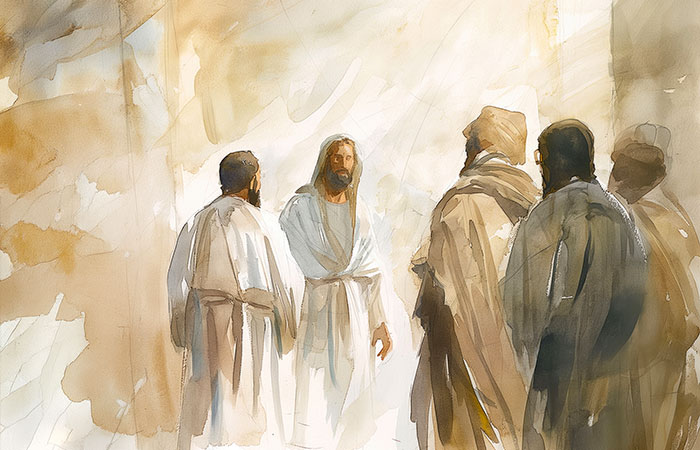
Jesus’ Teaching Peter, Andrew, James, and John
© Anna Shalamova | Dreamstime.com
Our world is racing into the future toward a tribulation period that will begin with a peace treaty for Israel. That will be preceded by the rapture or the removal of all believers in Christ from the earth. The tribulation will start when a very popular and powerful world leader establishes a peace agreement between Israel and an alliance of nations. Yet, there will still be rumors of wars, earthquakes, and evil events. In spite of the agreement, the world will still hate Israel as well as Christians. Our last study from Matthew 24:4-14 described those events: false prophets, betrayal by family members, and an increase in lawlessness even though the gospel will spread throughout the world. But after 3.5 years into the peace agreement with Israel, armies from the north and the south will invade Israel desiring to take control. At that point the world leader, the antichrist, will successfully defend Israel, but then he will enter the temple in Jerusalem and declare that he is God. He will violate the peace agreement and seek total control over the entire world, including Israel. He will be the exact opposite of Jesus Christ. While Jesus Christ is the Messiah and the Savior of the world for those who believe in Him, the antichrist will be the evil messiah who causes disaster everywhere. He will be empowered by Satan who will help him perform wonders. It will be easy to identify the antichrist for we are told that he will enter the temple in Jerusalem and declare that he is God. So, the middle point of the tribulation will be a critical point in the future. This study is about this critical middle point of the tribulation. At that point, the identity of the antichrist will be revealed and the horrors of the last part of the tribulation will begin. God will allow the antichrist to be the ruler of the world for 3.5 years. Our study is from Matthew 24:15; Mark 13:14; and Luke 21:20.
Daniel 9:27 and the Tribulation
The first verse of our study is Matthew 24:15. Jesus said,
Therefore when you see the ABOMINATION OF DESOLATION which was spoken of through Daniel the prophet, standing in the holy place (let the reader understand), then those who are in Judea must flee to the mountains. Matthew 24:15-16 (NASB)
Jesus said this just after He had finished explaining the birth pangs that will occur before His second coming in verses 4-14. As explained in the previous study, Jesus in Matthew 24:15 figuratively called the events that will occur birth pangs. We should understand birth pangs to include Braxton Hicks contractions and the early labor pains known as latent labor. Verses 6-7 correspond to the Braxton Hicks contractions which occur about three to four months before a baby’s delivery. Verses 8-14 correspond to the latent labor pains before delivery. We will discover in our next study that verses 16-28 correspond to the contractions of labor that immediately result in delivery. Therefore, Matthew 24:15 is the transition point between the latent and actual labor pangs. Symbolically speaking, the verse corresponds to the signal that it is time for the expectant mother to go to the hospital or for the midwife to come and help with the delivery. Verse 15 helps us identify when this point in time will occur.
As we read Matthew 24:15, we should notice that Jesus said, “when.” The “when” refers to some point in the future at which the “active labor pains” will start. What will happen? Jesus said, “The abomination of desolation which was spoken of through Daniel the prophet, [will be] standing in the holy place.” The prophecy that Jesus was referring to is found in Daniel 9:27 and Daniel 12:11. We will examine three passages, Daniel 9:27; 11:31; 12:1.
Amillennial, postmillennial, and preterist teachings focus on Daniel 11:31 and rarely include Daniel 9:27. Sometimes they include Daniel 12:11. Why? If we read Daniel 9:27, we discover that the Hebrew words that are translated as “abominations shall come one who makes desolate” in the NASB are identical to the Hebrew words that are translated as “abominations make desolate” in Daniel 11:31 and Daniel 12:11. That is, the same two Hebrew words for abomination of desolation occur in all three verses. So, why is Daniel 9:27 not included by everyone? The answer is Daniel 9:27 reveals that their view of the future is in error.
Daniel 9:27 tells us that a leader will make a covenant, that is, an alliance or a treaty with Israel and other nations for one week, which is seven years.1
And he will make a firm covenant with the many for one week, but in the middle of the week he will put a stop to sacrifice and grain offering; and on the wing of abominations will come one who makes desolate, even until a complete destruction, one that is decreed, is poured out on the one who makes desolate.” Daniel 9:27 (NASB)
This leader will be the antichrist. Then after 3.5 years, the antichrist will break the peace treaty. The abomination of desolation will occur at that point. This is summarized in the introduction. The statement “put a stop to sacrifice and grain offering” reveals he will not allow the Israelites to sacrifice at the temple in Jerusalem. That statement also reveals there will be a temple again in Jerusalem. Daniel 7:25-26 is part of the prophecy that provides more information about Daniel 9:27.
So in Matthew 24:15-16, Jesus tells the Israelites that when they see the abomination of desolation in the holy place of the temple in the city of Jerusalem, then they should flee. Why? Because that is the sign the antichrist has turned against them. He established the peace treaty, but he will not keep it. Also, he stops the sacrifices and worship in the temple and will declare himself to be God (2 Thessalonians 2:2-4; Revelation 13:14-15).
At that point, the identify of the evil Messiah will finally be revealed, and the horror of the last 3.5 years of the tribulation will begin. How do we know that 3.5 years will be the length of the last half of the tribulation? Daniel 9:27 says that the abomination of desolation will occur in the middle of the week. The week (or tribulation) is a week of years that will last for seven years. The first part is relative peace, but the last half of the tribulation will be horror. The antichrist will rage against Israelites who believe in Christ and against all believers around the world. In Matthew 24:16-28, Jesus tells the Israelites to flee to the mountains.
In sharp contrast, amillennialists, postmillennialists, and preterists claim that the leader in Daniel 9:27 refers to Christ. They claim the first 3.5 years mentioned in the verse refers to the length of Christ’s ministry. They claim that we are now living in the last 3.5 years of the seven-year period, and say that it started after Christ died on the cross. It is surprising that they interpret the first 3.5 years of the seven years literally, but they say the last 3.5 years are figurative and has lasted already for more than two thousand years.2 So, they interpret the first 3.5 years of the tribulation literally and the last half figuratively. But nothing in the context justifies that position or interpretation. Amillennialists, postmillennialists, and preterists do that in order to make Scripture fit their theory of God’s plan for the future.
Therefore, Matthew 24:15 is a future sign that will reveal to the world that they are half-way through the tribulation, and God is going to pour out horrors upon the world and the antichrist because of his behavior. Symbolically speaking, the last 3.5 years will be like the active labor pains that result in delivery. Jesus has given us a time marker.
Daniel 11:31 and the Abomination
The first passage that we will now study is Daniel 11:31. Almost every student of the Bible understands that the abomination of desolation mentioned in Daniel 11:31 refers to Antiochus Epiphanes’ sacrifice of a pig on the altar of the temple in Jerusalem and the erection of the statue of Zeus or Jupiter in the temple. Thus Daniel 11:31 helps us understand the meaning of the expression, abomination of desolation, since it describes Antiochus’ behavior. Dr. J. V. McGee provides this overview,
What is the abomination of desolation? Well, Daniel tells us about two of them. One of them was Antiochus Epiphanes, the Syrian, who came down and destroyed Jerusalem. In Daniel 11:31 we read: “And arms shall stand on his part, and they shall pollute the sanctuary of strength and shall take away the daily sacrifice, and shall place the abomination that maketh desolate.” History bears out the fact that Antiochus Epiphanes came against Jerusalem in 170 B.C., at which time over one hundred thousand Jews were slain. He took away the daily sacrifice from the temple, offered the blood and broth of a swine upon the altar, and set up an image of Jupiter to be worshiped in the holy place.3
As a result, when we read 2 Thessalonians 2:3-4, we can now understand that when the antichrist sits in the temple and declares himself to be God, that is the abomination of desolation spoken of by both Daniel and Christ.
Let no one in any way deceive you, for it will not come unless the apostasy comes first, and the man of lawlessness is revealed, the son of destruction, who opposes and exalts himself above every so-called god or object of worship, so that he takes his seat in the temple of God, displaying himself as being God. 2 Thessalonians 2:3-4 (NASB)
Notice that the Holy Spirit calls the antichrist the man of lawlessness and the son of destruction who opposes God. This means the spirit of the antichrist is already among us. That spirit can be seen in atheists and agnostics. They act like they are god, rejecting the God of gods. They have set themselves up` like god claiming He does not exist even though they cannot leave the earth and search for Him in the farthest reaches of space.
So, it will not be a surprise to others that the antichrist will act like god. The abomination of desolation will be vastly more evil than Antiochus Epiphanes. The antichrist’s atrocities will be the worst because he will be motivated and empowered by Satan who wanted to become God. The devil motivated one-third of the angels in heaven to rebel against God (Revelation 12:3-4). Satan is the ultimate abomination of abominations and the antichrist will be almost identical! So, Daniel 11:31 helps us understand the expression, abomination of desolation.
Daniel 12:11 and the Great Tribulation
The next important passage to examine is Daniel 12:11, since many theologians believe that Jesus referred to it in Matthew 24:15. This reads as,
From the time that the regular sacrifice is abolished and the abomination of desolation is set up, there will be 1,290 days. Daniel 12:11 (NASB)
This passage reveals that after the abomination of desolation occurs, there will be 1,290 days. That equals 1,260 days or 3.5 years, plus an extra 30 days. The 1,260 days after the abomination of desolation is the time from the abomination of desolation to the second coming of Christ as described by Christ in Matthew 24. This will become clear in the next study. The extra 30 days appears to allow time for the Sheep and Goat Judgment, which is also called the Judgment of Nations (Matthew 25:31-46).
The 1,260 days also appear in the book of Revelation. But first we need a short overview of the book. Revelation is a prophecy about the future seven-year tribulation described in Daniel 7:24-27. Revelation 6 provides an overview of the entire seven years of the tribulation. Verses 1-2 describes the first 3.5 years of the tribulation, a period of peace. Verses 3-4 are a prophecy. Symbolically, the red horse will remove peace from the earth. Verses 3-8 describe war, famine, and death, the horrors of the last half of the tribulation. A close examination of these verses reveals that the famine and death will be extraordinary, way beyond the normal events we have ever experienced for verse 8 says one-fourth of the population of the world will die. That has never happened, and it is not included in the birth pangs. When Jesus described the birth pangs, He warns the future Israelites to flee. He will do that in Matthew 24:16-28. Verses 9-11 describe the martyrs and the terror that will occur. Thus Revelation 6:3-17 are about the last half of the tribulation because the first half of the tribulation will be relatively peaceful, but not totally peaceful.
As we read the descriptions of the seal, trumpet, and bowl judgments in Revelation, it becomes apparent that these judgments will not occur in the first 3.5 years of the tribulation, but in the last 3.5 years of Daniel’s seventieth week. Descriptions of the last half of the tribulation are easy to identify because there are references to 1,260 days which equal forty-two months, or are described as time, times, and half a time (Revelation 12:14, 6; 13:5). In addition, the seal judgments result in one-third of the animals and plants on the earth being destroyed. The sun, moon, and stars will also be darkened. That has never happened, but it will someday.
Revelation 13:1-10 describes the antichrist ruling the world for forty-two months. Revelation 11 also tells us that for forty-two months the nations of the world will dominate Israel. Revelation 11:3 adds that two witnesses will prophesy in sackcloth during this time.
In summary, Daniel 12:11 refers to the last 3.5 years or 1,260 days of the tribulation. It is called the Great Tribulation by Christ (Matthew 24:21). This means that Matthew 24:16 starts the first description of the last half of the tribulation. Thus verses 16-28 are not figuratively about latent labor pains but about the active labor pains that will occur immediately prior to the second coming of Christ.
Luke 21:20-21 – Jerusalem Surrounded
uke 21:10-24 provides some additional information that is not included in Matthew 24:4-31 and Mark 13:24-32. When both Matthew and Mark refer to the abomination of desolation, they do not provide any information about the city of Jerusalem other than to reveal that the temple will exist, but Luke 21:20-21 reveals that Jerusalem will be surrounded by armies. Here are verses 20-21,
But when you see Jerusalem surrounded by armies, then recognize that her desolation is near. Then those who are in Judea must flee to the mountains, and those who are in the midst of the city must leave, and those who are in the country must not enter the city. Luke 21:20-21 (NASB)
There are three views as to the meaning of these two verses. The first view says that verses 20-21 refer to the invasion of the Roman army in 70 A.D. But we should notice first that Luke 21:20 refers to armies, not just one army. Historical data indicates that the Roman army attacked and laid siege upon Jerusalem. We must notice that Ezekiel 38-39 and Daniel 11:40-45 describe multiple nations attacking Israel and not just one. Also Scripture states all the nations of the world will attack Jerusalem at the battle of Armageddon (Joel 3:2-12; Zechariah 14:1-3). So, Luke 21:20-21 cannot be referring to the Roman army alone.
A second reason this view is wrong is that preterists would have us believe that the Romans caused the abomination to appear in the temple and that the second coming of Christ occurred in A.D. 70, which we are supposed to believe did not actually occur. Then they claim the real second coming of Christ will actually occur in the future. But Scripture never prophesied that Christ “would come but not really come” in 70 A.D., but would then really come in yet a future date!
A third reason the first view is wrong is that Jesus promised the disciples in Luke 17:22 that they would never see the second coming in their lifetime. Since we know the last apostle, John, died after 100 A.D., this view lacks credibility.
The second view says that Luke 21:20-21 refers to the battle of Armageddon, and Luke 21:22-24 provides recommendations about the battle and other specifics. This view is very plausible.
A third view that most likely is the correct one is that Luke 21:20-21 describes the armies that will surround Jerusalem during the battles of Gog and Magog in Ezekiel 38-39 and Daniel 11:40-45. These two prophesies describe two different invasions. The first invasion will occur at the middle of the tribulation, and the second one at the end of the tribulation at the battle of Armageddon. The study, “Prophecy of the Battle of Gog and Magog, part 3” summarizes this point.
The first reason the battle of Gog and Magog will occur in the last half of the tribulation is that Ezekiel 38:8, 10-12 states that Israel will be living in peace when Gog and his great army invade Israel. That agrees with the first 3.5 years of the tribulation. It begins with peace. This suggests Gog’s invasion breaks the peace in the middle of the tribulation. Apparently, the invasion enrages the antichrist and he begins attacking people and believers in the last half of the tribulation.4
Ezekiel 38:10-16 teaches us that Gog and other nations will attack Israel when it is at peace. That will occur in the middle of the tribulation. The article continues with the second through the seventh reasons. Here is the seventh reason,
Seventh, we believe the battle of Gog and Magog will occur during the last half of the tribulation because Ezekiel 39:25-29 refers to the millennial kingdom as the next event after the battle of Gog and Magog. This agrees with Revelation 20:4-6.5
It is important to note that Daniel 11:40-45 describes two invasions of Israel in the future and it appears that both provide an overview of military maneuvers given in Ezekiel 38-39. Thus views 2 and 3 provide an objective explanation of Luke 21:20, but it is unreasonable to conclude that view 1 is correct.
Conclusion
Matthew 24:15 is one of the most significant and critical verses that Jesus gave in the Olivet Discourse. It helps us determine the time of the second coming of Christ once we see the abomination of desolation, or if we cannot discern when the tribulation actually started. In the gospels of Matthew and Mark, it is clear that the signs Jesus gave do not point to a fulfillment date of AD. 70.
Amillennialists, postmillennialists, and preterists believe that the gospel of Luke makes a reference to the Roman invasion of Jerusalem in A.D. 70. Unfortunately, they overemphasize Luke’s record and reach a wrong conclusion. This occurs because they treat Scripture symbolically in order to rescue their theological viewpoint. They interpret literal Old Testament prophecies symbolically, and treat a number of symbolical New Testament passages literally.
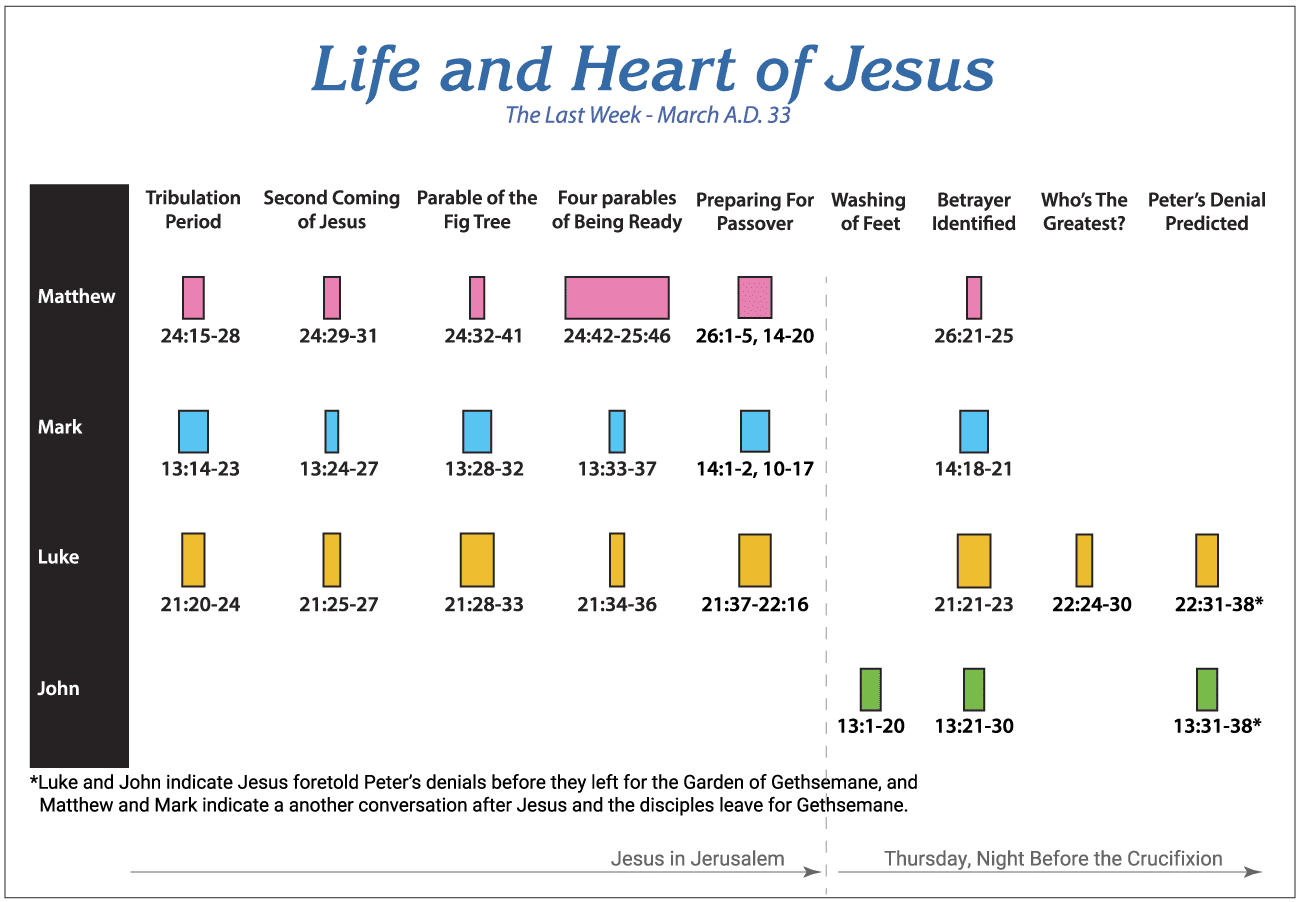
Together, the three gospels reveal more of the information that Jesus had shared with the disciples than if we had only read one gospel. The Holy Spirit moved the writer of Matthew and Mark to emphasize that Jesus is the Messiah for Jewish readers. Then Luke wrote for the Gentile readers and included the destruction of Jerusalem that will occur at the time that the abomination of desolation occurs in the future. Then he continued writing about the great tribulation through to the second coming of Christ.
Everything that the three synoptic gospels recorded about Jesus’ conversation with the four disciples of Peter, Andrews, James, and John. Jesus has been included. The time marker has been given, and now we are waiting for it to occur. Matthew 24 teaches us an important application. God wants every believer to understand His plan for the future. He does not want us to be fearful about the future. He is telling us that He is in control and to understand His plan!
May the Lord Jesus come quickly!
References:
1. Almost every theological view of the future, including the rabbis, are in agreement that the Hebrew word for week in Daniel 9:27 refers to seven years. See the studies titled, “Daniel’s Seventieth Week – The Tribulation”and “Daniel’s 69 Weeks – Prophecy About the Death of Christ” for the details.
2. Kim Riddlerbarger. A Case for Amillennialism. Baker Books. 2003. p. 156.
3. J. Vernon McGee. Matthew. Thru The Bible. Nelson Publishing Co. p. 128.
4. J. Calahan. Prophecy of the Battle of Gog and Magog, part 3. neverThirsty.org. Like the Master Ministries (www.neverthirsty.org/bible-studies/book-ezekiel/prophecy-of-the-battle-of-gog-and-magog-part-3/).
5. Ibid.
Suggested Links:
Life of ChristLast Days to the Crucifixion
Christ Prophesies About the Temple and the Second Coming
Birth Pangs and the Second Coming — Matthew 24:4-14