
Wedding Banquet Hall
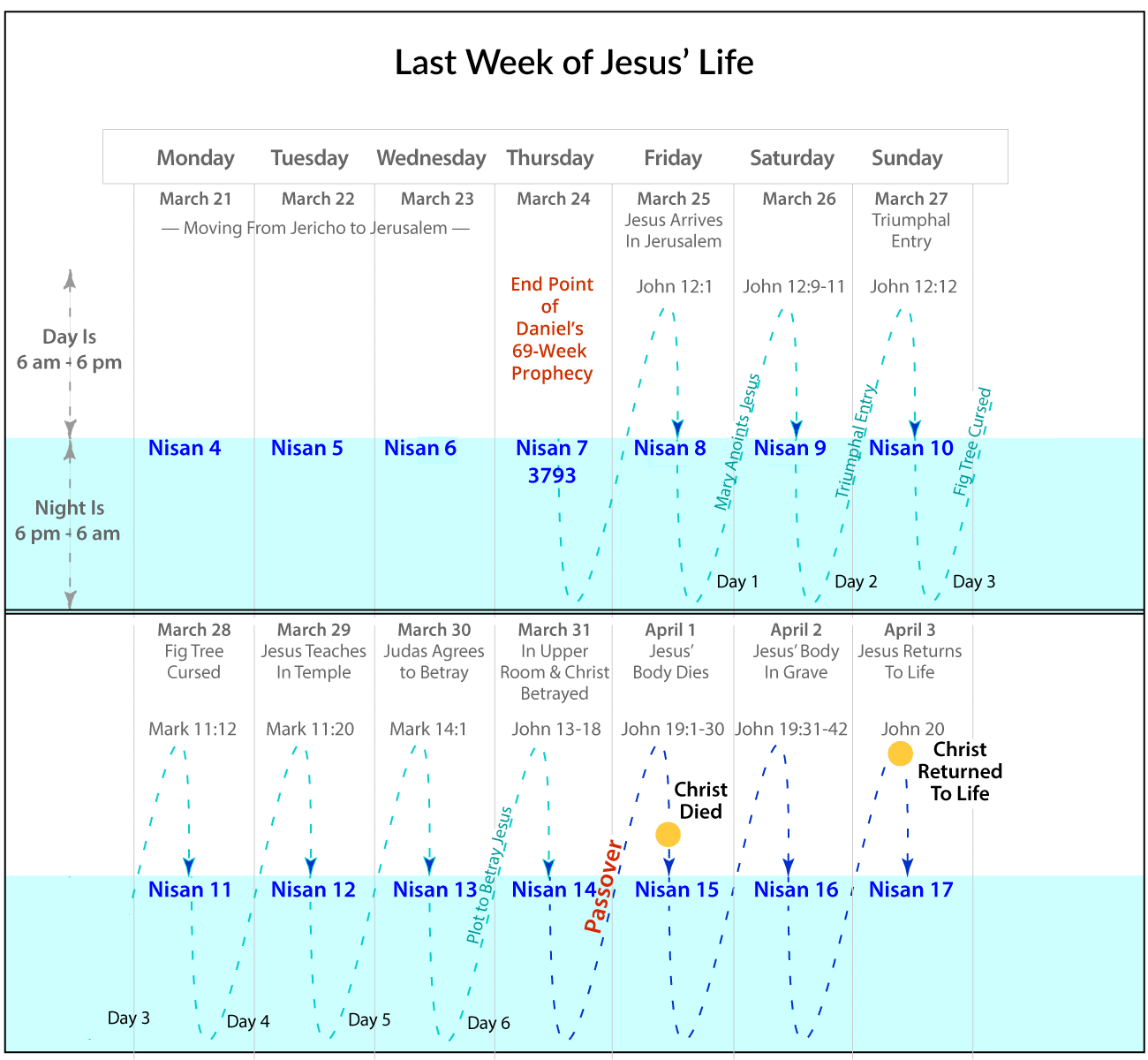
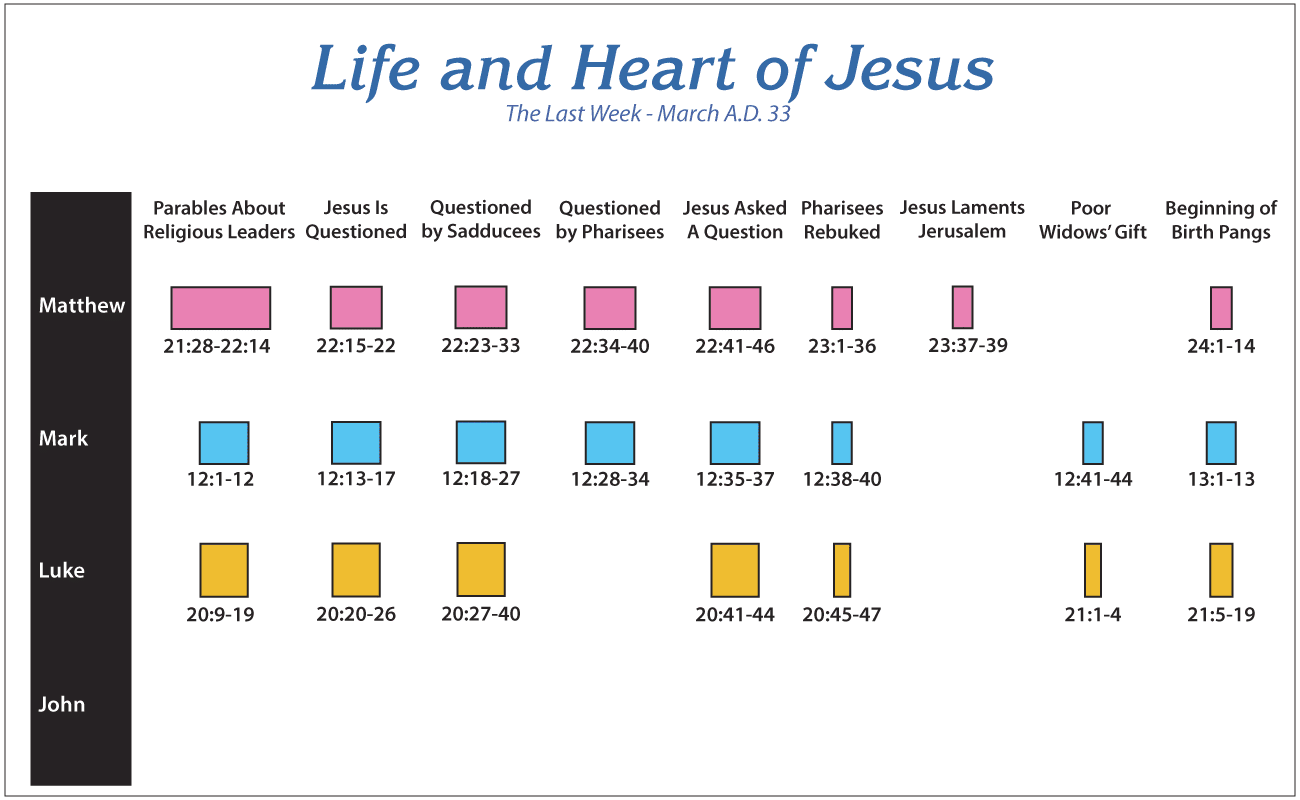
The “Parable of the Wedding Banquet” is the third parable that Jesus shared with the Sanhedrin Council after they challenged His authority. Most likely this parable and the preceding two parables were all given on the morning of Tuesday, 1 April A.D. 33, which was three days before Jesus was crucified. The reason for this conclusion is that the gospels reveal Jesus did a great number of things after this parable. Immediately, after the Sanhedrin Council had questioned His authority, Jesus gave them the Parable of the Two Sons and the Parable of the Vineyard and the Vine-growers. Jesus’ message to these religious leaders was that they were deceitful and disobedient to God. They refused to please God by believing in Jesus. In the second parable, the Parable of the Vineyard and the Vine-growers, Christ revealed that He knew they were planning to kill Him, the son of God. At this point, we can be confident that they were probably very angry. The parables revealed they had rejected Him and wanted to kill Him. Unbelief justifies destroying a person in some way, even if it means killing the person. This study is about the third parable. The title is “The Parable of the Wedding Banquet.” It was also directed right at the Sanhedrin Council. Only the book of Matthew records this parable. It is found in Matthew 22:1-14, and the question is, “Why did Jesus give the religious leaders this parable?”
A King Arranged a Wedding Feast
Here is the first part of the third parable.
And Jesus answered and spoke to them again by parables and said: “The kingdom of heaven is like a certain king who arranged a marriage for his son.” Matthew 22:1-2 (NASB)
Immediately we are told that Jesus spoke to the chief priests and the elders again. We should notice that the Greek word that is translated as “answered” is an aorist participle which means that Jesus was still explaining to the Sanhedrin Council by what authority He did these things. This helps us understand that all three parables were a reply to their question. In the first and second parables Jesus did not say those parables were illustrations of the kingdom of heaven, but He does in this one. The parables were messages of judgment. These were not vindicative parables but statements of reality.
The Invitation
This third parable has four sections. The first section is verses 1-3a and it is titled “The Invitation.” This third parable has four sections. The first section is verses 1-3a and is titled “The Invitation.” Jesus said the kingdom of heaven is like a certain king who arranged a marriage for his son. This raises four questions. The first question is, “What is the kingdom of heaven?” The answer is the kingdom of heaven includes heaven and everything God created. The Psalms tell us that God ruled as king in the Old Testament era. The gospels reveal He still rules as king today. The prophets tell us God will rule over His future millennial kingdom, which will transition into the eternal heaven. God will rule in the eternal state which is also called the eternal heaven as described in Revelation 21-22.
This brings us to the second question, “Who is the king?” Matthew 7:21 reveals that the king of the kingdom of heaven is God the Father. It is He who planned it from the foundation of the world (Mathew 25:34).
The third question is, “Who is the son in the parable?” He is the Son of God, the second person of the Trinity, the Messiah, that is, Jesus Christ (Matthew 1:1, 16-17; 2:4; John 1:41; 4:25). Not only did God the Father plan for the kingdom, but He has planned for Christ to reign as its king during the millennial kingdom (Philippians 2:9-11). At the end of the millennial kingdom, Christ will give control of the kingdom back to the Father (1 Corinthians 15:24). So those are the key symbols of the parable.
The fourth question is who are the guests? The answer is the first group of guests are the Old Testament Israelites. We will soon discover that more will be invited, but they will be different guests.
Now notice that Jesus said the “kingdom of heaven is like.” That is, it “may be compared to.” This parable is not an exact description of heaven. It is a teaching tool with a primary principle. Now let us now discover what Jesus was teaching.
First Invited Guests Refuse to Come
Verse 3 tells us that the king sent out His servants to remind the people whom he had previously invited that the wedding feast was ready.
“And he sent out his slaves to call those who had been invited to the wedding feast, and they were unwilling to come.” Matthew 22:3 (NASB)
In Jesus’ time it was customary to invite people in advance to a wedding and the wedding feast. A Jewish wedding feast would last for many days, typically a week. John MacArthur says this about the wedding feast,
In the ancient Near East, a wedding feast was inseparable from the wedding itself, which involved a week-long series of meals and festivities and was the highlight of all social life. For a royal wedding such as the one Jesus mentions here, the celebration often lasted for several weeks. Guests were invited to stay at the house of the groom’s parents for the entire occasion, and the father would make as elaborate provisions as he could afford. A royal wedding, of course, would be held in the palace, and a king would be able to afford whatever he desired.1
So, the king in the parable sent out his slaves to remind those whom he had invited that the wedding feast was ready. That is, it was time to come, but we are told that no one wanted to come! That is, no one wanted to respond to the gospel of Jesus Christ.
This parable is very interesting because it does not mention the bride, the bridesmaids, or the groomsmen, but only the son and those who were invited. This is not a typical wedding feast since this parable is not about an actual human wedding! But the Parable of the Ten Virgins in Matthew 25:1-13 is about an actual wedding.
The prophets were the slaves and the invitations were Old Testament prophecies that promised the future Messiah. Daniel 9:24-26 foretells the year, month, and day of the Messiah’s death. Other major prophecies told Israel that the Messiah would be virgin born (Isaiah 7:14). He would be God (Isaiah 9:6; Micah 5:2), and that He would be born in Bethlehem (Micah 5:2). Isaiah 53 prophesied to Israel that the Messiah would die in order to forgive our sins. Ezekiel 34 and 37 prophesy the future kingdom and reign of the Messiah over Israel and the world (Ezekiel 34:23-31; 37:24-28). It is prophesied that the Messiah would be both a priest and a king (Zechariah 6:13). Historical data shows that many people in Israel expected the Messiah to arrive in the first century.2 Both the Old Testament prophecies and the historical evidence shows that the invitation was given to Israel and understood by many in Israel. So, the invitation was given in the Old Testament, but when Christ was born, the religious leaders did not join the magi and search for Jesus (Matthew 2:1-6). The parable indicates that they refused to go. That was the first invitation.
So, I have a question. Who would refuse to come to a wedding feast to which the king had invited you? Who would not want to eat of the king’s best food? If the leader or king of your nation asked you to attend a fabulous wedding for his son, would you decline? The answer is probably “yes” if you hated your leader or king. You might not care if he was angry with you. Even if you had a previous commitment, you would be eager to rearrange your schedule if you liked and respected your leader or king. This helps us understand that these invited guests did not value or respect the king enough to come. They dishonored him.
Next, verse 3 says, “They were unwilling to come.” Officially speaking, Israel had rejected the invitation to believe in Christ and His kingdom.
First Invited Guests Kill the Slaves
Here are verses 4-6.
“Again he sent out other slaves saying, ‘Tell those who have been invited, “Behold, I have prepared my dinner; my oxen and my fattened livestock are all butchered and everything is ready; come to the wedding feast.”’ But they paid no attention and went their way, one to his own farm, another to his business, and the rest seized his slaves and mistreated them and killed them.” Matthew 22:4-6 (NASB)
Then the king sent his slaves a second time to urge the people who had been invited to the wedding feast to come because the food was ready. So, the second invitation is a second opportunity to respond. But Hebrews 9:27 warns us that after death, there are no more opportunities.
We are told the king’s slaves encouraged the guests to come by describing the wedding feast that had been prepared. The Greek word for dinner is ariston. It refers to the first meal of the day. Typically, only two meals were eaten each day. So, this meal was the first one of the day in the mid-morning. This seems to suggest that the servants went out early in the morning to invite the guests.
But the guests ignored the servants’ invitation again. None of them were interested in attending the wedding feast. Two guests left immediately. One went to his farm, and another went to his place of business. But the rest of the guests remained and killed the slaves who had reminded them of the invitation.
This symbolizes from a human perspective how God calls men, women, and children to believe in Christ. Romans 10:14-17 describes the process.
How then will they call on Him in whom they have not believed? How will they believe in Him whom they have not heard? And how will they hear without a preacher? How will they preach unless they are sent? Just as it is written, “HOW BEAUTIFUL ARE THE FEET OF THOSE WHO BRING GOOD NEWS OF GOOD THINGS!” However, they did not all heed the good news; for Isaiah says, “LORD, WHO HAS BELIEVED OUR REPORT?” So faith comes from hearing, and hearing by the word of Christ. Romans 10:14-17 (NASB)
Here we are told that people believe in Jesus Christ by hearing someone share the gospel or the good news about Jesus Christ. Then when they hear the “gospel invitation” to believe in Christ, they will either accept or reject the invitation to believe. In fact, they may hear the gospel several times before they make a decision. Jesus and His disciples urged people to repent telling them the kingdom of God was approaching (Matthew 4:17; 10:7). The parable describes God’s patience in salvation. That is why He calls again and again. The book of Ezekiel teaches us the principle that God repeatedly calls people to repent and turn to Him. Romans 2:4-7 teaches that God is patient and gives men time to repent. Romans 2:3-7 says that God patiently calls people to believe in Him and Christ
Some of the slaves in the second invitation were John the Baptist who declared that Jesus was the Messiah ( Matthew 3:2-3; Mark 1:3-4; John 1:21-30). Next, Jesus called everyone to repent and told them the kingdom of God was near (Matthew 4:17). John the Baptist indicated the long awaited Messiah was present (John 1:21-34). Early in Jesus’ ministry, John, James, and Peter knew that they had found the Messiah (John 1:41). Shortly after that, Jesus told the woman at the well that He was the Messiah (John 4:25-26). Matthew 10:7 reveals the twelve disciples were told to announce the kingdom of heaven was near. If the kingdom is near, then the Messiah was also near. But the gospels tell us that the religious leaders of Israel, the Sanhedrin council, and many people rejected Him. They rejected their invitation!
Even though the invitation had been given by the prophets, the disciples, and Jesus Himself, the religious leaders had rejected Him and the kingdom itself. Since the only way a person can enter the eternal heaven (the eternal state) is by entering the kingdom, this means the unbelieving religious leaders had not only rejected their Messiah but they had also rejected eternal life (see “The Judgment of the Nations — Sheep and Goat judgment”).
So, rejection of the king’s invitation to the wedding feast symbolized rejection of Christ and eternal life. The wedding of the church and Christ is a common metaphor in the New Testament of eternal life (2 Corinthians 11:2; Ephesians 5:25, Revelation 19:7; 21:2, 9).
This parable reveals that after a person has firmly rejected Christ, they are rejected and destroyed. Verses 7-8 captures this truth.
“But when the king heard about it, he was furious. And he sent out his armies, destroyed those murderers, and burned up their city. Then he said to his servants, ‘The wedding is ready, but those who were invited were not worthy.’” Matthew 22:7-8 (NASB)
Notice that Jesus said, “The wedding is ready, but those who were invited were not worthy.” The word “unworthy” describes a moral failing in these individuals. Their moral failing was that they did not believe in Jesus Christ who is the Messiah, the Holy One of God (John 6:69).
These guests revealed that they were not worthy of attending and enjoying the wedding feast nor did they want to attend. They rejected the king, his son, and the wedding celebration. This anticipates the future destruction of Jerusalem of A.D. 70.
Everyone Is Now Invited
Next, we are told the king sent his slaves out onto the major streets to invite as many people as they could find to come to the wedding feast.
“Therefore go into the highways, and as many as you find, invite to the wedding.’ So those servants went out into the highways and gathered together all whom they found, both bad and good. And the wedding hall was filled with guests.” Matthew 22:9-10 (NASB)
This time the slaves refer to the apostles and all other believers fulfilling the great commission. Matthew 28:19-20 is a command to call people to believe in Christ. Therefore, the slaves went into the highways. The word “highways” is three words in the Greek. It refers to a major road on which people traveled. So, these slaves went to places where people could be found and invited them to the wedding banquet. They invited as many as possible. They invited both good and bad people. The Greek words for “good” and “bad” refer to morally good and morally bad or evil. So, now the banquet hall was filled with all kinds of guests who wanted to come.
Obviously, this would make for a very strange banquet if strangers arrived at the wedding banquet. This helps us understand that this banquet is different than the normal wedding banquet.
Many Are Called But Few Are Chosen
Then verses 11-13 tell us that the king was mingling among the guests and speaking with them.
“But when the king came in to see the guests, he saw a man there who did not have on a wedding garment. So he said to him, ‘Friend, how did you come in here without a wedding garment?’ And he was speechless. Then the king said to the servants, ‘Bind him hand and foot, take him away, and cast him into outer darkness; there will be weeping and gnashing of teeth.’” Matthew 22:11-13 (NASB)
These verses reveal that as the king was talking to the guests, he found someone who was not dressed properly for the wedding. The king asked, “‘Friend, how did you come in here without a wedding garment?” Obviously, the man was dressed in casual clothes. In Christ’s time a bride and groom dressed like they were the king and queen (Isaiah 61:10; Jeremiah 2:32) and the guests were expected to be dressed up for the wedding. Once again we should notice that the bride is never mentioned. She is not important in this parable. Only the son of the king is important. The parable is about Jesus Christ, the Messiah.
So, when the king saw that a man had not dressed up for the wedding banquet, it reveals that he did not belong. He did not come to the wedding with respect or love for the king and his son. This guest was a very self-centered individual. He wanted to enjoy the wedding, but he did not belong.
Apparently, the king had clothes available for his guests since they originally came off the street. But this man just did not want to dress up. So, when the king asked about the man’s wedding clothes, the man did not know how to reply. So, the king ordered him to be cast into outer darkness where people will be wailing, weeping, and gnashing their teeth due to the pain. What is “outer darkness?” It is called hell. The other guests who came dressed wearing wedding clothes were not cast into hell.
Conclusion
The unworthy man in the parable represents every person who does not believe in Christ but rejects Him. The man was unworthy because he came to the wedding dressed in his own righteousness, which is no righteousness at all. He needed his sins to be forgiven and to be given or imputed with the righteousness of Christ (2 Corinthians 5:21; 1 Peter 3:18). A person with true faith responds in repentance over their sins, willingly submits to Christ, and desperately wants God’s forgiveness for sins. This recognizes the believer’s unworthiness, but that is not true of unbelievers who feel they are good people and do not have any need to be forgiven. These individuals have rejected the king’s invitation and His son. That is, they have rejected God the Father’s invitation to believe in Jesus Christ for they do not see any need to be forgiven. They have chosen to not attend or be forgiven.
Jesus concludes the parable with this statement,
“For many are called, but few are chosen.” Matthew 22:14 (NASB)
Verse 14 is the message of this parable. It was directed to the religious leaders. Many were called, but the first invitees and the religious leaders were not chosen to have eternal life because they themselves rejected Jesus Christ and the wedding feast. They thought that they could attend with their own standard of morality. The same is true for anyone else.
So, you are urged to repent of your sins, willingly submit to Christ, and seek God’s forgiveness for your sins. Believe in Christ today and be clothed with the righteousness of God Himself.
References:
1. John MacArthur. Matthew 16-23. The MacArthur New Testament Commentary. Moody press. 1988. p. 305.
2. Flavius Josephus and William Whiston, The Works of Josephus: Complete and Unabridged (Peabody: Hendrickson, 1987), 743.
Suggested Links:
Life of Christ – 200+ studies about the events, miracles, and teachings of JesusLast Days to the Crucifixion
Who Gave Jesus the Authority To Do These Things?
Parable of Two Sons and the Vineyard — How To Go To Heaven
Parable of the Vineyard and the Vine-growers