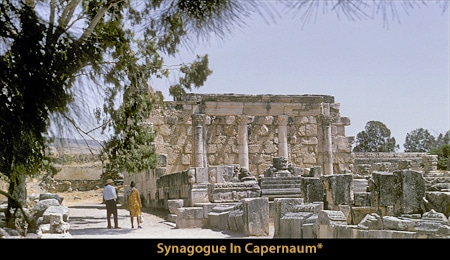
Healing At Pool of Bethesda

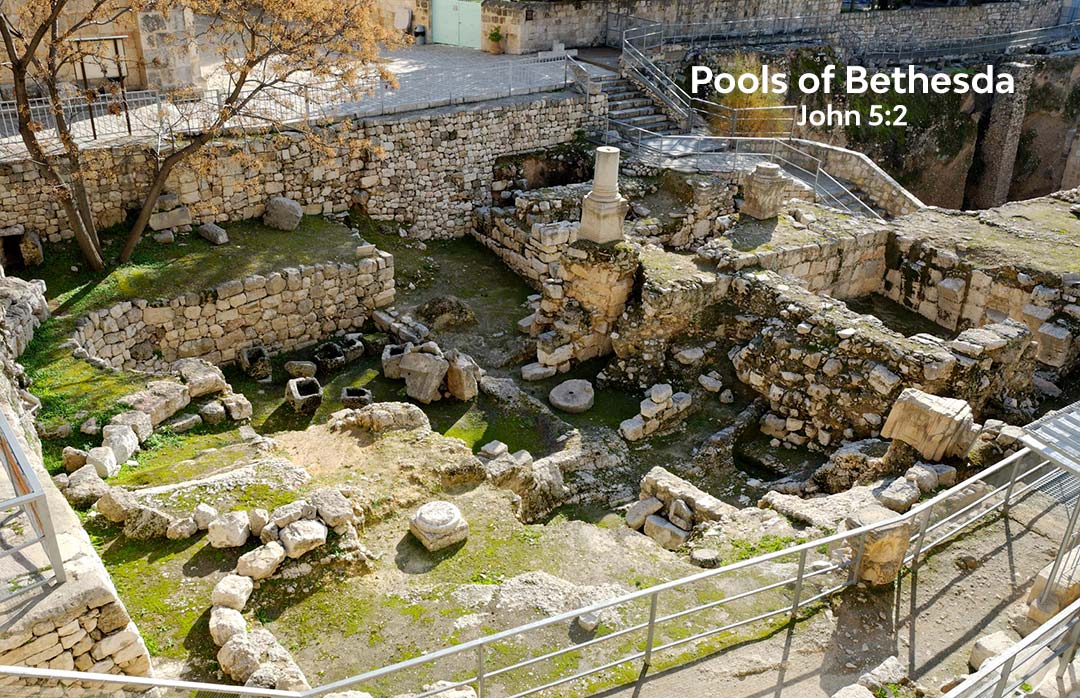
Pools of Bethesda Near St. Annes Church

During 2005 the book The Da Vinci Code climbed to the top of the New York Times bestseller’s list. The author, Dan Brown, stated on the opening page of his book that “all descriptions of artwork, architecture, documents, and secret rituals in this novel are accurate.” However, Ben Witherington III responded in his book The Gospel Code, “Our concern isn’t so much with Brown’s ability to describe art or architecture accurately . . . but with his handling of ancient documents and his treatment of early Christian history. In these realms he is . . . a purveyor of errors of both fact and interpretation, including some mistakes that even the amateur student of religious history should never make” (p. 16). In short, Dan Brown presented a number of significant errors as if they were fact. One of those errors is that the earliest historical documents never claimed that Jesus was God until the Council of Nicaea. Mr. Brown stated that Jesus was only a great man or a prophet (pp. 231-234). Mr. Brown has claimed to be a Christian, a follower of Jesus, and yet he is not aware of what Jesus declared about Himself.

Such comments are not new because even the religious leaders of Jesus’ day denied that He was God. They knew that Jesus declared He was God, but they just could not accept His statements as being true. Even though we seem to be more educated and live in technologically superior times, individuals choose to ignore what even the early doubters knew was true. We will discover in this study that Jesus did in fact declare that He was God – statements that some religious leaders have not accepted and still are unwilling to accept.

The Setting

When we come to our study in John 5:1-18, a gap in time has occurred.

After these things there was a feast of the Jews, and Jesus went up to Jerusalem.  John 5:1 (NASB)

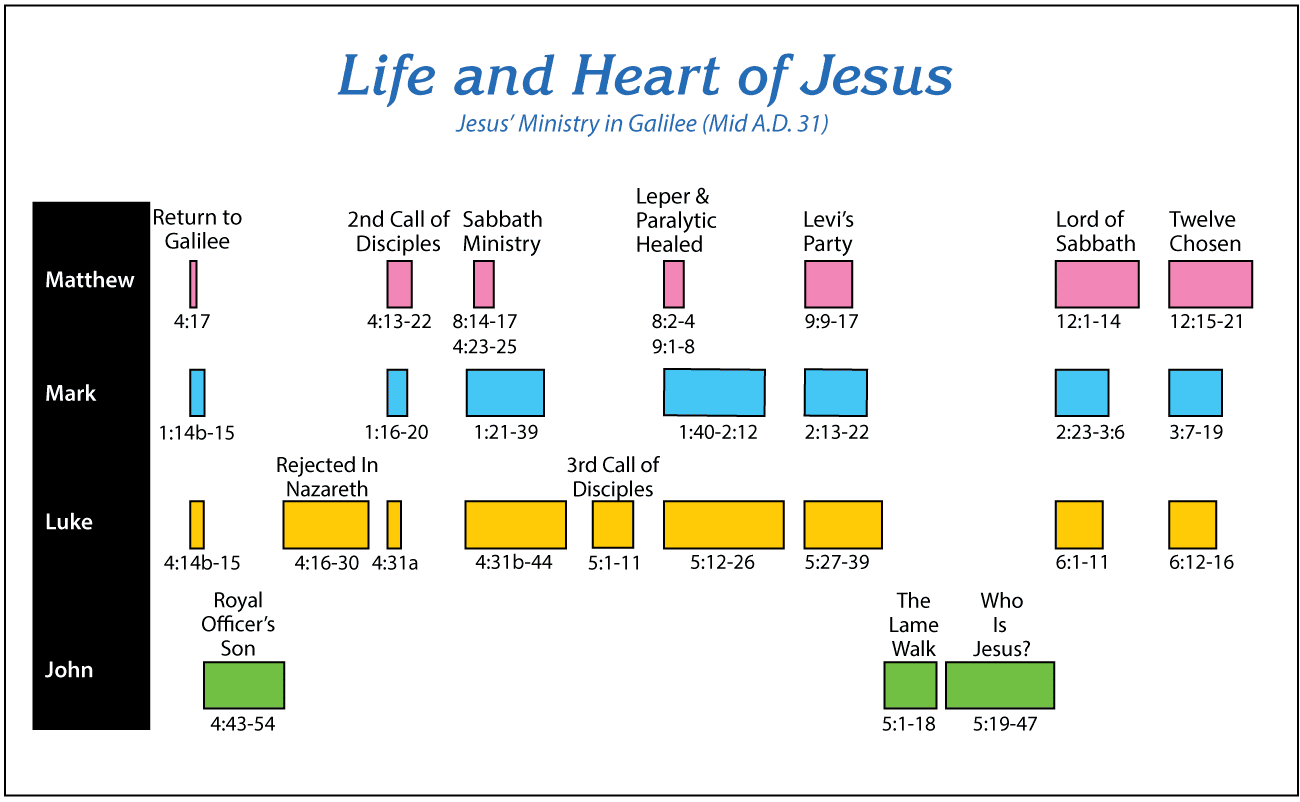
“After these things” tells us that time has passed, but we do not know how long it has been since Levi or Matthew gave his party for Jesus. Weeks or months may have passed. So the feast that John refers to is not Matthew’s party. It is the annual Passover Feast which was celebrated once a year in Jerusalem. This is the second Passover Feast that John has told us about. The first one occurred in John 2:13. This means that Jesus has been ministering for at least one year. It is very possible that Jesus has been ministering for about 1.5 years when we arrive at the events being described by the Apostle John.

We are told that Jesus “went up” to Jerusalem because the city was at a higher elevation than where He had been. He was in Galilee in our last study. When Jesus arrived in the city, it was Sunday (v. 9); and He came to a place where many who were sick, blind, lame, and withered were waiting to be healed.

Now there is in Jerusalem by the sheep gate a pool, which is called in Hebrew Bethesda, having five porticoes. In these lay a multitude of those who were sick, blind, lame, and withered . . .  John 5:2-3 (NASB)

The place was called Bethesda or “house of mercy.” It contained a pool which was located near the Sheep Gate. The pool area was covered with five porticoes. The porticoes were covered areas where the ill would lie and wait. We will discover in the following verses that they were waiting under the porticoes because they believed that a person could be healed when the pool water was “stirred” (v. 7). So when the waters were stirred, there was a race to be the first one into the water.
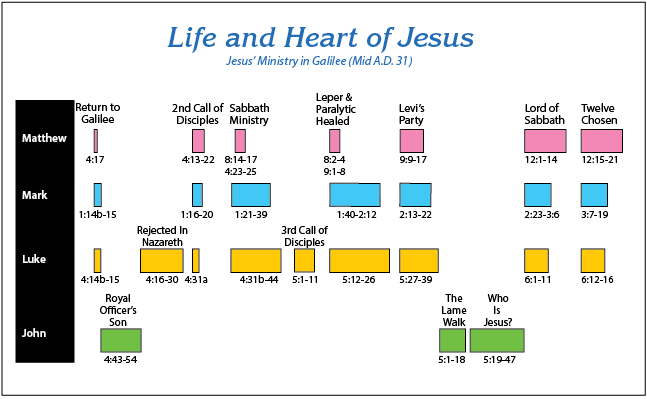
Chronology3 - Jesus' Ministry in Galilee - Mid AD 31

Passage In Doubt

Before we continue with our study, we must stop and examine the next one and one-half verses. All of the major Bible translations place the following words in brackets or indicate in some way that the words are in doubt.

. . . waiting for the moving of the waters; for an angel of the Lord went down at certain seasons into the pool and stirred up the water; whoever then first, after the stirring up of the water, stepped in was made well from whatever disease with which he was afflicted.  John 5:3-4 (NASB)

It appears that this passage might not belong in our Bibles because it has not been found in any of the ancient manuscripts before the fourth century A.D. That is, there is strong evidence that these words were inserted by someone about 300 years after the gospel of John was written in order to help us understand the passage. It was someone’s commentary about the pool. Therefore, it is highly doubtful that the words were written by the Apostle John. For anyone who is interested in a further discussion about the accuracy of our Bible and how scholars determine which words and verses belong in the Bible, you might be interested in the study called “How Accurate Is The Bible?” Now back to our study.

The Man Could Not Walk

When Jesus arrived at Bethesda, He saw many people, yet He went over to only one man – a man who could not walk. He apparently went to the most helpless of them all.

A man was there who had been ill for thirty-eight years. When Jesus saw him lying there, and knew that he had already been a long time in that condition, He said to him, “Do you wish to get well?” The sick man answered Him, “Sir, I have no man to put me into the pool when the water is stirred up, but while I am coming, another steps down before me.”  John 5:5-7 (NASB)

The man had been in this condition for 38 years. When Jesus finally stood next to him, the man was asked if he would like to get well. Jesus’ question was a strange one. Of course, the man wanted to get well. He had been waiting there at the pool for a long time with the goal of getting well. So why did Jesus word His question the way He did? Why did Jesus ask him if he wanted to get well?

The man’s reply to Jesus gives us the answer to our question. The man explained that every time the water was “stirred up,” he was not able to get into the water in time. Each time there was a race to be the first one into the pool. It was one person against another. Each time it had been a race, and each time he had lost. He must have been very discouraged, and by now he was very determined to be the next one in.

If you had lost each time, what would you be doing if you had been that man? Would you be looking around? Would you be talking with others or reading? Or, would you have had your eyes fixed on the pool and looking for the next time it stirred? If I had been that man, I would have been watching the pool all the time and as soon as the water was “stirred up” I would have tried to be the first one in the water. I would have also been as close as I could be to the pool. I think that is exactly what this man was doing. He was as close as he could be to the pool. His eyes were fixed on the water; Jesus was standing there, but the man did not realize that the one who could heal him was asking him a question. It appears that the question was asked to get the man’s attention off of the pool and onto Jesus.

The lame man was so busy focusing on his own problem that He missed Jesus – the one who could help him. Most of us, including the author, are just like this man. We become so focused on our problem and our own approach to solving the problem that we get our eyes off of God. We might pray, but God is really our back-up plan. In our pursuit to solve our situation, Jesus sometimes becomes our second option, our security blanket. In these situations, our eyes can become focused on the “pool” while we ignore the One who is standing next to us, until we hear the words, “Do you wish to get well?”

For some of us “pool of water” is problems at home and we focus on them. So we look to Ann Landers, Dr. Laura Schlesinger, or some secular book, or to psychologists for advice and we miss the Words of Life (the Bible) written by the Counselor of counselors. For some of us the “pool of water” is a problem with church leaders or with a pastor and we have forgotten that the Shepherd of shepherds is standing there offering guidance. It is easy to complain about a job situation and forget that God is our ultimate employer. It is He who gave us the job. It is He who really gives us the promotion. It is He who really gives us the pay increase. And it is easy to fix our attention on doctors and become demanding that they heal us, and we sometimes miss the fact that the Healer of healers will select us out of the multitude who are by the pool and will walk up to us when He is ready and ask, “Do you wish to get well?” All God wants is our focus to be on Him and not the pool.
Pools of Bethesda Asclepium

Get Up

Jesus’ reply to the man’s complaint was simple and quick, “Get up!”

Jesus said to him, “Get up, pick up your pallet and walk.” Immediately the man became well, and picked up his pallet and began to walk. John 5:8-9a (NASB)

Get up and walk! Jesus’ command was easy to understand. There were no more questions, no conversation – just a command, “Get up!” Immediately, the man stood up, picked up his pallet, and walked!

When God heals, He heals. When God fixes a problem in the church, at work, or in our soul, He fixes the problem. He knows the right solution. He knows what is best for us. He has given us the answers in His book – the Bible. 2 Timothy 3:16-17 tells us that the Bible has given us everything that we need to know for our spiritual life.

All Scripture is inspired by God and profitable for teaching, for reproof, for correction, for training in righteousness; so that the man of God may be adequate, equipped for every good work.  2 Timothy 3:16-17 (NASB)

The answers are found there.

Our Rules Were Broken

Jesus had healed this man, and the Jewish religious leaders were not happy that Jesus had healed this man on a Sabbath day.

Now it was the Sabbath on that day. So the Jews were saying to the man who was cured, “It is the Sabbath, and it is not permissible for you to carry your pallet.” But he answered them, “He who made me well was the one who said to me, ‘Pick up your pallet and walk.'” They asked him, “Who is the man who said to you, ‘Pick up your pallet and walk’?” But the man who was healed did not know who it was, for Jesus had slipped away while there was a crowd in that place. John 5:9b-13 (NASB)

At first the religious leaders challenged the man about carrying his pallet. When the man explained that the one who had healed him told him to carry his pallet, the religious leaders were upset with the unknown healer. Most likely they suspected that it was Jesus. The religious leaders were heartless. They did not rejoice that the man had been healed. They were only interested in the fact that someone had told the man to carry his pallet on a Sabbath. Who cares that he was healed!

Why did they react this way? The answer is found in their wrong interpretation of Exodus 20:10 where God had commanded them not to work on the Sabbath day. For centuries the Jews had correctly understood God’s command about working on the Sabbath as Nehemiah 13 proves. In that passage Nehemiah said this,

In those days I saw in Judah some who were treading wine presses on the sabbath, and bringing in sacks of grain and loading them on donkeys, as well as wine, grapes, figs and all kinds of loads, and they brought them into Jerusalem on the sabbath day. So I admonished them on the day they sold food. Also men of Tyre were living there who imported fish and all kinds of merchandise, and sold them to the sons of Judah on the sabbath, even in Jerusalem. Then I reprimanded the nobles of Judah and said to them, “What is this evil thing you are doing, by profaning the sabbath day?” Nehemiah 13:15-17 (NASB)

That was the type of work that God had encouraged them not to do. But the Pharisees missed the point and established hundreds of detailed rules. The Mishnah, their oral law, catalogues many rules that every Jew was to keep. Some of the rules said that a woman could not place a pin on her dress or wear jewelry because that would be work. She would be carrying something. A woman could not look in a mirror because she might be tempted to remove a gray hair and that would be work. A man could not wear wooden shoes with nails or phylacteries, or scrap his shoes. If a person’s false teeth fell out, no one could put them back in because that would be work. This is just a sampling of their list of rules. They had missed the point that Nehemiah well understood.

They were imposing rules that God had not imposed and had violated God’s law of love and compassion. God’s laws are designed for our good. It is like a father establishing rules for his children.

Sickness And Sin

After the man and the religious leaders had finished their discussion, the man left them and found Jesus.

Afterward Jesus found him in the temple and said to him, “Behold, you have become well; do not sin anymore, so that nothing worse happens to you.” The man went away, and told the Jews that it was Jesus who had made him well. John 5:14-15 (NASB)

It is important to notice the warning that Jesus gave this man, “. . . do not sin anymore, so that nothing worse happens to you.” This is a reminder that sometimes we are sick because we have sinned. If God heals us but we have not learned our spiritual lesson, another illness may come along later which is much worse. This is an important lesson for us. “Go and sin no more!”

After the man discovered that Jesus had healed him, he returned to the religious leaders and informed them that Jesus had healed him. It is unbelievable that this man did this to Jesus. Surely, the man knew why the religious leaders wanted to know who had told him to pick up his pallet. But the man reported on Jesus anyway. What a thankless heart from one who could now walk after 38 years!

As a result, the Jewish leaders started persecuting Jesus.

For this reason the Jews were persecuting Jesus, because He was doing these things on the Sabbath. John 5:16 (NASB)

This form of persecution was not physical but verbal persecution. This is a great reminder that many followers of Jesus have been persecuted – not just martyrs. Christians today are increasingly being persecuted around the world. The Pharisees were angry that Jesus had been healing on the Sabbath, eating on the Sabbath, and now was encouraging others to violate their Sabbath laws.

I Am God

In their anger the Jewish leaders searched for Jesus, found Him, and confronted Him.

But He answered them, “My Father is working until now, and I Myself am working.” For this reason therefore the Jews were seeking all the more to kill Him, because He not only was breaking the Sabbath, but also was calling God His own Father, making Himself equal with God.  John 5:17-18 (NASB)

It appears from Jesus’ response that they might have commanded Jesus to stop performing miracles and teaching because Jesus tells them that He is working just like the Father is working. Jesus was not going to stop.

Jesus was also telling them that He was God and they knew it. They understood Jesus’ words to mean exactly that – Jesus was God. So it is not surprising that these religious leaders wanted to kill Him. They did not like what He taught or did, He refused to stop, and now He declared that He was God. They must have been furious with rage.

Conclusion

Today, men and women do not like what Jesus taught and did either. Some like Jesus because they do not really know what Jesus taught. But others who understand that Jesus declared that He was God believe that He went too far and just like the unbelieving Pharisees, they want to “kill” Him from the pages of books, movies, newspapers, and television. So it is not surprising that Dan Brown wrote the book the Da Vinci Code. During an interview he revealed himself when he said the following words.

I consider myself a student of many religions. The more I learn, the more questions I have. For me, the spiritual quest will be a life-long work in progress.1

Mr. Brown considers himself a student of many religions and yet claims to be a Christian. But it is not possible to be a follower of Jesus if you reject what He declared about Himself. The Jewish leaders rejected Jesus’ statements too – that He was God!


Credit Line:

*Photograph(s) used by permission of BiblePlaces.com


References:

1. http://www.readinggroupguides.com/guides3/da_vinci_code2.asp



Comments or Questions?

Sign-up to be notified about future studies?

Keep The Rules!

Life is filled with laws, regulations, guidelines, opinions, and wisdom. Some of us follow these lists of “must dos” and others ignore them and pay for it later. Few of us have any memories about our life from birth to the time that we were five years of age. Yet, we understood, “No!” Adults who remember their teenage years know that “No!” and the list of “must dos” was often considered to be disagreeable. Yet, as teenagers most of us learned the wisdom of submission in most situations. A speaker used to conduct a seminar called, “Rules for Raising Children.” After some years he became a father and changed the tile of the seminar to “Suggestions for Raising Children.” When his children became teenagers, he discontinued the seminars. Rules typically evolve from wisdom. The words, “Do not put your hand in the fire” are spoken from wisdom. Yet, there are some people who enjoy adopting rules without a concern for others. The Jewish religious leaders of Jesus’ day adopted religious rules that God did not require. They probably started doing this with the goal of protecting the people from violating any of God’s laws. In this study, we will discover that later they had become more concerned about their list of rules than the spiritual life of the people. But the major question for us is, how did Jesus react?

Patched Quilt

The Setting

We have been observing tensions growing between Jesus and the Jewish religious leaders, the Pharisees and the Sadducees, during our recent studies. The first clue came in John 3:25 and 4:1 where we discovered that they were concerned over Jesus’ growing popularity. In Luke 5:20-21 the Pharisees had challenged Jesus about the fact that He forgave the sins of a paralyzed man. They could not accept the idea that Jesus was God and as a result had the authority to forgive sins.

In our last study, Jesus had called a tax collector to follow Him. His name was Levi or Matthew. Matthew was a Jew who worked as a tax collector for the Roman government. As a result, he was hated and despised by other Jews. Yet, Jesus chose him and commanded him to follow and Matthew did. Matthew’s response was to give a party in honor of Jesus and invite his own friends. We discovered in that study that Jesus’ disciples had come to the party along with tax collectors and sinners.

The Pharisees were unhappy when they saw Jesus and His disciples attending the party. So they challenged Jesus and wanted to know why He and His disciples were eating with the sinners and tax collectors. Jesus and His disciples had broken the Pharisees’ rules. According to the rabbis, good Jews were supposed to spend time with only righteous Jews. But Jesus did not conform to the Pharisees’ rules and concept of a coming Messiah. So the tensions were increasing because the conflict had started.

Question About Fasting

When we come to this study (Matthew 9:14-17; Mark 2:18-22; and Luke 5:33-39), the Pharisees and, for the first time, some of the disciples from John the Baptist challenged Jesus about another issue.

And they said to Him, “The disciples of John often fast and offer prayers, the disciples of the Pharisees also do the same, but Yours eat and drink.”  Luke 5:33 (NASB)

Chronology3 - Jesus' Ministry in Galilee - Mid AD 31

The issue was fasting. They wanted to know why Jesus and His disciples were not fasting.

It is amazing that John’s disciples had joined the Pharisees and challenged Jesus too! But it is possible that John’s disciples had been taught by John to avoid feasting and wine (Luke 7:33). John apparently was an esthetic and as a result his own disciples probably avoided feasts and the drinking of wine. Now that John was in prison, they would not have been able to get his advice and know how to respond to Jesus’ conduct. This could help explain why John’s disciples also asked Jesus the same question.

But it is not surprising that the Pharisees asked this question. The Mosaic Law taught that they were supposed to fast on the day of Yom Kippur, the Day of Atonement (Leviticus 16:29-34). But the Pharisees had added to God’s command and required that every Jew fast on Monday and Thursday of each week.

Thursday was selected for a fast because they believed that Moses had climbed Mount Sinai on a Thursday. Monday was selected because they believed that Moses had come down the mountain on that day. Therefore according to the rabbis, every Jew was expected to fast two times each week (Luke 18:12). So it appears that Matthew’s party occurred on either a Monday or a Thursday. If this is true, then Jesus and His disciples were feasting on a day when, according to the Pharisees, they should have been fasting. If so, they were in direct violation of the Pharisees’ rules.

The rabbis had decreed that no one could eat anything larger than a date on the Day of Atonement. Also, they were to avoid such things as eating, drinking, bathing, anointing oneself, wearing sandals, and having sexual relations on fast days (Mishna Yoma 8.1).

We will discuss fasting in more detail when we come to the Sermon on the Mount, but for now we will simply say that the Jewish fast involved the avoidance of many things and not just food. They had added many days of fasting and a long list of prohibitions not required by God. When the Pharisees fasted, they also put on a gloomy face and looked shabby. That is why Jesus said this to a crowd of people during the Sermon on the Mount,

And whenever you fast, do not put on a gloomy face as the hypocrites do, for they neglect their appearance in order to be seen fasting by men. Truly I say to you, they have their reward in full. Matthew 6:16 (NASB)

Jesus’ Response

Do you ever wish that you could go back in time and experience an event in history? This is one of those occasions for me. In my mind I can imagine Jesus and His disciples feasting while the Pharisees are fasting with long gloomy faces, uncombed hair, and shabby clothes. The Pharisees must have been peeking inside Matthew’s house or watching the party from outside. They were unhappy guys. So they asked, “Why are you feasting?

Jesus’ reply to them was great.

And Jesus said to them, “You cannot make the attendants of the bridegroom fast while the bridegroom is with them, can you? But the days will come; and when the bridegroom is taken away from them, then they will fast in those days.” Luke 5:34-35 (NASB)

Jesus implied that Matthew’s party was like a Jewish wedding. Weddings were supposed to be happy times. Jewish weddings were not a time of fasting and gloom. In fact, the rabbis had decreed that the bride, the bridegroom, and the wedding guests did not have to obey any religious observances because it was supposed to be a happy time. Wow, what does that say about their view of their religion? They as much as admitted that their religious duties were painful. The “attendants of the bridegroom,” who were the bridegroom’s groomsmen were supposed to be happy during the wedding, and the wedding did not end until the bride and bridegroom left.

Modern Day Wineskins

So Jesus implied that He was like the bridegroom and His disciples were like the groomsmen at a wedding. Therefore, how could they be unhappy while He was there? The party was not over because He was still there.

Illustrations

Jesus had replied to their criticism with a great answer. We can be confident that the Pharisees did not like His response. With this last reply, Jesus and the Pharisees had disagreed on several major issues. Jesus was breaking all of their rules. The emotions were increasing at the time that Jesus said the following,

And He was also telling them a parable: “No one tears a piece of cloth from a new garment and puts it on an old garment; otherwise he will both tear the new, and the piece from the new will not match the old.”  Luke 5:36 (NASB)

His first parable is about a patched garment. The Greek word that Jesus uses for “new garment” refers to an unmilledpiece of cloth which had not been shrunk. So if the patch had been sewed onto a garment and then repeatedly washed, the garment would eventually tear. The patch would only cause more trouble for the old garment.

Jesus’ second parable was about a wineskin.

And no one puts new wine into old wineskins; otherwise the new wine will burst the skins and it will be spilled out, and the skins will be ruined. But new wine must be put into fresh wineskins.  Luke 5:37-38 (NASB)

In Jesus’ day, wine was fermented in animal skins – wineskins. The fermentation process caused the skins to stretch and expand. If the old, dry wineskins were used again with new wine, they would expand again and eventually burst or split open. That is, the skin could not be used again.

Jesus’ message was clear to them. What He was teaching did not fit into their religion. Jesus’ teachings were like the patch or the new wine. What He was teaching and what He stood for would “rip” and “burst” their religion. The Pharisees had expanded God’s law by adding their own rules and regulations. Jesus had come to restore God’s law and not to destroy it. The religious leaders were destroying God’s law. Jesus would radically change their religion.

We are told that the rabbis had put “a hedge about the law” in order to protect every Jew from violating the law. That is, they had added rules and regulations in order to prevent God’s law from actually being violated. That sounds like they had good motives in the beginning, and maybe they did. But in the end their old garment had holes and their old wineskin had no future. Jesus’ parables about the garment and wineskin allow us to understand something about Him.

Conclusion

When Jesus entered the world on that first Christmas day, the religious practices of Judaism needed to be replaced. The Pharisees and Sadducees had distorted and corrupted God’s law. They had imposed rules upon the people that God did not require. They ignored God’s heart and pursued their own desires.

When the religious leaders saw Jesus repeatedly ignoring their “standards of righteousness,” they eventually became angry with Him. Their different views of faith and practice did not mix. The Pharisees wanted Jesus to change His views. It was okay for Jesus to teach, heal, and do some wonderful things just as long as He obeyed their rules and complied with their teaching.

It is not unusual to find some in the church and many outside the church who do not care about God’s view – what He spoke to us in the Bible. Some years ago, a chairman in a large church announced that certain teachings of the New Testament did not apply today. He made this statement because he did not like a teaching of the Apostle Paul. Everyone else disagreed with him, but he did not care. In short, he ignored the Word of God in order to accommodate his own viewpoint. He changed the meaning of scripture because he disagreed with it.

A young pastor once strongly argued with a group of church leaders about a doctrinal view and eventually persuaded them to change their view and agree with him. Several years later it was discovered that the young man did not really believe what he had argued for. It is common for men and women to use the Bible to win arguments and yet not believe what they are proclaiming.

There are many who use the Bible to support their philosophical, political, or ethical viewpoints. If we believe that the Bible is the Word of God – the words that God has communicated to us, then the goal should be to discover what God has said and not what we want it to say.

The Pharisees and some today are not interested in what God has said. They are more interested in making the Bible say what they want it to say than in what God said. But when Jesus came, He came speaking the truth because Jesus was the Light of men.

In Him was life, and the life was the light of men. John 1:4 (NASB)

He came correcting their false teachings. He came to set us free from sin, to teach us about Himself, to help us identify false religion and false religious practices, and to give us eternal life. Jesus did all of this. God came to give us the truth and not a distorted view.

When we come to the Bible, we need to search it carefully. We need to look carefully, investigating the meaning of the words in the original language in which it was written in order to discover what God has said. When we come to the Bible we should not be seeking support for some philosophical, political, ethical, or religious viewpoint. Otherwise, we are just like the Pharisees. Jesus is the way, the truth, and the life.

Jesus said to him, “I am the way, and the truth, and the life; no one comes to the Father but through Me. John 14:6 (NASB)

We will discover the way, truth, and the life in the studies to come. Our views about the Word of God do not count unless they agree with what the God of the Bible has said. May the Lord bless us as we seek to know His truth.


Comments or Questions?

Sign-up to be notified about future studies?

Call of Matthew

A young man once told me that he was a Christian, and then added that he was disappointed with God. So I asked him why he was unhappy and disappointed with God. He said that he thought God would make him rich like the man who had explained Jesus to him. I attempted to help him understand that God did not make all Christians rich. A person who seeks for and believes in Jesus is usually more interested in having their sins forgiven than in getting rich. The young man was seeking God for the wrong reason. Many remember the very rich man who asked Jesus, “What shall I do to inherit eternal life?” Jesus answered by telling him to go sell everything that he had. Some believe rich people need to give their money away to others. Do you like rich people? While most people would like to have the money of the rich, it is common to hear negative comments about the wealthy. What is God’s attitude toward those who are wealthy? We will discover the answer to that question in this study.

Levi, Son of Alphaeus

In our recent studies, we have seen Jesus free a man from demon possession, heal a nobleman’s son, heal Peter’s mother-in-law, heal many people in Capernaum, heal a leper, and in our last study heal a paralyzed man. Jesus has healed men, women, and children from poor and rich families, and those who are the “common people” as well as nobles. Jesus has not refused anyone. He has had compassion on all.

Jesus has also called four men to follow Him. Their names were Peter, Andrew, James, and John. He had to call them three times before they would finally understand what it means to follow Him, and then completely commit themselves. They were from the middle class of the Jewish society. Jesus ministered to everyone and called ordinary people to be his followers.

When we come to this study, which is found in Mark 2:13-22; Matthew 9:9-17 and Luke 5:27-39, we discover that Jesus was teaching people while He walked along the seashore of the Sea of Galilee.

And He went out again by the seashore; and all the people were coming to Him, and He was teaching them. As He passed by, He saw Levi the son of Alphaeus sitting in the tax booth, and He said to him, “Follow Me!” And he got up and followed Him.  Mark 2:13-14 (NASB)

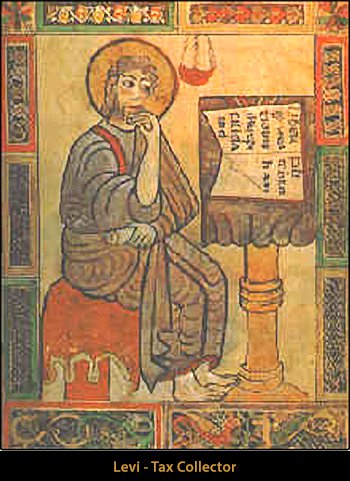
Both Mark and Luke call him Levi; only the gospel of Matthew calls him Matthew. Why would Matthew call him Matthew? The answer is that he chose to use his own name, Matthew, and not Levi. This shows the humanness of the gospels even while God is controlling what is being written.

Levi - Tax Collector

Tax Collectors

It appears that Jesus was looking for Levi all along when He finds him in a tax booth. The tax booth was not a shaky four-sided wood frame with large openings on each side. History tells us that the tax booth stood high above the ground. It was more like a life-guard station on a beach designed to help the tax collector see boats and people coming and going. The tax collector could then approach the individual or individuals and collect taxes. The tax booth was located along a major commercial trade route which connected Damascus and the Mediterranean Sea.

Chronology3 - Jesus' Ministry in Galilee - Mid AD 31

The Roman tax system was divided into districts. Each district was required to collect the assigned tax imposed by Rome. This tax booth was located in a region ruled by Herod Antipas, Tetrarch of Galilee. This means that Levi or Matthew was an employee of Herod Antipas. The Roman system allowed individuals to bid for the right to collect taxes. The highest bidder won the right to collect taxes. Luke 19:2 tells us that Zaccheus was a chief tax collector. That is, he must have been a high bidder for his area. In turn, he could then employ others to help him collect his promised taxes.

Two types of taxes were collected: fixed and duties or tolls. The fixed taxes were ten percent for food products such as oil, grain, and wine, as well as a one percent income tax. The duties and tolls included taxes for use of the roads, docking boats at the harbor, import and export taxes, and sales taxes. There was also a cart tax. The cart tax depended upon the number of wheels and the type of wheels used on the cart. There was no limit to the amount of money the chief tax collector or his employees could actually collect. Rome did not care how much the tax collector actually collected as long as he fulfilled his promise. If they collected more than the required bid, then they could keep the excess.

What Did Jesus See?

Why did Jesus ask Matthew to follow? Matthew must have been a surprising choice to the other disciples. Remember that Jesus and His disciples were Jewish! Matthew would have been hated by the Jews and maybe by some of Jesus’ own disciples.

The Jewish Talmud describes tax collectors as “robbers” (Sanhedrin 25b). The Jewish Mishnah Tohorot 7:6 said that if a tax collector entered a Jewish home, it would become unclean. Gabinus, the proconsul of Syria, accused Cicero of graft in the collection of taxes. In short, tax collectors were dishonest and hated. Jewish tax collectors were despised by the Jews. They were considered to be traitors. Reportedly, they were sometimes aligned with the mob and sometimes employed “enforcers.” The gospels record that the Jews sometimes grouped them together with “swindlers, unjust, adulterers” (Luke 18:11), prostitutes (Matthew 21:32), and Gentiles (Matthew 18:17). Tax collectors were not allowed to serve as witnesses in a court because they were considered to be dishonest. They were not permitted inside the synagogues. Because of their occupation and dishonesty, they were among the richest men in society.

Why did Jesus pick Matthew? Why did Jesus pick a rich man to be His disciple? The answer is not found in Matthew’s wealth, because Luke says that he left everything.

And he left everything behind, and got up and began to follow Him. Luke 5:28 (NASB)

Matthew left the tax booth, his employees, and the money. How many of us would walk away from our jobs in order to follow Jesus? Would you? What did Jesus see in Matthew? The answer is surprising. Jesus did not see a rich tax collector. Jesus looked past his occupation and saw a man who had the heart to follow after God. He picked someone everybody else would reject. He saw a man who was teachable and would some day be a great apostle for the cause and glory for God. He saw a man who some day would die as a martyr in Ethiopia for Him.

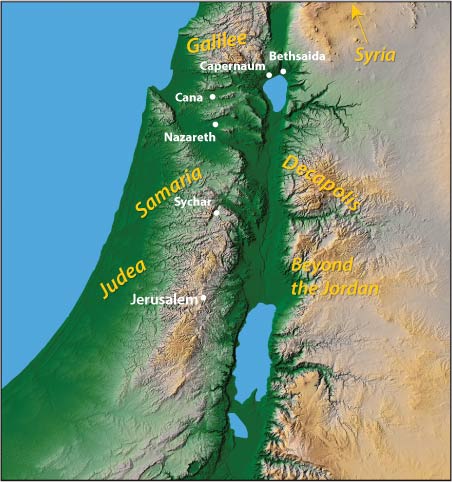
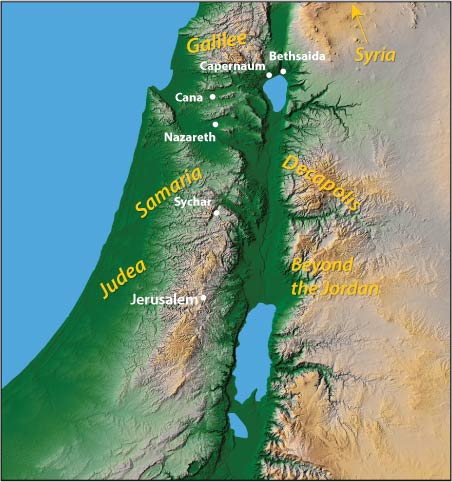
Map of Israel

This is a great reminder that God can use anyone who is willing to be used by God. That includes each one of us. But there is a key requirement – we must be willing to leave everything! The Greek word for “leave” that Luke uses actually means to abandon; that is Matthew “abandoned everything.” That is the prerequisite. Jesus knew that Matthew would do that. I suspect that Jesus had walked the shores of the Sea of Galilee many times before. I suspect that Jesus had talked with Matthew before because Matthew would have been sitting at the tax booth looking for more money. This time Jesus did not come to talk but to invite Matthew to follow. It was an invitation that Jesus knew he would respond to, and he did.

The Seeker Party

Matthew responded by holding an expensive party.

And it happened that He was reclining at the table in his house, and many tax collectors and sinners were dining with Jesus and His disciples; for there were many of them, and they were following Him.  Mark 2:15 (NASB)

The Greek word for “reception” that Luke uses (Luke 5:29) reveals that this was a huge feast and a very expensive one. Apparently, Matthew had invited his other friends: tax collectors and sinners. Maybe they were the only ones who would spend time with him, since the Jews would have nothing to do with tax collectors. Jesus and His disciples were also there. We are told in Matthew, Mark, and Luke that they reclined at the table. It would be like lying down on a sofa on your side while eating. This was a great party for all of his friends.

But why did Matthew have a party? Luke provides the answer to this nagging question when he says,

And Levi gave a big reception for Him in his house . . .  Luke 5:29 (NASB)

Matthew gave the big party for Jesus! It was a party to introduce his friends to Jesus.

Recently, my wife and I went to a local restaurant for dinner. After we had finished our meal and were walking out, a friend waved at us from inside the restaurant. I noticed that she was sitting with a group of women whom I did not know. I greeted this dear woman and asked her about the women at the table. She quickly whispered to me that they were women who lived near her home. They were neighbors. They were having dinner together and she was using this as an opportunity to build relationships. Her goal was to eventually introduce them to Jesus.

This appears to be what Matthew was doing. Matthew wanted his friends to believe in Jesus too! What better way than to hold a party and invite your non-believing neighbors.

The Uninvited Guests

But there were some uninvited guests standing outside who objected – the scribes.

When the scribes of the Pharisees saw that He was eating with the sinners and tax collectors, they said to His disciples, “Why is He eating and drinking with tax collectors and sinners?” Mark 2:16 (NASB)

The scribes of the Pharisees would be like seminary students today. The Pharisees were strict adherents to the Jewish faith who upheld the purity of the Jewish faith and life. They had adopted extra religious rules and regulations designed to prevent every faithful Jew from violating the law of God. They called these extra religious rules and regulations “a hedge about the law.” However, their extra rules violated God’s law and were great burdens on the backs of the people.

God wants you to . . .

Luke 5:30 tells us that the scribes of the Pharisees were “grumbling” because Jesus was eating with the tax collectors and “sinners.” The Greek word for grumbling is EGOGGUZON and was used to refer to “cooing birds.” The word is also in the imperfect tense which tells us that these scribes were continuously talking and complaining to one another about Jesus’ conduct. Finally, someone asked Jesus why He was eating and drinking with tax collectors and sinners.

And hearing this, Jesus said to them, “It is not those who are healthy who need a physician, but those who are sick; I did not come to call the righteous, but sinners.” Mark 2:17 (NASB)

Jesus told them that those who are well do not need a doctor. Only those who are sick really need one. Men and women are not any different today. There are those today who do not know that they are spiritually sick. Many of the Jewish religious leaders considered themselves to be spiritually well. Jesus’ message is clear. He did not come for them because they would not accept His message. He came for those who would respond.

The scribes did not care about the spiritual condition of the men and women at Matthew’s party, but Jesus did. Matthew adds these words to the end of his record,

But go and learn what this means: “I DESIRE COMPASSION, AND NOT SACRIFICE,” for I did not come to call the righteous, but sinners. Matthew 9:13 (NASB)

These were words spoken by Jesus.

Conclusion

Jesus quoted Hosea 6:6. Hosea had written the words, “I desire compassion, and not sacrifice,” to a nation whose heart had grown cold and indifferent to others. The prophet Hosea had rebuked the Jewish nation, and in turn Jesus rebuked the religious leaders. Jesus also rebuked some of His followers who had never reached out to their friends and neighbors.

Jesus loves rich men and women just as much as poor men and women, and everyone in between. Jesus loves the tax collector and sinners in our neighborhood and those downtown on the street. Jesus loves those who do not believe the Bible, and those who do.

Is there someone in your life whom you do not love? Is there someone who has offended you? God wants you to love them just as Jesus loved the tax collector and sinners of His day. If there is someone you are struggling with, you start turning things around by confessing your sins to God first. Then thank Him for forgiving you. Then if that person knows that there is an issue between the two of you, go to that person and make things right.

If there are people in your neighborhood or friends whom you have not told about Jesus, then invite them for dinner or do something and plan a strategy for sharing Jesus with them.

God wants you to love even the tax collectors in your life!


Comments or Questions?

Sign-up to be notified about future studies?

The Paralyzed Man

A friend once told me that he believed people became sick because they had committed a sin. He believed that the Apostle Paul’s “thorn in the flesh” in 2 Corinthians 12:7 was due to some sin that the apostle had committed. He also believed that the Old Testament saint Job was ill because he had sinned. He did not know how to respond when I told him that God had said Job had been “a blameless and upright man fearing God and turning away from evil” (Job 2:3). This comment reveals the fact that Job’s problems and illness were not due to personal sin. God had allowed these trials to cause Job to spiritually grow. Yet, some teach that all illness occurs due to sin. The Jewish leaders in Jesus’ time also believed as my friend did. Scripture teaches that sometimes we are sick because we have sinned, but not always (1 Corinthians 11:30).

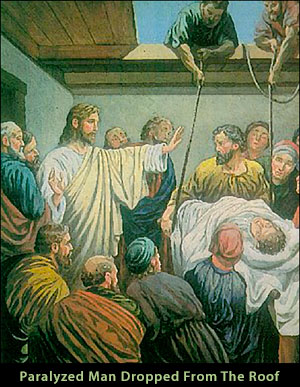
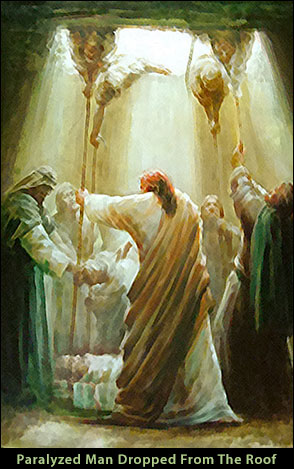
Paralyzed Man Dropped From Roof

The Start

Our last study was about a leper whom Jesus had healed. After the man was healed Jesus strongly encouraged the leper not to tell anyone, but he ignored Jesus’ request anyway. Next we are told that Jesus went into the wilderness and prayed. When we come to this study (Matthew 9:1-8; Mark 2:1-12; Luke 5:17-26), we discover that “some days” had passed when He returned home.

When He had come back to Capernaum several days afterward, it was heard that He was at home. Mark 2:1 (NASB)

Getting into a boat, Jesus crossed over the sea and came to His own city.  Matthew 9:1 (NASB)

If we combine the facts provided to us by Matthew and Mark, we discover that Jesus had returned to the city of Capernaum, His current home, by crossing the Sea of Galilee. Luke adds that crowds of people had discovered that Jesus was back home and had come to Him.

One day He was teaching; and there were some Pharisees and teachers of the law sitting there, who had come from every village of Galilee and Judea and from Jerusalem; and the power of the Lord was present for Him to perform healing.  Luke 5:17 (NASB)

The people came from the surrounding areas and among them were some religious leaders.

Why Did They Come?

Mark tells us that Jesus’ home was packed with people, like a bunch of sardines in a can.

And many were gathered together, so that there was no longer room, not even near the door; and He was speaking the word to them.  Mark 2:2 (NASB)

The home was so full that people were standing outside the door of the home. No one could get in. Could those standing outside hear Jesus? Why would people stand outside? Would you stand outside in order to hear someone teach? Many of us would leave.

Why did the religious leaders come? We suspect that they came to see if Jesus was going to teach something with which they did not agree. They were not truth seekers. They were critics.

But why did the crowd come? Both Mark and Luke say that they came to hear Jesus teach. They did not come to see His face, or to hear Him teach philosophy, mental health, astronomy, mathematics, or history. The crowd was not seeking food or water. The gospels say that they came to hear Jesus teach the Word of God.

This reminds me of the early years of a very large church in Sun Valley, California. The church was about 650 people in size and they were packing out the building they were in when they built a larger building, which today functions as a gymnasium. The building could seat about 1,000 people at one time. Within one year the church doubled in size. Then they started conducting two services and eventually put sound speakers outside so that the people could sit outside the building in order to hear the Word of God. People would come very early in order to get a seat, and those who did not come in time would sit outside in the cold and moisture. After several years, they built a larger building which is now called the Worship Center. The number of people attending the church doubled and then they started providing two services. About 10,000 people would gather on a Sunday morning, and about 20,000 attended the church. Why did they come? Why were they willing to sit outside? Several facts are true – they did not come primarily for fellowship. They did not come primarily for worship music. They did not come primarily because of the children’s ministry or the women’s ministry. The did not come in the early years because the church was large. They came to hear the Word of God. They sat outside in the cold to hear the Word of God. They wanted to hear the Word so much that they were willing to suffer.

Teaching was always Jesus’ priority! Jesus set the standard and He modeled the purpose for the church. The role of teachers and pastors is to teach the Word of God. We are to teach the scriptures in depth. We grow by in-depth teaching of scripture. That is the priority.

Chronology3 - Jesus' Ministry in Galilee - Mid AD 31

The Wonderful Team

Next we are told that some men wanted to bring their friend, a paralyzed man, before Jesus.

And some men were carrying on a bed a man who was paralyzed; and they were trying to bring him in and to set him down in front of Him. But not finding any way to bring him in because of the crowd, they went up on the roof and let him down through the tiles with his stretcher, into the middle of the crowd, in front of Jesus.  Luke 5:18-19 (NASB)

The man was lying on a bed. The Greek language reveals the man had been paralyzed for a very long time and everyone knew it. The man was not faking his paralysis. Mark 2:3 says that four men were carrying him. Apparently there was one man on each corner of the bed in order to carry him.

We are also told that the men had been trying to bring their friend inside. The Greek language is helpful once again and reveals that they had been repeatedly trying for some time. In short, these men were frustrated. They were not able to get into the house because of the crowd. Their goal was to get their friend in front of Jesus, and it was not possible. So someone had a great idea. Why not lower the man down through the ceiling of the home?

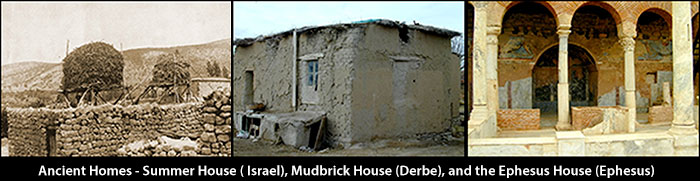
Apparently, they used the outside stairs to get the paralyzed man up on the roof of the home. Archaeology tells us that the roofs of the homes in Jesus’ day were constructed of timbers (tree poles) which were spaced about 2-3 feet (0.6 – 0.9 m) apart. Then small branches, reeds, brush, and palm fronds were laid on top of that. Next came leaves, dirt, and finally some clay which was rolled flat with stone rollers. Consequently, the roof could be removed in sections or in “tiles.” The bottom floor of the home was usually dirt or beaten clay. The second floor was usually made of wood. The doors were usually made of cloth, hides, or wood panels. The homes were commonly laid out with a courtyard in the middle or to one side.

Paralyzed Man Dropped From The Roof

Apparently, Jesus was sitting and teaching in the courtyard within the home. So when Luke says that they removed the tiles of the home, it appears that they removed a section of roof covered by clay over the courtyard. Mark 2:4 adds that they “dug” through the roof. That is, they removed the clay, dirt, and leaves in order to create a hole in the roof. Dirt and leaves must have started falling. If one of us had been there, we would have probably seen dirt and leaves falling. Jesus’ teaching would have been interrupted when the hole in the roof was created to lower their friend down through the roof in front of Jesus. All eyes would have been focused on the paralyzed man and Jesus.

Your Sins Are Forgiven

The gospel of Matthew says that Jesus told the paralyzed man, “Take courage.” The Greek word for “take courage” could also mean “Be brave.” Apparently, the man was fearful. Was he fearful because he believed that his paralysis was due to sin?

Seeing their faith, He said, “Friend, your sins are forgiven you.” Luke 5:20 (NASB)

So Jesus encouraged him by forgiving his sins. The Greek word for “forgiveness” reveals that Jesus forgave all of his past sins. Jesus forgave all of his sins. The man did not do any penitence on the ground. He did not recite the rosary or do some good deed. He was just lying there. He was paralyzed.

So why did Jesus say this to him? The answer is found in James 5:14-16.

Is anyone among you sick? Then he must call for the elders of the church and they are to pray over him, anointing him with oil in the name of the Lord; and the prayer offered in faith will restore the one who is sick, and the Lord will raise him up, and if he has committed sins, they will be forgiven him. Therefore, confess your sins to one another, and pray for one another so that you may be healed. The effective prayer of a righteous man can accomplish much. James 5:14-16 (NASB)

Here we discover that we can be sick because of some sin that we have committed. Healing comes when our sins are forgiven and the elders pray over us. Notice that the prayer of the elders must be offered in faith. The sick person is not required to have faith. If we look carefully at Luke 5:20, we discover that Jesus saw the faith of the four men and then forgave the man. Forgiveness came first, and not the healing. The healing came later.

How much faith was required? James 1:6-8 says that we must not doubt. Does that mean that we must believe that God will heal; otherwise, God will not heal? The answer is provided in the example of Shadrach, Meshach and Abed-nego in Daniel 3:13-17.

In this passage, Shadrach, Meshach and Abed-nego are ordered by Nebuchadnezzar to bow down and worship the king’s image. The three men respond by telling the king that they will not worship the image, and then add this,

Jesus did not just have authority. He was and is the authority!

If it be so, our God whom we serve is able to deliver us from the furnace of blazing fire; and He will deliver us out of your hand, O king. But even if He does not, let it be known to you, O king, that we are not going to serve your gods or worship the golden image that you have set up.  Daniel 3:17-18 (NASB)

These men did not know if God would deliver them, but they believed that God could. These three men are examples of faith, and God honored them.

The double minded man in the book of James is one who does not know if God could heal. People are healed when elders believe and the illness is due to sin. And the four men carrying the paralyzed man believed that Jesus could heal. Jesus saw their faith, forgave the man and planned to heal him. The paralyzed man was paralyzed because he had committed sin as implied in Jesus’ statement. But all paralysis is not due to personal sin.

When Jesus said, “. . . Your sins are forgiven you,” He comforted and encouraged the man. The man would have believed that his paralysis was due to sin because the religious leaders of his day taught that all sickness was due to sin. In his case, his paralysis was due to sin and Jesus forgave him, comforting him.

Jesus’ Authority

When the Pharisees heard this, they were upset.

The scribes and the Pharisees began to reason, saying, “Who is this man who speaks blasphemies? Who can forgive sins, but God alone?” But Jesus, aware of their reasonings, answered and said to them, “Why are you reasoning in your hearts? Luke 5:21-22 (NASB)

Matthew 9:4 tells us that Jesus had read their thoughts. This is proof that God can read your mind. He knows your thoughts, your wishes, and your sins. We cannot hide anything from God.

Which is easier, to say, ‘Your sins have been forgiven you,’ or to say, ‘Get up and walk’? “But, so that you may know that the Son of Man has authority on earth to forgive sins,”—He said to the paralytic —”I say to you, get up, and pick up your stretcher and go home.”  Luke 5:23-24 (NASB)

Jesus’ response is wonderful. Is it more difficult to heal a paralyzed man or to say the words, “Your sins have been forgiven you”? Then Jesus performed the more difficult task from a critic’s perspective – He healed the man. The message to the religious leaders was that Jesus had divine authority. He had authority that they did not have. They could not forgive sin, but Jesus could. The same is true today. Only God can forgive our sins. No man, priest, rabbi, pastor, or any other clergy can forgive our sins – only God. This event is all about Jesus’ authority.

Typical Jewish House

Instant Healing

When Jesus said, “. . . get up, and pick up your stretcher and go home,” the man was instantly healed.

Immediately he got up before them, and picked up what he had been lying on, and went home glorifying God. Luke 5:25 (NASB)

It was not his faith that healed him. He did not have to wait for his healing. The man stood up, picked up his bed, and went home. There is no mention of Jesus asking him questions, touching him, or receiving a holy zap. The man was just simply healed. He was healed in the sight of everyone in that home.

They were all struck with astonishment and began glorifying God; and they were filled with fear, saying, “We have seen remarkable things today.”  Luke 5:26 (NASB)

Luke tells us that the people were astonished. Mark says that they were amazed, and Matthew says that they were awestruck. All three gospels say that the people glorified God. Everyone was stunned by what had happened.

Conclusion

Sometimes when we are struggling through an illness, we often ignore the most obvious. We reach for some medicine, we call a doctor, or we complain. Sometimes complaining seems to help us feel better. But when we are down, discouraged, or “feeling blue” we should stop and ask, “What does God want me to learn?”

Sometimes we go on a fishing trip to escape or start looking for sin in our life. Not every illness is due to sin, but some of our illnesses are due to our own sin. So when we become sick, we should look at the possibility that our sickness is due to sin. Usually, we already know if this is the situation. If that is the case, we should confess our sins to God immediately (1 John 1:9). God will forgive our sins as He promised in Isaiah.

“Come now, and let us reason together,”
Says the LORD, “Though your sins are as scarlet,
They will be as white as snow;
Though they are red like crimson,
They will be like wool. Isaiah 1:18 (NASB)

If our illness persists, then we should call the elders or the leaders of our church to pray for us. If they are men of faith, then our illness will be cured as God promised in James 5:14-16.

If you have not asked God to forgive all your sins, if you have never asked God to take control of your life, then stop and tell Him that you believe in Him and ask Him to forgive all of your sins. If you are already a believer in God and you are sick, then confess any known sins and call the elders.

The greatest miracle in this passage is not the large crowd, the roof, the healing or Jesus’ compassion, but His forgiveness of sin. Only God can forgive and it is amazing that He wants to and is willing to forgive any of us. And it is wonderful that Jesus has authority to forgive your sins! God forgives sins!


Comments or Questions?

Sign-up to be notified about future studies?

Cleansing of the Leper

Leprosy is still a major disease in the year 2005. According to the Hughes Medical Center, there are 200 new cases of leprosy each year in the United States and 700,000 worldwide. India, Indonesia, Myanmar, and Brazil have the greatest number of outbreaks of leprosy. Statistically, there are 65 cases every hour. Leprosy is also called Hansen’s disease. It is a chronic, infectious disease that is caused by airborne bacteria. The disease attacks the nerves, resulting in numbness. Most of the people of the world are immune to it; but when the disease finds a home, it moves to the cooler parts of the body such as the skin, the eye, upper respiratory tract, and the genital region. The effects of the disease can be seen in photos published in text books and on the internet. There are two types of leprosy. The mildest form results in scaly and crusty skin. The worst form of the disease results in missing fingers, toes, and hands. It is an ugly disease.

The Leper Comes

This study in the Life and Heart of Jesus includes a leper – a man full of leprosy. Leprosy is not just a disease of the past. It is also a disease of the present. The poor man had the worst kind of leprosy as we will soon discover. The records of this event are found in Matthew 8:2-4; Mark 1:40-45; and Luke 5:12-16.

Before we look at the first verse, we should recall that Jesus had recently called Peter, Andrew, James, and John a third time. We were told in Luke 5:11 that these men left everything and followed Him. When we come to verse 12, time has elapsed. It appears that a lot of time has passed, because we are told that He enters “one of the cities.” We are not told which city, but it appears that Jesus had been traveling from one city to another in the “white space” in our Bible between verse 11 and 12.

While He was in one of the cities, behold, there was a man covered with leprosy; and when he saw Jesus, he fell on his face . . . Luke 5:12a (NASB)

The Greek word for leper is LEPRAS, and it means “a dread skin disease” or “a scale.” This is a very good description of the disease in its milder form. The gospel of Luke was written by a medical doctor. He tells us that this leper “was covered with leprosy.” He did not have a mild form of leprosy. He was full of leprosy from head to toe and front to back.

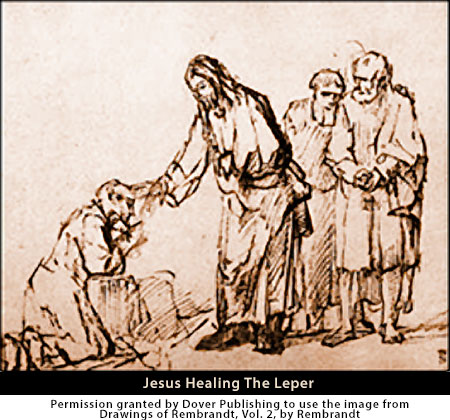
Jesus Healing The Leper

Mosaic Law

In the book of Leviticus, God gave the Israelites guidelines for controlling the disease of leprosy. God provided guidelines in Leviticus 13-14 which would help the priests identify leprosy and know how to respond if and when the man or woman was healed.

When leprosy was identified in a man or woman, he or she had to live alone (Leviticus 13:46). According to Josephus, Jewish lepers were expelled from the city (Josephus, Flavius. The Wars of the Jews 5.227). Everywhere they went they had to shout out loud, “Unclean, unclean!” (Leviticus 13:45). The Talmud required that a leper had to stay six feet (1.8 m) away from other people and 150 ft (45.6 m) when there was wind. According to the Mishnah, anyone who touched a leper, was near a leper, touched anything that a leper had touched, or entered his/her home was ceremonially unclean (Neusner, Jacob. The Mishnah pp. 997-1009). As a result the Jewish rabbis avoided lepers.

Chronology3 - Jesus' Ministry in Galilee - Mid AD 31

It must have been a lonely and a very emotionally painful life for a leper. Imagine the pain that would have occurred when a father or a daughter became a leper and was excluded from the city. How would you feel if you were a leper? How did parents, a wife, or the children feel when they had to talk to a family member six feet way? Also, it must have been difficult to buy goods from another person. The person selling the merchandise would need to drop the item on the ground and then step away before the leper could go and pick it up. If there was a disagreement or a crime committed against a leper, did the local policemen ignore them for fear of being defiled?

This reminds me of the time that I visited a person in an Intensive Care Unit (ICU) and I was told to put on a face mask, gown, and blue gloves. The coverings were for my protection as well as for the protection of the patient. With another patient, I had to wear a gown and gloves. Then before I left, I had to wash my hands with anti-bacterial soap. God implemented the guidelines in order to protect the leper and those around him/her. But the religious leaders – the rabbis – added to the Word of God and made the life of a leper more difficult.

Jesus’ Response

The gospel of Mark tells us that when the man saw Jesus, he fell to his knees. Matthew says that he bowed down. Luke pulled it all together and stated that the man ended up with his face to the ground. The man fell to his knees and bowed down with his face to the ground. Then he said, “If You are willing, You can make me clean.”

. . . and when he saw Jesus, he fell on his face and implored Him, saying, “Lord, if You are willing, You can make me clean.”  Luke 5:12b (NASB)

How did Jesus feel towards this human being that the rabbis would not go near? The Holy Spirit tells us in the gospel of Mark.

Moved with compassion, Jesus stretched out His hand . . .  Mark 1:41 (NASB)

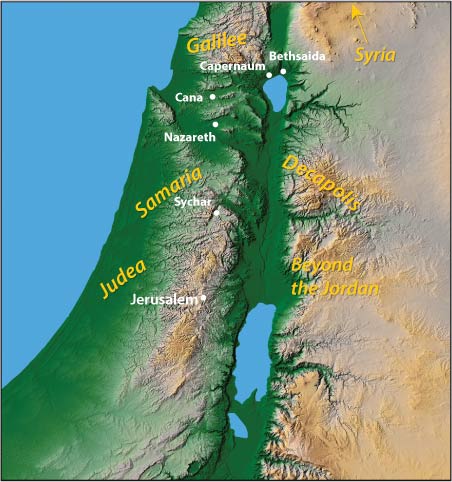
Map of Israel

Jesus was moved with compassion. Jesus did not move away as the rabbis would have. He probably moved closer. When the leper said,

Lord, if You are willing, You can make me clean.

He used an important Greek word for “will.” There are two basic Greek words for “will.” The first one has the sense of a rational decision, but the second one has the sense of an “emotional choice.” This last one is the word that the leper used. He appealed to Jesus’ emotions. He appealed to Jesus’ passion, and Jesus responded with emotion.

Matthew, Mark, and Luke tell us that Jesus stretched out His hand and as He touched him said, “I am willing.”

And He stretched out His hand and touched him, saying, “I am willing; be cleansed.” And immediately the leprosy left him. Luke 5:13 (NASB)

Immediately, the leprosy left him. He was instantly healed. He did not need to wait for his healing. He was not in the process of being healed. He was healed!

Do Not Tell

Jesus then commanded the healed man not to tell anyone except for the priest. Jesus knew that he had to go to the priest in order to be pronounced cured and be allowed back in the city according to the Mosaic Law (Lev. 13-14).

And He sternly warned him and immediately sent him away . . . Mark 1:43 (NASB)

And He ordered him to tell no one, “But go and show yourself to the priest and make an offering for your cleansing, just as Moses commanded, as a testimony to them.” Luke 5:14 (NASB)

Before the man left, Jesus sternly warned him not to tell others about his healing. The Greek word for “sternly” is a strong one and implies that Jesus spoke very strongly to him. Jesus did not want this miracle healing to be known among the population, but the healed man told others anyway.

But the news about Him was spreading even farther, and large crowds were gathering to hear Him and to be healed of their sicknesses. Luke 5:15 (NASB)

The healed man eagerly told his story and like lightening the wonderful news spread. Large crowds came to listen to the Word of God and to be healed. Have you noticed that the people came first to hear the Word of God and then to be healed? This is a pattern that we are seeing. The Word of God is the priority, not fellowship and not singing. Fellowship and singing to God are important, but they are not the priority. Every time Jesus meets the crowds, He teaches first and heals second. It is a message for us. The Word of God is the priority. It is amazing how many churches devote only thirty minutes or less to the teaching of His Word today. Forty-five to sixty minutes used to be the standard. It reveals that the commitment to teaching His Word in many churches has been watered down. Jesus’ priority was the teaching.

But notice that Jesus’ ultimate priority was prayer.

But Jesus Himself would often slip away to the wilderness and pray. Luke 5:16 (NASB)

Even Jesus had to escape in order to pray. Have you ever noticed how “things” get in the way and crowd out your prayer life? Jesus would slip away. He would escape in order to pray. It is a great pattern for us to follow.

Today, Jesus is still touching lepers - us!

Conclusion

What did the disciples learn from the One whom they were following during this event? They learned that Jesus loves those that others would reject – even lepers. They learned that Jesus would not move away from one who needed to be loved. They learned that Jesus had great compassion. They learned that He was willing to reach out and touch a pleading man whom they would avoid. Jesus touched a leper! But these disciples would not have done that. They would have pulled away just as the rabbis had taught them.

Jesus touched a leper! Jesus reached out and comforted a man who had probably not been touched for many years. Jesus touched a man who needed to know that someone loved him enough to touch him. Jesus did.

Today, Jesus is still touching lepers – us! Jesus forgives our sins. He heals us. He comforts us. He rescues us: and when our lives are over, He takes us home. We are all sinners in this life. We are just like the leper. We are in great need. Because of His great compassion, He reaches out and forgives us when we believe in Him. Jesus is in the business of touching those who are in need. He touches us too!

We will close with this poem from Jess Moody,

Have you ever taken a real trip down inside the broken heart of a friend? To feel the sob of the soul – the raw, red crucible of emotional agony? To have this become almost as much yours as that of your soul-crushed neighbor? Then, to sit down with him/her – silently weep? This is the beginning of compassion. (modified quote by Lloyd Cory, Quote Uniquote)

That is what Jesus does for each one us. He touches lepers!


Comments or Questions?

Sign-up to be notified about future studies?

Jesus Healed Many On The Sabbath

Every individual born on this planet has been uniquely designed because God is infinite, loving, and a master of variety. We see this every day of our life as we look at the world around us. For example, some people are short and others are taller. Some have dark hair and others have lighter hair. Some men are bald and others have a lot of hair even in their senior years. There are women who are great communicators and others who are quiet. There are people who are more interested in getting tasks accomplished and others who are more people-focused. That is, some of us are task oriented and some are people oriented. Those who are task oriented are more likely to ignore people in order to get a task completed. Those who are people oriented may not care if the task is completed at all. We see this every day. What type of person are you? Do you care more for people or more about getting the task done? What was Jesus like? Did He care more for people or more about tasks? This study will explore this question as we take a peek at Jesus’ heart and life.

Background

Two studies ago, Jesus had told Peter, Andrew, James, and John that if they would follow Him, He would make them fishers for the souls of men and women. We watched them respond and follow Him. Our last study started on the morning of a Jewish Sabbath day (Mark 1:21-28 and Luke 4:31-37). Peter, Andrew, James, and John continued following Jesus and went to the synagogue in Capernaum with Him. Most likely they thought that they had come to worship, but they did not realize what else was going to happen.

On that Sabbath morning, Jesus taught in the synagogue and at the conclusion of His message a demon-possessed man shouted, “Leave us alone . . . Holy One of God!” Jesus responded by rescuing the man from the demon. The people in the synagogue were astonished because they had never heard anyone speak with such great authority or display such tremendous power. Jesus not only was dynamic and spoke with authority, but He was also in control of the demons. The people had seen the power of God displayed, but they did not realize it. Just like most people who attend a sensational church service, they talked about their Sabbath morning experience with others whom they met as they walked home. As a result, the news about Jesus’ authority and power spread like a wild fire into all the surrounding district of Galilee.

Homes in Ancient Times

Peter’s House

When we come to this study (Mark 1:29-39; Luke 4:38-44), we are going to see what occurred during the rest of the Sabbath day. Our first verse tells us the service at the synagogue is over. The people along with Jesus and the four disciples have left the synagogue.

And immediately after they came out of the synagogue, they came into the house of Simon and Andrew, with James and John. Mark 1:29 (NASB)

After having taught and experienced the encounter with the demon possessed man that morning, Jesus must have been very tired. Most preachers and Sunday School teachers need some rest or at least some time alone after Sunday morning in order to recover their energy, but Jesus did not get this opportunity. After leaving the synagogue, Jesus and the four disciples walked to Peter’s home. We do not know what type of home Peter had, but it must have been large enough for a group of men and Peter’s family.

Now Simon’s mother-in-law was lying sick with a fever; and immediately they spoke to Jesus about her. Mark 1:30 (NASB)

When Jesus arrived at Peter’s home, He discovered that Peter’s mother-in-law was very sick. Have you ever wondered if the disciples had wives and children, since nothing has been said about them in the gospels so far? The answer is found in this passage, because we are told here that Peter had a mother-in-law, and if he had a mother-in-law then he had a wife. 1 Corinthians 9:5 confirms that this was true. So the house was filled with at least seven adults and probably a group of children.

Next, we are told that Jesus was asked by all four disciples to help her, not just by Peter. I wonder if Jesus wanted a break for at least a few minutes? How could He refuse the requests of all four disciples? Or, did He willingly want to help her? How would you have responded? Was Jesus task or people oriented?

The gospel of Luke records the same event and adds an additional detail about the mother-in-law’s health. Since Luke was a medical doctor, he uses precise medical terms on occasions. On this occasion he uses a Greek word that reveals she was suffering from a chronic, high fever. That is, she had had this fever for a long time. Peter’s mother-in-law was very sick and in great need.

The Healing

What did Jesus do? He responded to her need and healed her. For the first time in our series through the Life and Heart of Jesus, Matthew, Mark, and Luke each provide a number of additional details that the others do not include. These authors either obtained their information from someone who was there or the Holy Spirit miraculously provided it. Since God supernaturally wrote scripture through men and since He does not lie, we know that all of the accounts are accurate.

He touched her hand, and the fever left her; and she got up and waited on Him. Matthew 8:15 (NASB)

And He came to her and raised her up, taking her by the hand, and the fever left her, and she waited on them. Mark 1:31 (NASB)

And standing over her, He rebuked the fever, and it left her; and she immediately got up and waited on them. Luke 4:39 (NASB)

If we take all of these accounts and put them together, this is what happened. Jesus walked over to her and stopped. He reached down, touched her hand, and held it. Then He rebuked the fever and it left her. Immediately, she got up and waited on them. Now that is a miracle healing, just like the demon-possessed man earlier in the synagogue. She was instantly healed. She did not need to claim her healing, wait for her healing, or exercise faith to be healed. Jesus touched her and she was healed. Who had great faith? Not that mother-in-law and not anyone else. Notice that nothing is stated in this passage about the mother-in-law needing faith nor was anything said about the man who was rescued from the demon needing faith. Faith was not an issue in either miracle. Jesus’ power was not limited by her faith and He is not limited today by faith, either. Praise the Lord!

Things To Consider

What happened after that? What did they say to Jesus? Were they thankful? Did they eat a meal? What did they do? It is amazing that the gospels give us just bare facts. There is no embellishment. There is nothing fanciful in the accounts. None of the gospels add anything else. The gospel records move quickly from one significant event to another, leaving out vast quantities of details in Jesus’ life. The gospels are recording only key historical events.

What did the disciples think about their Sabbath day? Jesus had called them to follow Him, and so they did. They were in the spiritual training camp of Jesus Christ that day. They were His disciples. He was their master teacher. What did Jesus want them to learn from this experience? What do you think they learned from hearing and watching Jesus?

What did they talk about that afternoon? Did they ask Jesus about His morning message, or the demon-possessed man? What was the lesson Jesus wanted them to learn, or was it just an afternoon focused on people? What have you learned?

Definition of Sunset

The Evening

Our next verse indicates that Jesus had spent the entire day with these four men. When evening came, people started coming to Peter’s house.

When evening came, after the sun had set, they began bringing to Him all who were ill and those who were demon-possessed. Mark 1:32 (NASB)

Luke 4:40 says that people were coming while the sun was setting.

While the sun was setting, all those who had any who were sick with various diseases brought them to Him; and laying His hands on each one of them, He was healing them. Luke 4:40 (NASB)

Do Mark and Luke disagree? Were people coming when the evening came or were they coming while the sun was setting? At first, the two passages seem to be a contradiction. But, as usual, the problem is solved either by a careful review of the original language or by investigating the cultural background of Jesus’ time. A hint at the solution is even found in some English dictionaries where we find multiple definitions for “sunset.” So it should not be surprising that the Jews had multiple definitions for a sunset too!

In fact, the Jewish rabbis held to two different definitions for a sunset. The first Jewish definition says that sunset occurs when the orb of the sun completely disappears below the horizon and the sky is mostly dark. The second definition says that the sunset has occurred when the whole sky is totally dark (Talmud Shabbat 34b-35a and Talmud in Pesahim 94a). Therefore, it appears that Mark used the first definition and Luke used the second definition. That is, the people start coming when the orb of the sun was below the horizon and continued coming before the sky became completely dark.

Map of Israel

Healing Ministry

But why did the people wait until the sunset? They waited because the Jewish leaders taught that the Sabbath day ended when the sun has set. The Jews were not allowed to help anyone on the Sabbath until sunset, including those who were sick. However, the religious leaders allowed an exception for someone who was near death. Their man-made rules were more focused on laws than on loving people. The Jewish leaders were not people focused.

Since the evening had come, a great number of people were coming from the city to Peter’s house.

And the whole city had gathered at the door. Mark 1:33 (NASB)

The demon-possessed and those who were sick with various diseases were brought by friends. Some probably came on their own. We do not know the population of the city, but there could have been hundreds of sick and demon-possessed people at Peter’s door, including the sightseers. The passage says that the entire city had gathered at Peter’s home.

Jesus responded by healing each one.

And He healed many who were ill with various diseases, and cast out many demons; and He was not permitting the demons to speak, because they knew who He was. Mark 1:34 (NASB)

Demons also were coming out of many, shouting, “You are the Son of God!” But rebuking them, He would not allow them to speak, because they knew Him to be the Christ.  Luke 4:41 (NASB)

The gospel of Luke uses an imperfect tense combined with an active tense in Luke 4:40 to tell us that sick people were coming to be healed. Recently, I asked some nurses what that means. What does it mean if a person has been sick and is continuing to be sick? The answer was, “They have a chronic illness.” Did you know that Jesus was not performing fake healings? Jesus was not healing runny noses, or imaginary pains. No, He was healing people with real illnesses – real diseases. He was healing people with chronic conditions. The people who came and the people who brought them knew that their conditions were real because the conditions had been present for a long time. Peter also knew that his mother-in-law’s healing was real because she had a chronic condition, too! We should not be surprised that the disciples believed in Him, and we should not be surprised that the people were stunned with Jesus. We should not be surprised that Pontius Pilate wrote a report, which was archived in Rome, which stated that Jesus had performed miracles. The truth is, Jesus performed real healings – not fake ones. Jesus was not limited by any type of illness. He healed them all. He healed them instantly and healed them completely.

Predicted

The healing ministry of Jesus was predicted by the prophet Isaiah (Isaiah 53:4), and the gospel of Matthew reminds us of this.

This was to fulfill what was spoken through Isaiah the prophet: “HE HIMSELF TOOK OUR INFIRMITIES AND CARRIED AWAY OUR DISEASES.” Matthew 8:17 (NASB)

What Jesus had been doing and was doing should not have been a surprise to anyone. The testimony of the disciples, the response of the people to the healing of chronic diseases, the report of Pontius Pilate, and the prophecy in Isaiah 53 are all witnesses to the fact that Jesus’ healing ministry was real.

Prophecy of Isaiah 53:2-5

Do Not Speak

Jesus also rescued those who were demon-possessed. Both Mark and Luke tell us that Jesus would not allow the demons to reveal that he was God. Why did He do that? While we are not told, it appears that Jesus did not want the truth to come from demons. If Jesus had agreed that they were speaking the truth, then Jesus would have endorsed them as a source of truth. One of the early church fathers summarizes the issue very nicely with this comment,

[Jesus] has taught us never to believe the demons, even when they say what is ostensibly true. For since they love falsehood, and are most hostile to us, they never speak the truth except to deceive. They make use of the truth as a kind of bait. (Euthymius. Fragments. Ancient Christian Commentary. IVP. 1998. Vol. II, p. 22).

It appears that if Jesus had confirmed their statements as true, others would have sought out the demons as a source of truth. Jesus would not have wanted that to occur.

Early Morning

We are not told when Jesus went to sleep that night. It was probably a late evening given all of the people who came, but we are told that He awoke early in the morning, found a secluded place, and prayed.

In the early morning, while it was still dark, Jesus got up, left the house, and went away to a secluded place, and was praying there. Mark 1:35 (NASB)

Jesus had finally escaped everyone and had some peace. He had time to talk with God the Father, but eventually even this wonderful experience came to an end, when Peter and the other three disciples came looking for Him. When they found Him they said, “Everyone is looking for you!”

Simon and his companions searched for Him; they found Him, and said to Him, “Everyone is looking for You.” Mark 1:36-37 (NASB)

How did Jesus respond? How would a task-oriented person respond? Or, how about a people oriented person? How would you react after a busy Sabbath day and now having your prayer time interrupted? How did Jesus respond? The answer is found in the next verse.

He said to them, “Let us go somewhere else to the towns nearby, so that I may preach there also; for that is what I came for.” Mark 1:38 (NASB)

As a result, Jesus and the four men left Capernaum and went throughout all of Galilee.

And He went into their synagogues throughout all Galilee, preaching and casting out the demons. Mark 1:39 (NASB)

And Matthew adds,

Jesus was going throughout all Galilee, teaching in their synagogues and proclaiming the gospel of the kingdom, and healing every kind of disease and every kind of sickness among the people. The news about Him spread throughout all Syria; and they brought to Him all who were ill, those suffering with various diseases and pains, demoniacs, epileptics, paralytics; and He healed them. Large crowds followed Him from Galilee and the Decapolis and Jerusalem and Judea and from beyond the Jordan.  Matthew 4:23-25 (NASB)

Every task He performed was focused on people . . .

Conclusion

Are you surprised at Jesus’ answer and what He did? Luke tells us that after the four disciples found Jesus, the people also found Him and were holding on to Him. They did not want Him to leave. Most of us would have probably stayed and tried to minister to them in some way, but not Jesus. Are you surprised?

Most of us are out of balance when it comes to being task focused or people focused. We are either too task focused or too people focused. I know some people who are so people focused that they are unwilling to deal with a person’s sin because they believe that everything is about relationships. If that is true, then why did Jesus leave the people who were clinging to Him in Capernaum?

Jesus’ reason for leaving them was that He had been sent for another purpose. He had to go to other cities throughout Galilee. He also had a task to accomplish that was also people focused.

Some of us are too task focused, and our goal in life is to accomplish great things for God. Some of us do not know how to stop and as my wife says, “Smell the roses!” We need to love people more. Jesus did this too! He taught and healed people. He went out of His way to meet the woman at the well in Samaria. Jesus was like a waterfall, only instead of water, His love cascaded or fell down upon the people.

Jesus was both task and people oriented in perfect balance. Every task He performed was focused on people, and every person He loved motivated His tasks. He came to reach all of us, even us today. He came to preach the kingdom of God (Luke 4:43), that is, to give us the good news about Himself, and He came to die for our sins (John 12:27). Each of those tasks was “people focused” and each “task” was motivated by His love for us.

Please stop and ask God to help you love those around you. May every task you perform be focused on people, and may every person you love motivate what you do.

By this all men will know that you are My disciples, if you have love for one another. John 13:35 (NASB)

Jesus replied: “‘Love the Lord your God with all your heart and with all your soul and with all your mind.” Matthew 22:37 (NASB)


Comments or Questions?

Sign-up to be notified about future studies?

Jesus Cast Out A Demon On The Sabbath

The words that Jesus spoke in our last study are still occupying my thoughts, “Follow Me! And I will make you fishers of men.” Notice that Jesus did not start with, “I will make you fishers of men!” How often we forget that we cannot become fishers of men unless we are first following Him. Have you ever tried to go fishing with only a fishing pole, some bait, but forgot to bring along the hook that was needed to catch the fish? If we go fishing for the souls of men and women without following Jesus, we have forgotten the “hook.” We must submit ourselves to Jesus first if we want to catch the souls of men and women. Jesus is our God and the authority in every aspect of life, and we need Him!

Capernaum Synagogue from Boat

Theme of Our Study

The same theme continues into our study which is found in Mark 1:21-28 and Luke 4:31-37. In our last study we saw Jesus walking along the Sea of Galilee and eventually found Peter, Andrew, James, and John. It is these men to whom He commanded, “Follow Me!” When we come to the first verse in the Mark passage, we discover that Jesus and the four men had gone into Capernaum. On the Sabbath day they entered the synagogue. Jesus did not go alone. Jesus and His four disciples went together. Every true disciple follows the Master.

They went into Capernaum; and immediately on the Sabbath He entered the synagogue and began to teach. Mark 1:21 (NASB)

In this verse, we are reminded once again of two patterns of life that were true of Jesus. Jesus attended the synagogue on the Sabbath and He taught others.

The gospel of Luke tells us that Jesus was constantly teaching. The implication is that Jesus was teaching for a long time. In many countries around the world today there are Christians who are eager to hear the Word taught and eagerly sit for a long time in order to hear more. These folks were also eager to listen because they were amazed at what they heard.

They were amazed at His teaching; for He was teaching them as one having authority, and not as the scribes.  Mark 1:22 (NASB)

When teachers and preachers are empowered by the Holy Spirit, wonderful things began to happen – the Word of God becomes alive. This is an important truth. Today, some are teaching and/or preaching who have not been spiritually gifted by the Holy Spirit and are not spiritually growing. It is obvious because the listeners are bored. Jesus was dynamic and He spoke with authority.

The people in the Capernaum synagogue were amazed, and the people who attended the synagogue worship service in Nazareth (Luke 4:22) were thrilled with what they heard Jesus teach. Jesus was eloquent and dynamic. He was an incredibly wonderful teacher.

Chronology3 - Jesus' Ministry in Galilee - Mid AD 31

Speaking With Authority

The scribes in Jesus’ day were the professors of the Mosaic Law and the sacred writings. They were the official interpreters of scripture – the teachers of the day. A casual look at the Talmud reveals that they quoted one author after another. Their teachings were almost an intellectual discussion. The authority of scripture appears not to have been sufficient for them since they depended upon the authority of others.

When I first started teaching adults, I started with the book of 1 Timothy. I will never forget that Sunday School class because the Lord used it to teach me an important lesson. I had been teaching the class for many weeks. After one session, a dear woman approached me to make a request. Her request was simple, “Next week when you teach, I would like to know what God says about 1 Timothy.” I was discouraged at first even though I knew what she was trying to say. I was just like the scribes. I was quoting one author after another rather than showing the people what the Bible had to say. I was telling them what others said it meant. That is exactly what the scribes did.

But not Jesus! He was the authority! He did not need to quote anyone. In fact, when we come to the Sermon on the Mount, we will hear Jesus say, “You have heard, but I say.” Jesus was and is the authority, and He spoke with that authority.

Even Demons Attend Church

Apparently, when Jesus finished teaching, a man broke the silence in the synagogue with a shout.

Just then there was a man in their synagogue with an unclean spirit; and he cried out . . . Mark 1:23 (NASB)

The man was possessed by a demon and apparently had been in there while Jesus was speaking. It is obvious that the man was not a follower of God, since he had allowed a demon to possess his body. It appears that he wanted to be there, and sat through the entire meeting. Why would a demon possessed man sit and listen to God speak?

Are you surprised that the man and the demon would attend “church”? Some might be surprised that the man would even enter the synagogue. This is an important reminder that anyone can attend a church service without it effecting them. No one receives a spiritual blessing by just attending a meeting at a church. It is not any different than attending a social club or being a member of a sports club. There is nothing beneficial about attending a church service if one’s heart is not open and sensitive to God. God does not think well of us because we attend a church service or give money. He is interested in something else. He is interested in your heart’s response to Himself.

Revelation 2-3 and 3 John 9-10 refer to eight churches that were displeasing to God. Most of them were not submitting to the authority of God. Some of them did not love God very much. The leadership in one of those churches was acting like a bully toward others in the church. Other churches allowed false teaching to occur, and other churches ignored sexual promiscuity and sin. The last church in Rev. 3 was content with its religious activity, and another church praised people for being successful. But God was not happy, because they had a heart problem. They needed spiritual triple-by-pass open heart surgery. Their hearts were closed to God just as cholesterol clogs the veins. Attending church does nothing for a person who is not sensitive and open to God. So, it is not surprising that the demon possessed man entered the synagogue and sat down to hear Jesus teach.

At the end of Jesus’ message he shouted,

Let us alone! What business do we have with each other, Jesus of Nazareth? Have You come to destroy us? I know who You are—the Holy One of God! Luke 4:34 (NASB)

What business do we have with each other, Jesus of Nazareth? Have You come to destroy us? I know who You are—the Holy One of God! Mark 1:24 (NASB)

The demon was afraid and as a result he was bold and daring. “Leave us alone!” and then he adds “You are the Holy One of God!” Jesus was quick to respond and command him to be quiet and to come out of the man. The Greek word that Jesus used can be translated as “Muzzle it!” Just like one muzzles a dog. “Muzzle it!” Two words. That is all. But they are words with power – authority. This was conflict between the pit of hell and a holy God, and the people sitting there did not really know what was occurring or who Jesus was.

Capernaum Synagogue

Jewish Concept of Demons

During the time of Jesus, the Jews believed that there were lots of demons. They believed that there were demons everywhere. They believed that demons were created on the evening before the first sabbath day, and that they multiplied by having sex with Adam and Eve. Since the Jews believed that there were male and female demons, they taught that the male demons had sex with Eve and the female demons had sex with Adam before Seth was born.

They taught that there were demons in the air, in the trees, in gardens, vineyards, in ruined buildings, and especially dirty, desolate buildings. They believed that there was great danger in sleeping alone. One rabbi was so afraid that he took a lamb with him even to the bathroom hoping that a demon possess the body of the lamb instead. They thought that demons could enter a person even through food and drink. They believed that a person could determine that demons had been near the house during the night by putting ashes outside the front door to the house. Then, if there were demons around, the foot prints of demons would appear in the ash in the morning.

The Jews believed that they could exorcise a demon if they knew the demon’s name. They used special formulae with carefully chosen words to perform the exorcism. They used songs, and the Qumran literature contains poems for driving out demons (B. Nizan, ‘Shirei Shebah mi-Qumran “le-pahad u-lebahel” ruhot-Resha’, Tarbiz, 55 (1986), pp. 19-46). The ancient Jewish author, Flavius Josephus describes the following exorcism,

The manner of the cure was this: — He put a ring that had a root of one of those sorts mentioned by Solomon to the nostrils of the demoniac, after which he drew out the demon through his nostrils; and when the man fell down immediately, he abjured him to return into him no more, making still mention of Solomon, and reciting the incantations which he composed. – Josephus, Flavius, The Antiquities Of The Jews, Book VIII, Chap 2, 5

The Jews believed that demons were real, but their facts were wrong. They had ignored the teachings of scripture.

Jesus’ Authority

Jesus did not need poems, songs, chants, or rings to rescue the man from the demon. He simply commanded, “Muzzle it and come out of him!”

And Jesus rebuked him, saying, “Be quiet, and come out of him!” Mark 1:25 (NASB)

And the demon obeyed his Creator,

Throwing him into convulsions, the unclean spirit cried out with a loud voice and came out of him. Mark 1:26 (NASB)

The gospel of Luke adds,

And when the demon had thrown him down in the midst of the people, he came out of him without doing him any harm. Luke 4:35 (NASB)

With one last cry the demon threw the man to the ground just like a little boy having a tantrum. Then he came out. The gospel of Luke adds that the man was not hurt.

They were all amazed, so that they debated among themselves, saying, “What is this? A new teaching with authority! He commands even the unclean spirits, and they obey Him.” Mark 1:27 (NASB)

And the people were amazed. Why? They were amazed because Jesus did not teach like the scribes. He taught with power and authority! Jesus did not use or need poems, songs, chants, or rings to rescue the man from the demon! Jesus had authority in His teaching and over the demons! Jesus was not like anyone they had ever seen or experienced before. Jesus came with authority. He spoke with authority, and they knew it. They saw it. They witnessed it. They knew He had authority such that even the demons obeyed Him. Jesus was the authority!

Immediately the news about Him spread everywhere into all the surrounding district of Galilee. Mark 1:28 (NASB)

So, it is not surprising that the news about Jesus spread like a wild fire across the district of Galilee.

Conclusion

But there were some men there that morning in the synagogue whom we have not talked about. They were Jesus’ disciples, and they saw all of this. What did they think? How did they react? Jesus had called them several days before to “Follow Me! and I will make you fishers of men.” This was their first lesson. It was about His authority. Jesus did not just have authority. He WAS and IS the authority! Follow Me! The impact of those two words had to be strong. They did not yet realize that He was God. But they knew authority when they heard it, saw it, and experienced it.

Jesus is calling you to follow Him too! He is the one that each of us must start with. He is the authority and He says, “Follow Me!” Everything and anything that you might want or do must start with Him. You can try fishing without a hook but you will not enjoy the fishing experience. Jesus is calling for your submission first! Are you willing? Are you following Him?


Credit Line:

*Photograph(s) used by permission of BiblePlaces.com
Comments or Questions?

Sign-up to be notified about future studies?

The Second Call Of The Disciples

Acceptance and rejection is what Jesus experienced in the first year of ministry, as we have already seen in Jerusalem and Nazareth. Later when we come to the Sermon on the Mount, He will remind us that the religious leaders had rejected the prophets too! He was not alone. The self-righteous leaders rejected Jesus’ disciples just as Calvin, Luther and other great saints of the past have been rejected. Jesus was criticized by the religious leaders for His personal conduct and ministry. They had lied about Him and falsely accused Him. Shall we criticize Jesus because He rejected the religious leaders? In the end Jesus caused a religious split, just as Calvin and Luther did, and pointed us in the right direction. Was Jesus wrong to speak to the truth? Were the reformers wrong? Should we all still be Roman Catholics? Jesus came to earth for one purpose – to tell us the truth. He knew He would cause division (Matthew 10:35). Rather than being discouraged, Jesus “shakes the dust off His feet” against His critics (Mark 6:11) and proceeds with His divine mission.

Capernaum Next To The Sea of Galilee

Back In Capernaum

The next section in our study in the life of Christ is found in Matthew 4:13-22. Jesus is not complaining about His rejection in Nazareth. Instead, He is focused on the ministry that God called Him to perform. We find Him returning to Capernaum to meet a group of men who had a great destiny that God wanted them to perform too!

. . . and leaving Nazareth, He came and settled in Capernaum, which is by the sea, in the region of Zebulun and Naphtali. Matthew 4:13 (NASB)

Capernaum was located on the northwest shore of the Sea of Galilee or the Lake of Gennesaret (Luke 5:1). The Sea of Galilee is actually a lake, since it is a body of water surrounded by land. Capernaum was in the region of Zebulun and Naphtali, the land which had been given to Zebulun and Naphtali, who were sons of the patriarch Jacob.

Jesus went into a territory with a great heritage. Capernaum was a notable commercial city with a nearby east-west trade route. The city had a large fishing industry and was apparently the home of a high ranking official to King Herod. Rome had established a customs office as well as a detachment of soldiers in the city, and citizens from all over the Roman empire came through the city, both Jews and Gentiles. In older times the city was also known as “Galilee of the Gentiles” because of the large number of Gentiles who lived there. It was an ideal location.

So it is not a surprise that Jesus brought His family there and settled. It would have been great for the family, and would also serve as the hub for His ministry. He could reach out to many Jews and Gentiles. As we will soon discover, a number of His key disciples also lived there. All of this reminds us of one more prophecy that was fulfilled. It is recorded in Isaiah 9:1 and quoted by Matthew.

This was to fulfill what was spoken through Isaiah the prophet: “THE LAND OF ZEBULUN AND THE LAND OF NAPHTALI, BY THE WAY OF THE SEA, BEYOND THE JORDAN, GALILEE OF THE GENTILES — THE PEOPLE WHO WERE SITTING IN DARKNESS SAW A GREAT LIGHT, AND THOSE WHO WERE SITTING IN THE LAND AND SHADOW OF DEATH, UPON THEM A LIGHT DAWNED.” Matthew 4:14-16 (NASB)

When Jesus came to Capernaum, He did not come with the goal of having a “big ministry” or building a large church, nor was He looking for fame. He came to give us truth and to die for our sins. He was the Way and the Truth (John 14:6). In the gospel of John we read,

Then Jesus again spoke to them, saying, “I am the Light of the world; he who follows Me will not walk in the darkness, but will have the Light of life.” John 8:12 (NASB)

Map of Israel

Jesus was and still is the Light of the world. The Greek word translated as “dawned” actually has the sense of “to rise” or “to come to light.” It is used of a sunrise. So Jesus was not just a little light, a fluorescent light, a flashlight, a beacon light, or light from a lighthouse. He was brighter than all of them. He was like the rays of the sun shining into the darkness of night upon the men and women. They could not see until He came. Their darkness was the deepest dark of the night and they did not know the truth or admit that they were sinners.

For everyone who does evil hates the Light, and does not come to the Light for fear that his deeds will be exposed. But he who practices the truth comes to the Light, so that his deeds may be manifested as having been wrought in God.  John 3:20-21 (NASB)

Jesus was truth and light. He was on a mission to save the souls of people like you and me! He was fishing for the souls of men and women.

Jesus’ Message

We are not told about Jesus’ journey from Nazareth to Capernaum. Nazareth was hill country, and Capernaum was along a lake. It would have been a great journey. We do not know if He talked with others, stopped to rest, eat, or sleep along the 20 mile (32 km) journey. When He arrived, did He go home and visit His brothers, sisters, and mother? We know nothing about the city from scripture. Did they ask Him about the trip to Nazareth? Did He describe the reactions of their old friends?

When Jesus came to Capernaum this time, He started preaching the very same message that John the Baptist had been proclaiming.

From that time Jesus began to preach and say, “Repent, for the kingdom of heaven is at hand.” Matthew 4:17; Mark 1:15 (NASB)

Jesus came declaring the good news that the kingdom of heaven was at hand. Jesus uses the perfect tense of eggizo for the phrase “is at hand.” The perfect tense means that it is a completed task. That is, the kingdom was already near because He was there. This is exactly what Jesus told the Pharisees later in His ministry.

Now having been questioned by the Pharisees as to when the kingdom of God was coming, He answered them and said, “The kingdom of God is not coming with signs to be observed; nor will they say, ‘Look, here it is!’ or, ‘There it is!’ For behold, the kingdom of God is in your midst.” Luke 17:20-21 (NASB)

The kingdom was at hand because the King of the kingdom was here! The Light of lights had arrived.

The kingdom of heaven is also called the kingdom of God in Matthew, Mark, Luke, and John. The kingdom has always existed in a spiritual sense. It has existed since the time of King David (Psalm 45:6; Hebrews 1:8) because God reigns in the invisible world. The kingdom will physically exist on this earth for 1,000 years at some time in the future (Revelation 20:1-4), and will then continue forever in the new heaven and new earth. It is eternal. Now it is a hidden kingdom, but in the future we will see it. The kingdom is also called the kingdom of Christ (Ephesians 5:5) because it will be given to Jesus. So the King of the kingdom was present in Capernaum and the preacher was declaring, “Repent, for the kingdom of heaven is at hand.” Your King is here!

Sea of Galilee with Boats - 1870

Peter and Andrew

Can you imagine Jesus preaching that message in the synagogues and in open areas? Stop and imagine people stopping to listen and then speaking with Him. But Jesus did not spend all of His time preaching and healing. On at least one occasion this One who had been rejected, the Light of lights, the King of kings came seeking some teachable men who already believed in Him. So in verse 18 the Holy Spirit turns on the camera and sound, so to speak, and we see Jesus walking.

Now as Jesus was walking by the Sea of Galilee, He saw two brothers, Simon who was called Peter, and Andrew his brother, casting a net into the sea; for they were fishermen. And He said to them, “Follow Me, and I will make you fishers of men.” Matthew 4:18-19; Mark 1:16-17 (NASB)

As Jesus is walking we can imagine hearing the sound of the waves and the birds above our heads. Apparently, Jesus is by Himself and somewhere along His walk He finds the two fishermen that He is seeking, Peter and Andrew.

Jesus had met these two men once before, in John 1:35-51 where they discovered that He was their Messiah. It was then that they started believing in Him. It was then that they became Christians, or were born again. After believing in Him, Peter, Andrew, and John followed Jesus to Cana of Galilee where Jesus turned water into wine. From there they followed Jesus down to Jerusalem and watched Him throw the money changers out of the temple. They saw Him perform signs during the great Passover feast and they saw the response of the crowds. After Jesus spoke with Nicodemus, the disciples followed Jesus into Samaria, where He spoke with the woman at the well. And when Jesus finally returned to Galilee, scripture became silent about the disciples until now.

Capernaum was the home of Peter, Andrew, and John, as we will see later (Mark 1:29-31). But when did Peter and Andrew return home to Capernaum? We have no clue! But it is clear that they did not stay with Jesus. Just as Peter and Andrew returned home and to their boats, some believers have something more important than staying with Jesus. So Jesus has come on a personal visit to ask for something more from them.

Somewhere along the shore, Jesus saw Peter and Andrew casting a net into the water. The Greek tells us that their net was a medium size circular one with weights attached so that it would sink into the water and capture the fish beneath. The net was probably about 9 feet (2.7 m) in diameter and was usually thrown from the shore, but Peter and Andrew were in a boat throwing their nets into the water and then pulling them in to catch some fish.

Jesus walked up to them, and most likely a few minutes passed before He commanded, “Follow after Me, and I will make you fishers of men!” Why didn’t Jesus ask them to organize a study of the Torah, a choir, a healing service, or a social for the synagogue? He could have asked them to do any of those things, but Jesus was not interested in having them “do things.” Most of us are willing to do things for God. Most of us like supporting an organization, including a church, that we enjoy. Yet, how many are really willing to do whatever Jesus wants? Which describes you best?

The Light of lights wanted to see a passion in their hearts...

Jesus was looking for something more than busy activity from these men. He wanted something more than just their belief. He wanted their commitment! He wanted their hearts! He wanted their total obedience! They had talked with Him before. They had traveled with Him to Cana. They believed in Him, and now they knew that Jesus wanted something more. The Light of lights wanted to see a passion in their hearts to throw out the net of salvation and catch men and women who were in darkness. And they responded immediately, “at once,” and followed Him.

Immediately they left their nets and followed Him. Matthew 4:20; Mark 1:18 (NASB)

They even left their nets on the shore. That tells us that they were serious and very willing.

James and John

Then Jesus walked a little farther along the shore and found James and John, sons of Zebedee. More than likely it is late in the day, since James and John were mending their nets. The fishing for the day was probably over, and some of the broken nets were in need of repair.

Going on from there He saw two other brothers, James the son of Zebedee, and John his brother, in the boat with Zebedee their father, mending their nets; and He called them. Matthew 4:21; Mark 1:19-20a (NASB)

When Jesus approached them, the gospel of Mark says that Jesus commanded them to follow and immediately they did.

Immediately He called them; and they left their father Zebedee in the boat with the hired servants, and went away to follow Him. Mark 1:20; Matthew 4:22 (NASB)

The fact that their father was able to hire servants implies that they were not poor. Yet, they left it all to follow Jesus.

Chronology3 - Jesus' Ministry in Galilee - Mid AD 31

The Selection

Why did Jesus pick these men? He could have asked court officials to follow. He could have asked some priests, Pharisees, carpenters, educated individuals, or soldiers to follow Him. The soldiers knew how to obey. The court officials could have helped Him politically. Yes, the priests and Pharisees might have rejected Him once again. The carpenters would have been from the same trade and perhaps would have been supportive, and the educated could have helped in the planning. But Jesus picked some uneducated fishermen to come and fish for men. It is amazing that Jesus did not ask them to do something else.

In some churches fishing for men and women is not the priority. Instead, it is near the bottom. We would rather hear good preaching, sing beautiful songs, attend great banquets, and hope the pastoral staff is evangelizing the lost. We want to see the congregation increase in size, but when at church, we want only to talk with our friends. Yes, we want others to believe in Jesus, but we are more afraid of their rejection. If some of us were really honest, we would have probably told Jesus “No!” and explained that we needed to mend our nets, finish catching our quota of fish before the sunset, or put the nets away. Why did the Holy Spirit tell us that they had left their nets? It tells us that they were serious. It is a change in their hearts and it reveals their commitment.

Conclusion

Some believe that Luke 5:1-11 is part of the events that occurred in this study. But there are some significant differences between the events in Matthew and Mark and those that occur in Luke. We will discuss them in a later study. For now, it is important to see that the first time Jesus called these men, they believed in Him (John 1:35-51) and they followed. Matthew 4:13-22; Mark 1:16-20 and Luke 4:31 record the second encounter with Jesus where Jesus calls them to follow, and Luke 5:1-11 will be the third time that Jesus calls them to follow Him.

Like some Christians, they were eager to follow after they first believed, but after awhile they returned back to the old routine. Did the disciples return home early, or was it part of some plan they had with Jesus? If it was part of a plan, why did the disciples leave their nets immediately? Why did Jesus command them to follow? Why look for them on the shore of the lake and not at their homes? The answers to our questions suggest that Jesus’ visit and command was unexpected. This was not part of their plan. They needed to understand that God wanted more from them.

So, Jesus came seeking them once again. Jesus did not ask them to organize a study of the Torah, a choir, a healing service, or a social for the synagogue. He was not after more activity. He was seeking their hearts. He wanted them to follow and He wanted them to have hearts that wanted to fish for the souls of men and women.

Today, the Holy Spirit is seeking some of us too! We believed in Jesus at some point in our lives. We attend church, enjoy the music and the passionate preaching. We may be active in the church, but we may not be like Peter, Andrew, John, or Jesus. Our concept of “following” Jesus may be doing what we want, using our skills the way we want, caring for those we like, and seeking recognition. But Jesus wants something different. He wants your heart. He wants you to follow Him.

Jesus’ next priority is that we would have hearts that wants to fish for souls – nothing else! That call has been repeated for us in Matthew 28:19-20 and throughout the New Testament. This is not a call only for the disciples. It is for each one of us too!

God has prepared every believer to be a “fisherman of souls.” He has prepared you too, wherever you are. All that you need to do is ask the Holy Spirit to give you the opportunity and to give you the correct words to say (Acts 4:8). If you have believed in Jesus, He wants you to fish for men and women too!

But it starts with your relationship with Jesus. “Follow Me!” Jesus says, “And I will make you fishers of men.” So, how will you respond?


Credit Line:

*Photograph(s) used by permission of BiblePlaces.com
Comments or Questions?

Sign-up to be notified about future studies?


Rejection In Nazareth

Have you ever met a salesperson who openly confessed that he or she was only interested in your money and did not care if you received a fair price? If you have, I would love to hear about it. Most salesmen promise great deals at a bargain price. Few admit that they are motivated to encourage you to spend more than you should because they benefit from your spending. There are also salesmen who are not interested in your money but in your approval or their ability to control your thinking. They may be politicians, religious people, or lawyers. Many men and women can deceive us into thinking that they are great, charismatic, loving, and gracious – for a while. They are friendly on the outside and hide their real inner person. But as we spend time with them, we discover their real motives, attitudes, and characters. It takes time to discover the real person. After a while we see their “pattern of life.” Their “pattern of life” is who they really are.

Synagogue in Capernaum

Jesus In Action

When we come to the gospels, we are able to see Jesus in action. We are able to hear His words, see Him heal others, hear Him preach, see Him care for others, watch Him interact with the disciples, and eventually watch Him die for you and me. We are not able to just hear and see Him on a few occasions; we are able to hear and see Him for about four years. That is, we see enough to discover His patterns of life.

When we come to our study which starts in Luke 4:14-15, we discover that Jesus’ pattern of life included several things.

And Jesus returned to Galilee in the power of the Spirit, and . . . He began teaching in their synagogues . . . Luke 4:14-15 (NASB)

First, we are told that Jesus returned to Galilee in the power of the Holy Spirit. If we look closely at the gospels and the rest of the New Testament, we discover that Jesus was constantly filled with and guided by the Holy Spirit throughout His entire ministry, including His crucifixion (Luke 3:22; 4:1, 14, 18; 10:21; Acts 1:2; 2:22; 10:38; Hebrews 9:14; Romans 8:11; 1 Peter 3:18). He was under the control of the Holy Spirit in all that He did. That is, Jesus’ pattern of life included “being filled with the Holy Spirit.”

Chronology3 - Jesus' Ministry in Galilee - Mid AD 31

Jesus’ second pattern of life was His Sabbath day attendance in a synagogue. The Greek language reveals that Jesus was constantly doing this. Jesus’ pattern of life should also be our pattern. He set the example. Today some claim that they can worship God on the golf course or out in the wilderness. If one really wants to worship God, why go to the golf course and ignore the preaching of the Bible, which He wrote? The truth is – people go to golf courses to golf and not to worship! Jesus set the example by going to “church” or synagogue even though the synagogues were undoubtedly not all that they should have been.

Both patterns of life should also be true for us too! Galatians 5:16-23 and Ephesians 3:16; 5:17-18 command us to walk or to be filled with the Holy Spirit. That is, we are supposed to allow the Holy Spirit to control our lives throughout the day. God did not encourage us to be filled with the Holy Spirit in these passages, nor did He ask us to be filled. He commanded us to be filled with the Holy Spirit, just as He has also commanded us to gather on the first day of the week to worship with other Christians (1 Corinthians 16:2; Hebrews 10:24-25). Jesus set the pattern and we are supposed to follow.

Jesus Visits Nazareth

So when we come to the next verse in our study, we find Jesus continuing in His pattern of life.

And He came to Nazareth, where He had been brought up; and as was His custom, He entered the synagogue on the Sabbath, and stood up to read. Luke 4:16 (NASB)

Earlier Jesus was in Cana of Galilee where He had healed the son of a royal official to King Herod. If you recall, the father had traveled to Cana and left his son in Capernaum. Jesus did not travel to Capernaum but healed his son from a distance of 16 miles (26 Km). It was a stunning miracle, and the rumor of the miracle would have spread in that small region and quickly reached Nazareth, which was only 5 miles (8 Km) south of Cana and about 21 miles (34 Km) from Capernaum. According to John 2:12, Jesus had been in Capernaum before. The results of His ministry would also have reached Nazareth by now. We are not told what He taught or what miracles, if any, that he did in Capernaum. But we will see shortly that the people in Nazareth had already heard about His ministry before His return home. They had probably also heard about His miracles and teachings in Jerusalem, since the gospel of John has already told us that,

. . . when he was come into Galilee, the Galileans received him, having seen all the things that he did at Jerusalem at the feast: for they also went unto the feast. John 4:45 (NASB)

Now Jesus has come back to His childhood home of Nazareth. So how did the people in Nazareth respond to Him? How did they respond to this famous person, the One who did miracles? Many of the people would have known Him when He was a young boy. They would have known His mother too! So some of the people were probably very excited when they saw Him and rushed to tell others. Women might have run after Him to ask how He was doing, or to ask about His mother, brothers, and sisters.

Jesus would not have been able to keep His presence a secret. People would have been eager to talk with Him, if for no other reason than to ask if the reports about Him were true. Did any of Jesus’ childhood friends find Him and speak with Him? What did the old house in which He once lived look like?

Map of Israel

We do not know if Jesus arrived early in the week or the day before the Sabbath. But we do know that He was there on Saturday, the Sabbath. What was it like for Jesus to wake up that Sabbath morning and walk to the synagogue that He once knew so well? We have no answers to our questions, only thoughts. But it must have been an emotional time for Him and others.

When Jesus arrived at the synagogue and stepped inside, He probably found it filled with people who were eager to see and speak with Him. The elders would have been seated in the front, with the men and women on different sides of the room. We will soon discover that the chief ruler, who was responsible for the service, had asked Jesus to read and preach that morning. It appears that they wanted to hear this famous rabbi, or teacher, speak. Were the rumors about His eloquence correct?

The Message

The ancient worship service of the synagogue of Jesus’ day was structured. From the best information that we have, it appears that the worship service started with thanksgiving, and was followed by a prayer, seven short public readings from the Pentateuch (Genesis – Deuteronomy), a reading from the Prophets, a sermon, and then a benediction. The benediction was from Numbers 6:24-26,

The LORD bless thee, and keep thee: The LORD make his face shine upon thee, and be gracious unto thee: The LORD lift up his countenance upon thee, and give thee peace. Numbers 6:24-26. (NASB)

When it was time for Jesus to stand and read from the Prophets, the attendant or the minister of the synagogue took the scroll that had been selected for the morning, removed it from its cloth covering, and handed it to Him.

And the book of the prophet Isaiah was handed to Him. And He opened the book and found the place where it was written, “THE SPIRIT OF THE LORD IS UPON ME, BECAUSE HE ANOINTED ME TO PREACH THE GOSPEL TO THE POOR. HE HAS SENT ME TO PROCLAIM RELEASE TO THE CAPTIVES, AND RECOVERY OF SIGHT TO THE BLIND, TO SET FREE THOSE WHO ARE OPPRESSED, TO PROCLAIM THE FAVORABLE YEAR OF THE LORD.” Luke 4:17-19 (NASB)

Jesus unrolled the scroll and read only a portion of Isaiah 61:1-2. The passage was about Him. As we have already discovered, the Spirit of the Lord was constantly upon Him for ministry. This was the pattern of His life (Luke 3:22; 4:1, 14). He had been called to preach to the poor and helpless, and He did so throughout His ministry (Luke 4:43). He came proclaiming that the Kingdom of Heaven was at hand (Matthew 4:17). Their freedom from sin was near. He healed many and set free those who were oppressed by demon possession and disease. Jesus did all of these things, and they had heard the amazing reports, which claimed that He did.

And He closed the book, gave it back to the attendant and sat down; and the eyes of all in the synagogue were fixed on Him. And He began to say to them, “Today this Scripture has been fulfilled in your hearing.” Luke 4:20-21 (NASB)

Their eyes were fixed on Him. The Greek language says that the people were “staring” at Him. Their eyes were “glued to Him.” Everyone was watching to see what He would do or say next. Jesus must have sensed that He had their attention when He said, “Today, this scripture has been fulfilled . . . ” The message was simple. He was the fulfillment of the prophecy in Isaiah 61:1. He was the promised One – the Messiah!

As we will discover in a minute, the men and women in that synagogue were thrilled with His eloquence but not His message. He was a wonderful preacher. They had responded emotionally. They were like many down through time that are more interested in an emotional religious experience than in really knowing God. As a pattern of life, they looked for eloquence in their speakers. The early church father Origen writes these words,

When Jesus read this passage, He rolled up “the scroll, gave it to the servant, and sat down. And the eyes of all in the synagogue were fixed on Him.” Now too, if you want it, your eyes can be fixed on the Savior . . . When you direct the principle power of seeing in your heart . . . to contemplating God’s Only-Begotten, your eyes gaze on Jesus . . . I wish that the eyes of all . . . not the eyes of the body but the eyes of the soul – would gaze upon Jesus. (Homilies on the Gospel of Luke. 32.6 from Ancient Christian Commentary edited by Arthur Just).

Are you seeking after Jesus or an emotional experience? The prophet Jeremiah records these words from our God.

Then shall ye call upon me, and ye shall go and pray unto me, and I will hearken unto you. And ye shall seek me, and find me, when ye shall search for me with all your heart. And I will be found of you . . .” Jeremiah 29:12-14a (NASB)

If you really want to know God, then you need to constantly seek Him with all your heart. Only then will God reveal Himself to you.

Nazareth From The East

The Response

The men and women in that synagogue discovered that Jesus was indeed a powerful and wonderful teacher, for the next verse tells us,

And all were speaking well of Him, and wondering at the gracious words which were falling from His lips; and they were saying, “Is this not Joseph’s son?” Luke 4:22 (NASB)

This verse is poorly translated in most English Bibles. Every major Greek scholar agrees that they were not “speaking well of Him” but that they were simply “bearing witness” of Him. That is, they were talking among themselves about His sermon. Have you ever left a worship service and talked about the preacher and his sermon? That is exactly what they were doing. If we had been there, we might have heard one of them say, “The reports about Him are true. He was a great speaker!” But all we are told is that they thought that His words were gracious. Those were the positive comments.

There were also some negative comments. The major one was that He was just the “son of Joseph.” We can hear someone say, “There is nothing special about Jesus. He is just one of us. He was once just a carpenter. He has not done any miracles here in Nazareth like the ones we have heard about in Capernaum. All we received this morning was gracious words and claims.”

They understood Jesus’ sermon, and Jesus understood them. They had rejected Jesus’ message because they knew Him as a boy. This verse strongly suggests that Jesus had not peformed any public miracles as a boy. They did not know that Jesus could do miracles or that He was a great teacher. The familiar got in the way of their believing in Him. No wonder they said, “Is this not Joseph’s son?” So Jesus responded.

And He said to them, “No doubt you will quote this proverb to Me, ‘Physician, heal yourself! Whatever we heard was done at Capernaum, do here in your hometown as well.'” And He said, “Truly I say to you, no prophet is welcome in his hometown.” Luke 4:23-24 (NASB)

The proverb “Physician, heal yourself!” reveals their hearts. Jesus publicly said what was in their thoughts. They were not interested in receiving anything from Him. “Don’t heal us, heal yourself! Oh, those miracles that you supposedly did in Capernaum, how about doing some here in Nazareth?” The comment reveals that Jesus had not performed any miracles in their city during this visit. They had not seen Jesus do any miracles as a boy or during His visit. They could not believe that the reports were true. The familiar had gotten in the way. The crowd that had wanted to hear their “town boy” speak had turned against Him. They did not believe.

It is amazing how we reject those whom we know, and yet so quickly accept those whom we do not know at all. This occurs all the time. For example, consider a man who is rejected because he has confronted sin in the leadership team, but a casual complaint by a visitor is quickly accepted. Or, how about the rejection of the statements of a layman while the same ones made by a famous preacher are accepted. We honor the unknown. The proverb “Physician, heal yourself!” is true. The familiar is marginalized in favor of the unknown. It is a common pattern of life.

The proverb “no prophet is welcome in his hometown” is also true. It happened to Jesus! Sometimes a Christian who has been denied meaningful ministry in one church is given a significant opportunity to serve the Lord in another church. They become leaders, small group study leaders, Sunday school teachers, or evangelists. Some have been rejected because of jealousy. This is a common problem – a pattern of life – among leaders and pastors who fear being “upstaged.” But our hearts’ desire should be to step aside for someone else who can better serve the Lord than we can. Were some of the leaders at the synagogue in Nazareth jealous of Jesus?

The Insult

Since Jesus’ unbelieving friends had rejected Him, there was no reason to perform miracles. So Jesus “shakes the dust off His feet” (Matt. 10:14 ) when He says,

But I say to you in truth, there were many widows in Israel in the days of Elijah, when the sky was shut up for three years and six months, when a great famine came over all the land; and yet Elijah was sent to none of them, but only to Zarephath, in the land of Sidon, to a woman who was a widow. Luke 4:25-26 (NASB)

He reminds them that during a great draught and a great famine that the prophet Elijah did not help any Jewish widows, but only the Gentile widow of Zarephath in Sidon (1 Kings 17:9-18:1). God ignored the widows of Israel, but not a Gentile widow.

Every task He performed was focused on people, and every person He loved motivated His tasks.

This must have been difficult for the people to accept since they hated Gentiles. To be reminded that God had ignored them in favor of a Gentile was an insult. Then Jesus adds another insulting example,

And there were many lepers in Israel in the time of Elisha the prophet; and none of them was cleansed, but only Naaman the Syrian.  Luke 4:27 (NASB)

Elijah’s successor, Elisha, performed this miracle, but not for a Jew. Elisha cured only one leper. His name was Naaman, a Syrian (2 Kings 5:1-14). He was a Gentile too! Why did God ignore the need of Jewish lepers?

Just like Elijah and Elisha, Jesus was not going to perform a miracle in Nazareth. He would perform miracles in other cities, but not here. The ministries of Elijah and Elisha occurred at a time of great sin in the land. God had been rejected and Israel and Judah were being deported from the land. The men and women in the synagogue did not believe either. They understood Jesus’ message that the other cities would see His miracles but not Nazareth, and they responded in total anger,

And all the people in the synagogue were filled with rage as they heard these things . . . Luke 4:28 (NASB)

They understood that Jesus had accused them of unbelief. They did not like it and neither would most of us today.

Rejection of “Prophets”

Christians who stand for truth and righteousness are frequently rejected, just as Jesus and the prophets were rejected. When Jesus pointed out their sin, He used some words that hurt. When the prophets of old rebuked others, it hurt. In Proverbs 27:6, King Solomon wrote that the wounds of a friend are faithful. It is important to note that the word “wounds” implies that the friend’s words hurt. If you lovingly confront people about sin in their lives, it will hurt. How much it hurts depends on their sin and their willingness to deal with it.

When a man or a woman takes a stand for righteousness, it is very common that he or she stands all alone. Sometimes it is against one person, or a crowd, such as happened with Jesus. It is also common for such a person to be verbally and physically persecuted.

Have we forgotten Jesus’ words in the Sermon on the Mount?

Blessed are ye, when men shall revile you, and persecute you, and shall say all manner of evil against you falsely, for my sake. Rejoice and be glad, for your reward in heaven is great; for in the same way they persecuted the prophets who were before you. You are the salt of the earth; but if the salt has become tasteless, how can it be made salty again? It is no longer good for anything, except to be thrown out and trampled under foot by men. Matthew 5:11-13 (NASB)

Rarely do we connect Jesus’ words in verse 12 about the persecution of the prophets with salt in verse 13. The prophets were being salt and their rebuke hurt those who heard them. Jeremiah, Micah, and Malachi rebuked the priests or pastors of their day.

An appalling and horrible thing has happened in the land: the prophets prophesy falsely, and the priests rule on their own authority . . . Jeremiah 5:30-31 (NASB)

Her leaders pronounce judgment for a bribe, her priests instruct for a price and her prophets divine for money. (NASB) Micah 3:11

For the lips of a priest should preserve knowledge, and men should seek instruction from his mouth; for he is the messenger of the LORD of hosts. But as for you, you have turned aside from the way; you have caused many to stumble by the instruction . . .” Malachi 2:7-8 (NASB)

Jeremiah was eventually stoned to death for his actions. Many of the prophets suffered because they took a stand. As a result, Hebrews 11 tells us that many suffered. The prophets called sin – sin. They were vocal and they offended people. They were simply obeying God when they stood for righteousness. So the next time someone rebukes us for sin, we need to examine ourselves and repent.

Conclusion

These “Sunday worshippers” quickly revealed who they really were.

. . . and they got up and drove Him out of the city, and led Him to the brow of the hill on which their city had been built, in order to throw Him down the cliff. Luke 4:29 (NASB)

They wanted to kill Jesus because the pattern of their life had already been set. Their hearts did not become hardened when they heard Jesus that morning. Their hearts were already hardened toward God and any of His messengers. Yes, they were eager to hear a good sermon and to give alms to the poor. They were good synagogue people, or church people, but they were not godly people. The actions of these men and women in Nazareth revealed that their pattern of life was just like the fool and the adulterous woman in the passages below.

The way of a fool is right in his own eyes, but a wise man is he who listens to counsel.  Proverbs 12:15 (NASB)

This is the way of an adulterous woman: she eats and wipes her mouth, and says, “I have done no wrong.”  Proverbs 30:20 (NASB)

The way of the wicked is an abomination to the LORD, but He loves one who pursues righteousness. Proverbs 15:9 (NASB)

They justified their evil conduct.

This study has been about patterns of life. We have discovered at least three patterns of life of our Lord. He was filled with the Spirit, went to synagogue, and was a great teacher. We will discover more in the coming studies. The synagogue people had patterns of life too! Their actions revealed their spiritual maturity and their hearts. What are the patterns of your life? What do you do? What do you say? What do you watch? Would you want someone else to mimic your patterns of life? Are your patterns of life patterns that others should follow? We trust that the answer is, “Yes!”


Credit Line:

*Photograph(s) used by permission of BiblePlaces.com
Comments or Questions?

Sign-up to be notified about future studies?

Royal Officer’s Son Healed

Recently I saw a bobcat lying on the ground. He attracted my attention because his ears were moving and the sunlight was illuminating just the tips. A bobcat is like a lynx, smaller than a lion but much larger and deadlier than a household cat. They exist from southern Canada down into southern Mexico. But someone could claim that they are just a large house cat. Someone else could say that they are just a small lion. Someone could even say that they do not exist at all. For some even a photograph would not be enough. Physical evidence is not always enough to cause us to believe that something is true. The truth is that I must be willing to believe what someone shows me or tells me; otherwise, I will not believe. This is true is every aspect of life. For example, if a politician tells us that something is true, most of us immediately have doubts because we have learned that often politicians cannot be trusted. Yet, most of us will believe teachers or professors because we believe they are trustworthy. Why do you believe what you believe?

He exists because I see him?

Trip To Galilee

The wonderful response of the many men and women at the Passover Feast in Jerusalem (John 2:13-25) must have been exciting and, yet, discouraging because of their weak faith. While Jesus’ miracles and teaching brought the highly regarded religious leader Nicodemus to His door one night, trouble was also developing among the religious leaders in Judea. Jesus’ ministry resulted in some who believed, many who wanted to see more signs and miracles, and a few among the politically and religiously powerful who were unhappy with Jesus.

At the same time, John the Baptist was imprisoned in Galilee by King Herod. This could have encouraged the Pharisees to take action. Matthew, Mark, and Luke tell us that Jesus understood the danger, and as a result Jesus left Jerusalem for a safer region – Galilee.

Now when Jesus heard that John had been taken into custody, He withdrew into Galilee . . . Matthew 4:12 (NASB)

Now when Jesus heard that John had been taken into custody, He withdrew into Galilee . . . (NASB) Now after John had been taken into custody, Jesus came into Galilee, preaching the gospel of God, and saying, “The time is fulfilled, and the kingdom of God is at hand; repent and believe in the gospel.” Mark 1:14-15 (NASB)

And Jesus returned to Galilee in the power of the Spirit, and news about Him spread through all the surrounding district. And He began teaching in their synagogues and was praised by all. Luke 4:14-15 (NASB)

The Greek word in Matthew 4:12 which is translated as “withdrew” really has the idea of “escape.” That is, Jesus left Jerusalem and the surrounding area. He escaped not because He was afraid but because it was not yet time for the strong opposition to develop which would result in His death. It was time to leave. He would return later in order to teach and perform miracles once again. So Jesus escaped pending trouble and the “weak-faithed” crowds in Judea.

Matthew, Mark, and Luke did not record Jesus’ trip through Samaria. Mark tells us that Jesus preached the same message that John the Baptist preached, and Luke says that Jesus went to Galilee in the power of the Holy Spirit. Only John recorded Jesus’ trip into Samaria because he wanted us to know that Jesus was the Messiah and also to encourage us to also seek “living water.” Jesus entered the region of Samaria in order to meet “the woman at the well” and to let her and those in her town know that He was their Messiah.

Chronology3 - Jesus' Ministry in Galilee - Mid AD 31

Samaritans Believed!

In our last study, we discovered that the Samaritans were not eager for Jesus to leave. In fact, they asked Him questions and encouraged Him to stay for two days. John 4:41 tells us that they did not believe Him because of some trick, sign, miracle, or wonder that He performed. They did not need twentieth century “before” and “after” photographs of His miracles in order to believe in Him. They did not believe in Him because He had a large church, or because He was a famous man. Nor did they believe Jesus because He was charismatic or rich. No, Jesus had none of those things. They simply believed in Him because He had demonstrated that He was a prophet – the Messiah of Israel. They did not need more proof, but they trusted what He had to say. John 4:41 says,

Many more believed because of His word; and they were saying to the woman, “It is no longer because of what you said that we believe, for we have heard for ourselves and know that this One is indeed the Savior of the world.” John 4:41-42 (NASB)

They listened and believed. This was unusual because even the crowds in Jerusalem had to see signs and wonders before they would believe in Jesus (John 2:23-25). The Samaritans were not stupid people either, but their hearts were different. The crowds in Jerusalem needed a show. The faith of the Jerusalem crowds needed signs and wonders. They had doubt and were looking for proof. Their faith – if in fact they had faith at all – was thin and as a result Jesus was unwilling to entrust Himself to them.

But the Samaritans’ hearts were different. They were seeking a Messiah. One sign was sufficient in order for them to believe! They heard and believed. Jesus was not looking for intellectuals, the rich, or the famous, but for those who would yield to Him and believe. And they did. So after two wonderful days with the people of Sychar, Jesus leaves Samaria and continues on His trip to Galilee.

After the two days He went forth from there into Galilee. For Jesus Himself testified that a prophet has no honor in his own country. So when He came to Galilee, the Galileans received Him, having seen all the things that He did in Jerusalem at the feast; for they themselves also went to the feast. John 4:43-45 (NASB)

Without Honor

The proverb “that a prophet has no honor in his own country” is a well known phrase that is used by many people. It can be found in newspapers, books, and on the internet. Those who use the phrase may not realize that they are actually quoting the Bible. The proverb is true. That is, greater respect comes from those outside of our family or social group than from those within, if it comes at all.

Map of israel

The Greek word translated as “country” in John 4:44 is patpis. It refers to an area of land associated with one’s family. This proverb also occurs in Matt. 13:54-57; Mark 6:1-4; and Luke 4:16-24, and each time it refers to Nazareth and the surrounding area. Nazareth and the surrounding area was Jesus’ patpis because his parents, Joseph and Mary, had lived there before becoming engaged. After Jesus’ birth and the brief trip to Egypt, they returned there to raise Him.

Why did Jesus go to Galilee if He was without honor in His homeland? The answer is found in the fact that He had so much honor in Judea that trouble was chasing after Him just like a bobcat after a small animal. By going to Galilee Jesus was able to escape popularity, at least for a while. He went there because He had little honor and to avoid an immediate encounter with the Pharisees. For now He could continue His ministry in peace.

Therefore He came again to Cana of Galilee where He had made the water wine. And there was a royal official whose son was sick at Capernaum. When he heard that Jesus had come out of Judea into Galilee, he went to Him and was imploring Him to come down and heal his son; for he was at the point of death. John 4:46-47 (NASB)

The Royal Official

Some time after Jesus had arrived in Cana, a royal official traveled from Capernaum to visit Jesus. This man was most likely an official of King Herod, the Tetrarch of Galilee. If true, he would have been a significant individual. We know that this man came to Jesus for a serious reason because he had traveled 16 miles (25.7 Km) from Capernaum to Cana in order to ask Jesus to heal his sick son.

The Greek word for “sick” is in the imperfect tense which means that the official’s son had been sick for a long time. We do not know the nature of the son’s illness. It is not important; otherwise, the Holy Spirit would have told us. The Holy Spirit simply wants us to know that he had been sick a long time. Have you ever noticed that God does not tell us everything in the Bible? He does the same with each one of us. He never tells us more than we need to know. God expects us to trust Him while we do His will. If God told us the end result of following His will, some of us would not follow Him because some of us would not like the outcome!

Recently, a man was grieving his situation after doing God’s will. He saw what God had to say in the Bible. He obeyed, but he did not enjoy the outcome. Would he have done God’s will if he had known the pain that would have followed? God does not tell us everything about the official’s son. God only wants us to understand the message that He is trying to send us in this study.

Since the official’s son was very sick and since the father loved his son greatly, he started begging or imploring Jesus to come to his home and heal his son. The original language tells us that this official was repeatedly begging Jesus. He was not timid. He asked Jesus to come “down” to Capernaum. He said “down” because Capernaum was at a lower altitude than Cana. Capernaum is on the shore of Galilee at an altitude of 686 ft (209 m) below sea level. The father was serious and passionate because his son was near death. If we look closely at the passage, we discover that the father believed 1) that Jesus needed come to go to Capernaum in order to heal his son, and 2) that Jesus did not have power over death. The father did not believe that Jesus could raise the dead. He did not understand that Jesus did not need to go to Capernaum and He did not need to go immediately.

Signs And Wonders

How did Jesus respond to him? Most of us would have been offended by Jesus’ next words. Jesus did not offer to go to Capernaum. He did not promise to heal his son. Instead, Jesus saw the man’s heart and saw a very unusual person. He was not like the crowd standing around Him. This official was like the Samaritans. He did not need signs to believe. He had already heard the new reports and believed. The crowd needed to be like him. So Jesus said to the crowd,

So Jesus said to him, “Unless you people see signs and wonders, you simply will not believe.” John 4:48 (NASB)

The word “signs” refers to significant events such as healings – events that should capture our attention. The word “wonders” includes special indications of coming events – a special event that is greater than a “sign.” Together they cover every miraculous event that Jesus performed. “Unless you people see signs and wonders, you simply will not believe.” They were just like the people in Jerusalem. They needed signs and wonders to believe. Jesus’ words were not enough. They had doubts and were looking to be convinced. They were not like the Samaritans who simply believed Jesus after discovering that He was the Messiah. When Jesus said that they “will not believe,” He used a double negative – “they will not, not believe!” This is a strong statement. They will not believe without signs and wonders. It is sad when people do not believe God and want signs and wonders for proof.

The Same Is True Today

The same is true today for many people. Unless they see signs, they will not believe. Most of the people in the crowds in Jesus’ day needed signs and wonders to be repeated again and again to help them continue believing. The truth was – Jesus would never be able to do enough signs and wonders to cause them to believe. Yes, they were thrilled with Jesus’ “magic show,” but they were unwilling to believe in Jesus. There have always been churches filled with those who seek a show or signs. Some pastors give their congregation a good show with exciting preaching filled with watered down biblical content. Other pastors and teachers repeatedly promise their people “signs and wonders” to encourage them to believe that God is present and at work. Jesus had a different approach, He rebuked the crowds for seeking a sign. There was something more important than a sign or a wonder. It was choosing to believe in Jesus and do what He said!

Jesus was not saying that we should avoid looking for objective proof that He was the Messiah, the Living God, the Savior of the world. In fact, later in John’s gospel we read that the Holy Spirit recorded many of the signs that Jesus did so that we would believe,

Therefore many other signs Jesus also performed in the presence of the disciples, which are not written in this book; but these have been written so that you may believe that Jesus is the Christ, the Son of God; and that believing you may have life in His name. John 20:30-31 (NASB)

Objective proof has been given to us so that we would believe that Jesus is both our God and Messiah.

. . . who was declared the Son of God with power by the resurrection from the dead, according to the Spirit of holiness, Jesus Christ our Lord . . . Romans 1:4 (NASB)

Jesus has fulfilled the Old Testament prophecies which predicted the coming of the Messiah in the good news from Matthew, and Luke wrote the Gospel of Luke so that Theophilus might believe.

If we step back and look at the wonderful landscape spread out before us, we discover that Jesus was not telling the people that there is not a place for signs and wonders, but that signs and wonders should have led them to trust in God – Himself. Their goal was wrong. Signs and wonders are not the goal. The goal is to trust in what Jesus said or did. When signs and wonders continue to be needed, something is wrong!

Strong faith believes because of what it hears . . .

Hebrews 10:38 says that God wants His righteous ones to live by faith. He does not say that we are to live by signs and wonders. Anyone who does needs to confess their lack of faith as a sin and follow the example of the father who asked,

Immediately the boy’s father cried out and said, “I do believe; help my unbelief.” Mark 9:24 (NASB)

Strong faith believes what it hears from the Word of God and not what it sees. Faith is focused on Jesus and Jesus alone.

Those who constantly seek signs and wonders in the Christian life will not be men and women of faith. They will be men and women who have settled for something less. They are pursuing the sensational and have missed Jesus. They are seeking to increase their faith in the wrong way. It is a sin to doubt God. It is sin to not believe!

Jesus’ Passion

The royal official came to Jesus because he did believe and as a result, he asked Jesus to come with him and heal his son.

The royal official said to Him, “Sir, come down before my child dies.” John 4:49 (NASB)

But Jesus responded by refusing to go with Him and commanded him to go home alone.

Jesus said to him, “Go; your son lives.” The man believed the word that Jesus spoke to him and started off. John 4:50 (NASB)

Jesus’ words are short, “Go; your son lives!” Jesus did not perform any signs or wonders. Jesus did absolutely nothing that the father and the crowd could see! Jesus did nothing to encourage him that his son was healed or would live. He only used words, “Your son lives!” The crowds needed to see signs and wonders, but not this official. He already believed. He believed because of the news that he had heard about Jesus. He could have asked for a sign before going back home as proof that Jesus had healed his son, but he did not do that. Jesus told him to go home and he did. He had no questions! He just went. He just believed! Now – do you doubt that the man already believed in Jesus when he first came to Him?

The Miracle

So the official went down to Capernaum and some of his slaves met him on the road.

As he was now going down, his slaves met him, saying that his son was living. So he inquired of them the hour when he began to get better. Then they said to him, “Yesterday at the seventh hour the fever left him.” So the father knew that it was at that hour in which Jesus said to him, “Your son lives”; and he himself believed and his whole household. John 4:51-53 (NASB)

The official soon discovered that his son had started to get well when Jesus said, “Your son lives.”

The man did not ask for a sign or a wonder, but a sign was given – the most unbelievable sign anyone could imagine. Jesus performed a miracle 16 miles (25.7 Km) away. Jesus did not see the son, talk to the son, or touch him. Jesus performed no visible sign or wonder. He did not use any words, but yet the official believed Jesus. As a result, the official and all of his household believed in Jesus too!

Conclusion

The Holy Spirit closes the door on this historical event by telling us that this was Jesus’ second sign.

This is again a second sign that Jesus performed when He had come out of Judea into Galilee. John 4:54 (NASB)

Why another sign? We were given another sign because God knows that most of us need to see Jesus perform signs and wonders. Otherwise, we will not believe. But most of all, God wants us to believe in Him because He said it and not because He performed it. When you believe someone, you believe that person!

Those who do not believe His Word will look for somthing more than . . .

If you are a Christian, do you know that God has promised to meet all of your needs (Matthew 6:25-34)? Do you know that God has said He will help you pray (Romans 8:26)? Do you know that God is your real employer and the One who grants you favor with men (Prov. 3:1-4)? Yet some doubt Him and some of us seek a sign from this One who really cares. Some ignore God’s commands in the Bible and then cannot understand why trouble occurs in the church, at work, or at home.

When we look for something other than Jesus, we will ignore the clear teaching of scripture. Just like the crowd, truth was not found in Jesus but in something else. Just like the crowd, Christians ignore the holy standard called out in scripture for pastors, leaders, and the people in a church. Just like the crowd, we are not men and women of the Word of God but followers after that which appeals to us. We refuse to believe what we read from the Bible. We tend to be seekers after the appealing and dynamic.

If you are a Christian and you are doubting God, your best response is to answer the following three questions: 1) “Am I really a Christian?” 2) “Is there a sin in my life that I am struggling with?” and 3) “Do I understand what it means to become a Christian?” The reason for your doubts will be found in your answers. If you are not sure that you are a Christian, then tell God that you believe in Him and ask that your sins be forgiven. If there is a sin in your life that you are struggling with, then confess it to Him and ask Him to help you stop sinning. If your are not sure what it means to be a Christian, then read “Searching for God.”

This study has been has been a call to believe in God. The Holy Spirit wants us to believe what God has said in the Bible. That is it! He wants to believe His Word and then to follow. How are you doing?


Comments or Questions?

Sign-up to be notified about future studies?