Bible Question:
How can the event of the sun standing still for a day in Joshua 10:12-14 be explained scientifically/theologically?
Bible Answer:
In Joshua 10:12-14, we are told that during a battle, the sun stood still midday or about 12:00 p.m. in order to help the nation of Israel completely defeat the armies of five Amorite kings (Joshua 10:5-11). The battle is described in verses 7-10. In verse 11 we discover that the invading armies fled. It could have been in the winter since verse 11 says that God rained hailstones down from heaven on the invading army. As a result, many died. Then in verses 12-13, we are told that Joshua spoke to God first and then to the nation of Israel. God stopped the sun when Joshua publicly commanded that the sun stop.

Largest Hailstones Fell In Vivian, South Dakota, on July 23, 2010
Miracle of Hailstones
There are two obvious miracles here. The first miracle that occurred is the hailstorm that killed many soldiers in the invading armies in verse 11.
As they fled from before Israel, while they were at the descent of Beth-horon, the Lord threw large stones from heaven on them as far as Azekah, and they died; there were more who died from the hailstones than those whom the sons of Israel killed with the sword. Joshua 10:11 (NASB)
While most hailstorms contain small frozen chunks of water, these hailstones must have been very large. A miracle occurred that afternoon when these hailstones fell from the sky. But the miracle was not the size of the hailstones that killed many in the armies because very large hailstones do occur. In recent years, fist-size hailstones have destroyed homes, cars, windows, and have killed people.1 The Telegraph documented probably the most significant hailstorm when it reported that 200 people in the Himalayas were killed by giant hailstones.2 The miracle that occurred for Joshua was that God commanded the hailstones to drop unexpectedly. This event also suggests that the sky contained clouds.
Miracle of Stationary Sun and Moon
The second miracle occurred when the sun stood still. The passage states that Joshua commanded the sun to stop. Here is the passage,
Then Joshua spoke to the Lord in the day when the Lord delivered up the Amorites before the sons of Israel, and he said in the sight of Israel,
“O sun, stand still at Gibeon,
And O moon in the valley of Aijalon.”So the sun stood still, and the moon stopped,
Until the nation avenged themselves of their enemies.Is it not written in the book of Jashar? And the sun stopped in the middle of the sky and did not hasten to go down for about a whole day. There was no day like that before it or after it, when the Lord listened to the voice of a man; for the Lord fought for Israel. Joshua 10:12-14 (NASB)
What happened? As one would expect, there are a number of views that have been proposed to explain how this event occurred.
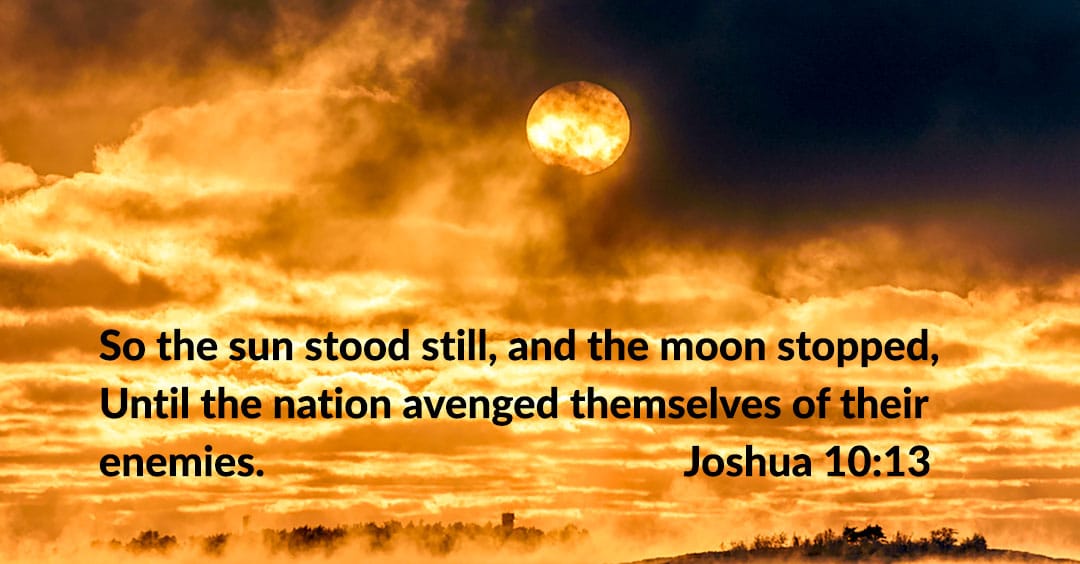
Sun Stood Still and Moon Stopped
View #1 – Figurative Language Was Used
One view claims that Joshua 10:12-14 is figurative language. Joshua imagined the sun and moon standing still. Supposedly, Joshua was too tired. So the day seemed long and in his excitement, he wrote poetically. It only seemed like the sun stood still to Joshua because the day was so long.3
This view is rejected for two reasons. First, there is a better explanation which will be presented later. The second reason for rejecting this view is that it reveals a low view of the Bible, for God wrote Joshua 10:12-14 by the Holy Spirit (2 Peter 1:21). Since God does not lie, what is written is true.
. . . God is not a man, that He should lie . . . Numbers 23:19 (NASB)
. . . God, who cannot lie . . . Titus 1:2 (NASB)
The conclusion is: this is not figurative language.
View #2 – The Earth Was Tilted
A second view says the earth was tilted toward the north so that the sun was visible into the evening. For example, the sun sets later in the evening in the northern hemisphere of the earth than at the equator. So, if the events in Joshua 10:12-14 occurred today between July and December, then countries such as Canada, Iceland, Finland, and others would experience sun twenty-four hours per day. Therefore, this view suggests that God titled the earth, changed the magnetic poles, and controlled the winds so that Israel would be in sunlight for one long day. The merits of this view is that the sun never sets during some days of the year in countries such as Iceland and Finland. But this view requires a miracle just as much as view 6 requires a miracle. But this miracle is unreasonably more complex.
View #3 – Sunlight Was Scattered
A third view says that the additional light was provided by scattering the sunlight through the clouds, or by diffusion of light due to meteors. But this view is unlikely because Scripture provides no supporting evidence. This view is simply mere speculation that seeks a naturalistic explanation to a divine miracle.
View #4– The Hailstorm Continued For One Day
Another view claims that Joshua actually prayed for the sun to not shine. That is, he prayed for darkness and the darkness was caused by the hailstorm which lasted for one day. This is the view of Claude Mariottini. He states,
It is true that God could stop the sun and still maintain the solar system in place. But the laws of physics bring serious doubts to the traditional interpretation of the text. The stopping in place of the sun and the moon would affect the whole solar system. In addition, there are other problems with this interpretation. 4
Claude Mariottini claims that the laws of physics would have been violated if the sun stood still. He finds a solution by assuming that the sun was “silent” too! That is, the sun did not shine. He proposes that the hailstorm or the “darkness” continued while Israel was killing the army of the Amorites (Joshua 10:5, 13). He claims,
This view also allows for a better understanding of the text without forcing upon it an interpretation that would require the reversal of the laws of physics.5
But this view must be rejected for three reasons. The first reason is that a literal and plain reading of Joshua 10:11-12 suggests that the hailstorm stopped in verse 11 since we are given a summary that more Amorite soldiers died from the hailstorm than from the Israelites. The summary statement would not have been given in verse 11 if the storm had continued into verse 12-13.
Second, as far as the heat of the day is concerned, any relief granted to the Israelites would also be given to Israel’s enemies. So, this theory fails the test of logic.
The third reason this view must be rejected is that the author claims the law of physics would have been violated if the sun stood still. But such reasoning displays a low view of the Bible and of our God. If God cannot lie then the Bible truthfully describes what happened.
The fourth problem with this view is that God can accomplish whatever He wants. Since God created the universe and put the celestial bodies in to place, then He is powerful enough to stop the sun and moon.
View #5 – An Eclipse Occurred
A fourth view says that Joshua 10:12-14 describes an eclipse. This view was held by Robert Dick Wilson (1856-1930). He said that the Hebrew word damam which is translated as “stood still” can mean “silent.” It is important to note that the Hebrew word damam can also mean “rest, wait, relax, quieted and motionless.” But “silent” is not the common translation. Damam is translated as “silent” only about 33% – 40% of the time in the Old Testament. In the English Standard Bible (ESV), New American Standard Bible (NASB), King James Bible (KJV), New King James Version Bible (NKJV), and Holman Christian Standard Bible (HCSB), the Hebrew word is translated as “silent” less than one-third of the time. The overwhelming view of many translators is that damam should not be translated as “silent.” Even if “silent” is the correct translation, this word does not provide strong Hebrew text support for the concept of a solar eclipse.6
Wilson is not alone in his belief that Joshua’s long day was an eclipse of the sun. Boling promotes the eclipse of September 30, 1131 B.C. as the very eclipse.7 Eugene Faulstich has a different opinion. He prefers the eclipse of April 19, 1421 B.C.8 Unfortunately, that eclipse occurred more than 300 years after the event described in Joshua. The biblical date for the event is estimated to have occurred about 1400 B.C.9,10 . However, some date the event about 1200 BC.11 The message is that aligning the dates of the eclipse to this historical event is uncertain.
More importantly, an eclipse is of a short duration, lasting at most eight minutes.12 NASA states,
This is about 7.5 minutes. The longest total solar eclipse from 4000 BCE to 8000 CE, a span of 12,000 years, will occur on July 16, 2186 and will last 7 minutes 29 seconds. Its path sweeps across Colombia, Venezuela and Guyana. The August 21, 2017 total solar eclipse, by comparison, will last a maximum of 2 minutes 43 seconds. About 70% of eclipses last longer than this.13
Such a short duration of eight minutes of darkness would have minimal impact on an enemy. Further, it would not have provided very much time to defeat the enemy with the darkness of evening approaching.
A natural occurring solar eclipse is not a good explanation for three reasons. First, astronomy cannot provide any solid supporting evidence of a solar eclipse in the time period of the event recorded in Joshua 10:13. The second reason a solar eclipse did not occur was that the Hebrew text does not support a solar eclipse.
A third reason a solar eclipse did not occur is that the sun stood over Gibeon and the moon stood over the valley of Aijalon (v. 12). Notice that verse 12 gives us the locations of both the sun and the moon. The sun is over Gibeon. The moon is over Aijalon. We must note that Joshua 10: 21 tells us that Joshua was most likely at Makkedah at the time of verses 12-14. This would mean that the viewing angle between the sun and the moon was about 22 degrees. Further, if Joshua was at Azekah, then the viewing angle would be greater.

Solar Eclipse Did Not Occur In Joshua 10:12-14
Consequently, the sun and moon would not be aligned in order to create a solar eclipse. Marten H. Woudstra made the following comment,
The respective locations of the sun and moon at the time that Joshua addressed them are at Gibeon and at the valley of Aijalon. This means that as Joshua looked in the direction of the sun, he saw it standing in the sky over Gibeon. Likewise the moon could be seen standing over the valley of Aijalon which was west of Beth-horon.14
That is, Joshua 10:12 states that the sun was directly overhead and the moon off to the west.

Sun and Moon Were Stopped For One Day
The fourth reason that a solar eclipse will not explain Joshua 10:13 is that the verse implies the sun was visible. The sun is not visible during an eclipse.
View #6 – The Sun Stood Still and The Moon Stopped
The sixth and final view that we will consider is a literal view that says the sun “stood still” and the moon “stopped.” That is, any potential darkness from the hailstorm did not continue. That is, the message of Joshua 10:13.
So the sun stood still, and the moon stopped,
Until the nation avenged themselves of their enemies. Joshua 10:13 (NASB)
That is, the sun was “motionless” and the moon “stopped.” That is the literal meaning of the Hebrew text (see Exodus 15:16 for damam). There is no solid textual evidence to support the idea that the sun and moon were “silent” or “dark.”
Archer and Waltke state,
In I Sam 14:9 the concept of “waiting” or “standing still” appears. This seems to be the meaning when Joshua asks the Lord to make the sun “stand still” and the moon “stop” so he could pursue the Amorites (Josh 10:12–13). Those interpreters who explain this miracle in terms of the silencing of the sun’s heat have a more difficult time, especially in view of the parallelism with the moon.15
Gleason Archer concurs by stating that the moon was in the west and the sun was in the east.16
This view believes that the Bible is the very words of God and that is why 2 Timothy 2:15 calls the Bible the Word of Truth. The message is that the book of Joshua is truth and records what God did.
Genesis 1:1 clearly explains how the universe came into existence along with the laws of physics.
In the beginning God created the heaven and the earth. Genesis 1:1 (NASB)
Since He created everything in the beginning, we can be confident that He knows how to change or freeze the laws of physics and perform a miracle without destroying the universe or creating havoc. God can do whatever He wants to do with His creation. Revelation 19:6 reminds us that He is all powerful.
Then I heard something like the voice of a great multitude and like the sound of many waters and like the sound of mighty peals of thunder, saying, “Hallelujah! For the Lord our God, the Almighty, reigns. Revelation 19:6 (NASB)
Job 38-39 reveals that God knows the details of His creation. He put the laws of physics in place. Colossians 1:17 states that He continues to hold the universe together. He continues to maintain the subatomic particles and the laws of the universe. He is the glue of the universe! He can change the laws at His discretion to accomplish His will because He established them. We can be confident that God knows how to change the laws of the universe any time He desires without causing a disaster. He can do anything. Hallelujah!
Evidence The Sun Stood Still
Consider the supporting evidence from Dave G. Becher that the event actually occurred. He writes the following,
We see mythological accounts of long nights from the Maori people of New Zealand, who “have a myth about how their hero Maui slowed the sun before it rose,” as well as a historical account from “the Mexican Annals of Cuauhtitlan (the history of the empire of Culhuacan and Mexico)” [which] “records a night that continued for an extended time.” 17
In fact, there are many more accounts from North, Central, and South America, of long nights. Various native North American Indian tribes have tales of a long night, as detailed in 1914 by Olcott, regarding the Ojibway, Wyandot, Dogrib, Omaha, and Bungee Indians.18
There is a tale of long nights from the Quiche Mayans of Guatemala, as well as an account from Peru during the reign of Titu Yupanqui Pachacuti II (who ruled at the same time that Joshua was in Canaan).19
“The Greek historian Herodotus … wrote that when he visited Egypt, the priests there showed him an ancient manuscript which told the story of a day which lasted about twice as long as a normal day.” 20
Ancient Egyptian hieroglyphics also tell a story of Joshua’s long day, according to Femand Crombette.21
According to Gill’s Commentary, there is a Chinese account from an ancient manuscript now lost, that recounted a period of time during the reign of Emperor Yau (concurrent with Joshua’s account), when the sun stood still for ten days, (which is quite possibly an overestimated, subjective guess as to the actual amount of time, since all their sun docks were halted).22
J. G. Frazer recounts a story from the Fiji Islands, in which the sun was stopped from setting.23
Conclusion
Since God is all-powerful, we conclude that He can stop the sun and moon, freeze the laws of physics and still maintain the universe. Any other view is a very low, illogical and dishonoring view of an all-powerful, omniscient, self-existing God. He does not need our help to explain away a divine miracle with a humanistic and rationalistic explanation.
Joshua 10:12-14 describes a miracle performed by the God of miracles.
References:
1. “Mamma mia! Naples hammered with fist-sized hailstones.” RT.com; “8 Deadliest Hail Storms in History.” NewsMax.
2. “Giant hail killed more than 200 in Himalayas.” The Telegraph (telegraph.co.uk).
3. J Carl Laney. Answers to Tough Questions. Kregel. 1997. pp. 60-61.
4. “Rereading Joshua 10:12-13: The Long Day of Joshua.” Claude Mariottini (claudemariottini.com).
5. Ibid.
6. “Joshua’s Long Day.” Enoch Calendars (gocentricity.com).
7. Tom Slattery. The Tragic End of the Bronze Age: A Virus Makes History. iUniverse. 2001.
8. Dave G. Becher. The Tripartite Helmet of Hope and Salvation: The Omniscience, Omnipotence. WestBow Press. 2016. p. 413.
9. James Usher. The Annals of the World. Master Books. 2004. p.51.
10. Walvoord & Zuck. The Bible Knowledge Commentary. ChariotVictor Publishing. 1985. p. 326.
11. R. K. Harrison. Old Testament Times. Hendrickson Publishing. 2001. p. 177.
10. Marten H. Woudstra. The Book of Joshua. Eerdmans Publishing Co. 1981. 175-176.
12. NASA (eclipse2017.nasa.gov/how-long-does-longest-possible-total-solar-eclipse-last)
13. Ibid. “Rereading Joshua 10:12-13: The Long Day of Joshua.”
14. Ibid.
15. Harris, R. L., Archer, G. L., Jr., and Waltke, B. K. (Eds.). (1999). Theological Wordbook of the Old Testament (electronic ed., p. 193). Chicago: Moody Press.
16. Gleason Archer. Encyclopedia of Bible Difficulties. Zondervan. 1982. P. 162.
17. Immanuel Velikovsky. Worlds In Collision. Dell, New York. 1950. p. 61 note 3. quoted in Becher. Ibid, p. 412.
18. Olcott, W. T. , 1914. Sun Lore of all Ages: A Collection of Myths and Legends Concerning the Sun and its Worship. (New York: G. P. Putnasm’s Sons). Becher. Ibid, p. 412.
19. Becher. Ibid, p. 412.
20. Totten, C. A. L., 1891. Joshua’s Long Day and the Dial of Ahaz, A Scientific Vindication and A Midnight Cry, 3rd Edition, (New Haven: Our Race Publ. Co.), p. 25.
21. Verdique Historique de l’Egypte Antique, from the Cerele Scientifique et Historique, France and Belgium. quoted in Becher. Ibid, p. 412-413.
22. John Gill, Joshua 10:13. John Gill’s Exposition of the Bible. accessed 8/13/2024. Christianity Today. www.christianity.com/bible/commentary/john-gill/joshua/10.
23. Frazer, J.G., 1914. “The Magical Control of the Sun,” Golden Bough. 3rd ed., 1:316. quoted in Becher. Ibid, p. 413.
Suggested Links:
Can We Trust the Bible, part 1?Can We Trust the Bible, part 2?
Is The Bible Complete and Inerrant?
Does Deuteronomy 28:63 contradict Ezekiel 18:23?