How to be a Great Minister of Christ, part 2
How to be a Great Minister of Christ Part 2 Header

The Bible tells us that sometime after a believer dies and goes to heaven, they will receive rewards for the good works they did while they were here on this earth. Most believers would like to receive rewards from God and hear Him say that they had finished well. The apostle Paul had the same desire. In 2 Timothy 4:7 he shared his heart.

I have fought the good fight, I have finished the course, I have kept the faith. 2 Timothy 4:7 (NASB)

In our last study, we discovered that the apostle Paul shared with Timothy, a pastor of a church, how he could also finish the course well! As we studied the advice Paul gave to Timothy, we discovered five principles as to how we also can finish well.

The first three principles told us that every pastor must 1) review and warn about apostasy, 2) constantly study Scripture, and 3) avoid ungodly teaching. As pastors strive to do this with excellence, they will have fought the good fight, finished the course, and kept the faith.

When you hear these principles, you may think they are only for a pastor. But that is not true. Why? Hebrews 5:11-14 gives us an important truth often missed.

For though by this time you ought to be teachers, you have need again for someone to teach you the elementary principles of the oracles of God, and you have come to need milk and not solid food. Hebrews 5:11-14 (NASB)

Here we are told that every Christian should be able to teach others. It is a mark of spiritual maturity. This does not mean that every believer should have the spiritual gift of teaching. God has not called every believer to be a pastor of a church. But this passage does tell us that every believer should be learning so that they can at least explain the Scriptures to others. This is necessary for a believer to finish well. There is a difference between being able to explain the Scriptures and teaching them.

The fourth principle is that a pastor must strive for godliness in his life. We discovered in 1 Timothy 3:16 that Jesus is the ultimate example of godliness. So, striving to be like Christ is striving for godliness. A few examples of godliness would be obeying God, loving God, growing in faith, following the examples of your elders, giving, and avoiding false teachers. The fifth principle is that a pastor must command and teach these principles. The fifth principle is that a pastor must command and teach these principles.

In our study today from 1 Timothy 4:12-16, we are going to discover five more principles about how to be a great minister or servant for Christ and end well. We will also learn that if the pastor lacks these principles, then the believers in his church will not grow spiritually.

Be an Example of a Believer

Our study is 1 Timothy 4:12-16. Here is verse 12,

Let no one look down on your youthfulness, but rather in speech, conduct, love, faith and purity, show yourself an example of those who believe. 1 Timothy 4:12 (NASB)

Here Paul gives Timothy the sixth principle of how to be a great minister of Christ and finish well. He told Timothy that he needed to be an example of how a believer should behave. This principle also applies to every believer.

This verse reveals that God wants a pastor to be a great example to the church whether he is younger or older. Many years ago, I knew a senior-pastor of a church who started dressing and acting like the younger people in his church. The music of the church and his sermons changed. I wondered why he changed?

But Paul did not tell Timothy to behave in any particular way so as to appeal to other people. Paul told Timothy to be an example in his speech to other believers. None of the ten principles that Paul gave Timothy include growing the size of the congregation. That is God’s business. A pastor must remember that the congregation will follow his example. They will see him as an example of spiritual maturity. How he dresses and acts reveals if he is a spiritual father of the faith. God does not give him special rewards for acting spiritually immature in order to gain a greater following. He is supposed to be an example of Christ.

Notice the first quality he mentioned in the list. Paul tells Timothy that he must be an example of speech first. In Colossians 4:6 every believer is urged to,

Let your speech always be with grace, as though seasoned with salt, so that you will know how you should respond to each person. Colossians 4:6 (NASB)

The emphasis is on speech. I have heard a pastor use swear words from the pulpit. Maybe he thought that would appeal to the people. But Colossians 4:6 reveals that God was not pleased. His speech should be seasoned with grace.

He forgot or did not even know this command that Paul gave to Timothy. He was to be an example to believers. He was not to mimic unbelievers for some effect. The gathering of the church is for the benefit of believers and not unbelievers. It is clear in the New Testament that the leaders of the church are to be godly examples to the believers. For example, Paul urged the churches to imitate his godly example. Listen to his exhortation to the believers in Corinth and in Philippi.

Be imitators of me, just as I also am of Christ. 1 Corinthians 11:1 (NASB)

Brethren, join in following my example, and observe those who walk according to the pattern you have in us. Philippians 3:17 (NASB)

In 1 Peter 5:1-3, the apostle Peter told the elders of the churches to be examples to the flock. In Hebrews 13:7, believers were urged to imitate the faith of their leaders. The verse says,

Remember those who led you, who spoke the word of God to you; and considering the result of their conduct, imitate their faith. Hebrews 13:7 (NASB)

Notice that believers are first urged to imitate those who are their leaders. That could include one of the elders. Second, believers are to imitate those who teach them the Word of God. Third, believers are urged to imitate those whose lifestyle is truly godly.

Ephesians 4:25 gives us some more advice about our speech. It says that believers are not to lie.

Therefore, laying aside falsehood, SPEAK TRUTH EACH ONE of you WITH HIS NEIGHBOR, for we are members of one another. Ephesians 4:25 (NASB)

God tells believers that their speech should always edify others in verse 29. Then in verses 26 and 31, believers are told to avoid angry speech and evil words.

So, Paul told Timothy to watch his speech. Paul does not mean to be a hypocrite, but a pastor should have a great desire to change his life if necessary to be an example.

Next, Paul told Timothy to be an example of conduct. The Greek word for “conduct” is anastrophe. It refers to a person’s pattern of life. A good example of this word is found in Ephesians 4:22-24.

That, in reference to your former manner of life, you lay aside the old self, which is being corrupted in accordance with the lusts of deceit, and that you be renewed in the spirit of your mind, and put on the new self, which in the likeness of God has been created in righteousness and holiness of the truth. Ephesians 4:22-24 (NASB)

Notice that Paul referred to the former manner of life of believers. Then he said that we need to lay aside our old self and put on our new self. This helps us understand that conduct refers to our pattern of life. We all sin because we are not perfect. Paul is talking about our normal conduct.

Then Paul said that our pattern of life should also include love and faith. People cannot see the love and faith in your heart. But they can see the effect it makes in your pattern of life. Finally, Paul told Timothy to be an example of purity. The word refers to sexual purity. It is one of the most difficult areas for many Christians. So, Paul told Timothy to control himself in this area.

In summary, Timothy was to be an example of a believer to everyone in the church. He was to show them how a believer in Jesus Christ lives! Otherwise, he would cause others to stumble. Ultimately, in Ephesians 5:1 Paul commanded us to imitate God.

Have A Biblical Ministry

The seventh principle of a great minister of Christ is that he will have a biblical ministry.

Until I come, give attention to the public reading of Scripture, to exhortation and teaching. 1 Timothy 4:13 (NASB)

Notice that Paul told Timothy that he was to do three things: read, exhort, and teach. Paul literally commanded Timothy to be committed to the reading, the exhortation, and the teaching. The order of the words is important. Paul starts with reading and ends with teaching. Paul followed the same pattern that is described in Nehemiah 8:8,

They read from the book, from the law of God, translating to give the sense so that they understood the reading. Nehemiah 8:8 (NASB)

The word “publicly” in 1 Timothy 4:13 is in italics in the NASB. That means “publicly” is not in the original Greek text. It was added. It is an interpretation by the translators, but publicly is implied.

What Paul describes follows the pattern of public worship in the Jewish synagogues. The gospels reveal that when Jesus entered a synagogue, He stood to read Scripture and then taught the passage. Just read Luke 4:16. So, Timothy was to do the same thing.

First, Paul told Timothy to read Scripture during the church service. I am afraid that sometimes this is viewed as a ritual. But it was not a ritual to Paul. It was an essential part of the worship service. The congregation should hear God speak directly to them. Second, Timothy was commanded to teach and exhort the Scriptures. The Greek word for “teaching” is didaskalia. Most of the time in the New Testament it is translated as “instruction” or “doctrine.” That is, it refers to the principles or doctrines of Scripture. Timothy was to first teach the doctrine in the passage and then exhort. If we examine Paul’s pattern of teaching, we discover that he taught doctrine before he applied the passage.

For example, Romans 1-11 is all doctrine. The last part of Romans 11 is a doxology. Then beginning with chapter 12, Paul starts his exhortation and application. He says in Romans 12:1,

Therefore I urge you, brethren, by the mercies of God, to present your bodies a living and holy sacrifice, acceptable to God, which is your spiritual service of worship. Romans 12:1 (NASB)

In the book of Galatians, he teaches from chapter one through chapter four, and then in chapter five he starts his exhortation or application. In Ephesians, Paul teaches doctrine from chapters 1 through most of chapter 4, then he begins the application in chapter four, verse 25. Paul repeats this pattern in most of his books. He has a doctrine section and then application follows. Paul commanded Timothy to read, teach, and exhort.

Justin Martyr, an early church father reveals that Paul’s pattern was adopted by the early church. He wrote this in his book “First Apology”:

On the day called Sunday, all who live in cities or in the country gather together to one place, and the memoirs of the apostles and the writings of the prophets are read, as long as time permits; then, when the reader has finished, the presidents speaks, instructing and exhorting the people to imitate these good things.1

So, the early church read, taught the principles, and applied them. John MacArthur makes this insightful comment,

The fourth-century bishop of Constantinople John Chrysostom was nicknamed “golden-mouthed.” Of him John R. W. Stott writes,

He is generally and justly regarded as the greatest pulpit orator of the Greek church. Nor has he any superior or equal among the Latin Fathers. He remains to this day a model for preachers in large cities.

Four chief characteristics of his preaching may be mentioned. First, he was biblical. Not only did he preach systematically through several books, but his sermons are full of biblical quotations and allusions. Secondly, his interpretation of the Scriptures was simple and straightforward. He followed the Antiochene school of “literal” exegesis, in contrast to fanciful Alexandrian allegorizations. Thirdly, his moral applications were down to earth. Reading his sermons today, one can imagine without difficulty the pomp of the imperial court, the luxuries of the aristocracy, the wild races of the hippodrome, in fact the whole life of an oriental city at the end of the fourth century. Fourthly, he was fearless in his condemnations. In fact, “he was a martyr of the pulpit, for it was chiefly his faithful preaching that caused his exile.” (Cited in John R. W. Stott, Between Two Worlds [Grand Rapids: Eerd­mans, 19821, 21)

His simple, direct exposition of Scripture, coupled with moral application, is a model for all preachers to imitate.

. . .

Preaching and teaching is the highest calling of a minister. It is tragic that so many in our day have been diverted from that. They spend their time on nonessentials, and their people end up spiritually impoverished.2

Dr. McGee adds this helpful comment for pastors and anyone else who follows Paul’s instruction to Timothy. He says,

This was applicable to Timothy personally also. The minister can grow personally only by reading the Word for his exhortation and instruction. A growing minister will make a growing church. One of the greatest things ever said concerning Dwight L. Moody was said by a neighbor: “Every time Mr. Moody comes home, you can just tell how much he’s grown spiritually.” Are you further along spiritually today than you were this time last year? Are you growing in grace and the knowledge of Christ? The only way to do so is by reading the great truths of the Word of God.3

Use Your Spiritual Gifts

The eighth principle of a great minister of Christ is that he is to use his spiritual gifts. This principle is given in verse 14,

Do not neglect the spiritual gift within you, which was bestowed on you through prophetic utterance with the laying on of hands by the presbytery. 1 Timothy 4:14 (NASB)

Now Paul commands Timothy to not neglect the spiritual gift that was given to him. A better translation of “do not neglect” is “to not be careless.” What an incredible command. Some commentators struggle with the idea that Timothy may have started neglecting his ministry. But that seems to be exactly what he did. In chapter one, Paul reminded him that he had been instructing him to not let certain men teach strange doctrines. But it appears that he may have. Later in 2 Timothy 1:6, Paul told Timothy to kindle afresh the gift that God had given to him. It appears that Timothy had become discouraged in the ministry and ignored Paul’s advice in this verse. He may have become lazy in his ministry, and Paul knew it.

In this verse, Paul encouraged Timothy to use his spiritual gift. 1 Corinthians 12:11 teaches us that the Holy Spirit gives us spiritual gifts. One of those gifts is teaching (1 Corinthians 12:28). It is also clear that since the Holy Spirit gave Timothy a spiritual gift, then it was God’s will for Timothy to have the spiritual gift and to use it. Therefore, Paul reminded Timothy that he had been commissioned to be a pastor by a group of elders. We are told that the group of elders was the council of the elders. The NASB uses the word “presbytery.”

The application for pastors and every believer is that God has given every Christian a spiritual gift. The application for us is that God wants us to use it.

Be Absorbed in These Things

The ninth principle for a great minister of Christ is that a pastor is to be absorbed in these things. Verse 15 says,

Take pains with these things; be absorbed in them, so that your progress will be evident to all. 1 Timothy 4:15 (NASB)

This verse does not agree with the Greek text very well. The Greek word for “take pains” is better translated as “to care for.” That is, rather than not caring about his ministry, Timothy was to deeply care for his ministry.

Also, the word “absorbed” is not in the Greek text. The Greek actually just reads “be in.” The idea is that Timothy was to be completely dedicated to or consumed with these principles. He was to be an example of a godly believer. He was to be reading, exhorting, teaching, and using his spiritual gift. His heart was to be greatly committed to these things. He was not to be a hypocrite.

A wise congregation that pays attention to a pastor’s teaching will be able to eventually sense if their pastor is growing spiritually. If he is growing spiritually, he will learn new insights due to being absorbed in the Scriptures. He will want to teach what he is learning. But a pastor who is not absorbed in the Scriptures will not be growing. His lack of progress will be evident to all. When this happens, he will become boring and your spiritual growth will be hindered. The church will begin to decay, because God blesses through the leadership of the church.

Persevere in These Things

The tenth principle for a great minister of Christ is that he perseveres in his ministry. Verse 16 says,

Pay close attention to yourself and to your teaching; persevere in these things, for as you do this you will ensure salvation both for yourself and for those who hear you. 1 Timothy 4:16 (NASB)

Notice that Paul emphasizes two things to Timothy: his own spiritual growth and his teaching. His teaching or doctrine was the most important task. His own spiritual growth and his teaching are to be his priorities. It is an error to be more interested in application, and avoid doctrine. The Holy Spirit will apply the principles to each believer. The doctrine is always the power behind the application.

Then Paul told Timothy to persevere in these things. That is, as Timothy followed these ten principles he would ensure salvation for himself and those listening to him. What Paul meant was that as he faithfully followed these principles, he and other believers would continue to grow in their faith. Throughout the New Testament, believers are told to persevere in their faith. Why? Because some of them may not really be believers but tares (Matthew 13:24-30, 36-43). 1 John 2:19 reminds us that just because someone attends church, that does not mean they are a Christian.

They went out from us, but they were not really of us; for if they had been of us, they would have remained with us; but they went out, so that it would be shown that they all are not of us. 1 John 2:19 (NASB)

Philippians 2:12-13 teaches us that we must continue to persevere in our salvation, and yet, God is helping us do that. It says,

So then, my beloved, just as you have always obeyed, not as in my presence only, but now much more in my absence, work out your salvation with fear and trembling; for it is God who is at work in you, both to will and to work for His good pleasure. Philippians 2:12-13 (NASB)

To work out our salvation includes reading and studying the Scriptures, obedience, confessing our sins, and praying. As we do these things, we are striving to sin less and less. Romans 8:13-14 tells us a primary sign a person is saved is that they sin less. That is how we work out our salvation. As Timothy persevered in the ten principles, he would also work out his salvation. That is what Paul meant by, “or as you do this you will ensure salvation both for yourself and for those who hear you.” In addition, as believers follow these principles, they will gain confidence that they are saved. Yet, from the divine perspective, 1 Peter 1:3-9 tells us that God keeps true believers in the faith.

Conclusion

1 Timothy 4:6-16 gave us ten principles. We have learned what to look for in a pastor. We have learned what makes a great minister for Christ. We have learned how all believers can finish well.


References:

1. Justin Martyr. First Apology. Translated A. W. F. Blunt, Cambridge Patristic Texts (Cambridge University Press, 1911), I.67. John Stott. The Message of 1 Timothy & Titus. Inter-Varsity Press. 1996. p. 121.
2. John MacArthur. 1 Timothy. The MacArthur New Testament Commentary. Moody Press. 1995. pp. 179-180.
3. J. Vernon McGee. 1 Corinthians through Revelation. Thru the Bible. Thomas Nelson Publishers. 1983. p. 450.


How to Show Respect to Everyone

How to Show Respect to Everyone Header

Our study may make some feel uncomfortable. We are going to learn how God wants us to show respect to everyone else who is older than us. We will also learn how God wants us to show respect to anyone who is younger.

As I studied the passage I will be teaching, I discovered important principles in both the Old and New Testaments. Then I began to wonder how other countries showed respect to those who are older and younger. I discovered that in Pakistan, it is extremely important to treat your elders with respect. For example, a younger person must never address an elder by their first name. A person must “use a clear, soft, low tone of voice when communicating with an elder.” One must “try to avoid ‘yes’ or ‘no’ questions and use open-ended questions instead.” The younger a person, the greater the respect that must be shown.1

In Ghana, younger people do not address the elderly by their first name. They must always say, “Mr., Mrs., Sir, or Madam.” Ghanaians are also the most likely to jump up on public transportation and offer their seat to older passengers. In a report titled, “Ten Insights Into Ghanaian Culture: #8 – Respect In Ghana,” it is stated,

Anyone older than you is to be treated with deference––the older they are, the more deference that is necessary: you must be the first to greet them (and greet them, you must); you must offer your assistance in any way you can; you must run errands for them; you must serve them first . . .2

In the Philippines, great respect is also shown to anyone who is older than you. For example, if you are speaking to an older person, you will always add the word “opo” to the end of your statement, which is the equivalent of “sir” or “madam.” In Morocco the hands of the elderly are kissed as a sign of respect. Many countries have laws that require respect be shown to the elderly. Great respect for elders seems to be shown around the world, except not so much in the western countries.

Do Not Sharply Rebuke…But Appeal

Respect for the elderly did not begin with those countries. It began with our God, as we will see in our study. Our study is from 1 Timothy 5:1-2. These two verses paint a picture of how to show respect to those who are older and to those who are younger. Verse 1 and 2 say,

Do not sharply rebuke an older man, but rather appeal to him as a father, to the younger men as brothers, the older women as mothers, and the younger women as sisters, in all purity. 1 Timothy 5:1-2 (NASB)

These verses have six parts. Verse 1 gives us two principles, and both verses apply those principles to four groups of people.

The first principle is given in verse 1, “Do not sharply rebuke . . . but appeal.” This principle is then applied to two groups of people: older men, and older women. The Greek word that is translated as “sharply rebuke” is epiplesso. It is a compound word made up of epi and plesso. Plesso has the meaning “to strike at” and epi then heightens the meaning of the word. But in this context, the word has the sense of a verbal attack. That is, we are never to use harsh words with someone who is older. We are never to display an attitude of superiority toward someone older. We are never to attempt to seize control with our words over them or try to win an argument with someone who is older. Instead, Paul tells Timothy that he is to appeal to those who are older.

The word “appeal” is translated from the Greek word parakaleo which means “to comfort, encourage, or urge.” The noun form of this word is “comforter.” It is used of the Holy Spirit. So, Paul gave Timothy this divine principle so that he and we would never assault an older person with words but instead seek to encourage and comfort them. Sadly, some youth believe that “tell it like it is” is honorable. Some take pride in “speaking their mind.” Some are upset at the evil and so they “go to war” to correct the wrong. But that is unloving and disrespectful.

In this verse Paul primarily applies the principle of respect to situations where an older believer is habitually committing some sin. In this situation, Timothy was not to use verbal assaults, insults, or verbal abuses to motivate them to stop sinning. To do otherwise, is to not show love and respect.

I think Dr. McGee summarized the sense of “Do not sharply rebuke . . . but appeal” when he said this,

In other words, he was not to take the position of a know-it-all or of a dictator over these older men. He was to encourage them and have a word privately with them if he thought it was necessary.3

Galatians 6:1-2 echoes this principle,

Brethren, even if anyone is caught in any trespass, you who are spiritual, restore such a one in a spirit of gentleness; each one looking to yourself, so that you too will not be tempted. Galatians 6:1-2 (NASB)

This passage is talking about how to rescue someone from a sin they are habitually committing. The first step is to be spiritual. That is, the rescuer must be free of any habitual sins. The rescuer must approach the sinning believer in a spirit of gentleness. That is the first principle given to us in 1 Timothy 5:1. In the process we must be careful to not commit sin ourselves. That would include the sin of not showing respect.

But what are we to do if the believer does not respond to our gentle approach of encouragement to be holy? If the man is an elder of the church, then 1 Timothy 5:19-21 applies. It says,

Do not receive an accusation against an elder except on the basis of two or three witnesses. Those who continue in sin, rebuke in the presence of all, so that the rest also will be fearful of sinning. I solemnly charge you in the presence of God and of Christ Jesus and of His chosen angels, to maintain these principles without bias, doing nothing in a spirit of partiality. 1 Timothy 5:19-21 (NASB)

This describes church discipline of an elder. Matthew 18:15-18 is the passage that we normally think of when we discuss church discipline. It requires the rescuing believer to go to the sinning believer one-on-one. If that effort to rescue is not successful, then he or she is to ask another person to help in the rescue. Finally, if that fails, then the elders of the church must become involved. From the beginning to the end, great respect is to be given. So in 1 Timothy 5:1-2, Paul gives us a principle that applies to two groups of older people.

Show Respect To Older Men

The first group of older people are older men. The Greek word for “older men” is presbuteros. This word means “elders.” It can refer to the elders of the church. But since verses 1 and 2 include younger men, older women, and younger women, it is clear that this time the Greek word just refers to older men.

In the Old Testament, God has given us a number of important verses about how younger people are to treat their parents. The first passage in the Old Testament is Exodus 21:17. It is about a disrespectful child. Three other passages about a disrespectful and verbally abusive child are Leviticus 20:9; Deuteronomy 21:18-21 and Proverbs 20:20. Here is Deuteronomy 21:18-21,

If any man has a stubborn and rebellious son who will not obey his father or his mother, and when they chastise him, he will not even listen to them, then his father and mother shall seize him, and bring him out to the elders of his city at the gateway of his hometown. They shall say to the elders of his city, “This son of ours is stubborn and rebellious, he will not obey us, he is a glutton and drunkard.” Then all the men of his city shall stone him to death; so you shall remove the evil from your midst, and all Israel will hear of it and fear. Deuteronomy 21:18-21 (NASB)

God has established the principle to motivate the youth to respect their parent. That is a warning or a negative instruction in the law about showing respect to the parents.

God has also tried to motivate us to honor our parents with a promise or a positive instruction. The promise is the fifth commandment in the Ten Commandments. It says,

Honor your father and your mother, that your days may be prolonged in the land which the LORD your God gives you. Exodus 20:12 (NASB)

The promise is repeated in Deuteronomy 5:16 and in the New Testament in Ephesians 6:2-3. Here is Ephesians 6:2-3,

HONOR YOUR FATHER AND MOTHER (which is the first commandment with a promise), SO THAT IT MAY BE WELL WITH YOU, AND THAT YOU MAY LIVE LONG ON THE EARTH. Ephesians 6:2-3 (NASB)

This time the Holy Spirit adds another reason why we should show respect or honor to our parents. It says, “so that it may be well with you.”

God’s Attitude Toward Older People

So why did God give us a warning and a promise? As you listen to these verses ask yourself, what is God’s attitude toward older people?

Every one of you shall reverence his mother and his father, and you shall keep My sabbaths; I am the LORD your God. Leviticus 19:3 (NASB)

You shall rise up before the grayheaded and honor the aged, and you shall revere your God; I am the LORD. Leviticus 19:32 (NASB)

A gray head is a crown of glory. Proverbs 16:31 (NASB)

What is God’s view of older people? He wants us to honor them. That means how we treat older people is a moral issue. It is sin to be disrespectful.

Examples of Disrespect to Older People

Unfortunately, we often think that showing respect to older people is nothing more than common courtesy. It is something that we should do because they are wiser and older. They are having more physical problems. Now that is true, but we have discovered that showing respect or honor is much more than common courtesy. It is a sin to be disrespectful.

Micah 7:1-6 gives us an example of disrespect. It reveals that disrespect is a symptom of the moral decline of a nation. As I read this, notice what the prophet Micah says,

Woe is me! For I am
Like the fruit pickers, like the grape gatherers.
There is not a cluster of grapes to eat,
Or a first-ripe fig which I crave.
The godly person has perished from the land,
And there is no upright person among men.
All of them lie in wait for bloodshed;
Each of them hunts the other with a net.
Concerning evil, both hands do it well.
The prince asks, also the judge, for a bribe,
And a great man speaks the desire of his soul;
So they weave it together.
The best of them is like a briar,
The most upright like a thorn hedge.
The day when you post your watchmen,
Your punishment will come.
Then their confusion will occur.
Do not trust in a neighbor;
Do not have confidence in a friend.
From her who lies in your bosom
Guard your lips.
For son treats father contemptuously,
Daughter rises up against her mother,
Daughter-in-law against her mother-in-law;
A man’s enemies are the men of his own household.
Micah 7:1-6 (NASB)

Micah tells us the godly people have died in the nation of Israel in verse 2. He says in verse 3, that the people did evil with two hands, and not with just one hand. In verse 4, he says the best of the people are like a briar bush. A briar is a prickly bush, and not just a single thorn. In verse 5, he said you cannot trust your neighbor. He has been listing the sinful conditions of the nation and the sins of his nation. Then in verse 6 he reveals another sin. They did not respect those who were older. This reveals that a lack of disrespect is a sin.

An example of disrespect to parents is revealed in Genesis 19:30-38. In that passage, Lot’s daughters showed disrespect to their father in two ways. First, they made him drunk, and then they had sex with him when he did not understand what was happening.

The point is that disrespect is a sin. It is contrary to God’s will. God wants us to respect those who are older than we are.

Example of Respect to Older People

The book of Job gives a great example of respect for those who are older. The book tells us that Job had three counselors. Job 32:6 says that one of them named Elihu was younger than Job. Notice how he showed respect to Job.

Now Elihu had waited to speak to Job because they were years older than he. Job 32:4 (NASB)

How did Elihu show respect? He waited for Job to speak before he spoke. The message is that it has always been a sign of respect for youth to not interrupt older people. Those who interrupt their elders are only thinking about themselves.

So the first principle is that we are to respect older men. If they are in sin, we are to appeal to them or to be respectful.

Treat Younger Men As Equals

1 Timothy 5:1 also gives us a second principle. We are to treat younger men as brothers, as equals. It is applied to a second group. This is true even if we catch them in some sin. Romans 12:10 says,

Be devoted to one another in brotherly love; give preference to one another in honor. Romans 12:10 (NASB)

Hebrews 13:1 says,

Let love of the brethren continue. Hebrews 13:1 (NASB)

The verse is better translated as “Let brotherly love continue.” Both verses describe a type of love. It is love that you would show to a brother. These verses assume that you love your brothers. They command us to love others as we do our own brothers. We are to show respect to our brothers in love. Since these are commands, they reveal that it is sin to not show respect to older men by appealing to them, even when we are dealing with sin. It is also a sin to not treat both our own brothers and Christian brothers as equals.

So, the first principle is that we are to treat older people with respect. When it involves rescuing them from sin, we are to appeal to them. The second principle is that we are show respect to younger men by treating them as equals.

Show Respect to Older Women

1 Timothy 5:2 then applies the first principle to older women. Proverbs 19:26 says,

He who assaults his father and drives his mother away
Is a shameful and disgraceful son. Proverbs 19:26 (NASB)

There is a kind of man who curses his father
And does not bless his mother. Proverbs 30:11 (NASB)

Proverbs 30:17 warns,

The eye that mocks a father
And scorns a mother,
The ravens of the valley will pick it out,
And the young eagles will eat it.
Proverbs 30:17 (NASB)

It is obvious from these verses that it is a sin to not respect our own mothers too! Recently, I saw this title on a social media page, “Why is there such a lack of respect for senior citizens in America?” Someone replied that America worships youth and not age. Someone else said they do not deserve respect and listed a series of sins that seniors commit. Another person said, “Posh, I don’t know. To me it is not an age issue. Disrespectful people disrespect!” That was probably the wisest answer on the page, but it still misses the mark. Disrespect is sin.

Treat Younger Women as Equals

The last part of 1 Timothy 5:2 is about younger women. The second principle applies to them. We are to treat younger women as sisters. We are to lovingly treat them as equals. But notice that Paul gives a warning. He says that we are to do it with “purity.” The word simply means “without any moral defect,” or “sinlessness.”

This means that in all of our interactions with younger women, we are to treat them as equals and we men are to guard ourselves against any sexual attractions. The same would be true of women toward younger men.

Conclusion

We have learned two principles in dealing with people, especially in the family of God. We are to treat older men and women with great respect. We are to appeal to them when rescuing them from sin. We are to treat younger men and women as equals. The goal is to always show them love. As we do this, we please our God and show love to everyone around us.


References:

1. “Cultural Do’s and Don’ts: Pakistani Elderly.” Cultural Do’s and Don’ts: Pakistani Elderly. (www.asianpacificpolicyandplanningcouncil.org/)
2. “Ten Insights Into Ghanaian Culture: #8 – Respect In Ghana. thetravellingsociologist. (www.thetravellingsociologist.com/respect-in-ghana/) 30/05/2017./
3. J. Vernon McGee. 1 Timothy. Thru the Bible. Thomas Nelson. 1983. p. 451.

Jesus Heals the Blind Man Bartimaeus

Jesus Heals Bartimaeus Header

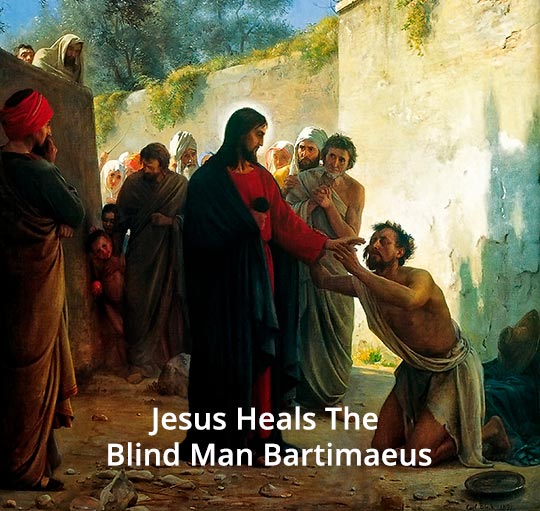
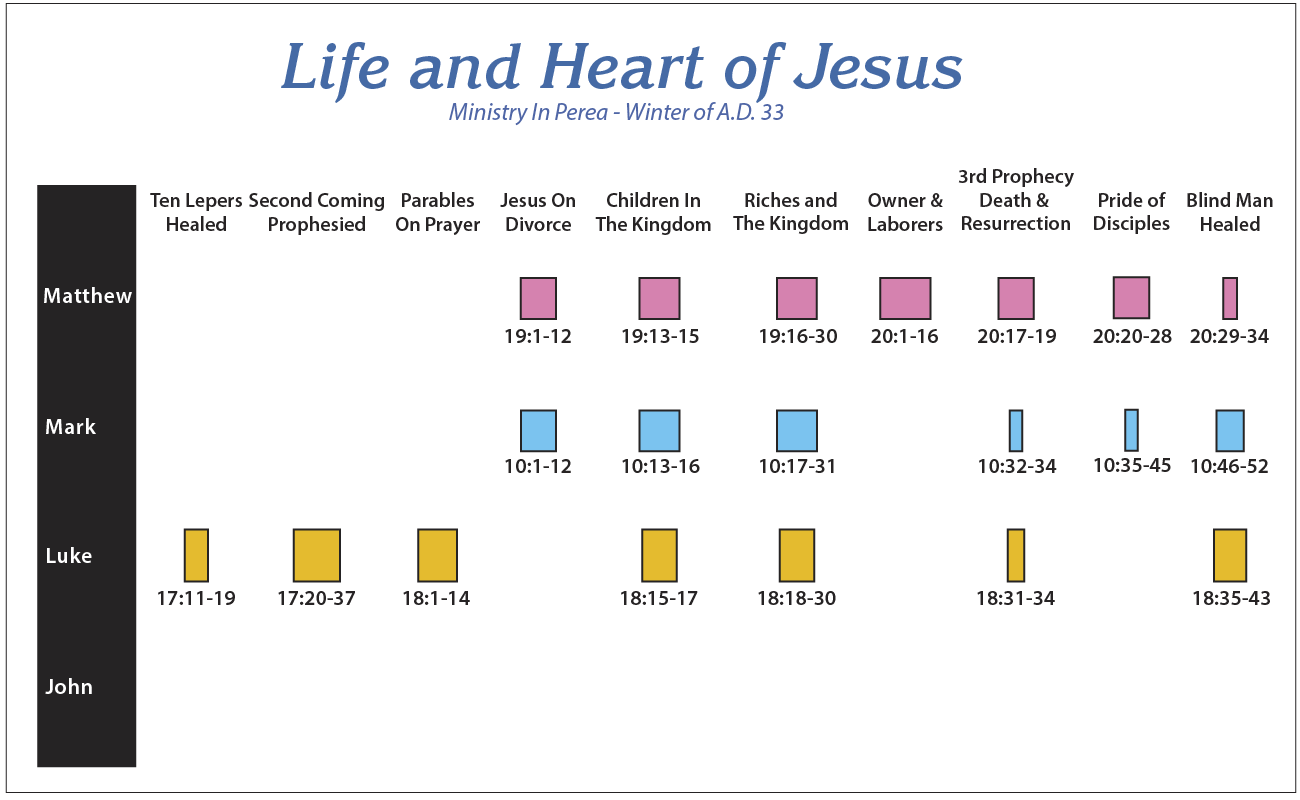
In our last study, Jesus had just rebuked the disciples for their ugly display of pride. I say ugly because that is a good way to describe the blatant attempt by James and John to gain the prestigious position of sitting on the right and left sides of Jesus in the kingdom. They wanted those positions of honor and power, so they asked before the other ten disciples did. When the other disciples discovered what they had done, they were angry. They wanted those positions too! It is sad to see their behavior in the gospels. But as soon as I say that, I do not mean to imply that I have no pride. It is just sad that this incident occurred. It is a warning to you and me about pride. This study is about the next event recorded in Jesus’ life. Matthew, Mark, and Luke tell us that two blind men who were begging to be healed. One was a man named Bartimaeus. In the next study we will learn about a man called Zaccheus. The character of both the blind men and Zaccheus are in sharp contrast to that of the twelve disciples. The twelve disciples were like many Christians. Because they were confident of their salvation, they had moved on to the next important issue. How important would they be in the kingdom of heaven? In contrast, the blind men and Zaccheus were humble. How about you? How would you respond? Our study is about two humble blind men who had faith in Jesus. We are going to learn six important facts about genuine faith. Our study is from Matthew 20:29-34; Mark 10:46-52 and Luke 18:35-43.

Israel Map 39

Jesus Approaches Jericho

Matthew 20:29 tells us that as Jesus and the disciples are leaving Jericho, a large crowd was following.

As they were leaving Jericho, a large crowd followed Him. Matthew 20:29 (NASB)

But Mark 10:46 and Luke seem to give different reports. Mark 10:46 says that Jesus, the disciples, and the crowd come to Jericho and were leaving.

Then they came to Jericho. And as He was leaving Jericho with His disciples and a large crowd . . . Mark 10:46a (NASB)

That agrees with Matthew, but Luke 18:35 appears to disagree when it says,

As Jesus was approaching Jericho . . . Luke 18:35a (NASB)

“Approaching” is not “leaving.” The solution to this apparent problem is that the Greek word for “approaching” is engizo. The basic meaning of this word is “to be near.” It can be translated as “in the vicinity.” That is, Jesus was moving in the vicinity of Jericho. But more likely, Matthew and Mark referred to the old ruins of Jericho, and Luke referred to the new Jericho. The old original Jericho had been destroyed by the Israelites when they entered Palestine. (Joshua 6). In Jesus’ time the city had been rebuilt just south of the old ruins.1 So, it is possible that Matthew and Mark referred to the ruins of the old city, and Luke referred to the new city. This would also agree with Luke 19:1 which says that Jesus entered Jericho later and met Zaccheus. Since all of Scripture was written by the Holy Spirit (2 Peter 1:20-21), we know He wrote Matthew, Mark, and Luke. So there is no contradiction in the details. We must discover the facts so that we can understand what they were reporting. The modern-day Jericho was fifteen miles north of Jerusalem.

Two Blind Beggars

Matthew 20:30 tells us that two men were sitting by the road when Jesus, the disciples, and the crowd approached Jericho.

And two blind men sitting by the road . . . Matthew 20:30a (NASB)

But both Mark and Luke do not mention that there were two blind beggars. They just focus on one of the men. The one man they speak of was a blind beggar sitting by the road (Mark 10:46b; Luke 18:35b). Only Mark gives us his name, Bartimaeus, and Luke says he was begging. Bartimaeus was a blind beggar sitting by the road. We do not know anything about the other man, except that he was also blind!

. . . a blind beggar named Bartimaeus, the son of Timaeus, was sitting by the road. Mark 10:46b (NASB)

. . . a blind man was sitting by the road begging. Luke 18:35b (NASB)

Bartimaeus must have been a well-known individual, or he would not have been mentioned by name in the gospel of Mark.

Aerial View of Ruins of Ancient Jericho - Tell es Sultan

Real Faith Will Focus On Christ

The gospel of Luke gives us the next chronological event. We are told Bartimaeus heard a crowd walking by.

Now hearing a crowd going by, he began to inquire what this was. Luke 18:36 (NASB)

The ears of the two blind men worked very well. They heard the crowd, but they could not understand who was there or what they were doing. So, the two men, especially Bartimaeus, asked what was happening. Both the gospels of Matthew and Luke tell us that the crowd said Jesus the Nazarene was walking by them.

. . . hearing that Jesus was passing by, cried out, . . . Matthew 20:30a (NASB)

They told him that Jesus of Nazareth was passing by. Luke 18:37 (NASB)

We can imagine the panic that must have gripped the blind men when they heard that Jesus had not stopped, but He was walking past them. Their opportunity for healing was walking by them. Maybe Jesus had already walked too far away for Him to hear them? So, what would you do if you were blind and could not see if He was near or far away? All three gospels tell us both men shouted as loudly as they could asking for mercy.

Matthew and Mark use the Greek word krazo to tell us the blind men “cried out.” The word reveals that they spoke very loudly. But the gospel of Luke uses the Greek word boao, which literally means to “shout or scream.” That is, at least one of the blind men, Bartimaeus, was screaming as loudly as he could. There have been moments in life, when we shouted loudly. He did not want to miss this opportunity to be healed. Jesus had not stopped to talk with them. Jesus was walking past them. They did not know how far away or how close He was to them. This opportunity to be healed might never occur again.

So, Bartimaeus shouted as loudly as he could in order to be heard above the noise of the crowd. We can imagine the blind man’s emotional panic. Jesus was walking away! So loudly, they begged for mercy and called Jesus the Son of David.

. . . cried out, “Lord, have mercy on us, Son of David!” Matthew 20:30 (NASB)

When he heard that it was Jesus the Nazarene, he began to cry out and say, “Jesus, Son of David, have mercy on me!” Mark 10:47 (NASB)

And he called out, saying, “Jesus, Son of David, have mercy on me!” Luke 18:38 (NASB)

In his desperation, the blind man’s shouting revealed that he believed in Jesus. He was like the soldier in the trench in the midst of a fierce military battle. A man once said there are no atheists in the foxholes during a war when bombs are dropping nearby. It is easy to be an atheist when you are eating a meal in the comforts of your home and enjoying yourself. It is just theory to claim that God does not exist when you cannot see Him and you think you are in control. But when your life is in danger and you cannot help yourself, then what you really believe is revealed. When someone’s child is about to die and no one else can help, then the true beliefs of a person are revealed.

People reveal that they do really believe in God when they are in a helpless situation. This blind man’s faith was revealed in his desperation. He did not just shout; he screamed for help! A man or woman who desperately believes in God, will pour out their heart to Him when they finally realize that no one in this universe can help them. That was true of Bartimaeus and the other blind man.

Matthew, Mark, and Luke tells us that when the men cried out, they called Jesus the Son of David (Matthew 20:30; Mark 10:47: Luke 18:38). The gospels reveal that other people also called Jesus the Son of David when they asked Him for mercy. Son of David had two meanings. First, it referred to a descendant of David (2 Samuel 13:1; 1 Chronicles 29:22; 2 Chronicles 1:1; 11:18; 13:6; 30:26; Proverbs 1:1; Ecclesiastes 1:1). The blind men were correct. The genealogies of both Joseph and Mary reveal they were descendants of King David (Matthew 1:1, 20; Luke 3:23, 31-32). The term also referred to the Messiah (2 Samuel 7:8–16; Matthew 12:23; Revelation 22:16). The Messiah was prophesied to be a descendant of King David.

It is obvious that they used Son of David with a second meaning, because no ordinary person could do the thousands of miracles that Jesus did during His ministry. It is clear from Matthew 12:22-23 that when Jesus cast out demons, that the people thought He was the Son of David or the Messiah. The gospels of Matthew, Mark, and Luke reveal that when people begged Jesus to heal them, they called Him the Son of David (Matthew 9:27; 15:22; 20:30-31; 21:9, 15; Mark 10:47, 48; 12:35; Luke 18:38-39). So they shouted loudly and begged, “Jesus, Son of David, have mercy on me!” They believed Jesus was the Messiah and that He could heal them. This reveals these two blind men believed in Jesus. That was their first step to being healed. This gives us our first important fact about faith. Real faith focuses on Christ and upon who He is!

Oh, if only we were like these two blind men when we have problems. The great lesson for us to remember is that when we are blind to the solution of our problems, we should cry out to our Savior! While the blind men did not know if Jesus would hear them, we know that our Savior hears every believer when we pray. In addition, 1 Peter 5:7 reminds us that we are to cast all of our care upon God because He cares for us! These two blind men did not know what was going to happen, but we do! Their faith was focused on Christ.


Faith Will Persist

The next important fact about faith is that it persists. Next we are told the crowd objected to their shouting. I imagine that some of us might have objected to the shouting too! Most likely their shouting was a ten on the scale from one to ten! I doubt that these men were shouting at six on the scale. I doubt they were shouting at eight either. This was their once-in-a-lifetime to be healed and so they were shouting as loudly as they could. So, the crowd did not like the screaming! All three gospels focus on this fact. The gospels tell us the crowd “sternly” told them to be quiet.

The crowd sternly told them to be quiet, but they cried out all the more, “Lord, Son of David, have mercy on us!” Matthew 20:31 (NASB)

Many were sternly telling him to be quiet, but he kept crying out all the more, “Son of David, have mercy on me!” Mark 10:48

Those who led the way were sternly telling him to be quiet; but he kept crying out all the more, “Son of David, have mercy on me!” Luke 18:39 (NASB)

The Greek word for “sternly” has the sense of a rebuke with a threat of penalty. But these two men ignored the threat and cried out “all the more” or greatly. This seems to mean that they cried more eagerly and constantly. What an irritating experience that must have been for the crowd. I can imagine how I would feel if someone was screaming in my ear.

But we must not miss a spiritual truth. They persisted screaming greatly because they believed Jesus Christ was really the Messiah. Real faith persists. Real faith grows stronger due to conflict. Oh, it may waver briefly like a flag blown by the wind, but it will never become detached from the pole. So, real faith focuses on Christ. Also, real faith never detaches from Jesus. Instead, it grows stronger.

Faith Obeys Christ

The next important fact about faith is that it obeys. Now Jesus commanded the two blind men to come to Him. I believe that Jesus commanded them to come so that we could see that real faith obeys. The gospels tell us,

And Jesus stopped and called them . . . Matthew 20:32a (NASB)

And Jesus stopped and said, “Call him here.” So they *called the blind man, saying to him, “Take courage, stand up! He is calling for you.” Throwing aside his cloak, he jumped up and came to Jesus. Mark 10:49-50 (NASB)

And Jesus stopped and commanded that he be brought to Him . . . Luke 18:40a (NASB)

The gospel of Luke says that Jesus commanded that Bartimaeus be brought or led to Him. Mark tells us that the crowd called him. This seems to be the correct understanding of “brought” to Him. So, Bartimaeus threw aside his cloak, jumped up and walked to Jesus. While Matthew does not say anything about the other blind man, it will become obvious that he came too! These two blind men are examples of real faith. Real faith focuses on Jesus. Real faith persists, and real faith obeys.

Ruins of Ancient Jericho - Tell es Sultan

Faith Asks Christ

Real faith also asks for help from the one in which he or she trusts. These two blind men are examples of that fact too! The three gospels tell us that Jesus asked them, “What do you want Me to do for you?” Notice how the men answered Jesus.

And Jesus stopped and called them, and said, “What do you want Me to do for you?” They *said to Him, “Lord, we want our eyes to be opened.” Matthew 20:32-33 (NASB)

And answering him, Jesus said, “What do you want Me to do for you?” And the blind man said to Him, “Rabboni, I want to regain my sight!” Mark 10:51 (NASB)

. . . and when he came near, He questioned him, “What do you want Me to do for you?” And he said, “Lord, I want to regain my sight!” Luke 18:40b-41 (NASB)

Apparently, one man asked, “Lord, we want our eyes to be opened,” and Bartimaeus himself said, “Lord, I want to regain my sight!” One can feel the emotion and high energy these two blind beggars put into their request. After their shouting and being told to be quiet by the crowd, they asked Jesus to help them to see again. They did not ask the crowd. They did not ask each other. They asked the Son of David, their Messiah to heal them. They knew their only hope to be healed was through Jesus Christ.

The same is true for us even today. We usually visit a hospital or a doctor when we are ill. We hope they can make us well. But we forget the principle that is given to us in Psalm 127:1. The principle is that unless the Lord heals us, the medical personnel are working in vain. It says,

Unless the LORD builds the house,
They labor in vain who build it;
Unless the LORD guards the city,
The watchman keeps awake in vain.
Psalm 127:1 (NASB)

This verse reminds us that God is total control.

The Holy Spirit has also told us in James 5:13-17 to call the elders when we are sick, and have them pray for us. But notice that verse 13 reminds us that it is not the elders, nor their faith that alone heal, but it is the Lord who heals us, if He wills to do so.

And the prayer offered in faith will restore the one who is sick, and the Lord will raise him up, and if he has committed sins, they will be forgiven him. James 5:15 (NASB)

Just like the two men, they shouted. They screamed to be healed. They asked their Messiah to heal them. He was the only One who could heal. His name is Jesus Christ, our Savior, Lord, and God. So, real faith focuses on Jesus. Real faith persists. Real faith obeys, and real faith always seeks help from the only One who can help.

Faith Results in Salvation

Next, we discover that faith in Christ saves. Matthew 20:34 reveals that Jesus was moved with great emotion toward these two men. I think He was moved because He knew they greatly believed in Him. The Greek word that describes Jesus’ emotion actually refers to a person’s bowels.

Moved with compassion, Jesus touched their eyes . . . Matthew 20:34a (NASB)

It tells us that Jesus felt emotion for these men deep inside His bowels. We experience this occasionally. When we love someone or are moved emotionally toward a person, we feel it in our abdomen. That is the same thought as the Greek word that describes how Jesus felt toward these two blind beggars who were pleading for help! They were acting this way because they had faith in Jesus!

The NASB’s Greek translation in Mark and Luke leave us with the wrong idea as to what Jesus said. Mark 10:52 says that Jesus told them their faith had healed them.

And Jesus said to him, “Go; your faith has made you well.” Mark 10:52a (NASB)

But the translation of Luke 18:42 is a little different. It says that the men were healed and saved.

And Jesus said unto him, Receive thy sight: thy faith hath saved thee. Luke 18:42 (NASB)

But an accurate translation of both Mark 10:52 and Luke 18:42 reveals that Jesus used the Greek word, sozo, which means “to be saved.” That is, Jesus announced the men were saved, and also healed. In fact, the tense of “to be saved” is the perfect tense. That reveals these men had already believed in Jesus, and as a result were already spiritually saved. Then Jesus healed them.

Faith and salvation occurred together and then their healing followed. This passage does not teach that these men were healed because of their faith. Instead, the passage teaches that they were saved because of their faith, and then Jesus healed them because He was moved with compassion.

Faith Follows

Then immediately after Jesus touched their eyes and said, “Receive thy sight,” they were able to see. Now some men during Jesus’ ministry just walked away. But not these two men. Notice what each gospel says,

. . . immediately they regained their sight and followed Him. Matthew 20:34b (NASB)

Immediately he regained his sight and began following Him on the road. Mark 10:52b (NASB)

And immediately he received his sight, and followed him, glorifying God . . . Luke 18:43a (NASB)

This is a very special and emotional event. These two men immediately saw their Messiah, the One in which they believed. Contrary to the teaching of some today, they did not have to wait for the healing to occur. They did not have to imagine they were healed. We are told immediately they received their sight, like the snap of two fingers. As a result they followed Christ.

We have learned six important facts about real faith. First, real faith focuses exclusively on Jesus. Second, real faith persists. Third, real faith obeys. Then real faith always seeks help from the only One who can help. Fifth, real faith saves the sinner for a salvation that is guaranteed. Sixth, real faith submits and humbly follows. These two men followed Jesus on the road to Jerusalem. I wonder if they watched Him when He was crucified? Is that why Bartimaeus’ name is recorded?

Finally, the people saw this amazing miracle and glorified God.

. . . and all the people, when they saw it, gave praise unto God. Luke 18:43b (NASB)

Chronology14

Conclusion

I look forward to the day that I can see Christ in heaven. These men saw Him when He walked among us. They are a picture of what it will be like for us some day when we see Jesus. Because we have already believed in Jesus, we are saved, and our salvation is secure (1 Peter 1:3-9). Because of our position in Christ, we are already sitting in heaven (Ephesians 2:6). Some day our long wait will be over.

So, we have learned six important characteristics of faith this passage. How does your faith in God measure up? May I urge you, figuratively speaking, to get out your ruler and measure your faith? These blind men had real faith that humbly clings to Jesus, persists, obeys, always seeks, clings to Christ for the forgiveness of sins, submits and humbly follows! Do you?


Reference:

1. Flavius Josephus. Wars of the Jews. Book IV. Chap. 8.3. Kregel Publication. 1963. p. 539.

How to Become the Greatest In the Kingdom

How to Become the Greatest Header

I remember walking outside one summer night to put the trash in the trash cans. As I walked along the front of the house and turned the corner toward the trash cans, I heard a rattlesnake shaking his rattle. Instantly, I knew that familiar sound because we live on what the neighbors call “rattlesnake row.” We have heard rattlesnakes many times. But this time I did not see it in the dark. I only heard it from the among the rocks some feet away. I knew it was close because it sensed my presence. Pride is like a dangerous snake in the dark of night. Usually, you cannot see it, but it is there. It is most easily recognized in children. Almost every parent has heard their children demand that someone return a toy or some food with the scream, “Give it to me. It is mine!” The child unknowingly embarrassed himself or herself by revealing that they think they are more important than everyone else. The sad part about pride is that as a person becomes older, we try to hide our pride. Pride hides itself. Children are not like snakes in the dark, but adults are because they endeavor to hide their pride. Pride motivates many people to serve the Lord Jesus. They want a sense of importance. Maybe they do not want to waste their life. But when a adult’s pride is offended, they strike with fangs. Pride can motivate and destroy relationships and organizations. Pride is a sin that should not exist in the life of a believer. Our study is about pride and is from Matthew 20:20-28 and Mark 10:35-45.

A Mother and Her Two Sons

Matthew 20:20-28 and Mark 10:35-45 describe the next event after Jesus told His disciples they were going to Jerusalem where He would be killed. Only Matthew and Mark record the event. It is a sad event since the pride of the disciples can be seen once again. Earlier as they walked to Capernaum,the disciples had argued about who would be the greatest in the kingdom of heaven. (Matthew 18:1-6; Mark 9:33-34; Luke 9:46-47). So, the disciples asked Jesus who among them would be the greatest in the kingdom. They were confident that one of them would be the greatest. They had incredible pride, thinking that the list of potential candidates was limited to themselves. Jesus told them that it starts with becoming a believer. It begins with humility. No one will become a believer if they are not willing to become humble before God. They will admit they are sinners and repent of their sins. They will submit themselves to Christ.

Truly I say to you, unless you are converted and become like children, you will not enter the kingdom of heaven. Whoever then humbles himself as this child, he is the greatest in the kingdom of heaven. Matthew 18:3-4 (NASB)

The greatest in the kingdom are those who are the most humble. One would think that after our Lord had taught them that truth, the desire to be the greatest would have disappeared. But the pride of the disciples was like the hidden rattlesnake in the dark. It was still there, it just was not visible. But in this study, their snake-like pride becomes visible again. The opening verses of our study are Matthew 20:20-21.

Then the mother of the sons of Zebedee came to Jesus with her sons, bowing down and making a request of Him. And He said to her, “What do you wish?” She said to Him, “Command that in Your kingdom these two sons of mine may sit one on Your right and one on Your left.” Matthew 20:20-21 (NASB)

Here we are told the mother of the two sons of Zebedee came to Jesus and asked a favor. Mark 10:35-37 provides more information and gives us the names of the two sons.

James and John, the two sons of Zebedee, *came up to Jesus, saying, “Teacher, we want You to do for us whatever we ask of You.” And He said to them, “What do you want Me to do for you?” They said to Him, “Grant that we may sit, one on Your right and one on Your left, in Your glory.” Mark 10:35-37 (NASB)

Her two sons were named James and John. We have read about them before. Initially, they were disciples of John the Baptist (John 1:35-40) before they started following Jesus. Later, Jesus met them two times at the seashore of the Sea of Galilee because they were fisherman (Matthew 4:21-22; Mark 1:19; Luke 5:1-10). That suggests these two men were hardworking and strong. They ran a successful business.

Mark 3:17 tells us that when Jesus made them disciples, He called them “Boanerges,” which means, “Sons of Thunder” (Mark 3:17). That suggests they became angry quickly, and were immature. That fits with Luke 9:54 which says both brothers told Jesus that a village, which had rejected Him, should be destroyed with fire from heaven. Their attitude is not what we would expect from followers of Christ. This reveals the character of these men. They were strong, quick-tempered men, who were ready to defend Christ. The desire to defend Jesus was great, but the attitude was wrong.

Matthew 5:37-39 tells us that Jesus only allowed James, John, and Peter to accompany Him when He entered into an official’s house to heal his daughter. Jesus did not ask any other disciple. Matthew 17:1 and Mark 9:2 tell us that these two men were so highly favored that Jesus took them and Peter up to the Mount of Transfiguration. None of the other disciples were able to join them. Later, we will learn that James, John, and Peter asked Jesus about the signs of the future, and He answered their request in private (Matthew 24:3; Mark 13:3 ). There was one more time when Jesus asked only James, John, and Peter to join Him. That was when He went to the Garden of Gethsemane to pray before His arrest (Mark 14:32-35). All of these examples help us understand that these two men were favored. Jesus saw beyond their rough edges. He knew their great potential for the kingdom of God. So, they were part of Jesus’ inner circle! They felt privileged. There were twelve disciples, but Jesus had chosen three of them for the inner circle: Peter, James, and John. Now that was a privileged position. It is not surprising that because of their personalities coupled with a sense of privilege that they asked Jesus for a special favor.

Who was the mother of James and John? Matthew 20:20 just says that she was the mother of the sons of Zebedee. If we search the gospels we can discover her name. First, Matthew 27:55-56 tells us that many women were standing at a distance from the cross. One of the women was called Mary Magdalene. The second Mary was the mother of James and Joseph. Verse 56 says,

Among them was Mary Magdalene, and Mary the mother of James and Joseph, and the mother of the sons of Zebedee. Matthew 27:56 (NASB)

Second, Matthew 10:2-4 says there were two disciples named James. One was the son of Zebedee, and the other James was the son of Alphaeus. Therefore, since the third woman mentioned in verse 56 is the mother of the sons of Zebedee, the second women mentioned in verse 56 must be the wife of Alphaeus. Third, if we read Mark 15:40, we discover the name of the mother of the sons of Zebedee is Salome.

There were also some women looking on from a distance, among whom were Mary Magdalene, and Mary the mother of James the Less and Joses, and Salome. Mark 15:40 (NASB)

So, Zebedee was the father of James and John, and Salome was the wife of their father. That is the family. It is also possible that Salome was Jesus’ aunt (John 19:25). If that is true, then Salome is in a powerful position to make a special request of Jesus for her sons.

Chronology14

Pride is Deceptive

It is clear from Matthew 20:20-21 and Mark 10:35 that Salome, James, and John had planned to ask Jesus together for a special honor. But we are not told why they chose this time to make their request. We do not know anything about the location of this event. But it will become obvious that they spoke with Jesus a little distance away from the other disciples. They are a perfect illustration of pride. Pride deceives. They did not want any competition from the other disciples when they made their request. They wanted to make their request first, and win “the prize” before the other disciples discovered what they had done. This gives us the first principle about pride. Pride is deceptive. Psalm 73:6 states that pride is like a necklace, a necklace of violence.

Therefore pride is their necklace;
The garment of violence covers them.
Psalm 73:6 (NASB)

In its deception pride hurts others. Pride is secretive in its quest for honor. It quietly slithers along in the grass like as snake.

Both Matthew and Mark tell us that Salome, James, and John approached Jesus. But Matthew 20:20 leaves us with the impression that Salome bowed down before Jesus and asked, “Command that in Your kingdom these two sons of mine may sit one on Your right and one on Your left.” In sharp contrast, Mark 10:35 gives us the impression that James and John made the request. More information about the timeline of this event would have been helpful so that we could understand who said what when, but the record does not tell us. Since Scripture was written by God the Holy Spirit, we know that both Matthew and Mark accurately recorded what happened. It is clear that Salome, James and John made this request of Jesus together! There can be no contradiction in those facts, but the order of who spoke when is not provided. It seems that perhaps Mark 10:35 describes what happened first.

James and John, the two sons of Zebedee, *came up to Jesus, saying, “Teacher, we want You to do for us whatever we ask of You.” Mark 10:35 (NASB)

The Greek tense for “saying” is a present participle, which refers to continuous action. This suggests they were asking as they approached Jesus. They were not timid but bold. They took the lead and were already speaking as they approached Jesus. They spoke first and asked, “Teacher, we want You to do for us whatever we ask of You.” Mark 10:36-37 states that Jesus answered with, “What do you want Me to do for you?” They said to Him, “Grant that we may sit, one on Your right and one on Your left, in Your glory.” That was a bold request.

Matthew 20:20-21a tells us that mom bowed down and made her request.

Then the mother of the sons of Zebedee came to Jesus with her sons, bowing down and making a request of Him. Matthew 20:20 (NASB)

It seems best to understand that she did not wait to hear Jesus’ reply to her sons or she made her request next. She quickly bowed down in order to add the weight of her request. Matthew 20:21 says, “And He said to her, “What do you wish?” She said to Him, “Command that in Your kingdom these two sons of mine may sit one on Your right and one on Your left.”

Together they made the same request of Jesus. If Salome was Jesus’ aunt, then the three of them must have believed that she had some extra influence. So, pride is deceptive.

Pride Is Ambitious

Matthew 20:22 and Mark 10:38-39a give us the second principle. Pride is ambitious. These verses tell us that Jesus answered them with,

“You do not know what you are asking. Are you able to drink the cup that I am about to drink?” They said to Him, “We are able.” Matthew 20:22 (NASB)

Mark 10:38 includes a phrase that Matthew does not include. He adds a statement about baptism.

“You do not know what you are asking. Are you able to drink the cup that I drink, or to be baptized with the baptism with which I am baptized? They said to Him, ‘We are able.’” Mark 10:38-39a (NASB)

Jesus used the phrase “drink the cup that I drink” to refer to His own cup of suffering which He had just explained. He had just told them that they were going to Jerusalem, and there He would die and be resurrected (Matthew 20:18-19; Mark 10:33-34). While the disciples did not understand what He had said, at least He told them the truth. The cup He was going to drink was a cup of suffering. The expression “cup of” occurs about fifteen times in Scripture. Six times it has a positive meaning. But the other nine times it has a negative meaning: cup of His anger (Isaiah 51:17; Revelation 14:10), cup of reeling (Isaiah 51:22), cup of the wine of wrath (Jeremiah 25:15; Revelation 16:19), cup of horror and desolation (Ezekiel 23:33); and the cup of demons (1 Corinthians 10:21).

So, Jesus replied to their question with a question. Could the two sons drink the cup of suffering that He was about to experience? Jesus was going to Jerusalem to be crucified. Boldly and without wisdom, they replied that they could drink the same cup. Pride is ambitious and aggressive. They said, “We are able.” Just like a snake.

Because these two men were ambitious, they believed they could do whatever it was to which Jesus was referring. They were the “Yes, we can do anything duo!” James 4:13-16 rebukes this second principle of pride.

Come now, you who say, “Today or tomorrow we will go to such and such a city, and spend a year there and engage in business and make a profit.” Yet you do not know what your life will be like tomorrow. You are just a vapor that appears for a little while and then vanishes away. Instead, you ought to say, “If the Lord wills, we will live and also do this or that.” But as it is, you boast in your arrogance; all such boasting is evil. James 4:13-16 (NASB)

This passage captures the attitude that was missing in these young men. Oh, they said, “We are able.” We can do such and such! We can do it Jesus! They believed they could do whatever they desired. Often we hear politicians tell the people of a nation that they can do anything. James 4:16 says “all such boasting is evil.” Notice it does not say “some” but “all” such boasting is evil. James and John were displaying evil! They did not consider that God the Father might not want them to do that.

Frankly, there have been times that I have felt that I could do something and then the Lord has reminded me to ask Him if it is His will. Maybe you have failed to ask God what was His will, and just charged ahead assuming you would succeed. Pride deceives others and self, and becomes ambitious. It rarely considers the will of God. Are you careful to ask God if your plans are in conformity with His?

Then Jesus made this surprising statement to them,

He said to them, “My cup you shall drink; but to sit on My right and on My left, this is not Mine to give, but it is for those for whom it has been prepared by My Father.” Matthew 20:23 (NASB)

And Mark says,

And Jesus said to them, “The cup that I drink you shall drink; and you shall be baptized with the baptism with which I am baptized. But to sit on My right or on My left, this is not Mine to give; but it is for those for whom it has been prepared.” Mark 10:39b-40 (NASB)

When Jesus told them they would drink His cup, He hinted that some day they would suffer. Acts 12:1-2 tells us that James did drink the cup of suffering when he was martyred for his faith with a sword. John drank the cup when he was imprisoned on the island of Patmos (Revelation 1:9). In time they suffered too!

But Jesus could not grant them the privilege of sitting on His right and left side. It was for God the Father who had made that decision already to make that decision. With that comment, the humility of Jesus is revealed. He was in total submission to the Father. The kingdom had been planned by God the Father from the foundation of the world (Matthew 24:34). the kingdom belonged to the Father (Matthew 26:29). Philippians 2:9-11 reveals that the Father will exalt Christ and give Him authority over all the nations of the world. Verse 10-11 say,

. . . so that at the name of Jesus EVERY KNEE WILL BOW, of those who are in heaven and on earth and under the earth, and that every tongue will confess that Jesus Christ is Lord, to the glory of God the Father. Philippians 2:10-11 (NASB)

When the kingdom ends after one thousand years, Christ will hand control of the kingdom back to the Father (1 Corinthians 15:24).

Notice that Jesus said what they wanted had already given away. Jesus said, “for whom it has been prepared.” The Greek word “prepared” is in the perfect tense. That refers to completed action in the past with continuing effect. That is, the Father had already made the decision. They had asked the wrong person. The Father did not make decisions based on someone’s personal ambitions and self-confidence.

So, Christ gave them the facts. That must have been disappointing. They had asked the wrong person for the positions they had ambitiously pursued. Has that ever happened to you? Have you embarrassed yourself by asking someone for something only to be told they could not help you? Have you ever after plotting and planning discovered that you had asked the wrong person?

Pride Wants To Be First

Now Matthew 20:24 tells us the other disciples heard the discussion. They were very upset.

And hearing this, the ten became indignant with the two brothers. Matthew 20:24 (NASB)

The Greek word for indignant has the basic meaning of being very angry.

A strong word for angry resentment. In the papyri. The ten felt that James and John had taken advantage of their relation to Jesus.1

The disciples were very angry because they wanted those two seats too! Their pride burst into flames on the inside. I wonder what words came out of their mouths. But neither Matthew or Mark tell us about any of their reactions. It is amazing that all of the disciples did not see their sin. They believed they had been wronged. The struggle to be first was simply a right. To be first was like finding a rabbit in the desert. Whoever could eat it first had the right to eat it. For them, the desire to have the position of first was neither a right or wrong. It was simply who could win the prize. They thought James and John had mistreated them. What the two brothers had requested was a gift that belonged to them. Has that ever happened to you? Someone offended you because you wanted what they wanted, but they asked first and got it? Maybe it was just a silly piece of pie or the last scoop of ice cream. Maybe it was a position of leadership at work or church.

Proverbs 29:23 tells us about the consequences of pride.

A man’s pride will bring him low,
But a humble spirit will obtain honor. Proverbs 29:23 (NASB)

Even if the disciples did not say anything, Jesus knew their hearts and thoughts (Luke 11:17). James and John were brought low by their actions and the other ten disciples were brought low by their anger. Now the snake could be seen!

This was a sad and embarrassing situation within the team of disciples. The team had already argued about who would be the greatest in the kingdom once before, and now the same issue occurred again in a different way! This time James and John wanted to secure the position of the greatest by a power-play. If they could just sit on the right and left of Jesus in the kingdom, then they would be greater than the other disciples. They thought this was the way to win! But, they failed. This was an embarrassment. The family was embarrassed.

How did Jesus feel about their pride? Job 40:11b-12a reveals how God responds to pride. God Himself repeats this statement twice.

Look at everyone who is proud, and humble him. Job 40:12a (NASB)

The message is that God will humble the arrogant. Proverbs 16:5 says,

Everyone who is proud in heart is an abomination to the LORD;
Assuredly, he will not be unpunished.
Proverbs 16:5 (NASB)

Proverbs 16:19 adds,

It is better to be humble in spirit with the lowly
Than to divide the spoil with the proud.
Proverbs 16:19 (NASB)

Isaiah 2:12 describes the Lord as a king leading His army against the proud.

For the LORD of armies will have a day of reckoning
Against everyone who is proud and lofty
And against everyone who is lifted up,
That he may be abased.
Isaiah 2:12 (NASB)

So, how did our God, Jesus Christ, respond to their pride? The next verse in both Matthew and Mark reveal that Jesus saw into their hearts. He responded with an open rebuke.

Israel Map 39

Pride Seeks Total Control

The next verse, Matthew 20:25 states,

But Jesus called them to Himself and said, “You know that the rulers of the Gentiles lord it over them, and their great men exercise authority over them. It is not this way among you.” Matthew 20:25 (NASB)

So, Jesus called them to Himself and began to rebuke them. He began by describing some characteristics of pride as revealed in the Gentile leaders. Another ugly truth about pride is that it seeks to control others. Ultimately, it does not want to be a team player. The Greek word that Jesus used for “lord it over” is katakyrienuo. In Acts 19:16 it is used of demons “subduing” some men. In 1 Peter 5:3 elders are warned to not have this attitude. This helps us understand that pride seeks to conquer and push other people down below the proud individual. That describes the two sons and their mother. It describes all of the disciples. It describes us!

Second, Jesus says that pride seeks to “exercise authority over.” The Greek word for this phrase is a strong word that describes tyrannical control. It wants total control. Sometimes we refer to people as “control-freaks.” That is pride on steroids. Jesus has just revealed their root problem. He did not avoid their sin! Their sin was pride. Pride seeks total control. It is happiest when it is “lording over others.”

We can see that in our nations. Tyrants, dictators, politicians, moms and dads, and even our children want total control. Why? It is pride in its rawest form. Pride is brutal in its purest form. The disciples were struggling with it, and they had lost several battles so far. In God’s kingdom, pride will not be tolerated. Isaiah 14:12-14 reveals that Satan was filled with pride. Consequently, he wanted to replace God. Ultimately, his pride motivated him to seek to replace God and become God. He failed. The creature wanting to become God over his Creator and true God. That was not wise! Do you want control?

How To Be Great

So, pride is deceptive, ambitious, wants to be first, and seeks total control. Pride is the core sin that we have inherited from the first parents Adam and Eve. So, Jesus rebuked them for their sin and then He gave them an important principle. Jesus told them how they could become great, megas.

But whoever wishes to become great among you shall be your servant. Matthew 20:26 (NASB)

Jesus said the one among them who was great, was the one who was the servant among them. The Greek word that Jesus used for servant is diakonos. The word can refer to a servant in a house. The word has the idea of one who renders service.

If you respond positively to Jesus’ statement, then that is your first step toward becoming great within your group, whatever group that is. Many church leaders hear this principle and respond positively. But frankly, it is the rare group of church leaders who actually put it into practice. When they are in the midst of making decisions, there is always one or two who act like James and John. The serpent is in the room! The memory of the principle quickly flies away like a bird. In the context of the church, we should turn the organization chart upside down. The leaders are the real servants who should be laboring hard in Word and doctrine. They are to serve the congregation by working hard at preparing to teach and then in teaching. The rest of the church should labor hard in using their spiritual gifts so that they can effectively minister to fellow believers. The same is true in the home. When each member of a household labors hard in their God-assigned responsibilities, they are the great ones.

The ones who remember this principle and put it into practice are the great ones in God’s eyes (speaking figuratively)! That must have been a shock to the disciples, for that was not their idea of how to become great.

How to Be Great

Then Jesus reached His high point.

And whoever wishes to be first among you shall be your slave. Matthew 20:27 (NASB)

The Greek word He used for slave in verse 27 is doulos. The word refers to a literal slave, someone who takes orders from other people. Jesus gave a wonderful definition of humility! This seems to be a strange definition to us. We usually think humility “is thinking less about ourselves.” But that is not a biblical definition of humility. Jesus gradually prepared them and us for His definition by describing the Gentiles, and then telling us the great are servants, and now those who are first are slaves. His definition of humility is being the slave for others. Oh, we do not like the idea of slavery! Pride does not like the idea. So, we consider it bad.

Satan is an illustration of pride. Isaiah 14:13-14 describes Satan’s thoughts.

But you said in your heart,
“I will ascend to heaven;
I will raise my throne above the stars of God,
And I will sit on the mount of assembly
In the recesses of the north.
I will ascend above the heights of the clouds;
I will make myself like the Most High.”
Isaiah 14:13-14 (NASB)

Satan wanted the highest position and to be in control, just as God was. Satan did not want to be anyone’s slave.

Now notice that Jesus added, “just as the Son of Man did not come to be served, but to serve, and to give His life a ransom for many.” Jesus has given us a definition of humility again. Humility serves! Philippians 2:8 says,

Being found in appearance as a man, He humbled Himself by becoming obedient to the point of death, even death on a cross. Philippians 2:8 (NASB)

This is a clear statement that humility is submissive. Humility is so submissive that it will die for someone. That was not true of the disciples. This is not true of most people. Oh, we will die for a spouse or a child because we love them. But a better test is will you die for someone else? Jesus did (Romans 5:7-8).

For one will hardly die for a righteous man; though perhaps for the good man someone would dare even to die. But God demonstrates His own love toward us, in that while we were yet sinners, Christ died for us. Romans 5:7-8 (NASB)

Jesus gave the disciples a personal example of humility in the Upper Room when He washed their feet. We are told in John 13:3-5,

Jesus, knowing that the Father had given all things into His hands, and that He had come forth from God and was going back to God, got up from supper, and laid aside His garments; and taking a towel, He girded Himself. Then He poured water into the basin, and began to wash the disciples’ feet and to wipe them with the towel with which He was girded. John 13:3-5 (NASB)

When Jesus did this, He performed an act that only slaves or servants were supposed to do. Apparently, there were no slaves in the Upper Room to wash the disciples feet when they entered the room. It is obvious that none of the disciples had volunteered to wash one another’s feet. No one wanted to do what a slave was supposed to do. Even though Jesus had rebuked them repeatedly for their pride, they had not yet learned the lesson. So, Jesus washed their feet. He took the lowest position and served them as a slave would. He washed their dirty, dusty, smelly feet. Have you ever washed a stranger’s feet? I have! It is humbling. I did not expect to feel that way, but I did. You kneel before them. You wash their feet in water and then wipe them with a cloth to dry them. It is an experience like no other. That is what Jesus did.

When Jesus finished washing their feet He said,

You also ought to wash one another’s feet. For I gave you an example that you also should do as I did to you. John 13:14b-15 (NASB)

What was Jesus’ point? We need to follow Jesus’ example by being humble.

Conclusion

Then Jesus concluded with,

Just as the Son of Man did not come to be served, but to serve, and to give His life a ransom for many. Matthew 20:28 (NASB)

Now Jesus tied everything together. Jesus is the ultimate example of humility by dying for everyone. He is the greatest! He is the first! Humility is not deceptive or ambitious. It does not desire to be first, or to seek control. Humility is not feeling bad about yourself. Jesus’ definition of  humility is submission to others. Humility serves others, even to the point of dying for others. I have never seen a snake do that. Have you? Satan will not, but Jesus does! What about you? When is the last time you yielded and submitted to another person?


Reference:

1. A.T. Robertson, Word Pictures in the New Testament (Nashville, TN: Broadman Press, 1933), Mt 20:24.

How to be a Great Minister of Christ, part 1

How to be Great Minister of Christ Header

Almost everyone who is involved in the ministry has a deep desire to be successful. By a minister, I mean the senior pastor of a church. But “minister” can also refer to anyone who is involved in any form of ministry in the church or para church ministry. The person may be ministering to the little children, youth, young adults, or adults. Biblically, every believer should be involved in ministering in some way. Some believers who are committed to serving Jesus Christ share the same passion that the apostle Paul mentioned in 2 Timothy 4:7. Paul said he wanted to finish well. They also want to finish well!

Our study is from 1 Timothy 4:6-11 and is about how to finish well. This study is the first part of “How to be a Great Minister of Christ.” This passage is actually directed to pastors in a church. But the principles also apply to everyone who ministers. This passage will help you understand what is required to be a great minister for Christ Jesus. You will discover the passage was written to Timothy, a pastor, but the principles apply to every believer who is ministering for Jesus. We will discover five principles that are required for that to happen.

Will Remind and Warn About Apostasy

The first principle is that those who minister will remind or warn others about apostasy. Our study begins with 1 Timothy 4:6. It says,

In pointing out these things to the brethren, you will be a good servant of Christ Jesus, constantly nourished on the words of the faith and of the sound doctrine which you have been following. 1 Timothy 4:6 (NASB)

In this verse, the apostle Paul told Timothy that if he points out these things, “you will be a good servant.” The Greek word for “servant” is diakonos. It is important to notice that Paul did not tell Timothy how to be a bad servant, or a mediocre servant. The primary purpose of this passage was to tell Timothy, a pastor in the church in Ephesus, how to be a good servant for Christ. The word “good” is a poor translation of the Greek word that Paul used. The Greek word for “good” in this verse is kalos. When I took Greek, I was taught that the word simply means “good.” But it means much more than good. It can have the sense of honorable, praiseworthy, beautiful, morally good, and excellent. Kalos has a blurred sense of all these words. So, Paul told Timothy and he is telling us how to be a honorable servant or a praiseworthy servant of Christ Jesus. To simply say “good servant,” minimizes the sense of the word. A better statement would be an excellent or a great servant of Christ Jesus. That is, the Holy Spirit is telling us how a believer can be worthy of praise as a servant of Christ Jesus.

The first step or principle of a great servant of Christ is he or she will be “pointing out these things to the brethren.” When the Holy Spirit says “these things” He referred to things in verses 1-5. Those verses tell us that a great servant will remind fellow believers that the Holy Spirit had prophesied apostasy would occur in the last days. He will warn the congregation about the dangers of deceitful spirits and the doctrines of demons. Some who teach the Scriptures fail to do that today because they fear offending others. So, some servants of Christ do not warn about false teachers and false doctrines. On one occasion I warned a congregation about the false teachers Joel Osteen, Kenneth Hagen, Creflo Dollar, Benny Hinn, and Ken Copeland. Later a woman complained that I did that because she liked Joel Osteen. But the Holy Spirit tells us that every good servant of Christ will warn about deceitful spirits and the doctrines of demons. They will warn others in order to rescue them from apostasy.

Will Constantly Study the Scriptures

The second principle of a great servant of Christ Jesus is that they will be “constantly nourished on the words of the faith and of the sound doctrine which you have been following.” That is, the servant will be nourished on two things — words of the faith and sound doctrine. The phrase “words of the faith” refers to the Word of God. The key word is “word.” “Sound doctrine” refers to the teaching, or to the biblical doctrines.

So, Paul is telling us that a great servant of Christ Jesus will be constantly nourished on the Bible. That is how he will be reading and studying Scripture. But some servants of Christ are on a diet. They are anorexic. Anorexia hurts a person’s health. Paul said when a believer is not on a spiritual diet they are hurt spiritually. The Greek word for “nourished” is a present participle. It has the sense of constantly being nourished. That is, a great servant of Christ Jesus is continually reading and studying the Bible. Why? Because some servants are not very committed to the study of the Bible. Hebrews 5:11-14 tells us that a believer who is on a spiritual diet starts becoming spiritually stagnant and begins to lose their knowledge and understanding of Scripture.

Paul also told Timothy that he must nourish himself in sound doctrine or the teaching of the Scriptures. If Timothy did not do this, how could he teach the Scriptures to others? How could Timothy teach the Scriptures with excellence if he is on a spiritual diet himself? The answer is obvious. That reminds me of a pastor who was teaching his congregation while he was on a spiritual diet. His pulpit ministry left people feeling spiritually empty because he was spiritually empty. Now imagine a believer in the church ministering for Christ while he was on a spiritual diet? I think we understand that his ministry would be spiritually empty too! The principle applies to pastors in the pulpit and to anyone else who ministers for Christ.

John Stott made this helpful comment about the phrase “a good servant” of Christ. He said,

I have always loved this expression. Jesus Christ has ministers of all sorts – good, bad and indifferent – but I cannot imagine a nobler ambition than to be ‘a good minister’ of his. Moreover, Paul makes it plain that it is the good teaching (6c) which makes the good minister, and that in two ways, namely that he both instructs people in it and nourishes himself on it.

. . .

This seems to be a general rule. Behind the ministry of public teaching there lies the discipline of private study. All the best teachers have themselves remained students. They teach well because they learn well. So before we can effectively instruct others in the truth, we must have ‘really digested’ it (JB) ourselves.1

Believers can tell if their Bible teacher or pastor is constantly reading and studying the Bible. They can tell if he or she is digesting the Word of God. Just listen to what is being taught. Do you hear the same Bible truths again and again? That is a sign the teacher or pastor is not growing and they just keep feeding you the same old food Sunday after Sunday or Bible study after Bible study. John MacArthur stated,

This quality is basic to excellence in ministry, but is sadly lacking in the church today. Much contemporary preaching is weak and produces weak churches because it reflects a lack of biblical knowledge, and a minimal commitment to the study of Scripture. For many pastors, study is an unwelcome intrusion into their schedule. It interrupts the routine of administrative tasks and meetings with which they occupy themselves. They study only enough to make a sermon, not to feed their own hearts and think deeply and carefully on divine truth. The result is impotent sermons that fall on hard hearts and have little impact.

That has not always been the case, however. Throughout church history, most of the greatest theologians have been pastors. For example, in addition to their work of reforming the church, the Reformers had regular pastoral responsibilities. The leaders of the seventeenth-century English Puritan movement, men like John Owen, Richard Baxter, Thomas Goodwin, and Thomas Brooks, were pastors. As pastors, they were above all students of Scripture, not merely communicators, administrators, or counselors. Their understanding and interpretation of Scripture was marked by precision. They labored hard at teaching and preaching (cf. 5:17).

William Tyndale, the sixteenth-century English reformer and Bible translator, was an example of a man with a burning desire to study and understand God’s Word. In prison shortly before he was martyred, he wrote a letter to the governor-in-chief asking for a warmer cap, a candle, a piece of cloth to patch my leggings …. But above all, I beseech and entreat your clemency to be urgent with the Procureur that he may kindly permit me to have my Hebrew Bible, Hebrew Grammar and Hebrew Dictionary, that I may spend time with that in study. (Cited in J. Oswald Sanders, Spiritual Leadership, rev. ed. [ Chicago: Moody, 1980], 148)

It is to that expert study of Scripture that Paul called Timothy. The translation “constantly nourished” reflects the present tense of the participle. The continual experience of being nourished on the truths of God’s word is essential. An excellent minister must read the Word, study it, meditate on it, and master its contents. Only then can he be “approved to God as a workman who does not need to be ashamed, handling accurately the word of truth” (2 Tim. 2: 15).2

So, the first principle of how to be a great servant of Christ is to remind and warn people about apostasy. The second principle is to constantly be nourished on the Scriptures. That is, read it, study it, and master the doctrines of Scripture.

Will Avoid Ungodly Teachings

The third principle of a great servant of Christ is that he avoids ungodly teachings. It is given in the first part of verse 7,

But have nothing to do with worldly fables fit only for old women. 1 Timothy 4:7a (NASB)

Paul told Timothy to have nothing to do with worldly fables. Timothy was to avoid them, or refuse to have anything to do with them. That is the meaning of the Greek word that is translated as “to have nothing.” “To have nothing” means the great servant of Christ will avoid worldly fables. The word for “have nothing” is an imperative in the Greek. That means Paul commanded Timothy to refuse to have anything to do with worldly fables. He was not to be interested in them or teach about them. Now some people may like to hear such entertaining ideas in a sermon or in a Bible study. Some servants of Christ may want to entertain the people with ungodly myths when they teach the Scriptures, but a great servant of Christ will not do that.

Now what are “worldly fables”? The ESV translates “worldly fables” differently. It uses the phrase “irreverent, silly myths.” But the NASB has translated the Greek more accurately. The meaning of the Greek word for “worldly” refers to that which is extremely unholy. The Greek word for “fables” is muthos, from which we get the English word myth. So, Timothy was commanded to avoid or reject unholy myths. We are to avoid them also.

Books have been published that describe some of the ancient Jewish myths. The stories in these books disagree with the Bible. They contain fanciful myths and legends. Most likely Paul knew about some of them. He may have been referring to them here. In 1 Timothy 1:3-4, Paul had already told Timothy to not allow myths to be taught because they might cause people to speculate. At NeverThirsty, people have asked us questions about some Jewish myths. We have discovered that myths can cause some people to doubt the faith. Consequently, we have responded to just a few in order to defend the Bible and rescue them from false doctrine. Myths often appear as ancient facts, extra-biblical truth, pseudo-science, and occultic wisdom. Therefore, I do not want to teach them or discuss them. John Stott has said, they are just “spiritual junk food.”3 A great servant of God will only discuss those things that are profitable for edification and not for entertainment.

When Paul said the ungodly myths were “fit only for old women,” he referred to a problem that existed in his day. Women were not usually taught the Scriptures. They were not always well educated. So, they tended to believe things that were not biblical. That is less of a problem in an educated culture where many Christian women study and read the Scriptures.

Will Train For Godliness

The fourth principle of a great servant of Christ is that he will train for godliness. The principle is given to us in the last part of verse 7 through verse 10. The last part of verse 7 and verse 8 says,

On the other hand, discipline yourself for the purpose of godliness; for bodily discipline is only of little profit, but godliness is profitable for all things, since it holds promise for the present life and also for the life to come. 1 Timothy 4:7b-8 (NASB)

Now Paul told Timothy and us to discipline ourselves for the purpose of godliness rather than get involved with ungodly myths. We are not to get involved in ungodly myths, but we are to disciple ourselves for godliness.

The Greek word Paul used for “to discipline” is gumnazo. We get our English word gymnasium and gymnastics from it. The basic meaning of gumnazo means “to train.” It is an imperative which means Paul commanded Timothy to discipline himself for the purpose of godliness. We are to train ourselves for the purpose of godliness.

We know that physical training is hard work. It requires exercising day after day if we do it correctly. Maybe the training involves push-ups, running, weight-lifting, and other activities. But the most difficult part about training is self-control. Self-control is required to keep doing the same routine day after day. Many people have started training, and then they stop after a while. But those who train themselves, push themselves. Someone who is in training does not allow their feelings to control what they do.

So, how do we train ourselves for the purpose of godliness? First, we must use self-control. Without self-control, your emotions control you. Second, verse 6 says we need to be constantly nourished on the Bible and master the doctrines of Scripture. Third, verse 7 tells us to avoid ungodly teachings—avoid that which is not the Word of God. May I ask, “What do you normally read?” Do you read about all of the lies and speculation in the news or the Scriptures? Paul commands us to train ourselves for godliness by reading and studying the Scriptures and mastering doctrine. As you read and study, you will discover wonderful insights, be encouraged, challenged, grow in your love and knowledge of God, and be convicted of sin. If you do not discipline yourself to read and study the Word of God, you will not grow in holiness either. To refuse to sin requires self-control. Self-control is part of the fruit of the Spirit. That means we must walk in the Spirit to grow in self-control. You must push yourself as if you were training for the Olympics. You must work hard.

Paul says the goal is godliness. But what is godliness? We will begin to discover the answer by turning to 2 Peter 3:11. This verse will help us understand godliness is more than holy behavior.

Since all these things are to be destroyed in this way, what sort of people ought you to be in holy conduct and godliness . . . 2 Peter 3:11 (NASB)

In this verse, notice that the apostle Peter refers to both “holy conduct” and “godliness” together. This means that godliness is not holy conduct, because both words are used together. Godliness is something different than being holy. The Greek word used for godliness in this verse is the same one in 1 Timothy 4:8. So then, what is it godliness? The Greek word for godliness is eusebeia. It means more than living a holy life; it refers to a life that conforms to all that we discover in the Bible. It refers to devotion and service to God in the fullest sense.

The ultimate example of godliness is Jesus Christ. Why did I say that? Notice that the word “godliness” occurs in chapter 3, verse 16. There we are told,

By common confession, great is the mystery of godliness:
He who was revealed in the flesh,
Was vindicated in the Spirit,
Seen by angels,
Proclaimed among the nations,
Believed on in the world,
Taken up in glory. 1 Timothy 3:16 (NASB)

The word godliness is used in reference to Jesus. We discovered that in the last study. We are to become like Him. He prayed to the Father. He submitted to the Father. He worshiped the Father. He obeyed the Father. He never sinned. He was filled with the Spirit. He was spiritually perfect. He is the ultimate example of godliness. He is our example of how to live. As we read and study Scripture, more and more we will grow toward godliness. If you do not study and read, then you will slide backward in your spiritual life.

Next Paul said, “godliness is profitable for all things, since it holds promise for the present life and also for the life to come.” This reveals another truth that we often miss. There is a benefit to godliness. The benefits of godliness are a greater knowledge of the Word of God, answered prayers, greater commitment to God, increased devotion, overflow of the fruit of the Spirit, increasing victory over sin, and increased assurance of our faith. The only way we can realize these benefits is by being nourished from the study of Scripture. We must read it, study it, and pursue holiness. When he says there is a benefit in the next life, He may be referring to our rewards, but that is not clear.

Then in verse 9 we read,

It is a trustworthy statement deserving full acceptance. 1 Timothy 4:9 (NASB)

The Holy Spirit literally says, “Faithful words worthy all acceptance.” He is telling us that we can trust verse 8. Verse 8 is a promise for every believer. The Holy Spirit promises that if we nourish ourselves on the Scriptures we will realize great benefits in this life and in the next life. But this is a promise that we can fully trust. We can put the promise in the spiritual bank in heaven. The promise is safe and certain.

Then in verse 10, we are told,

For it is for this we labor and strive, because we have fixed our hope on the living God, who is the Savior of all men, especially of believers. 1 Timothy 4:10 (NASB)

When Paul said “it,” he referred to the life in heaven that he mentioned already in verse 8. He said “the life to come” is what we labor and for which we strive. He does not mean we are trying to earn it. He is simply referring to the fact that our labor and our striving in this life is not futile or empty. I believe 1 Corinthians 15:58 has the same idea,

Therefore, my beloved brethren, be steadfast, immovable, always abounding in the work of the Lord, knowing that your toil is not in vain in the Lord. 1 Corinthians 15:58 (NASB)

Our labor and striving is not empty.

Next, Paul added a statement that makes some believers uncomfortable. He said that Jesus,

. . . is the Savior of all men, especially of believers.

Paul already told us in other passages that God the Father predestined the elect to become believers (Romans 8:29-30). He chose those who would believe before the foundation of the world (Ephesians 1:3-4). They are called the elect. A great illustration for us is Paul. Acts 9 tells us that Jesus appeared to Paul on the road to Damascus. It is obvious that God decided that the apostle Paul would become a Christian. Paul was not planning or seeking to become a Christian. In fact, he wanted to murder and torture Christians! So, when Jesus appeared to Paul, it was completely God’s idea. Christ had chosen Paul to be saved, and He made it happen (Acts 26:12-23).

So what did Paul mean here? First, He was simply saying that Christ is the Savior of men because He provides those things that are necessary for life. He saves people from death by providing their physical needs (Acts 14:17; 17:25). He causes the sun to rise and sends rains on the good and evil (Matthew 5:45). He shows kindness and patience to sinners by giving them time to repent (Romans 2:3-8). The Greek word for save and savior can mean something other than salvation from sins. That is, God saves people from all kinds of things. But in reference to “the life to come” He especially saves believers. “Especially,” is used to emphasize the special meaning of being saved from our sins.

So, our labor and strife is not empty. We must cling to the promise that all our struggles in life are not empty. We have an inheritance in heaven, a reservation in heaven, and it is protected by our God (Ephesians 2:6; 1 Peter 1:4-8). Our salvation is certain and so is the benefit of our labor for Christ. Paul was encouraging both Timothy and us.

Will Command and Teach Scripture

The fifth principle of a great servant of Christ is that he or she will command and teach these principles,

Prescribe and teach these things. 1 Timothy 4:11 (NASB)

Now Paul told Timothy to command and teach others. Paul gave Timothy five principles for a how to be a great minister. A great servant of Christ will remind and warn about apostasy, will constantly study the Scriptures, will avoid ungodly teachings, will train for godliness, and will command and teach Scripture.

That includes every believer – not just pastors!


References:

1. John Stott. The Message of 1 Timothy & Titus. The Bible Speaks Today. InterVarsity-Press. 1996. p. 116.
2. John MacArthur. 1 Timothy. The MacArthur New Testament Commentary. Moody Press. 1995. p. 161.
3. Ibid. John Stott.

Why People Fall Away From The Faith

Why People Fall Away From Faith header

Recently, we featured an article on our NeverThirsty FaceBook page about the false doctrine of Annihilationism. This doctrine says that eventually the wicked will be destroyed rather than suffering in hell forever. Those who teach the false doctrine of Annihilationism believe that if the wicked suffer in hell forever, that will tarnish God’s glory. They also believe that hell would mar God’s eternal state after He destroys the universe and creates the new heaven and earth described in Revelation 21-22.So. They believe in their hearts that God would be good if He eliminated all evil, including the evil place called hell. But there are at least three reasons why Annihilationism is a false doctrine. First, Scripture teaches us that everyone lives forever. In Matthew 25:46 Jesus teaches,

And these will go away into eternal punishment, but the righteous into eternal life. Matthew 25:46 (NASB)

That is, both the unrighteous and righteous will live for eternity. The sad truth is the unrighteous will suffer forever. There are other passages that reveal their punishment will last forever. The second reason the doctrine is wrong is that Scripture teaches hell will exist forever. So, why would hell exist forever if eventually no one will be living there? What is the purpose of an empty eternal hell? The third reason is, why would an infinitely holy God release sinners from hell when they still refuse to repent of their evil? Revelation 21:8; 22:10-12 reveals that these wicked sinners will never stop sinning. They will continue rebelling while in hell or the lake of fire. How can an infinitely holy God be soft on Christ rejecting, hating sinners who refuse to repent? That would mean God is not holy and just. He is soft on crime. In summary, Annihilationism is a false doctrine. We were surprised at how many people responded with cursing and hateful comments. We have never experienced such anger to any article that we have featured or posted.

Now, why did I start with this illustration? Because false doctrine is exploding. The Internet is flooded with so many false teachers and deceptive doctrines about the Bible. These false teachers are distorting the meaning of the Bible and people are believing them. The tragedy is that people are deceived into believing lies. As a result, apostasy is increasing.

False teaching has existed since Satan lied to Eve when he said that she could become like God, knowing good and evil, if she ate the fruit. He deceived her. He lied to her. Yes, she did know the difference between good and evil after eating the fruit, but she did not expect what actually happened. Satan did not tell her what would actually happen to her. She ate and then died spiritually. Satan had intentionally deceived her. I wonder if he thought to himself, “I got you, Eve!” I do not know if he did, but that was what he wanted. False teaching is more than a wrong understanding about the Bible. Satan uses false teaching to pull people away from the truth. Satan works to cause people to become apostates. Satan is fighting against God to prevent people from believing in Jesus Christ and being saved. Satan is trying everything to win. There is a battle here on planet earth for the souls of men and women. Eve had heard the truth, but after listening to Satan, she believed him and disobeyed God. Next Adam sinned, both became sinners, and all of their children were then born with a sinful nature.

Apostasy was Prophesied— 1 Timothy 4:1a

Our study is from 1 Timothy 4:1-5, and it is about false teaching and apostasy. Let’s begin by reading verse 1, which says,

But the Spirit explicitly says that in later times some will fall away from the faith, paying attention to deceitful spirits and doctrines of demons. 1 Timothy 4:1 (NASB)

The first thing we need to notice is the phrase “fall away from the faith.” The Greek word for “fall away from the faith” is aphistemi. The word is sometimes translated as “to depart,” “to desert,” or “to leave.” That is, these individuals had heard the truth, but then left without ever believing in Christ. 2 Peter 2:22 refers to apostate teachers as dogs who return to their own vomit, and as pigs who wallow in mud after a bath. The Jews hated both dogs and pigs. So, the statement is not about believers losing their salvation but about individuals who never became believers. They had heard the truth, and eventually, they left. 1 John 2:19 says,

They went out from us, but they were not really of us; for if they had been of us, they would have remained with us; but they went out, so that it would be shown that they all are not of us. 1 John 2:19 (NASB)

This helps us understand that apostates were never Christians, even though they knew the Bible and may have been teaching it.

So, our study is about apostasy. We are going to discover five important principles about apostasy. The first principle is that apostasy was prophesied. The second principle is that it is occurring. Then we will learn that demons are the source of apostasy, people promote apostasy, and the error of apostasy.

Paul begins by giving Timothy and us the first principle about apostasy. He says apostasy was prophesied to occur. Apostasy has occurred and it is certain to continue occurring. Notice the word “explicitly.” It refers to a precise or exact statement by the Holy Spirit Himself. Paul wants us to know that what he is about to say is not his opinion. The Holy Spirit said it. He did not say it on his own. There are several New Testament passages about apostasy.

For example, in the parable of the Sower of the Seed (Matthew 13:20-22), Jesus declared that some people will believe, but then later leave the faith due to trials, affliction, persecution, worry, and wealth. Then in Matthew 24:4-5, 10, 24, Jesus warned us that false prophets would arise and people would fall away from the faith. God uses these various situations to reveal who are the real believers and who are not real. Some people abandon the faith because they never got their eyes off the world (1 John 2:15-17). They loved the world too much and eventually returned to the world.

Other people get caught into false doctrine by false prophets or teachers and eventually leave the true faith. Examples of this are found in 2 Thessalonians 2:3-12. There Paul warns about demonic forces who motivate people to become apostates. Throughout the book of Hebrews, people are warned to believe in Christ. They are urged to do more than just hear truth. They are urged to believe the truth and hold on to it. If they do not, they reveal that they are apostates. They are individuals who never truly believed and trusted in Jesus Christ. Hebrews 3:12-13 warns,

Take care, brethren, that there not be in any one of you an evil, unbelieving heart that falls away from the living God. But encourage one another day after day, as long as it is still called “Today,” so that none of you will be hardened by the deceitfulness of sin. Hebrews 3:12-13 (NASB)

The warning about false teaching and warnings against apostates are also found in 2 Peter 2:1-3; 3:3 and 1 John 2:18. Finally, Jude 3-4, 17-19 urges believers to fight for the faith. In summary, 1 John 2:19 tells us that these individuals were never really Christians.

I will later provide another example about apostasy which will be from the Old Testament. So, the first principle is that the Holy Spirit Himself prophesied that it would occur.

Apostasy is Occurring — 1 Timothy 4:1b

The second principle is that apostasy had already started occurring in the time of the apostles. Notice that we are told “in later times some will fall away from the faith.” When Paul says “later times,” we must remember that the last times started during the time of Jesus. Hebrews 1:1-2 says,

God, after He spoke long ago to the fathers in the prophets in many portions and in many ways, in these last days has spoken to us in His Son, whom He appointed heir of all things, through whom also He made the world. Hebrews 1:1-2 (NASB)

Notice the verse says that God the Father spoke to us in the last days. The last days started when Jesus came. Romans 5:6 says Jesus was born at the “right time,” and Galatians 4:4 says He was born in the fullness of time—the last days. When the apostle Paul wrote 1 John 2:18, he told his readers they were living in the last hour. Yet, 2 Peter 3:3 refers to the future also as the last days. This gives us the second principle about apostasy. It was already occurring during the time of the apostles and it is still occurring today. So, the simple truth is that apostasy is occurring. But it will explode even more as we get nearer to the time of the rapture and the tribulation.

The Source of Apostasy — 1 Timothy 4:1c

The third principle about apostasy is that the demonic world is the root cause of apostasy. Paul tells us that some unbelievers will hear the Bible taught, and yet, “paying attention to deceitful spirits and doctrines of demons.” The Greek word that is translated as “paying attention” is a present participle. This means that someone who becomes an apostate started listening, and then continued listening to deceitful spirits and doctrines of demons. They listened and gradually became convinced the false teacher was correct. Then they left the faith. They abandoned the faith because they never believed in Jesus.

This verse and 2 Corinthians 11:13-14 help us understand that demonic forces are the source of false doctrine. These two verses say,

For such men are false apostles, deceitful workers, disguising themselves as apostles of Christ. No wonder, for even Satan disguises himself as an angel of light. 2 Corinthians 11:13-14 (NASB)

Verse 13 refers to false apostles and deceitful teachers. Then verse 14 reveals that Satan is the root problem. Satan disguises himself as an angel of light. That is, he deceives people into thinking he is morally good.

2 Corinthians 4:3-4 adds that Satan has blinded the eyes of men so that they will not believe the truth. False religion and false teaching is how he does this.

And even if our gospel is veiled, it is veiled to those who are perishing, in whose case the god of this world has blinded the minds of the unbelieving so that they might not see the light of the gospel of the glory of Christ, who is the image of God. 2 Corinthians 4:3-4 (NASB)

Deceitful spirits and the doctrines of demons promote apostasy by using deception. They distort Scripture and provide a wide variety of false teachings and false doctrines that will appeal to as many different people as possible. Satan provides a smorgasbord of deceptive teachings because different people respond to different false teachings and false doctrines. So, the third principle is that demons promote apostasy.

People Promote Apostasy — 1 Timothy 4:2

The fourth principle is that demons use humans to promote their false teachings and false doctrines. Verse 2 says that apostasy is occurring because people are “paying attention to deceitful spirits and doctrines of demons,”

By means of the hypocrisy of liars seared in their own conscience as with a branding iron . . . 1 Timothy 4:2 (NASB)

That is, demons uses men who have seared consciences. The actual Greek word for “seared” was used to refer to cauterization of a wound. It was not used to refer to a branding iron. This reminds me that I had a cancerous growth removed from my right hand. During the procedure the dermatologist cauterized my wound because she had to dig so deep and it was bleeding so much. That is, the men demons use have a cauterized conscience. So, they either do not know they are lying or they pretend to tell the truth, even while they know they are lying. They are hypocritical liars. Notice the passage refers to the doctrines as being the creation of demons.

Ezekiel 13 and 14 give us an amazing description of some false prophets and apostasy in the Old Testament. In these two chapters, God is speaking to His prophet Ezekiel. Starting in verse 2 we are told that God said,

Son of man, prophesy against the prophets of Israel who prophesy, and say to those who prophesy from their own inspiration, ‘Listen to the word of the LORD! Thus says the Lord GOD, “Woe to the foolish prophets who are following their own spirit and have seen nothing. O Israel, your prophets have been like foxes among ruins.’” Ezekiel 13:2-4 (NASB)

Notice that God told Ezekiel to rebuke the false prophets because they were lying to the people. Their prophecies were lies. Their prophesies were from their own inspiration, their own spirit. They were motivated by their own imagination. God may have implied that they were very emotional and dynamic speakers. Verse 6 says,

They see falsehood and lying divination who are saying, ‘The LORD declares,’ when the LORD has not sent them; yet they hope for the fulfillment of their word. Did you not see a false vision and speak a lying divination when you said, ‘The LORD declares,’ but it is not I who have spoken?

Therefore, thus says the Lord GOD, “Because you have spoken falsehood and seen a lie, therefore behold, I am against you,” declares the Lord GOD. “So My hand will be against the prophets who see false visions and utter lying divinations. They will have no place in the council of My people, nor will they be written down in the register of the house of Israel, nor will they enter the land of Israel, that you may know that I am the Lord GOD. It is definitely because they have misled My people by saying, ‘Peace!’ when there is no peace.” Ezekiel 13:6-10a (NASB)

Notice how many times Yahweh called them liars. In verse 6, Yahweh said, “They see falsehood and lying divination.” Then He referred to “false vision and speak a lying divination” in verse 7. Then He said they have “spoken falsehood and seen a lie” in verse 8. In the next verse, Yahweh refers to “false visions and utter lying divinations.” Then He adds, they have “misled My people.” That is, they taught something that they claimed was true, but it was not true. Finally, they declared, “Peace” when there was no peace. They lied. They deceived. It was their own imagination or their own spirit. They were very convincing, and the people loved their message. The false prophets were dynamic and persuasive.

The people of Israel had listened to these false prophets. If we keep reading, we discover in chapter 14, verse 6 that God warned those who believed the false prophets and were following them to repent and stop. Listen to God’s warning to them,

Therefore say to the house of Israel, ‘Thus says the Lord GOD, “Repent and turn away from your idols and turn your faces away from all your abominations. For anyone of the house of Israel or of the immigrants who stay in Israel who separates himself from Me, sets up his idols in his heart, puts right before his face the stumbling block of his iniquity, and then comes to the prophet to inquire of Me for himself, I the LORD will be brought to answer him in My own person. I will set My face against that man and make him a sign and a proverb, and I will cut him off from among My people. So you will know that I am the LORD.’” Ezekiel 14:6-8 (NASB)

These people of Israel were worshiping idols. God says the root problem was not in the teachings of the false prophets, but in the hearts of the people. They had heard the Word of God; but after hearing the false prophets, they turned away and followed the false prophets. This is an example of apostasy. This helps us connect the first four principles together. Apostasy was prophesied. It is occurring. Demons promote it by using humans who are seared in their conscience.

Error of Apostasy — 1 Timothy 4:3-5

The fifth principle reveals the error of apostasy. Paul gives us two examples of the false doctrines of demons in verse 3. Then in verses 4-5, he reveals their error. The examples of false doctrines are two examples of asceticism. Verse 3 describes them,

Men who forbid marriage and advocate abstaining from foods . . . 1 Timothy 4:3a (NASB)

Paul’s message in these verses is that demons design false doctrines to appeal to different people. Some people will respond to annihilationism. Some people respond to salvation by works and others to the idea that everyone is saved. Others like to hear that God wants you to be healthy and wealthy. Some people respond to legalism and others to asceticism. The false doctrines in verse 3 are examples of asceticism. They teach that people should not marry and people should abstain from certain foods.

Both false doctrines are promoted by religions, and by many individuals. Some Roman Catholics will eat fish on Fridays but not any other form of meat as an act of penance in honor of Christ who sacrificed Himself on the cross. The Seventh Day Adventists and many messianic ministries observe the food prohibitions of the Mosaic laws. It is interesting that they pick and choose what they will observe from the Old Testament. They do not do animal sacrifices. They promote these examples of asceticism as a way to be more devoted to God and to receive blessings from God.

But the last part of verse 3, and verses 4 and 5 teach us that these are examples of false doctrine.

. . . which God has created to be gratefully shared in by those who believe and know the truth. For everything created by God is good, and nothing is to be rejected if it is received with gratitude; for it is sanctified by means of the word of God and prayer. 1 Timothy 4:3b-5 (NASB)

The demons promote these false doctrines and men and women, who are their tools, teach them. Paul tells us that they missed some biblical principles. The first is that God created marriage and food. The second principle is that everything God created is good. Just read Genesis 1 and 2. Repeatedly, we are told that everything God created was good. So, marriage and food are good and they should not be rejected. Now you may have had a bad marriage experience and you may not like the taste of certain foods, but that does not mean they are not good. The third principle is that we need to have positive attitudes about them. For the Holy Spirit says, they should be gratefully shared by those who believe and know the truth. They are sanctified or set apart from evil by the word of God and prayer. They are not to be rejected.

So, what is the error of apostasy? It fails to objectively consider all that Scripture has to say about certain topics. They pick and choose and distort what does not agree with their viewpoint. Some are untaught in the Scriptures and some are unteachable (2 Peter 3:15-16).

In Genesis 1:27-28 and 2:24-25, God commands males and females to marry and have children. After Christ died and was resurrected, the Mosaic food laws were revoked. Jesus tells us in Mark 7:19 that all foods are now clean. There are other passages that teach the same principle (Acts 10:9-15; Romans 14:1-12; Colossians 2;16-17).

Conclusion

The message of these five verses is that apostasy is occurring. Demons deceive and create false doctrines to appeal to a wide variety of people. Then they use humans to teach them, and people believe them. People then start to follow the false teacher and eventually fall away from the faith. 1 Peter 1:4-5 tells us that a true believer will never leave the faith because God protects the faith of true believers for salvation. Apostasy occurs when unbelievers reject what they have heard and abandon it. As a believer in Jesus Christ, we need to help people understand the truth. We need to fight for the truth of the faith.

Remember The Marks of a True Believer

Remember Spiritual Qualities of Believers

Research has been conducted to determine how long people remember a pastor’s sermon or a teacher’s lesson. But in reality, all of us remember differently. How long we remember things varies as well as how soon we forget. One of the questions I thought about some years ago was, “How long did it take before I had trouble remembering my own sermon?” It was an interesting thought process to realize that after a couple of days I started having trouble remembering some of what I had taught on Sunday morning. And I gave the message! It was even more difficult to try and remember a month later and forget the idea of remembering a year later! I think most of you have had similar experiences. Somebody preaches a message or you go to a Bible study; by the time you get home, you probably already have difficulty remembering most of what you just heard. So, you wonder what am I learning? Yet, sometime later when someone asks you a question, all of a sudden you remember a point. But if you try to recall it on your own, it can be very difficult.

So, it is interesting that we find evidence in Scripture that God understands. In Genesis 18:17, God commands Abraham to teach his children. We read,

The LORD said, “Shall I hide from Abraham what I am about to do, since Abraham will surely become a great and mighty nation, and in him all the nations of the earth will be blessed? For I have chosen him, so that he may command his children . . . Genesis 18:17-19a (NASB)

now watch,

. . . and his household after him to keep the way of the LORD by doing righteousness and justice, so that the LORD may bring upon Abraham what He has spoken about him.” Genesis 18:19b (NASB)

The word for “command” here in the Hebrew is in the imperfect tense and that means Abraham is supposed to continue commanding his children. When was the last time you heard someone make the point that Abraham was commanded to teach his children about God? Here is God’s command that Abraham is to command his children and his household after him to keep the way of the Lord. This is the basis for husbands to teach their wives, and fathers to teach their children. It is the principle for us to teach one another. So I thought it was interesting that Abraham was supposed to keep commanding. Now why would God tell Abraham to repeatedly command his children? The word “command” is in the imperfect that implies a repetitive action. So why are we supposed to repeatedly command our children to obey and follow God?

In Deuteronomy 4:10, we find that Moses is speaking and says,

Remember the day you stood before the LORD your God at Horeb, when the LORD said to me, “Assemble the people to Me, that I may let them hear My words so they may learn to fear Me all the days they live on the earth, and that they may teach their children.” Deuteronomy 4:10 (NASB)

God wanted all Israel to come before Moses so that He could teach them and their children. What is amazing about this passage of Scripture is that Deuteronomy is a summary of Leviticus. A lot of what is taught in Leviticus is summarized and part of what is in Exodus is summarized in the book of Deuteronomy. So this is a repeat. God wants both the adults and the children to learn His words.

In Deuteronomy 6:4, which is called the great Shamah, we read,

Hear, O Israel! The LORD is our God, the LORD is one! Deuteronomy 6:4 (NASB)

Then verse 7 says,

You shall teach them diligently to your sons and shall talk of them when you sit in your house and when you walk by the way and when you lie down and when you rise up. You shall bind them as a sign on your hand and they shall be as frontals on your forehead. You shall write them on the doorposts of your house and on your gates. Deuteronomy 6:7-9 (NASB)

The message of the passage is that we are to teach our children. The word for teach is in the perfect tense, implying that we are to do it and keep on doing it. It is another reminder that we are to repetitively be teaching our children about God.

Now why is God doing this? Because we tend to forget! We cannot remember 2 hours later what the sermon was about, let alone the next day, or a month later. But if it is repeated enough and the right circumstances occur, we have this amazing ability to remember something that applies to a current situation. God knows our frailty and so He commands us to remember and to teach others so that we all will remember.

Psalm 119:11 is a passage of Scripture that I memorized as a boy. Psalm 119:11 says,

Your word I have treasured in my heart,
That I may not sin against You.
Psalm 119:11 (NASB)

David memorized Scripture. That is the best way to remember. You memorize it and you review it and review it so that you will remember.

The apostle Paul was familiar with the problem. In 1 Corinthians 4:17, Paul was speaking to the Christians who were in the city of Corinth and said,

For this reason I have sent to you Timothy, who is my beloved and faithful child in the Lord, and he will remind you of my ways which are in Christ, just as I teach everywhere in every church. 1 Corinthians 4:17 (NASB)

Paul said, I am teaching this everywhere and in every church and Timothy is going to come remind you of what I have taught you.

So You Can Remember These Things

At this point we have learned that God understands that we have a memory problem. The apostle Paul understood the problem. In our study now in 2 Peter 1:12-15, you will find that Peter understood the problem too. Peter understood that we have a problem remembering. When we read the whole passage, you can see that he was talking about remembering. In verse 12, Peter said that he is ready to remind us. In verse 13, he told us that it is right to remind us. In verse 15, he told us he will be diligent to remind us. Here is the passage,

Therefore, I will always be ready to remind you of these things, even though you already know them, and have been established in the truth which is present with you. I consider it a right, as long as I am in this earthly dwelling, to stir you up by way of reminder, knowing that the laying aside of my earthly dwelling is imminent, as also our Lord Jesus Christ has made clear to me. And I will also be diligent that at any time after my departure you will be able to call these things to mind. 2 Peter 1:12-15 (NASB)

Peter says he is ready to remind them. Peter says it is right for him to remind them. He says he is being diligent to remind them so that after his departure, they can recall. So you might have wondered why I was talking about memory in our introduction. The answer is that every pastor, teacher, and Christian needs to remind other believers of the truths of the word of God. Peter’s emphasis in this passage is that believers need to remember spiritual qualities they must possess if they are true Christians.

Always Be Ready to Remind You

So, we will examine each verse individually. Verse 12 says,

Therefore, I will always be ready to remind you of these things, even though you already know them . . . 2 Peter 1:12a (NASB)

I am going to stop there. Notice that when Peter said “therefore,” it is pointing back to verses 5-11. For Peter said in verse 12, “to remind you of these things.” What things? The things that are in verses 5-11. We saw them in our last study. There are eight different spiritual qualities that will be increasing in an individual if the person is a believer. If they are increasing, they give a person assurance that they are a real Christian. So he says, I want to remind us of these things. That tells us those eight qualities of spiritual growth must exist in the life of a true Christian. When was the last time you heard someone talk about those eight qualities of spiritual growth?

Then Peter said,

. . . even though you already know them, and have been established in the truth which is present with you. 2 Peter 1:12b (NASB)

He is looking forward when he said, “and have been established in the truth which is present with you.” The message is that they were already established. I want you to notice that. This tells us that Peter had already taught these eight principles of spiritual growth.

Some people have wondered what he means by “the truth.” There are a number of views as to what this means. Let me just quickly make the point that when he said, “established in the truth,” he is not saying that they knew the Scriptures. I believe they knew Scripture, but I do not believe that what he is saying is that they knew all of the Scriptures because the Scriptures were not yet completely written. The rest of the New Testament had not been completed. The book of Revelation had not been written. So, when he said that you have been established in the truth, the truth cannot refer to all of the New Testament. It is important to notice that he said, “which is present in you.” He is talking about the fact that they are believers. Truth was established in them in the sense that they were believers. So Peter said, you are believers who have already heard about these eight qualities of spiritual growth.

Awaken You to Remember

In verse 13, he said,

I consider it right, as long as I am in this earthly dwelling, to stir you up by way of reminder. 2 Peter 1:13 (NASB)

In verse 12, he said that I am ready to remind you. A good pastor or teacher is ready to remind. A Christian should be ready to remind another Christian about those biblical principles that will help them through situations through which they are going.

Peter said “It is right that I remind you.” It is as if he was defending himself. It is right for me to do this. Sometimes we hear a preacher repeat some principles in Scripture and we are a little discouraged that they are doing that. Sometimes I hear the criticism, “He is repeating himself again.” But he is supposed to repeat himself. He is to be ready to repeat himself. It is right for him to repeat himself so that we will remember.

Then he said, “to stir you up by way of reminder.” The word for “stir up” in the Greek has the idea to arouse or to awaken. Think about that. It is right to awaken us. It is as if we were asleep. So Peter said, “It is right for me to awaken you. Stop sleeping! Wake up and remember!” Peter was describing it as though they were asleep. I was thinking about the illustration with which I began. A couple of hours after a sermon, or after a lesson taught by a teacher, it is difficult to remember what you were taught. A day later, you will remember even less. A month later, you might not even remember that you even sat and listened to the pastor or listened to the teacher. Forget remembering anything a year later! It is close to impossible. It is as if you are asleep and so it is right for me to awaken you so that you will remember. Wake up! Remember what I taught you.

Peter’s Motivation to Remind Them

Then Peter explained why he was saying these things,

Knowing that the laying aside of my earthly dwelling is imminent . . . 2 Peter 1:14a (NASB)

He said he was going to die soon. He adds,

. . . as also our Lord Jesus Christ has made clear to me. 2 Peter 1:14b (NASB)

Now it could be that what Peter was referring to is John 21. In John 21, Jesus was having a discussion with Peter. In verses 15-17, Jesus asked Peter three times, “Do you love me?” Peter responded and then Jesus says, “Truly, truly, I say to you.” He is talking to Peter and continues with,

. . . when you were younger, you used to gird yourself and walk wherever you wished; but when you grow old, you will stretch out your hands and someone else will gird you, and bring you where you do not wish to go. John 21:18 (NASB)

Jesus was talking about His own death. Verse 19 makes that point clear,

Now this He said, signifying by what kind of death he would glorify God. And when He had spoken this, He said to him, “Follow Me!” John 21:19 (NASB)

We know from history that when Peter was about to be put to death by crucifixion on a cross in the same position as Christ, he asked to be crucified upside down. So, they crucified him upside down. Now when Peter said that he is going to soon die, I wonder if he was remembering what Jesus said in John 21:18 and 19? Is that all that means? Or, did Jesus tell him that in a certain number of years he was going to die? Did Jesus tell Peter privately that he was going to soon die? Or, was it obvious to Peter that he was going to soon die? We do not have the answer. There are any number of possibilities. All we know is that Peter said he was going to soon die. We believe that Peter died about A.D. 67. That is why Peter was making the point that he is ready to remind them. He said it is right that, “I remind you.” He said, “Especially given the fact that I am going to die soon.” He wants them to remember these things.

Call These Things to Mind

Then he said,

And I will also be diligent that at any time after my departure you will be able to call these things to mind. 2 Peter 1:15 (NASB)

Now notice what he does again. He was talking about “these things.” In verse 12, he said that he was ready to remind them. Then he said that it is right for “me to remind you.” Now in verse 15, he says, I am going to “be diligent to remind you so that after my departure you will remember these things.” I wonder, how many times did Peter actually teach this? I could not help but think about the role of pastors and teachers and their need to faithfully review. They need to remind because we forget. They need to review by illustration. They need to review by reading the verses again and again. Review the principles. Scripture does that. How many times throughout Scripture do you read about Jesus dying on a cross and coming back to life? How many times do you repeatedly read different principles about God or the fact that we are sinners? If we do not read the principle that we are a sinner, such as Romans 3:23, we forget. That verse says,

For all have sinned and fall short of the glory of God. Romans 3:23 (NASB)

Also, there are illustrations in Scripture that we are sinners. Some sins described in Scripture are really appalling. Scripture reminds us and reminds us in different ways. We should not be surprised when we go from one book in the Bible to another book in the Bible and we read some of the same principles. We should not be surprised. Why? Because God wants to remind us and remind us. That is why.

But in this passage, Peter said that his purpose for reminding them is so that they will be able to call these things to mind. He wants them to remember the spiritual qualities they must possess if they are true Christians. As these spiritual qualities are increasing, they will be assured that they are believers.

Imitating Peter

Now you might be thinking that we have finished this study. But that is not correct. I want to talk about “these things.” Let me do what Peter did. I want to be ready to remind you. It is right for me to remind you, and I am going to be diligent to remind you because in verse 12 Peter wants to remind us of “these things.” At the end of verse 15, he wants us to remember “these things.” What are “these things?” They are in verses 5-11. Now I am not going to reteach that entire study. But I want to emphasize a particular aspect of that study.

I want to talk about the first three qualities of spiritual growth. They describe the process of spiritual growth. We understand that we are supposed to walk in the spirit and walking in the spirit is the key to victory in the Christian life. That is the key to growing spiritually. 1 John 2:12-14 gives us an illustration of spiritual growth and it helps us understand where we are in that process because it talks about little children, that is the newborn Christian, young men and fathers of the faith. We can read the passage and understand where we are. It is like a measuring stick, so we can understand where we are in the process of growing spiritually. What Peter has done is to give us some essential qualities that must be true.

We Begin With Saving Faith

We will start with verse 5. I want to emphasize some particular aspects. Verse 5 says,

Now for this very reason also, applying all diligence, in your faith supply moral excellence. 1 Peter 1:5 (NASB)

The word for “apply” means to add to. So he is talking about adding to our faith and faith is where we start. The faith is the starting point. We become a Christian by faith. We believe in Jesus. Our sins are forgiven. We are regenerated. We become a new creation or new creature, a new person. We are transformed. We are now called saints. We are declared to be righteous. That is what happens when a person believes in Christ. So he said, “you are to add something to your faith.” This is the starting point. Our faith is just a starting point and in order to grow spiritually, we need to add to that faith.

Faith Plus Moral Excellence

Remember Romans 1:17 and other passages in the New Testament say we are to walk by faith. Here we told to add to our faith moral excellence. The word for “moral excellence” actually is the same word that appears at the end of verse 3, “excellence.” We are told “His own glory and excellence.” We should insert “moral” right before the word “excellence” in verse 3 or delete the word “moral” in verse 5. It is the same word but for some reason the New American Standard translates the word differently. What we are being told is that we are to add excellence to our faith. The Greek word here is “arete.” It has the idea of moral courage. It was actually used sometimes of somebody who was going to do something that was life threatening. They went ahead and did the right thing anyway. It would be like a mother dying to save her child. It is a lofty term. It has the idea in this context of spiritual heroism. It is the idea of faith coupled with this exceedingly incredible excellence. The idea is that we are to take our faith to the pinnacle. We started with faith. We are walking by faith. We are to take our faith to the pinnacle. Let me give you some examples. I am going to repeat a couple from last time.

In Hebrews 11:7, we are told,

By faith Noah, being warned by God about things not yet seen . . . Hebrews 11:7a (NASB)

The message is he hadn’t seen these things. Noah had not seen rain. He did not understand a worldwide flood. That was something he had never seen. Then we are told,

. . . in reverence prepared an ark for the salvation of his household, by which he condemned the world, and became an heir of the righteousness which is according to faith. Hebrews 11:7b (NASB)

What does this mean? Noah had never heard about rain. He did not understand what rain was, but he went out and he obeyed God anyway. Then in verse 8, we are told,

By faith Abraham, when he was called, obeyed by going out to a place which he was to receive for an inheritance; and he went out, not knowing where he was going. Hebrews 11:8 (NASB)

Imagine going from one place to another place and God says, “When you get there, I will show you where you are supposed to be. You are just supposed to move out and I will direct you.” So Abraham went out. He did not have a GPS. He did not have an iPhone. He did not even have a map. He did not have anything that today we might consider to be essential. He just started moving and God directed him. Abraham was faithful. Abraham had no idea what was going to happen; he just obeyed.

Then we read in verse 17,

By faith Abraham, when he was tested, offered up Isaac, and he who had received the promises was offering up his only begotten son. Hebrews 11:17 (NASB)

Here Abraham was offering up the son who was to inherit the promises. Wouldn’t that seem to be a mistake? But Abraham went ahead and planned to offer his son. Abraham went ahead and did what seemed to be wrong because God told him to do it. Have you ever read something in Scripture and said to yourself, “I do not think that will work.” I have had people tell me that. They read something and said, “If I do that, all kinds of trouble will happen.” Are we smarter than God? Abraham really believed God and obeyed. Noah did too.

Let me give you some passages about faith. Have you ever read where Jesus told people they had little faith? May I ask you, do you have little faith? How much faith do you have? Where would you put yourself on a scale from 1 to 10? Would you say that you are a 1, or a 5 when it comes to trusting God or having faith in God? Are you a 10? Where are you on the scale?

Matthew 6:30 says,

But if God so clothes the grass of the field, which is alive today and tomorrow is thrown into the furnace, will He not much more clothe you? You of little faith! Matthew 6:30 (NASB)

Jesus was talking to the people and told them they have little faith. Why did He say that? Verse 31 says, “Do not worry then.” See that little statement? What does that reveal about little faith? If you have little faith, you worry. Or put another way; if you worry, that means you have little faith. In this passage of Scripture, Jesus talked about worry five times. I want you to see that. Look at verse 25,

For this reason I say to you, do not be worried about your life . . . Matthew 6:25 (NASB)

Then look at verses 27-28,

And who of you by being worried can add a single hour to his life? And why are you worried about clothing? Matthew 6:27-28 (NASB)

In verse 31, we just read, “Do not worry then.” Then in verse 34, He said,

Do not worry about tomorrow. Matthew 6:34 (NASB)

What is one sign of little faith? Worry! What is excellence in faith? To our faith we are to add moral excellence. We are not to worry. We are to trust God. Look at Matthew 8:23. The disciples were out at sea and Jesus was asleep. Verse 23-25 say,

When He got into the boat, His disciples followed Him. And behold, there arose a great storm on the sea, so that the boat was being covered with the waves; but Jesus Himself was asleep. And they came to Him and woke Him, saying, “Save us, Lord; we are perishing!” Matthew 8:23-25 (NASB)

Notice what Jesus said in verse 26,

Why are you afraid, you men of little faith? . . . Matthew 8:26a (NASB)

What is another symptom of little faith? Fear. We know that because He said, “why are you afraid, you men of little faith?” He connected fear and little faith.

Then He got up and rebuked the winds and the sea, and it became perfectly calm. Matthew 8:26b (NASB)

If you know anything about seas, even if a storm stops immediately, the waters continue to toss. The fact that the water was instantly perfectly calm was a miracle. So far we see the symptoms of little faith are worry and fear.

Look now at Matthew 14:31. This time the disciples were out on the sea and Jesus came walking to them. Verse 28 tells us that Peter said to him,

Lord, if it is You, command me to come to You on the water. Matthew 14:28 (NASB)

I have to admit that I think Peter wanted to have a fun experience. Now look at verses 29-31. They say,

And He said, “Come!” And Peter got out of the boat, and walked on the water and came toward Jesus. But seeing the wind, he became frightened, and beginning to sink, he cried out, “Lord, save me!” Immediately Jesus stretched out His hand and took hold of him, and said to him, “You of little faith, why did you doubt?” Matthew 14:29-31 (NASB)

So what is another symptom of little faith? Doubt.

The fourth example is found in Matthew 16. It is amazing that Matthew has recorded all of these examples. Matthew 16:8 says,

But Jesus, aware of this, said, “You men of little faith, why do you discuss among yourselves that you have no bread?” Matthew 16:8 (NASB)

This is a fourth example of little faith and you might be wondering what Jesus was talking about. What is the problem? If you look back at verse 7 we read,

They began to discuss this among themselves, saying, “He said that because we did not bring any bread.” Matthew 16:7 (NASB)

The message is that Jesus had warned the disciples in verse 6 about the leaven of the Pharisees and the Sadducees. Now the disciples were talking among themselves. They were struggling and anxious about how to respond. So, this is an example of anxiety and Jesus said, “You men of little faith.”

What are the symptoms of little faith? Doubt, fear, anxiety, and worry are all symptoms of little faith. Peter said, “Add to your faith, moral excellence.” That is, bring your faith up to a pinnacle. You do not worry. You do not have fear. You are not in doubt. You are not anxious. You are like Noah and like Abraham. You trust God. That is the next quality to add to your faith. So, you start with faith and then you perfect your faith.

How to Add Excellence to Your Faith

Look now at the next verse. In Matthew 16:9, Jesus asks,

Do you not yet understand or remember the five loaves of the five thousand, and how many baskets full you picked up? Or the seven loaves of the four thousand, and how many large baskets full you picked up? Matthew 16:9-10 (NASB)

What is the answer to adding excellence to your faith? Remember what God has already done in your life. That is how you build your faith. You remember what God has already done. One way to do that is to memorize Scripture. David said that he was going to memorize Scripture that he would not sin against God. How about memorizing Scripture so you can remember the faithfulness of God? Memorize Scripture to remember the faithfulness of God and then remember what He has done in your own life. That is how we build moral excellence on our faith. I believe it is the first fundamental principle of a Christian. That is the starting point. Peter said, I want to remind you of these things. He said, I am ready to do it. It is right for me to do it. I am going to be diligent to do it. Why? Because it is important for our spiritual growth that we build on our faith.

Add Knowledge to Your Excellence

Then he added in 2 Peter 1:5,

. . . and in your moral excellence, knowledge. . . . 2 Peter 1:5b (NASB)

Romans 10:2 talks about zeal without knowledge. You can trust God and trust God and trust God. But if you have no guidance and no direction, it is just zeal. You are trusting God, but you may still do stupid things. Zeal without knowledge is actually sin.

Add Self-Control to Your Knowledge

Verse 6 then says,

And in your knowledge, self-control . . . 2 Peter 1:6 (NASB)

It is the idea that you are controlling yourself. One of the major problems many have though believers is self-control. We end up sinning because we do not fight sin. We do not fight the temptation to sin.

Add Perseverance to Your Self-Control

Then we are told to persevere. That is, you continually fight the battle for self-control. Paul said in 1 Corinthians 9:27 that he keeps fighting the battle of his flesh. Self-control is part of the fruit of the Holy Spirit (Galatians 5:22-23). It only grows as we walk in the Spirit. As perseverance increases, your self-control increases. If you are a true believer, godliness will be added to your perseverance. To your godliness, you find that brotherly kindness will grow. Then love will be added to your brotherly kindness, if you are a believer and a growing believer. I will not walk through each of these last qualities of spiritual growth. You get the idea.

Conclusion

Peter wants believers to remember that these eight essential qualities of spiritual growth. We are to cultivate them. They will grow as we walk in the Holy Spirit. If you are a believer, you see them grow in your life. The last essential spiritual quality is God’s love. It is the ultimate spiritual quality. That is the highest form of love. It is the love that is a result of a decision. It is our choice to do that. It is the pinnacle of love. Remember what Jesus said the first commandment is?

YOU SHALL LOVE THE LORD YOUR GOD WITH ALL YOUR HEART, AND WITH ALL YOUR SOUL, AND WITH ALL YOUR MIND. Matthew 22:37 (NASB)

Do you see the logical progression of what Peter is teaching us? Peter wanted to remind us of these things so we will remember the signs that we are true Christians. If these spiritual qualities are yours and are increasing, then you will gain confidence that you are a true believer. So, Peter says remember these eight essential qualities of spiritual growth. Cultivate them. As you do, you be assured that you are a believer and you become more like Christ.

How to Safeguard the Truth

How to Safeguard the Truth
Our study comes from 1 Timothy 3:14-16. These three verses encourage every believer, especially pastors and church leaders, to follow Paul’s directions in 1 Timothy so that the truth of the Scriptures is safeguarded. Therefore, I have titled this study, “How to Safeguard the Truth.”

You will learn that those churches who do not follow Paul’s instructions are like boats on the sea that failed to drop their anchors. Consequently, they are drifting out on the great oceans of the earth and are not fulfilling their mission. They are like lighthouses with lights that no longer light to shine the truth once given to us by the apostles. Consequently, people do not see or hear the truth. Revelation 2-3 describes seven churches. We are told that only two of the churches escaped rebuke. Laodicea was rebuked because that church did not have any believers. Sardis had a great name that it was alive, but it was almost dead. There were only a few Christians left. The churches at Pergamum and Thyatira tolerated false teachers and false doctrine. The church at Ephesus was the seventh church. It was drifting too! It had lost its first love for Christ; consequently, they had lost His truth. History tells us that Christ removed them. Now I am sure there were some believers in those drifting churches who sensed they were not being spiritually fed and left for greener pastures, and they should have. They realized their churches were in trouble better than their spiritually numb leaders. The church that Timothy was pastoring had some problems. So Paul was giving Timothy some biblical principles as to how the church should conduct itself to safeguard the truth.

The message of these three verses is about how the saints are to conduct themselves in the church so that it remains the pillar and support of the truth.

Our Study — 1 Timothy 3:14-16

Verses 14-16 can be outlined in three sections: a) the benefits of 1 Timothy (v. 14-15a), the purpose of the church (v. 15b), and the core truth (v. 16). These sections give us three important facts.

Map of the Mediterranean Region

Benefits of 1 Timothy (v 14-15a)

The first fact is found in verses 14-15a.

I am writing these things to you, hoping to come to you before long; but in case I am delayed, I write so that you will know how one ought to conduct himself in the household of God, which is the church of the living God . . . 1 Timothy 3:14-15a (NASB)

Paul told Timothy that he is writing about “these things.” Then he said that he was hoping to come to Timothy “before long,” or “soon,” but he could be delayed. Since Paul was not sure when he could come, he wrote this letter. At this point, Paul was traveling in the West, probably in Spain, and Timothy was in Ephesus.1 Personally, I love Paul’s statement to Timothy. He expresses love and tenderness to Timothy. He revealed that he wanted to visit Timothy. Paul showed the same compassion for the believers in the city of Corinth in 1 Corinthians 16:5-7. In 2 Corinthians 1:15-18 he explained why his trip was delayed. He did not want these dear saints to think he did not love them. In 1 Thessalonians 2:18 Paul told the believers in Thessalonica that Satan hindered him from coming to them. He also told Philemon that he wanted to visit him (Philemon 22). Paul repeatedly demonstrated that he loved people, just as he did for Timothy. This time Paul is far away, and his return may be significantly delayed.

So, Paul wanted Timothy to know that he wanted to visit him. The letter explained why he wrote 1 Timothy. He said, “so that you will know how one ought to conduct himself in the household of God.” The important word in this verse is “conduct.” Other Bibles say “behave.” The Greek word is an old verb which had the sense of “to turn up and down,” or “upside down.” It is usually translated today as “conduct.” There are two ways to understand “conduct.”

First, this word may reveal that Timothy had not been conducting himself correctly in the church. There are hints in this letter of rebuke. For example, in 1 Timothy 1:3-7 we learn that Paul had urged Timothy to again instruct certain men to not teach strange doctrines. Then in verses 18-19, Paul commanded him to keep the faith. In chapter four, verse seven Paul urged Timothy again to avoid worldly fables. Later in the last chapter in verse 20-21, Paul urges Timothy to avoid worldly and empty chatter, and so-called knowledge. Here is what Paul wrote.

O Timothy, guard what has been entrusted to you, avoiding worldly and empty chatter and the opposing arguments of what is falsely called “knowledge” — which some have professed and thus gone astray from the faith. Grace be with you. 1 Timothy 6:20-21 (NASB)

Notice Paul said, “which some have professed and thus gone astray from the faith.” Paul implies some have drifted from the truth as a result. So, Paul warned Timothy about the danger of abandoning the truth. Maybe Timothy had been drifting. If not, the encouragement is still true. Pastors, elders, and every believer must “conduct” themselves correctly in the household of God.

The second way to understand “conduct” is in a positive way. That is, Paul was simply telling Timothy what is the correct conduct for believers in the church of God. But it seems best to understand Paul’s instruction as a warning because 2 Timothy reveals that Timothy was drifting like a boat on the ocean.

Then Paul referred to the church in two ways when he said, “household of God, which is the church of the living God.” First, he says, ‘the household of God.” The Greek word for “household” is oikos. It is the same word that he used in 1 Timothy 3:4-5 and 12. In those verses it refers to a family in a house or home. Then Paul says, “which is the church of the living God.” Now he refers to the body of Christ, or every believer around the world and in times past who have believed in Christ. That is, the church of the living God gathers as a local family in individual buildings or groups somewhere. We call those gatherings the local church. Wherever it meets, Paul has given us instructions about the correct conduct of the church; so, Paul is talking about your church!

Before we leave this verse, notice that Paul referred to God as the “living God.” Paul reminded us that the body of Christ, all believers, belong to a living God, and not an idol. In Isaiah 46:5-9 God speaks. He says,

To whom would you liken Me
And make Me equal and compare Me,
That we would be alike?
Those who lavish gold from the purse
And weigh silver on the scale
Hire a goldsmith, and he makes it into a god;
They bow down, indeed they worship it.
They lift it upon the shoulder and carry it;
They set it in its place and it stands there.
It does not move from its place.
Though one may cry to it, it cannot answer;
It cannot deliver him from his distress.
Remember this, and be assured;
Recall it to mind, you transgressors.
Remember the former things long past,
For I am God, and there is no other;
I am God, and there is no one like Me . . .
Isaiah 46:5-9 (NASB)

The message is that God does not sit on a table in the living room, on some rocks in a patio, or on the mantle of a fireplace. He is not lifeless. He is the living God who can hear our prayers, and act to help us. True believers are members of the family of the living God.

So, Paul instructed Timothy and every local gathering of the church of the living God, wherever it meets, how to conduct itself. That is the benefit of 1 Timothy and the first important fact. 1 Timothy is God’s manual on how the church should function. It is God’s instruction manual on “how to do church correctly.”

Temple of Aphaea

Purpose of the Church (v. 15b)

Why did Paul tell Timothy how he and the congregation should conduct themselves in the church? He tells us in verse 15. Paul gives the reason in the last part of verse 15. Paul says the church is . . .

. . . the pillar and support of the truth. 1 Timothy 3:15b (NASB)

Now we must not quickly blur or smear “pillar” and “support” together into one word. Paul and the Holy Spirit gave us two words for a reason. So, I want to discuss each word briefly so that this becomes alive. First, the word “pillar” reminds us of the pillars of the ancient temples that found throughout the Roman empire. Their function was to hold the top of the temple high so that everyone could see the temple. Second, the Greek word for “support” has the sense of foundation. This means the church of the living God is the foundation of the truth. Its pillars are to hold the truth up high so that everyone will be able to see and hear it.

This reminds me of the first house that we purchased. It was a “fixer-upper.” We bought the house “as is” from a private party. We did not understand what we were doing, but at least we had a house. After buying it, I began to see cracks in the walls inside the house. Later I walked around the house and noticed a crack that ran all along the outside wall around the house. Then I crawled under the house and discovered the house stood above the ground on wooden supports. Later, a neighbor told us that the area used to be a swamp. The house had been moved from its original site and placed there. Then I realized why the house had cracks. The foundation was not solid. The ground was not stable. So, I spent several years repairing the cracks both on the inside and on the exterior walls. The house looked great and we were able in time to sell it. Then an earthquake occurred, and all the cracks reappeared. You see, the problem was not the cracks in the walls. The problem was that the foundation was bad. If our house had been a temple with pillars, some of the pillars might have collapsed. Paul said the church is the pillar and the foundation of the truth.

Paul’s illustration is perfect. When the church has ungodly elders and deacons, or false teachers, the foundation of the church begins to break, and the truth begins to crack and so does its doctrinal truth. When the church does not pray, strange doctrines are permitted, or pastors do not preach as they should, or elders are not honored or disciplined without preference, then the foundation begins to crack. Paul gave his instructions for a reason. If his instructions are not followed, the foundation of the church will begin to crack. Then the church stops proclaiming truth. Then the gospel will not spread and ultimately, the church will be devoid of truth.

Paul’s point is that his instructions are given so that the church will fulfill its purpose. The purpose of each local church is to safeguard the truth once for all handed down to the saints (Jude 3). So, Paul has been telling Timothy how believers should conduct themselves in the church. Paul has already instructed Timothy that teachers must avoid strange doctrines. He must reject false teachers. We understand how false teachers are a threat to the truth. Paul says the church must pray, women are to dress modestly, and women are not to teach men or exercise authority over men. We understand prayer, but we fail to realize that violating the role of women results in sin in the church. Failure to identify elders and deacons results in immature spiritual leaders. In the next three chapters, Paul will warn Timothy about deceitful spirits and doctrines of demons in chapter four. Next, he will tell Timothy how to teach and how to care for widows, the seniors, and the elders in the church. Then Paul will conclude with instructions both to pastors and to the saints. These instructions apply to the body of Christ everywhere it meets. Failure to obey are sins of the church.

So, Paul has been discussing the doctrine about how we are “to do church,” or ecclesiology, since chapter one. He will continue through chapter five. That is what he means by “how one ought to conduct himself in the church.” He does not begin to give us personal application until chapter six.

The first important fact is that the book of 1 Timothy teaches how the gathering of the church is to function. The second important fact is that the church is to safeguard the truth. When the church does not function correctly, it will not safeguard the truth.

The Core Truth (v. 16)

This leads us to the third section of our study which is verse 16. This will give us the third important fact. The core truth of the Scriptures is what we teach and preach about Jesus Christ. So, Paul closes with what we believe was an early church hymn. He did not provide us with the musical score. He just gave us the lyrics of the hymn. Here are the words.

By common confession, great is the mystery of godliness:
He who was revealed in the flesh,
Was vindicated in the Spirit,
Seen by angels,
Proclaimed among the nations,
Believed on in the world,
Taken up in glory. 1 Timothy 3:16 (NASB)

The immediate question is what does Paul mean by mystery of godliness? While there are a variety of opinions, I think the answer is that it refers to Christ. The best Greek manuscripts include the word hos. That means the best translation is, “great is the mystery of godliness He who was revealed in the flesh.” That is, Christ is the mystery of godliness. He was revealed in the flesh. The idea of mystery is that it is difficult for us to understand all that Scripture teaches about Jesus, who is our sinless and holy Savior. It is difficult for us to understand how our holy God could take on human flesh, be without sin, return to life, and ascend back to heaven. He is truly a mystery. Later in chapter six, Paul will remind us that Christ is immortal and dwells in unapproachable light—in His Shekinah glory. Jesus was and is a mystery of godliness.

Paul and the Holy Spirit may also have said it this way to remind us to pursue godliness. I found it very interesting that the word godliness occurs fifteen times in the New Testament. Every time this Greek word occurs in the epistles, it is written by Paul and Peter, except for one time in Acts. It occurs in 1 and 2 Timothy, Titus, and 2 Peter. These two men were fathers of the faith who were preoccupied with godliness. When Paul declared that Jesus is the mystery of godliness, he also reminds us to pursue godliness because Jesus is holy.

So, what does the hymn say? Those interested in music and poetry will quickly discover this hymn has six lines, which are divided into three parts, with two lines per part. Some divide the hymn into two parts of three lines.

He Who Was Revealed in the Flesh

The first line compares Christ to His flesh. It says, “who was revealed in the flesh.” This reminds us of the birth of Christ or the incarnation of Christ. Our holy and majestic God took on human flesh in a virgin named Mary and was born in the city of Bethlehem. Hebrews 2:14 tells us,

Therefore, since the children share in flesh and blood, He Himself likewise also partook of the same, that through death He might render powerless him who had the power of death, that is, the devil. Hebrews 2:14 (NASB)

Philippians 2:6-8 also tells us that Jesus was completely God and completely man. He was one hundred percent both. Notice the word “revealed.” It is translated from a Greek word that means “to make visible.” It is telling us that the early church understood that Jesus had existed previously, before appearing in human flesh. If you have wondered what the early church believed about Jesus, this hymn will be helpful. That is, suddenly He appeared in human flesh. Galatians 4:4 says that when He did, it happened in the fullness of time. 1 John 4:1-3 teaches us that anyone who denies the incarnation of Christ is a false teacher.

Was Vindicated in the Spirit

The second line is, “Was vindicated in the Spirit.” There are two important words here. The first word is “vindicated.” It means “to declare righteous,” or “to reveal to be righteous.” The second word is “spirit.” There is debate if “Spirit” refers to the spirit of Jesus or the Holy Spirit. But it seems best to understand it to refer to the Holy Spirit.

So if we combine these together, we are being told that it was the Holy Spirit who helped to declare that Jesus was righteous. In that sense He was vindicated against His accusers. The Holy Spirit caused Christ to be virgin born (Matthew 1:18; Luke 1:35). The Holy Spirit descended upon Jesus at His baptism (Luke 3:22), led Him into the wilderness to be tempted by Satan (Luke 4:1), and led Him back to Galilee (Luke 4:14). During His temptation He proved Himself to be holy or righteous. The Holy Spirit filled Jesus during His ministry and empowered Him to perform miracles (Luke 4:18; 5:17; Acts 2:22). Acts 10:38 says Jesus was anointed by the Spirit. The Holy Spirit also helped Jesus offer Himself on the cross (1 Peter 3:18) and helped Him be resurrected (Hebrews 9:14). His resurrection revealed that He was God (Romans 1:3-4) and His sacrificial death was accepted by God the Father (Romans 4:25). That is, the Holy Spirit helped Jesus throughout His entire ministry.

Seen by Angels

The third line is, “Seen by angels.” This reminds us that the angels were with Jesus from His birth to His ascension. Gabriel announced the birth of Christ to Mary (Luke 1: 26-27). Angels announced His birth to some shepherds (Luke 2:8-14). They ministered to Jesus after His baptism (Matthew 4:11). Angels were at the tomb after His resurrection (Matthew 28:1-5; 26:2-6; Luke 24:1-7; John 20:11-13) and at His ascension (Acts 1:11). 1 Peter 1:10-12 teaches us that the angels longed to know about Christ.

Proclaimed Among the Nations

The fourth line is, “Proclaimed among the nations.” The gospels and Acts tell us that Jesus commanded the disciples to spread the good news about Him to the entire world (Matthew 28:19-20; Luke 24:45-49; Acts 1:6-7). The book of Acts and the rest of the New Testament tells us that this did happen.

Believed on in the World

The fifth line is, “Believed on in the world.” That did happen. John 12:42 tells us that many of the Pharisees believed in Jesus. Acts 6:7 says many of the Jewish priests believed in Jesus. The book of Acts tells us that eight thousand souls believed in the early days of the church. Then many more believed in Jesus in the years that followed. This was surely an encouragement to the early believers to see what God was doing.

Taken up in Glory

The sixth and final line is, “Taken up in glory.” That happened too! Acts 1:9-11 says,

And after He had said these things, He was lifted up while they were looking on, and a cloud received Him out of their sight. And as they were gazing intently into the sky while He was going, behold, two men in white clothing stood beside them. They also said, “Men of Galilee, why do you stand looking into the sky? This Jesus, who has been taken up from you into heaven, will come in just the same way as you have watched Him go into heaven.” Acts 1:9-11 (NASB)

So, the third important fact is the central truth the church is to safeguard – the truth outlined in the hymn. That central truth is about Jesus Christ. Like a waterfall, that truth shouts loudly and clearly that men can have their sins forgiven by believing the truth captured in this hymn. This hymn summarizes the gospel.

Conclusion

So, what is the message for every believer? We must follow Paul’s instructions. He has told us how to conduct ourselves in the local gathering of the church of the living God. Only then will the church safeguard the truths of Scripture, and the central truth is the gospel. It is the good news about our Savior and Lord, Jesus Christ. So, is there something that should be done differently in your church?


Reference:

1. Clement of Rome. I Clement 5:5-7; The Muratorian Canon 34-39; Eusebius. Eccl Hist. 2.25.5 ;John Chrysostom . Second Timothy, Homily 10.

How to Choose the Deacons — Their Qualifications

How to Choose the Deacons Header

We have been learning about God’s design for the church in 1 Timothy. Chapter one is about false teachers in the church. Chapter two is about prayer and the role of women in the church. In chapter three we started with an overview of how God wants his leadership team to be organized in the church. We learned that He wants a group of godly men called elders, overseers, or pastors to oversee and shepherd the flock. In the last study, we learned about the qualifications of elders, or how do we discover who is an elder. We learned that God the Holy Spirit works in the lives of future elders to bring them to spiritual maturity and to give them the spiritual gifts necessary for their responsibilities. That is, the Holy Spirit has determined who He wants to serve as elders and then He prepares these men to be elders. He has also given us the qualifications to help the church identify the men He has selected and prepared. We concluded that an elder is an elder because he is an elder. The point is a church can never make a man an elder by simply appointing him to that office. It can only recognize the spiritual maturation the Holy Spirit has accomplished in the man.

We discovered in Philippians 1:1 that God’s design for the church includes another type of leader called deacons. The same principle also applies to deacons. The purpose of this study is to learn what God has revealed about deacons and how they are to function in the church.

Deacons First Appear in Acts 6:1-6

We start with Acts 6:1-6, which is about the first deacons in the early church. In this passage, we are told there was a problem. Then we are told the apostles wisely provided a solution. In the process of solving the problem, the apostles established the first deacons. So, let’s read the passage. It says,

Now at this time while the disciples were increasing in number, a complaint arose on the part of the Hellenistic Jews against the native Hebrews, because their widows were being overlooked in the daily serving of food. Acts 6:1 (NASB)

First, we are told that the number of believers was increasing. That was good news. But then we learn of some bad news. Some of the Hellenistic Jews or Greek Jews complained that their widows were being ignored in the daily serving of food. Verse 2 is the response of the apostle. It says,

So the twelve summoned the congregation of the disciples and said, “It is not desirable for us to neglect the word of God in order to serve tables.” Acts 6:2 (NASB)

After hearing about the problem, the apostles told the congregation that it would not be good for them (the apostles) to neglect the word of God to serve tables. Yes, it was very important for the widows to not go hungry, but there was a much greater priority for the apostles’ time. That priority was studying and teaching the Word of God.

Then in verse 3, the apostles provided the solution to the problem.

Therefore, brethren, select from among you seven men of good reputation, full of the Spirit and of wisdom, whom we may put in charge of this task. Acts 6:3 (NASB)

They told the congregation to select seven men and gave them the qualifications that these men had to possess. The men had to have a good reputation, be full of the Spirit and of wisdom. If a man was full of the Spirit, then he would possess a list of additional spiritual characteristics. Those qualities are listed in 1 Timothy 3:7-12. After their selection, the apostles would put them in charge of the task of ensuring the widows were fed.

Verse 4 adds,

But we will devote ourselves to prayer and to the ministry of the word. Acts 6:4 (NASB)

Notice the priority of the apostles. These are also the priorities of the elders. Their priority was prayer and the study of the word of God. This reveals what God the Father considers to be the most important ministry of an apostle and also an elder. Then Acts 6:6 tells us the congregation selected or nominated seven men. The verse says the apostles formally appointed these seven men to their position of overseeing or organizing the feeding of the Hellenistic widows. If the apostles had not been convinced that each of the men were qualified, we can be confident they would not have appointed them.

So, who were these seven men? These seven men were the first deacons. Why do we call them deacons? Notice the word “serving” in verse 1 and “serve” in verse 2. Both Greek words are related to diakonos, which has been transliterated as deacon. The Greek word means “to serve.” What was their responsibility? They were to take care of those organizational affairs of the church that were given to them by the apostles. They were not an independent board controlling the church.

Another important point for us to remember is that the elders in churches today have inherited the teaching and oversight role the apostles had in the early church. That is clear in 1 Peter 5:1 when the apostle Peter referred to the elders of the churches as his fellow elders. So, today the elders have the final responsibility of overseeing and shepherding the church. They also direct the deacons.

Deaconesses First Appear in Romans 16:1-2

I believe the New Testament teaches us that there were female deacons too! Romans 16:1-2 refers to a female deacon, and her name is Phoebe. The passage states,

I commend to you our sister Phoebe, who is a servant of the church which is at Cenchrea; that you receive her in the Lord in a manner worthy of the saints, and that you help her in whatever matter she may have need of you; for she herself has also been a helper of many, and of myself as well. Romans 16:1-2 (NASB)

You might wonder where is the word deacon? In this verse the word for deacon is translated as servants. The Greek word for servants is diakonos. It is the normal Greek word for servant. In verse 2, Paul urged the believers in the city of Rome to help this dear woman. The reason he made this request was that she, herself, had been a helper of many. Now some people have suggested that the term deacon should be changed to helper. But Greek word for “help” is the verb form of the noun for “helper,” which is prostatis in this verse. The point is that the servant and helper are distinctly different. A deacon and a deaconess are more than just helpers. They have a spiritual function of oversight, but their role of oversight is determined by the elders. They do not have the privilege of determining their own role. That is clear from Acts 6:1-4.

Function of Deacons

So, we have discovered that deacons can be male or female. But what is their function or duties? The answer is they are to support the elders. In the last study, we discovered there are a variety of ways elders can be nominated and finally selected. The same process should be followed for selecting the deacons.

Now what are the qualifications for selecting deacons? That is what this study is about. It is from 1 Timothy 3:8-13. I want to teach each one because if we just quickly read these different qualifications, they will blur together in our thinking. We will be left with the impression that all God is saying is that the deacon must be a very spiritual man, or something like a Buddha sitting with his arms and legs crossed, just having the appearance that he is a godly man. But it is important to realize that God gave us a list of qualifications for a reason. Did He give us this list so that we could just ignore it or let the words blur together? The advantage of discussing each one is that we discover what it means to be a godly person.

Qualifications for Identifying Deacons

1 Timothy 3:8-13 gives us thirteen qualifications for deacons. These spiritual qualifications cover two areas of a deacon’s life: 1) the deacon’s personal life, and 2) how the deacon will perform in his or her areas of responsibilities. There are no other qualifications recorded in Scripture for a deacon. We must remember that just as the Holy Spirit prepares a man spiritually to qualify for the office of elder, he also prepares those men and women He wants to serve as deacons.

Qualifications Related to a Deacon’s Personal Life

So, what are the Holy Spirit’s qualifications for deacons? We will start with 1 Timothy 3:8-9, which says,

Deacons likewise must be men of dignity, not double-tongued, or addicted to much wine or fond of sordid gain, but holding to the mystery of the faith with a clear conscience. 1 Timothy 3:8-9 (NASB)

Must Have Dignity

The first spiritual qualification, which is a measure of spiritual maturity, is that a deacon must have dignity. The Greek word for “dignity” is semnos. It has the idea of “serious in mind,” or “honorable.” That is, a deacon must not be a silly person and one who is not serious in mind, but he is not a cold and indifferent person. This word occurs in Philippians 4:8 where it is translated as “honorable.” That is, we are looking for a person whose conduct is honorable.

Must Not be Double-Tongued

The next qualification for a deacon is that he must not be double-tongued. The Greek phrase is me dilogos. It literally means “not say twice.” That is, a deacon cannot be a person who says one thing to one person about a topic, and then says something different to another person about the same topic. Some people who are political do that. People who are fearful of what others think do this too! They are people pleasers. So, they say what each person wants to hear. They are deceivers just like the devil himself. Such behavior should never occur in the life of a godly man. Deacons must not be hypocrites in their speech. Instead, he must be trustworthy even to his own hurt. Psalm 15:2-4 says that a man of integrity “swears to his own hurt and does not change.” This is another description of a godly person.

Must Not be Addicted to Much Wine

The third qualification is that a deacon must not be addicted to much wine. In the Greek grammar, the word “addicted” is a verb and it is a present participle. That means this qualification prohibits a person who is actively drinking wine from being a deacon. He is not to be habitually drinking wine.

Some believers have read Paul’s encouragement to Timothy to drink a little wine for his stomach’s sake in 1 Timothy 5:23, and they wonder how this qualification and this verse fit together. The verse says,

No longer drink water exclusively, but use a little wine for the sake of your stomach and your frequent ailments. 1 Timothy 5:23 (NASB)

There are two important facts for us to notice. First, Paul told Timothy to use a little wine. The word “little,” comes from the Greek word “oligos.” The word means a small amount or few. Second, the wine that was consumed in the time of Jesus and the apostles was more like flavored water. The wine was mostly water. Here is an important statement from Robert Stein about the wine in Jesus’ day.

It is evident that wine was seen in ancient times as a medicine (and as a solvent for medicines) and of course as a beverage. Yet as a beverage it was always thought of as a mixed drink. Plutarch (Symposiacs III, ix), for instance, states, “We call a mixture ‘wine,’ although the larger of the component part is water.” The ratio of water might vary, but only barbarians drank it unmixed, and a mixture of wine and water of equal parts was seen as “strong drink” and was frowned was upon. The term “wine” or oinos in the ancient world, then, did not mean wine as we understand it today but wine mixed with water. Usually a writer referred to the mixture of water and wine as “wine.” To indicate that the beverage was not a mixture of water and wine he would say “unmixed (akratesteron) wine.”

. . .

In the Talmud, which contains the oral traditions from about 200 B.C. to A.D. 200, there are several tractates in which the mixture of water and wine is discussed. One tractate (Sabbath 77a) states that wine does not carry three parts of water well is not wine. The normal mixture [was] said to consist of two parts of water to one part wine. In a most important reference (Pesahim 108b) it is stated that the four cups every Jew was to drink during the Passover ritual were to be mixed in a ratio of three parts water to one part wine. From this we can conclude with a fair degree of certainty that the fruit of the vine used at the institution of the Lord’s Supper was a mixture of three parts of water to one part wine. In another Jewish reference from around 60 B.C. we read, “It is harmful to drink wine alone, or again, to drink water alone, while wine mixed with water is sweet and delicious and enhances one’s enjoyment (II Maccabees 15:39).1

The point is that the wine of Christ’s time was not like our wine. Our wine is more like their strong-drink.

Must Not be Fond of Sordid Gain (1 Timothy 3:8)

The next spiritual qualification is that a deacon must not be fond of sordid gain. That is, the deacon must not be greedy for money. He must not be dishonest. This qualification is especially important if the deacon controls money in the exercise of his ministry. If the deacons in Acts 6:1-4 had spent money in order to fulfill the responsibilities of their ministry, this character trait would have been very important or he might have spent the money on himself.

Must Hold to the Mystery of Faith

The fifth spiritual qualification is that a deacon must hold to the content of the faith. What does Paul mean by the mystery of the faith? First, he is not referring to one’s personal faith in Jesus. He is referring to the content of the Scriptures — the Faith. Paul loves to use the word “mystery” in his letters. He uses it to refer to truth that was not revealed in the Old Testament, but is revealed in the New Testament. That is, a deacon must believe in the Scriptures. This eliminates men who do not completely believe in or accept all of the Scriptures. He must believe in the faith that has been handed down by the apostles (Jude 4, 17).

Second, Paul says he must hold to it with a clear conscience. We have already discovered in 1 Timothy 1:5, 19 that this means a deacon’s conscience does not condemn him because he is disobeying Scripture. When a believer disobeys God, the Holy Spirit will convict them of disobedience. The result is that he does not have a clear conscience. So, a deacon must believe the Scriptures and obey them. Otherwise, he will feel guilty.

Before we leave this spiritual qualification, notice that there is no requirement for a deacon to be skillful in teaching. Only elders must have that spiritual gift. This is a major difference between an elder and a deacon.

Must First Be Tested

Verse 10 gives us the sixth spiritual qualification. It says a deacon must be tested and pass the test without blame before serving. Here is the verse.

These men must also first be tested; then let them serve as deacons if they are beyond reproach. 1 Timothy 3:10 (NASB)

The Greek word for “be tested” is dokimazo. It has the idea of “testing to determine if it is real.” Also, the tense of the Greek word is in the present tense. That is, the test is not a short event, or a one-time event. It is an ongoing test in which the church and the leaders are able to determine if the man passes the spiritual character qualifications in this list. The test could also include other traits such as faithfulness.

Must Be Above Reproach

The next qualification is that the deacon must be above reproach. It is immediately connected to the ongoing testing. The Greek word is similar to the qualification of “above reproach” in verse 2 with a slight difference. The difference being that as a result of being tested, he is not blamable. Before a person is allowed to serve as a deacon he must be observed and found to be without blame. There must be no exceptions.

Husband of One Wife

The eighth spiritual qualification of a deacon is found in verse 12. But before we go there, I want to say that I believe the qualifications we have just studied in verses 8-10 also apply to both male and female deacons. Verse 11 applies only to deaconesses and verse 12 is only about deacons.

So, verse 12 is about the eighth spiritual qualification of deacons. This unique qualification is that a male deacon must be a “one woman man.” This is the same qualification that is required of an elder in verse 2. We have already learned that this means a man must be completely devoted to his wife. If a man is completely devoted to his wife, he will never divorce her, have a mistress, flirt with other women, or intentionally view pornography or commit other sexual sins. This is a very important spiritual qualification since he will be working with both women and men in his ministry.

Manages His House Well

The last qualification for a male deacon is that they must be “managers of their children and their own households.” This is the same qualification that is required of an elder in verse 5. The deacon must do more than lovingly manage his wife and children. He must be the spiritual leader of the home (Ephesians 5:26-28; 6:4). He must provide for his family also (1 Timothy 5:8), and his children must be under control and in submission. These are high standards that God has established. This qualification is essential for a deacon since he will have oversight responsibilities delegated to him by the elders. The elders need a man who is faithful and is capable of providing oversight. His home demonstrates if he has these skills.

Qualifications Related to a Deaconess’ Personal Life

The meaning of verse 11 is in much dispute. Some think it is about the wives of deacons and others think it is about deaconesses. The reason for this difference of opinion is that the Greek word that is translated as “women” is gyne. It can mean “women” or “wives.” Consequently, some think this verse refers to the wives of the deacons, and others think this refers to female deacons.

The view that favors the wives of deacons says that it would be awkward to first discuss deacons and then switch back to deacons in verse 12. This view also thinks verses 11 and 12 are a unit discussing the family of the deacon. Some say that this cannot refer to deaconesses since there is no discussion about deaconesses in any other part of the New Testament.

Those who think this verse refers to female deacons point out that verse 8 introduces deacons with the word “likewise,” and when women are introduced in this verse, the word “likewise” is used again. So, chapter 3 began discussing the qualifications of elders, verse 8 began discussing deacons, and it appears that verse 11 discusses deaconesses. That is, verse 11 introduces the unique qualifications of deaconesses. That is the first reason why some believe verse 11 is about deaconesses. The second reason is why would God give us qualifications about the wives of deacons but not give us any about the wives of elders? The third reason is that there are not any possessive pronouns indicating these women belonged to deacons. Therefore, I believe the best conclusion is that verse 11 is about female deacons or deaconesses.

Must Be Dignified

So, with that explanation, I believe verse 11 is about deaconesses. This is the first unique qualification for deaconesses. The qualification is that deaconesses must be dignified. This is the same Greek word that was used for deacons in verse 8. This means that a deaconess must not be a silly person but one who is serious in mind. She is also not a cold and indifferent person. We are looking for a woman who is honorable in conduct.

Must Not be a Malicious Gossip

The next qualification for a deaconess is that she must not be a malicious gossip. The Greek word, diabolos, literally means “two-devils.” In this verse it should be translated as a “slanderer” because that is the basic meaning of the Greek word. She must be in control of her tongue and in control of what she says about people.

Must Be Temperate

The third qualification for a deaconess is that she is temperate. This is the same qualification required of an elder in verse 2. The Greek word has the sense of “avoiding excesses and extremes.” This qualification would eliminate a woman who has addictions and extreme behaviors.

Must Be Faithful in All Things

The fourth and final qualification for a deaconess is that she is faithful in everything. This means she can be trusted and is dependable. She does not promise to do something and then not do it. She is faithful in all. This is important in the context of ministry in the church.

Conclusion

At this point, you can see the spiritual health of a church is not determined by how a church is organized, but by the spiritual character of its leaders. We have also discovered what it means for a deacon to be a godly person. The spiritual qualifications that we have studied help us understand what type of godly men and women God considers worthy of serving Him in the role of a deacon. It is more than that he or she is a nice, loving Christian. These qualifications set a very high standard.

1 Timothy 3:13 is our last verse. It is a promise of rewards. It says,

For those who have served well as deacons obtain for themselves a high standing and great confidence in the faith that is in Christ Jesus. 1 Timothy 3:13 (NASB)

The phrase “high standing” is a promise from God that deacons who serve well obtain two things. First, they will be highly respected by those whom they serve as godly leaders. I believe this also means that God will grant them great honor. Second, the phrase “great confidence in the faith” means that God promises they will gain a high confidence in the faith. That happened to me when I served as a deacon. My faith and trust in Christ exploded. It encouraged and motivated me to further serve the Lord Jesus Christ. It was a wonderful promise from God and was literally fulfilled in my life. The promise is given to every deacon and deaconess whom God has called to serve Him in this way.


Reference:

1. Stein, Robert. Wine Drinking in New Testament Times. Christianity Today. June 20, 1975. pp. 9-11.

Death and Resurrection of Jesus Prophesied

Death & Resurrection of Jesus Prophesied

Jesus and the disciples have been together now for about three and half or perhaps four years. About two months ago (January 33 A.D.), Jesus and His disciples left Jerusalem after He raised Lazarus from the dead (John 11:41-46). They left because the religious leaders had finally decided to kill Him (John 11:47-57). So, Jesus and the disciples went North into Galilee, and He has been teaching and healing. It was now March, and it is estimated they are just days away from the city of Jerusalem when we come to our study. Jesus has just finished talking with the rich young ruler and has taught the twelve disciples that it is not possible for people to save themselves, but all things are possible with God. He taught them that God the Father was in complete control of all that happens in salvation. He calls, gives a person faith, and promises the elect eternal life. In this study, Jesus will tell the disciples that they are now going to return to Jerusalem. This means Christ will be crucified in about one week. Most of what remains in the gospels is about the final week of Jesus’ life before His death and resurrection. Jesus will not return to Galilee again until after He dies. In this study, you will hear Jesus’ announcement about the events that will occur very soon, and the disciples response (Matthew 20:17-19; Mark 10:32-34, and Luke 18:31-34).

Israel Map 39

Previous Prophecies of Jesus’ Death

Matthew 12:39-40 tells us that Jesus had made a very brief comment about His resurrection in the early part of A.D. 32. He said,

But He answered and said to them, “An evil and adulterous generation craves for a sign; and yet no sign will be given to it but the sign of Jonah the prophet; for just as JONAH WAS THREE DAYS AND THREE NIGHTS IN THE BELLY OF THE SEA MONSTER, so will the Son of Man be three days and three nights in the heart of the earth.” Matthew 12:39-40 (NASB)

Later Jesus was more specific when He prophesied to the disciples on two other occasions that the religious leaders would kill Him in Jerusalem and then He would be resurrected. The first time was in the summer of 32 A.D. On that occasion, Peter objected and Christ rebuked Satan (Matthew 16:21-23; Mark 8:31-33; Luke 9:21-22).

The second time Jesus told them again was in the early fall of 32 A.D. Matthew 17:22-23 records,

And while they were gathering together in Galilee, Jesus said to them, “The Son of Man is going to be delivered into the hands of men; and they will kill Him, and He will be raised on the third day.” And they were deeply grieved. Matthew 17:22-23 (NASB)

This time we are told they were deeply grieved at Jesus’ prophecy. But one wonders why were they grieved since Mark 9:32 reports that they did not understand because they were afraid to ask.

But they did not understand this statement, and they were afraid to ask Him. Mark 9:32 (NASB)

That is truly an amazing statement. It reveals they now had a very high opinion of Him. Jesus was so highly revered they were afraid to ask questions. Have you ever had trouble asking someone questions because you highly respected them? I have. That reveals an important truth about the apostles. It also reveals that Jesus was amazing!

Luke 9:45 says the disciples did not understand the meaning of Jesus’ comment because it had been hidden from them, and because they were afraid to ask for clarification.

But they did not understand this statement, and it was concealed from them so that they would not perceive it; and they were afraid to ask Him about this statement. Luke 9:45 (NASB)

The Greek word for “concealed” is parakalupto. It is a passive verb which means that the disciples did not do this; God did it to them. They received the action. Now why did God cause them to not understand? It is possible they would have done something that God the Father did not want them to do.

Jericho Wilderness

Returning to Jerusalem

Now it is about three to four months later, and the gospels of Matthew, Mark, and Luke tell us that Jesus gave a third prophecy of His death and resurrection to the twelve disciples as they are moving toward Jerusalem. Mark provides more information about what happened before Jesus gave the prophecy. Mark 10:32 states,

Now they were on the road going up to Jerusalem, and Jesus was walking on ahead of them; and they were amazed, and those who followed were fearful. And again He took the twelve aside and began to tell them what was going to happen to Him . . . Mark 10:32 (NASB)

Mark says that Jesus and the disciples were on the road that went up to Jerusalem. They were returning to Jerusalem after about two months of ministry away. John 11:54 told us that they had left for the city of Ephraim after Jesus had raised Lazarus from the dead. He and the disciples had left Jerusalem because the religious leaders had planned to murder Him (John 11:47-53). John 11:16 has already revealed the disciples knew that it was dangerous for Jesus to be in Jerusalem. They had left to prevent Jesus from being murdered. It was not yet time for Jesus to die. But now it was time. They are now only about one week away from the feast of Passover on April 1, 33 A.D.

So, we are told they were going up to Jerusalem. Jesus was walking ahead of them, leading the way. There were two groups of people with Jesus: the twelve disciples and another group. The Greek grammar clearly reveals there were two different groups. The first group were the disciples. They were amazed that they were going to Jerusalem. The disciples knew it was very dangerous for Jesus to return to the city. On a scale of 1 to 5, the danger for Christ was a 5+. The second group may have been other disciples. Whoever they were, they were afraid, apparently, because they knew the religious leaders wanted to murder Jesus.

When we are told that Jesus took them aside “again,” we should understand this to refer to the fact that Jesus routinely had private meetings with the disciples about His plans. Jesus was disciplining or mentoring them. So, the again1 simply means that Jesus had another private meeting with the twelve disciples alone. He did not include the other group of disciples that was also following Him.

Both Luke 18:31 and Matthew 20:17 communicate the same fact that Jesus and the disciples are moving toward Jerusalem. However, the NASB seems to imply that Matthew 20:17 tells us they were about to go up. The actual Greek simply means they were already going up and Jesus was talking about their destiny.

We will discover later in Matthew 20:29 that Jesus and the disciples will soon be arriving in Jericho. That means they were somewhere in the Jordan Valley and would soon be in Jericho. Since Jericho had an elevation of about -250m (-830 feet), and the elevation of Jerusalem is about 780 m (2,560 feet), this explains why we are told they are were about to go up to Jerusalem. Since Jericho is about 46 km (24.2 mi) miles from Jerusalem, this means it will take them at least one to two days before they will reach Jerusalem.

Chronology14

Third Prophecy of Jesus’ Death

Luke 18:31 gives us information that is not shared by Matthew and Mark. The verse says,

Then He took the twelve aside and said to them, “Behold, we are going up to Jerusalem, and all things which are written through the prophets about the Son of Man will be accomplished.” Luke 18:31 (NASB)

Jesus told the disciples that everything the prophets had said would happen to the Son of Man would be fulfilled in Jerusalem. So, what did the prophets prophesy about Jesus? Luke 18:32-33 tells us. It says,

For He will be handed over to the Gentiles, and will be mocked and mistreated and spit upon, and after they have scourged Him, they will kill Him; and the third day He will rise again. Luke 18:32-33 (NASB)

Jesus shared seven important facts that were prophesied about Him with the disciples. Mark 10:33-34 adds some details that Luke did not include. He reported,

Behold, we are going up to Jerusalem, and the Son of Man will be delivered to the chief priests and the scribes; and they will condemn Him to death and will hand Him over to the Gentiles. They will mock Him and spit on Him, and scourge Him and kill Him, and three days later He will rise again. Mark 10:33-34 (NASB)

Mark added that Jesus would “be delivered to the chief priests and the scribes; they will condemn Him to death.” Matthew added the fact that Jesus would be crucified. Neither Mark nor Luke included that fact. Matthew reported,

Behold, we are going up to Jerusalem; and the Son of Man will be delivered to the chief priests and scribes, and they will condemn Him to death, and will hand Him over to the Gentiles to mock and scourge and crucify Him, and on the third day He will be raised up. Matthew 20:18-19 (NASB)

This gives us the biblical principle we need to examine every biblical passage about a topic in order to have a full understanding. Each gospel provides some information the other gospels did not include. But together they give us a complete understanding of what happened. All together we have nine prophecies or facts that Jesus shared with the disciples.

1st — Delivered to the Religious Leaders

The first prophecy that Jesus shared is that the He would be delivered to religious leaders, who were the chief priests and scribes (Mark 10:33). Since we are not told to which prophecy He was referring, we can only speculate. One prophecy may be Isaiah 53:3. The verse refers to the rejection of the Messiah, and then it says, “we did not esteem Him.” The “we” would include the religious leaders. Zechariah 11:8 has been understood by the ancient Jews to refer to the priests, elders, and scribes. If true, the phrase “weary of me” would refer to Christ. That is, the religious leaders were weary of Him and took action to remove Him. Therefore, they condemned Him to death. John 11:47-53 describes the religious leaders’ frustration with Jesus. They were “weary” of Jesus. So, they condemned Him to death (Luke 22:66-23:7). Two more prophecies that clearly apply are Psalm 22:12-13, 16.

2nd—Handed Over to the Gentiles

The second prophecy Jesus mentioned is that “He will be handed over to the Gentiles” (Luke 18:32). Psalm 22:16 is a prophecy about the death of Christ. The prophecy says,

For dogs have surrounded me;
A band of evildoers has encompassed me;
They pierced my hands and my feet.
Psalm 22:16 (NASB)

The context is obvious, and the first line may allude to Gentiles because the Jews of that day called Gentiles dogs.

3rd—Will be Mocked

Next, Jesus said the prophets prophesied that He would be mocked. Psalm 22:6-7 is maybe the most important prophecy that said Jesus would be mocked. Verse 6 of the chapter tells us the Messiah would be a reproach of men, that is, He would be scorned or taunted. The Messiah would also be despised.

But I am a worm and not a man,
A reproach of men and despised by the people.
All who see me sneer at me;
They separate with the lip, they wag the head . . . Psalm 22:6-7 (NASB)

Verse 7 says others would “sneer at” Him, “separate the lip” and wag their heads at Him. The Hebrew word for “sneer” also means “to mock.” This prophecy clearly was fulfilled when Christ died (Matthew 27:31; Mark 15:31; Luke 22:63; 23:11, 36).

4th—Be Mistreated

The fourth prophecy says that the Messiah would be mistreated. The Greek word for “mistreated” is hubrizo. The word has the primary meaning of “insult,” or “to act shamefully toward someone.” Isaiah 53:3 prophecies that the Messiah would be despised and forsaken. It describes the attitude of the leaders and everyone else who would be present at His trial, the call for Him to be crucified, and the crowd watching Him die.

He was despised and forsaken of men,
A man of sorrows and acquainted with grief;
And like one from whom men hide their face
He was despised, and we did not esteem Him.
Isaiah 53:3 (NASB)

Psalm 22:6 makes a more specific prophecy. It prophesies that the Messiah will be a reproach.

But I am a worm and not a man,
A reproach of men and despised by the people.
Psalm 22:6 (NASB)

The Hebrew word for “reproach” refers to “being taunted,” or “being shamed.” Now that is mistreatment! In Matthew 27:27-30 we are told the soldiers shamed Jesus by stripping Him naked, and gambling for His clothes. Mark 15:16-17 says the Roman soldiers dressed Jesus as a king and put a crown of thorns on His head. They beat Him with reeds. They mistreated Christ. Matthew 27:27-31, 35, 38, 40, 42-43, 48-49 lists other forms of mistreatment.

Zechariah 11:12-13 prophesied that the Messiah would be betrayed, and He was by Judas. That is another form of mistreatment.

5th—Be Spit Upon

The fifth prophecy that Jesus referred to was that people would spit on Him. Isaiah 50:6 is a clear prophecy that states this would happen to the Messiah. The verse says,

I gave My back to those who strike Me,
And My cheeks to those who pluck out the beard;
I did not cover My face from humiliation and spitting.
Isaiah 50:6 (NASB)

This prophecy adds that His back would be struck. His beard would be pulled, and yet, He would try to hide his humiliation.

6th—Be Scourged

The sixth prophecy that Jesus mentioned to the disciples was that He would be scourged. We have already discovered Isaiah 50:6 prophesied that His back would be hit. Isaiah 52:14 states that His appearance would be deformed.

Just as many were astonished at you, My people,
So His appearance was marred more than any man
And His form more than the sons of men.
Isaiah 52:14 (NASB)

Isaiah 53:5 also refers to His scourging,

. . . And by His scourging we are healed. Isaiah 53:5b (NASB)

7th—Be Killed

The seventh prophecy Jesus shared with the disciples is that He would be killed. There are several clear and obvious prophecies that refer to His death. Here are three of them.

By oppression and judgment He was taken away;
And as for His generation, who considered
That He was cut off out of the land of the living
For the transgression of my people, to whom the stroke was due?
Isaiah 53:8 (NASB)

Then after the sixty-two weeks the Messiah will be cut off and have nothing . . . Daniel 9:26 (NASB)

I will pour out on the house of David and on the inhabitants of Jerusalem, the Spirit of grace and of supplication, so that they will look on Me whom they have pierced; and they will mourn for Him, as one mourns for an only son, and they will weep bitterly over Him like the bitter weeping over a firstborn. Zechariah 12:10 (NASB)

Isaiah 53:8 prophesied the Messiah would be “cut off out of the land of the living.” Daniel 9:26 simply states, “the Messiah will be cut off,” and Zechariah 12:10 prophesied the Messiah will have been pierced. That is, they killed Him and pierced Him with nails and a sword.

8th—Rise on the Third Day

The eighth prophecy that Jesus gave was that He would be resurrected. Acts 2:24-32 provides the prophecy and explains the prophecy. The prophecy is found in Psalm 16:8-11. Psalm 110:1 also requires that the Messiah would again be alive. Here is Psalm 16:10.

For You will not abandon my soul to Sheol;
Nor will You allow Your Holy One to undergo decay.
Psalm 16:10 (NASB)

There are other prophecies about Christ’s death to which Matthew, Mark, and Luke do not refer. There are prophecies that Jesus would be betrayed by a friend, who was Judas (Psalm 41:9; Zechariah 11:12-13). Another prophecy said the disciples would forsake Him (Zechariah 13:7). The soldiers would gamble for His clothes (Palm 22:18). His hands and feet would be pierced (Psalm 22:16; Zechariah 12:10). The Messiah would die between two criminals (Isaiah 53:12). Finally, the Messiah would return to heaven (Psalm 16:10; 68:17-18; 110:1).

Jesus’ Death

Amazingly, we are told that the disciples did not understand Jesus’ message.

But the disciples understood none of these things, and the meaning of this statement was hidden from them, and they did not comprehend the things that were said. Luke 18:34 (NASB)

This was not the first time the disciples did not understand something that Jesus said. Luke 9:45 tells they did not understand the first time Jesus told them. They did not understand the second time either (Mark 9:32). This is the third time they did not understand Jesus’ message. But this time we are told that Jesus’ statement was “hidden” from them. The Greek grammar reveals that the word “hidden” is in the passive tense. Someone was hiding it from them. That is, God was hiding the meaning from them. The Greek grammar also reveals that God the Father had been doing this. We have already discovered that it happened both the first time and the second time Jesus shared the news.

Why would God the Father hide the information? We are not told. Maybe they would have taken action that would not be helpful to Jesus. Maybe they would have been too discouraged since they thought that Jesus was going to establish the kingdom. They were wrong. If they had known, they may have stopped following Jesus. Whatever the reason, God the Father hid the meaning from the disciples.

Conclusion

This simple statement from Jesus would be remembered later (Luke 24:45; John 12:16). That is why Jesus told them. They would remember later and understand.

Maybe they were not permitted to understand so that they would not stop Jesus from dying. God the Father’s plan had been revealed in the prophecies. We have learned that Jesus shared the Old Testament about His betrayal, horrible mistreatment, crucifixion, and glorious resurrection. The Father’s plan was for the Lamb of God to die. He came to die and nothing was going to stop the plan for Jesus to die for the sins of the world. The plan to rescue the elect from their sins would not be thwarted. The disciples could not be permitted to stop the plan.

But they would later understand. When they did, we can only imagine the surprise and joy they must have felt when they realized the plan was fulfilled in their lifetime. They witnessed what the prophets and angels wished to understand but could not (1 Peter 1:10-12). Do you understand that Jesus died for your sins and was resurrected? His resurrection is proof that He was and is God. It also proves He was and is the perfect Lamb of God Who takes away our sins. Do you want your sins forgiven? Then tell Him!


Reference:

1. William Hendricksen states, “Note “again,” for this was not the only time that Jesus made a temporary separation between groups of followers, or even within a group. See Mark 3:13 (cf. Luke 6:13); 4:35, 36; 5:37, 40; 6:31, 45; 7:17, 33; 9:2; 14:32, 33; and see also 9:30.” William Hendricksen. Mark. New Testament Commentary. Baker Books. 1975. p. 404.