The question, “Could a solar eclipse have occurred when Christ died?” is important because secular historians are agreed that there was darkness at the time of Jesus Christ’s death. One secular historian named Phlegon, who was born about 80 A.D., did not see how a solar eclipse could have occurred at the time of Christ’s crucifixion since a full moon was in progress. In addition, Thallus at about 52 A.D. wrote that darkness had covered the earth at the time of Christ’s death. He did not understand how a solar eclipse could have occurred. Astronomy has shown that on the day Christ died, there was a full moon.
A careful study of the time at which Christ died reveals that He died on April 3, 33 A.D. The Bible also tells us that the darkness that day lasted for three hours (noon to 3 pm). Since this is much too long for a solar eclipse, the duration of the darkness also argues against a solar eclipse.
And it was now about the sixth hour, and darkness fell over the whole land until the ninth hour, the sun being obscured . . . Luke 23:44-45 (NASB)
These verses reveal the sun was obscured on the day Christ was crucified. If we look for natural events to explain this event, this can only happen when the moon passes between the sun and the earth. This is called a solar eclipse. But this could not have occurred because the Bible also tells us that Jesus died on a Friday just before Passover (John 19:14-16). This is important because the Jews scheduled Passover during a full moon. A solar eclipse cannot occur during a full moon. There is a second reason a solar eclipse cannot explain the darkness. Astronomical records show that no solar eclipse occurred on that date anywhere near the city of Jerusalem.
Solar Eclipse
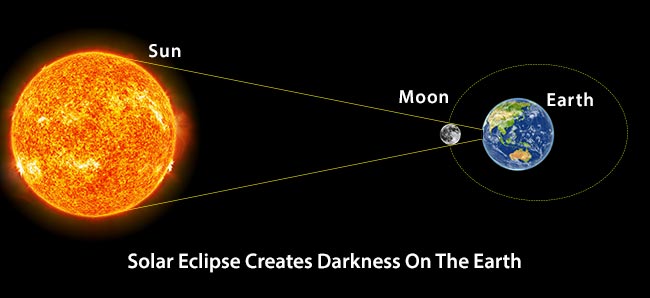
A solar eclipse can only occur when the moon passes between the sun and the earth. When this happens, the moon is referred to as a new moon. When the moon passes between the sun and the earth as shown in the figure, the sun’s rays are blocked and part of the earth is darkened.
Full Moon
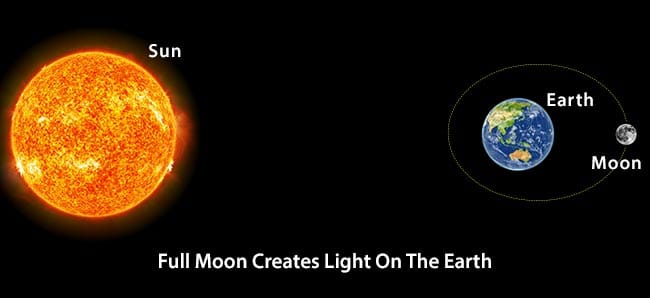
A full moon only occurs when the moon is behind the earth. The expression full moon means that it appears in the night sky as fully illuminated and completely round. This means the moon must be behind the earth, otherwise the light reflected off the moon would not be seen on earth.
Conclusion
We have already pointed out that a solar eclipse did not occur on the day Jesus died for a full moon in progress. An eclipse could not have occurred during Jesus’ crucifixion since the moon was in the wrong position. Thus natural events cannot explain what happened. Thus a supernatural event occurred. This miracle affims that Jesus Christ was and is God.