Bible Question:
Where in the New Testament does it describe the pastor's duties to his church?
Bible Answer:
What are the pastor’s duties to a church? From God’s viewpoint every pastor is an elder and every elder has a pastor’s heart. This is an important biblical truth because scripture recognizes men who are not in “full-time” ministry to be pastors too. In fact, any male who satisfies the qualifications of an elder is an elder. But he becomes an elder of his church when approved and recognized by that church.. Once an elder, he is always an elder until he disqualifies himself through sin or lack of faithfulness. Scripture never refers to a “term of office” for elders. Elders stop being elders when they are disqualified (1 Timothy 5:19-21).

What Are the Pastors’ Duties
List of Pastor’s Duties
A pastor’s responsibilities or duties are given in several key passages in the New Testament. There is also a previous question and answer that may be helpful. What are the responsibilities of elders and/or pastors? The chart below provides a summary.
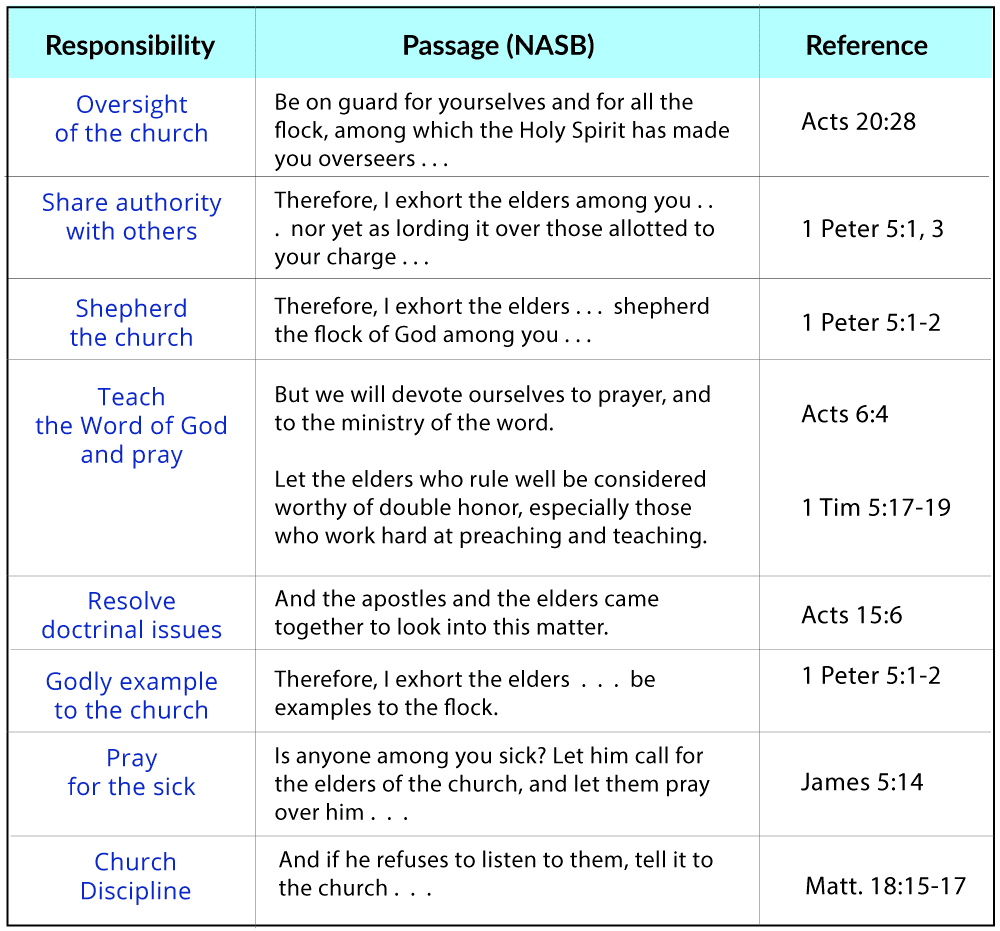
The Most Important Responsibility
Some years ago we visited a church to help them in the selection of a new pastor. At one point during the weekend, we asked them what they thought was the most important duty of a pastor. We gave them a list of possible duties: administration, Christian Education, church discipline, community service, counseling, evangelism, prayer, sermon preparation, social action, teaching/preaching, visitation in the home, weddings/premarital counseling, funerals, visiting the sick, and visitation in the home, as well as others. Then we asked them how many hours the pastor should spend on each one. The results were amazing. Most everyone said the pastor should spend most of his time in sermon preparation and teaching/preaching, but they thought he should spend only about 10 hours per week doing this. That told us that the leaders of this church did not really believe the duties of the pastor was to teach and preach. If they had, the number of hours should have been at least double. For an additional article dealing with the duties of a pastor, the selection of a pastor, and for a copy of the above mentioned questionnaire please read “Thoughts On Selecting A Pastor.” Another important article is “A Call: Teach The Bible.”
Many Christians believe the pastor should be an administrator for the church. They fail to realize that God did not give every pastor the spiritual gift of administration. It is common for churches to seek a pastor who is a great people person, an excellent administrator for the church, and an effective counselor, as well as a great preacher. But ten hours a week for sermon preparation and teaching/preaching is not enough. In fact, this church had missed the emphasis of the following two passages.
And the twelve summoned the congregation of the disciples and said, “It is not desirable for us to neglect the word of God in order to serve tables. But select from among you, brethren, seven men of good reputation, full of the Spirit and of wisdom, whom we may put in charge of this task. But we will devote ourselves to prayer, and to the ministry of the word.” Acts 6:2-4 (NASB)
Let the elders who rule well be considered worthy of double honor, especially those who work hard at preaching and teaching. 1 Timothy 5:17 (NASB)
In the first passage the apostles were being asked to do some church administration – to care for some widows. Now that is an important and loving ministry. But they responded by saying that this was not the most important priority for them. I am sure some in that church thought they were unloving and uncaring to these widows. But their greatest priority – greatest expression of love – was to be in prayer for them and to teach and preach the Word to them.
This is the same message in 1 Timothy 5:17. In the early church there were two types of elders. There were elders who were gifted in administration – “rule well” – and those who worked hard at teaching/preaching. In many churches the elders who rule well are called lay elders and the other elders are called pastors. However, Acts 20:17, 28 and 1 Peter 5:1-3 indicate that all elders are pastors even if their vocation and spiritual gifts are different. Some elders will naturally excel in administration and others in teaching and preaching.
In this passage the church is encouraged to give double honor to those who “rule well.” Some understand “double honor” as being money. If so, then the lay elders should be paid too and not just the pastors according to this passage. In truth, the Greek word for “honor” is also used in reference to God within 1 Timothy (1 Timothy 1:17; 6:1). The word typically means “honor.” Notice that the phrase “especially” has the sense of “most importantly” and not just the one who excels in preaching and teaching. Who receives the highest honor? It is the one who works hard at teaching and preaching. An elder who has the responsibility of teaching and preaching but forsakes that responsibility in order to excel in administration is not “especially” worthy of double honor. An elder who teaches and preaches is not necessarily worthy of double honor either, but the one who excels and works hard at teaching and preaching is worthy of double honor. The Greek word for “work hard” has the idea of being physically, mentally, and emotionally weary from study. Now that is working hard! To work only ten hours a week at digging in the sacred book is not working very hard.
Conclusion:
The most important duty of a pastor is to work hard at preaching and teaching. By his sermons and his teaching, he shows his love for God and for the congregation. It will be obvious in the messages a pastor preaches when he is not growing in his walk with God and is not spending many hours in scripture. The apostles did not have time for administration and neither do pastors today. In fact, some of the centralization of power with pastors would disappear if administrative duties were turned over to other elders and deacons The priority of the apostles was the teaching of the scriptures – the Bible. When the Bible is seriously taught book-by-book and verse-by-verse, Christians will be warned about sin, be encouraged in the faith, learn how to live the Christian life, and best of all discover the character of God.
Suggested Links:
A Call: Teach The BibleWho are the elders? Are they pastors?
Should the institutional church exist?
Thoughts On Selecting A Pastor
Is it right for pastors to get paid as a profession?
God's Design For The Church