When Napoleon Bonaparte was born in France in 1769, the world did not care nor was the world looking for his birth. But in 1793, the world began to notice him after he defeated the British army at the city of Toulon, France. The victories in his famous career are now recorded in the pages of history books. The births of other men such as Greece’s famous philosopher Socrates, Egypt’s priest Mantheo, India’s religious leader Gandhi, and China’s Shi Huangdi (221-204 B.C.) of the Oin dynasty, who built the Great Wall of China were not expected. But there is one birth and one death that should have been expected because it had been predicted for about 500 years. The prophecy was not a general one. It did not predict that the Messiah would just die sometime. It predicted His death within one month. The prophecy did not apply to someone who would die in some country, or to just anyone who would die in Jerusalem. It applied to only one person – a Jew who would die before the date of April 1, A.D. 33. The prophecy is found in Daniel 9:24-26a.

Prophecy of Daniel’s Sixty-Nine Weeks
The early church father Jerome indicates in his commentary on the book of Daniel that many individuals believed that Daniel 9:24-26a was a prophecy about the Messiah. The prophecy in Daniel 9:24-26a refers to 70 weeks. After the 69th week the prince or Messiah would die. It is important to note that the term “weeks” refers to a period of seven years, as will be explained later. Additionally, Jerome states that there were Jews who agreed that the prophecy of 69 “weeks” seemed to point to the era of Jesus.1
Julius Africanus, another ancient author, reported that Phlegon had stated, “And the calculation makes out that the period of seventy weeks, as noted in Daniel, is completed at this time.”2 In section XVI of Julius Africanus’ The Extant Fragments of the Five Books of the Chronography of Julius Africanus, we discover that he attempted a calculation of Daniel’s 69 weeks and concluded that the prophecy pointed to Jesus Christ. We will discover that this prophecy of Daniel is like a pointer that specifies a date after which the Messiah would die. In fact, the prophecy predicts that the Messiah would die after 69 “weeks.” No one today and no one at the time of the prophecy could have qualified to be the Messiah. Here is the first part of this incredible prophecy.
Seventy weeks have been decreed for your people and your holy city, to finish the transgression, to make an end of sin, to make atonement for iniquity, to bring in everlasting righteousness, to seal up vision and prophecy, and to anoint the most holy place. Daniel 9:24 (NASB)
The Seventy Weeks
The Hebrew word for “weeks” is sabua and it means a “period of seven” and can refer to seven days, weeks or years. In this passage sabua refers to “seven years” or a heptad. Today there is wide agreement among many scholars that this is the correct interpretation of sabua. This interpretation is supported by Daniel 9:2, where we are told that Daniel was reading the scroll of Jeremiah and discovered that the time was approaching for the Jewish captives to return to Canaan. Daniel 1 it tells us that Nebuchadnezzar had taken a group of Jewish captives from Canaan to Babylon in 604 B.C. Daniel 9:1-2 reveals that almost 70 years had elapsed since then, and it was about time for them to return to Canaan. God had allowed the captives to be deported because of the sins of their kings. The length of the deportation was determined by the number of sabbatical years that the Israelites had failed to observe (2 Chronicles 36:21; Jer. 34:12-22). God had commanded them to allow the land to be dormant every seventh year (Leviticus 25:4-5, 27-46). But they had failed to observe the command for seventy sabbath years, or 490 years. Consequently, God decreed that their captivity would last for 70 years. Consequently, Daniel would have understood the reference to “seventy weeks” in the prophecy to be 490 years.
Also, Genesis 29:20-30 makes it clear that it was customary among the ancient Jewish people to refer to a “week” as another way to refer to seven years. Genesis 29:20 tells us that Jacob served Laban for seven years in order to marry Rachel. Unfortunately, Laban was dishonest and refused to give Rachel to Jacob on his wedding night, even though she was the one for whom he had labored. Instead Laban gave Jacob his oldest daughter Leah. Jacob did not discover the problem until the morning. If we look at verse 30, we discover that Laban offers Rachel, his younger daughter, to Jacob if he will serve another “week.” Then at the end of the verse we are told that this “week” is “seven years.” This example demonstrates that the term “week” did mean “seven years” in the proper context.
Therefore, we conclude along with many others, ancient and modern, that the expression “seventy weeks” refers to “seventy periods of seven years” or “490 years.” Therefore, Daniel 9:24 tells us that 70 weeks or 490 years had to elapse before sin would be eliminated and everlasting righteousness would occur. That means the end of the world. We will explore this more in our next study.
Sixth-Nine Week Prophecy
The prophecy of 70 weeks contains three prophecies. The first prophecy is the focus of this study. It refers to a period of 69 weeks. The last two prophecies are about the tribulation and the end of the world. They will be explored in the next study.
So you are to know and discern that from the issuing of a decree to restore and rebuild Jerusalem until Messiah the Prince there will be seven weeks and sixty-two weeks; it will be built again, with plaza and moat, even in times of distress. Then after the sixty-two weeks the Messiah will be cut off and have nothing . . . Daniel 9:25-26a (NASB)
Here we are told that the prophecy of 69 weeks (7 weeks plus 62 weeks) starts on the date a decree is issued to restore and rebuild the city of Jerusalem and ends when Messiah the Prince is cut-off and has nothing, that is, he dies.
In order to understand this prophecy, we will perform three calculations starting with the end date and concluding with the start date. That is, we will determine the end date or the fulfillment date of the prophecy. Next, we will determine the length of time predicted by the prophecy between the start and end dates. Then we will determine the start date of the prophecy.

End Date of The Prophecy — April 1, A.D. 33
The end date corresponds to the date the Messiah the Prince is cut-off. Therefore, when did Jesus Christ die? We will start by determining when He was born, then how long He lived, and finally when he died. It has been commonly believed and taught that Jesus was born in 6 B.C. or 4 B.C. But recent facts indicate that He most likely was born in 2 B.C. We derive this conclusion from historical data, the gospels, and from statements recorded by the early church fathers who state that Jesus was born about 2 B.C.
Date of Christ’s Birth
Those who believe that Jesus was born in 6-4 B.C. do so because they believe that Herod the Great died in 4 B.C. Herod the Great was the king who was alive at the time that Jesus was born. He was the one who killed the children under 2 years of age in Matthew 2. Jack Finegan has published a monumental book that strongly indicates Herod the Great did not die in 4 B.C. but around 1 B.C.3 That changes the date of Jesus’s birth.
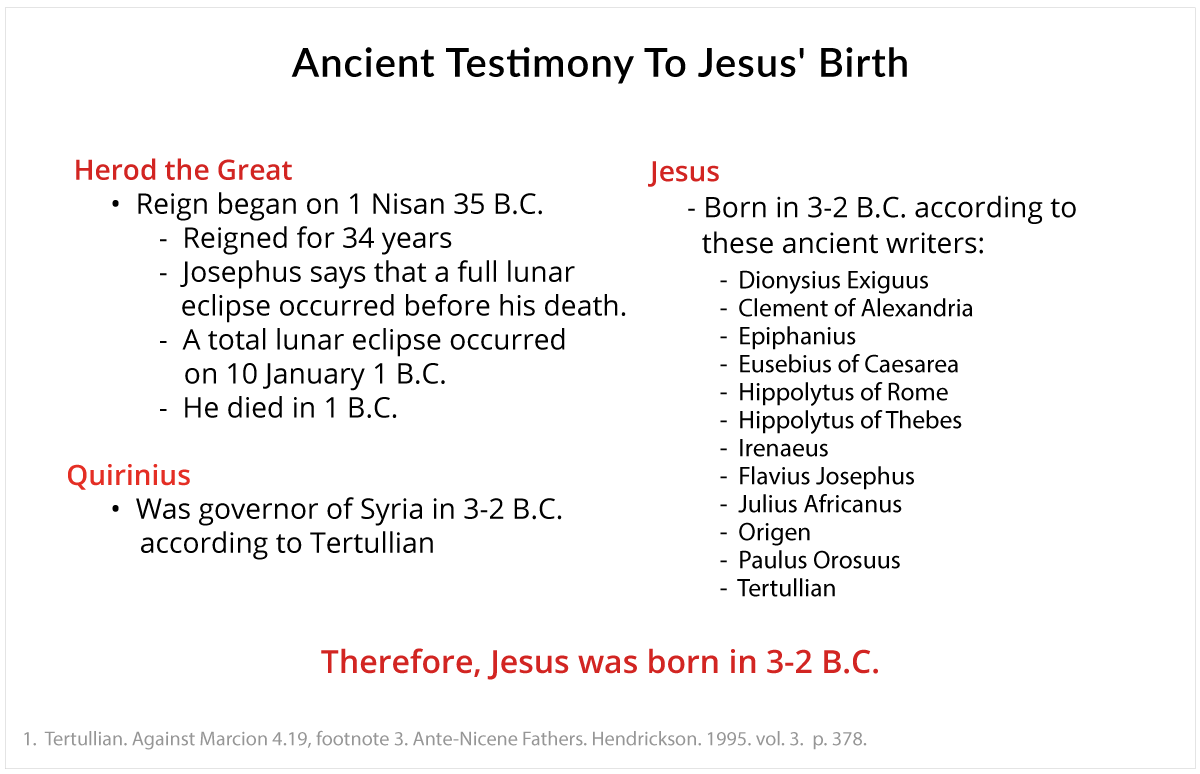
Historical data reveals that Herod died just after a full lunar eclipse.4 A lunar eclipse occurred on January 10, 1 B.C. It was total and lasted longer than the lunar eclipse on March 13, 4 B.C.5 Josephus and astronomy support this claim. Finegan also suggests that the governor Quirinius of Luke 2:2 reigned in 3-2 B.C.6 Wieseler provides supporting evidence that Publius Sulpicius Quirinius was the rector or acting governor over Syria from about 4 B.C. to 1 B.C.7

If we look at the reigns of other kings, governors, and the tenure of Israel’s chief priests around the time Jesus lived, we discover that Jesus had to be born sometime around 3-2 B.C. Early church fathers such as Eusebius, Hippolytus of Rome, Irenaeus, Julius Africanus, Origin, and Tertullian all claimed that Jesus was born about 3-2 B.C. The Jewish historian Josephus also adds his weight to the date. Collectively, this information suggests that Jesus was born 3-2 B.C.
Length of Christ’s Life
Now how long did Jesus live after His birth? The apostle Luke helps answer the question when he tells us that Jesus started His ministry at about the age of 30 years.
And when He began His ministry, Jesus Himself was about thirty years of age . . . Luke 3:23 (NASB)
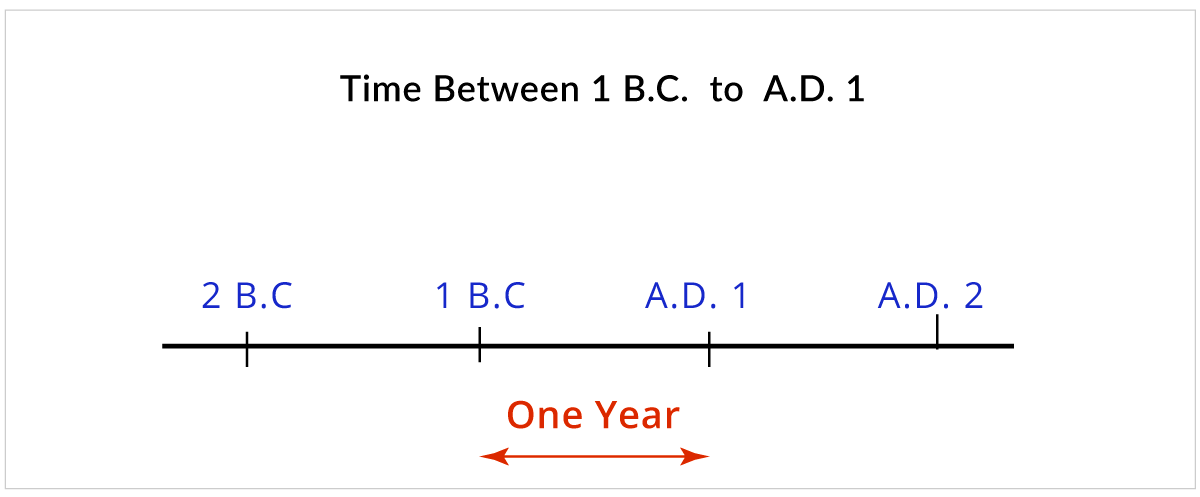
This means that Jesus could have started His ministry when He was 29 years of age or maybe when he was 31 years of age. This gives us a range of dates for the start of His ministry from 27 A.D. to 30 A.D. (remember there is only one year from 1 B.C. to 1 A.D.). Since Jesus’ ministry lasted somewhere between three to four plus years, Jesus’ ministry could have lasted until He was 30 years or 34 years of age.
Possible Years of Christ’s Death
Our first clue as to the time of Jesus’ death comes from John 2:20 where we are told that construction of the temple had already been in process for 46 years. Since construction of the temple started in 20/19 B.C. that means Jesus’ ministry began after A.D. 27/28. We also know from Matthew 26:3 that Jesus ministered while Caiaphas was the high priest (A.D. 18 to A.D. 37) and Pontius Pilate was governor (Luke 3:1) from A.D. 26 to A.D. 36. Consequently, we conclude that Jesus’ ministry and death occurred between A.D. 30 and A.D. 36. However, it is highly doubtful that Christ lived past A.D. 34 given the year of His birth and the length of His ministry. Now we have the range of years in which Jesus died, but not the exact day.

Exact Year of Christ’s Death
Next, we need to know on what day of the week Jesus died? This will help us determine the actual year of His death. The New Testament tells us that Jesus died on a Friday or the day of preparation for the Sabbath (Matthew 27:62-63, Mark 15:42-43, Luke 23:54-55 and John 19:14, 31). Luke 23:44-46 says that Jesus cried out and died at the ninth hour or about 3 p.m. in the afternoon. The following passage also reveals that Jesus died on the eve of the Sabbath or Friday.
And behold, a man named Joseph, who was a member of the Council, a good and righteous man (he had not consented to their plan and action), a man from Arimathea, a city of the Jews, who was waiting for the kingdom of God; this man went to Pilate and asked for the body of Jesus. And he took it down and wrapped it in a linen cloth, and laid Him in a tomb cut into the rock, where no one had ever lain. And it was the preparation day, and the Sabbath was about to begin. Luke 23:50-54 (NASB)
That is, Christ died before the Sabbath and before the Passover observance began.
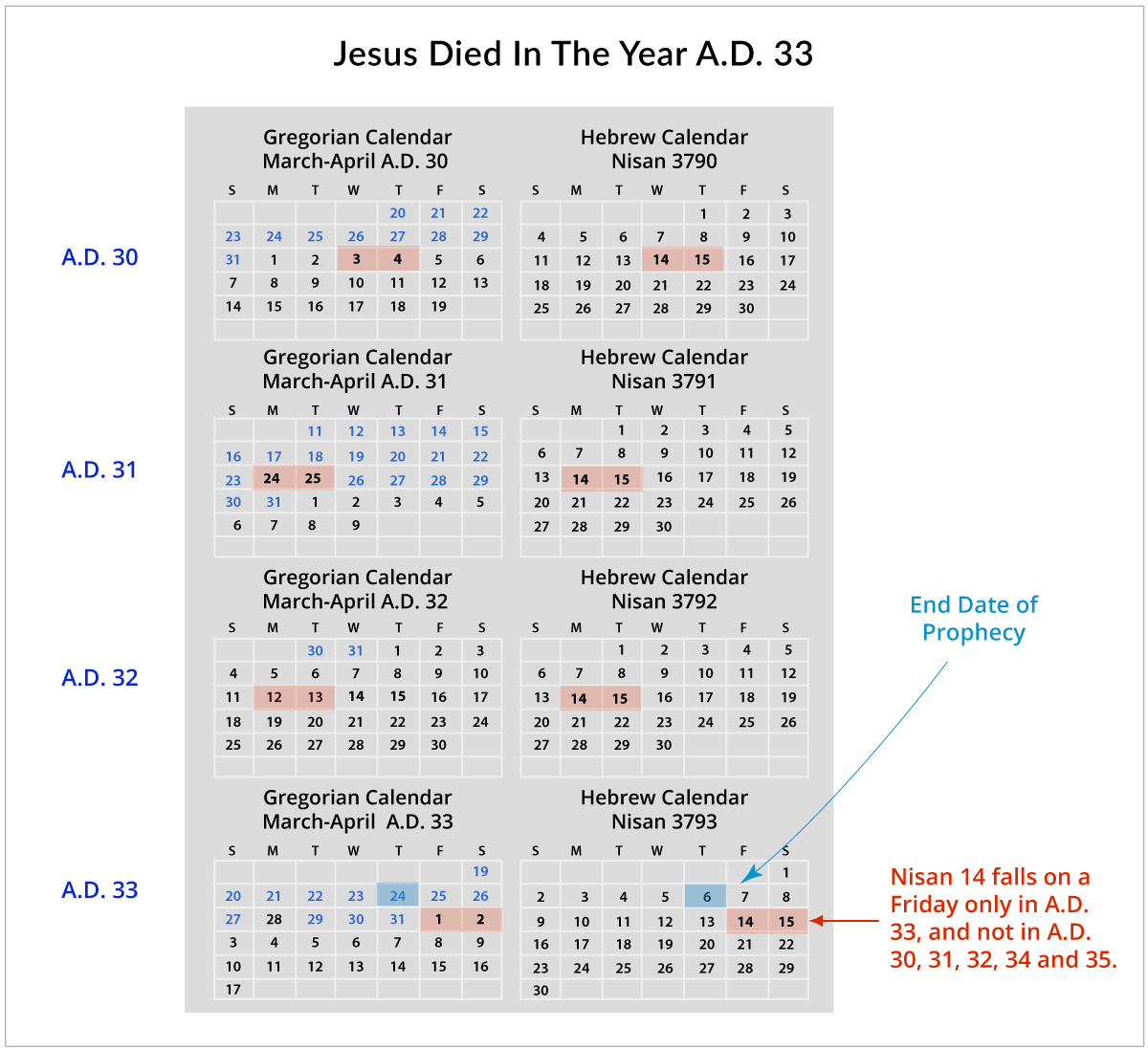
This means that when Jesus died, He died on the day of Passover which is Nisan 14. Passover starts at twilight on Nisan 14 (Exodus 12:6-14; Leviticus 23:5; Numbers 9:5, 28:16-17). Officially, it started at 6:00 p.m. The Jewish Passover continues into Nisan 15. Since Passover occurs during a full moon we can determine when Nisan 14 occurred on a Friday between the years of A.D. 30 to A.D. 36. We can verify when the full moon occurred on a Friday within the range of those years using sophisticated astronomy software8 or a quality Jewish-to-Gregorian calendar converter.9 The results show that Nisan 14 occurred on a Friday in only three years: A.D. 26, A.D. 33 and 36. A full moon did not occur on any Friday that was also the day of Passover in the years of A.D. 30, 31, 32, 34 or 35. It is important to note that the monthly calendar for Nisan in the year A.D. 34 and 35 are identical to that in A.D. 31 and A.D. 32. That means Nisan 14 did not occur on any Friday between A.D. 30 and A.D. 35, except in the year A.D. 33. That leaves only one year in which Jesus could have died – A.D. 33. Therefore, Jesus died on April 1, A.D. 33 in the Gregorian calendar. In the Julian calendar the date is April 3, A.D. 33 and in the Jewish calendar it is Nisan 14, 3793. Now we know the end date of the prophecy.

Elapse Time of The Prophecy — 69 Weeks
Next we need to determine how much time was predicted to occur between the start and end date of the prophecy. The predicted time of the prophecy is given by the statement “seven weeks and sixty-two weeks,” because Daniel 9:25-26 has told us that this is the elapsed time between the start date, “issuing of a decree to restore and rebuild the city of Jerusalem”, to the end date, “until Messiah the Prince is cut-off and have nothing” is a sixty-nine week period of time.
The reader should understand that the phrase “sixty-two weeks,” in verse 26, follows the phrase seven weeks. Some have attributed special significance to the “seven weeks” period or 49 years, but the book of Daniel does not tell us. It is only creative guess work to conclude that there is some special significance. Therefore, 69 weeks has elapsed when we are told that “Messiah the Prince is cut-off and have nothing.”
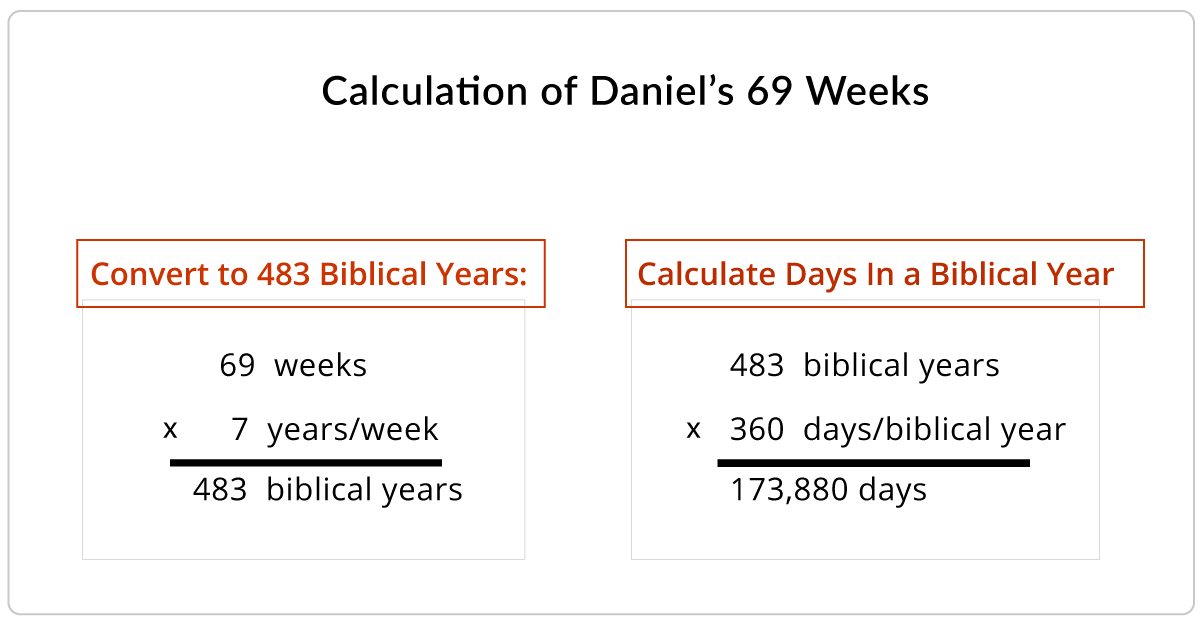
Second, we have already discovered from Daniel 9:24 that a “week” in this passage refers to a seven year period. Consequently, the 69 weeks refers to 483 years (69 weeks x 7 years/week).
At the end of the 483 years, the prophecy states that the Messiah would be cut off and have nothing. The Hebrew word that is translated as “cut-off” can also mean “to kill, to eliminate, or to permit to perish.” The wording of the Hebrew text is also important. The phrase “have nothing” is actually one word that means “not.” The message is clear. The Messiah will die after the 69 weeks. He will cease to exist. He will be “not.” This means that the Messiah would die 483 years after the decree to restore and rebuild Jerusalem.
Now we must convert the 483 biblical years into our present twentieth century Gregorian calendar. A biblical year contains 30 days per month or 360 days per year. This fact can be determined by comparing Genesis 7:11 and Genesis 8:4. In Genesis 7:11 we are told that the great flood that occurred during Noah’s life started on the second month and the seventieth day. Genesis 8:4 tells us that the flood ended on the seventh month and the seventieth day, and Genesis 7:24 says that the flood lasted for 150 days. Since we are told that the flood lasted for five months as well as 150 days, this means that the biblical calendar contains 30 days per month or 360 days per year. We obtain the same conclusion by comparing Revelation 12:6 and 13:5.
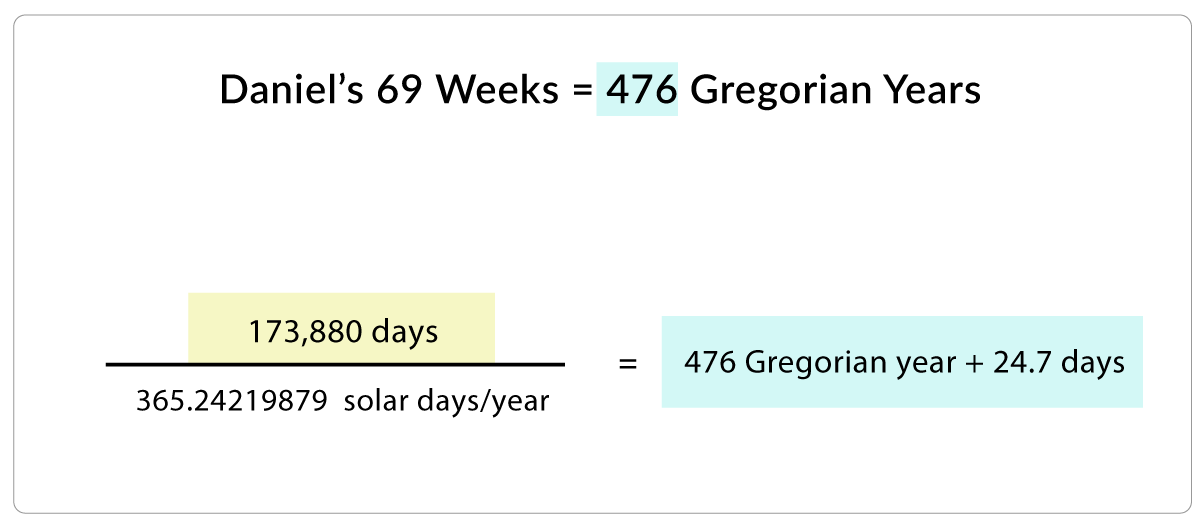
Now we need to convert the biblical years into Gregorian years. Therefore, we multiply the 483 biblical years by 360 days per year and we obtain 173,880 days. This is the number of days from the start of the prophecy to the end of the prophecy. Next we want to determine how many Gregorian years are represented by these 173,880 days. Since there are 365.24219879 days in a Gregorian year we divide the 173,880 days by 365.24219879 and we discover that the 483 biblical years equals 476 years and 24.7 days or approximately 25 days in the Gregorian calendar. Therefore, the predicted time from the start to the end of the prophecy is 476 Gregorian years, and 25 days.
Start Date of The Prophecy
At this point we have determined the end date of the prophecy and the time between the start and end dates of the prophecy. Now we want to determine the start date of the prophecy. This will be done in two steps. First, we will examine three decrees in the Old Testament, one of which is the official start date of the prophecy. Second, we will examine the month given in one of those decrees to determine the precise time of the decree.
Which Decree Is Correct?
The first step in determining the start of the prophecy is to determine which decree Daniel 9:25 refers to.
So you are to know and discern that from the issuing of a decree to restore and rebuild Jerusalem until Messiah the Prince there will be seven weeks and sixty-two weeks; it will be built again, with plaza and moat, even in times of distress. Daniel 9:25 (NASB)
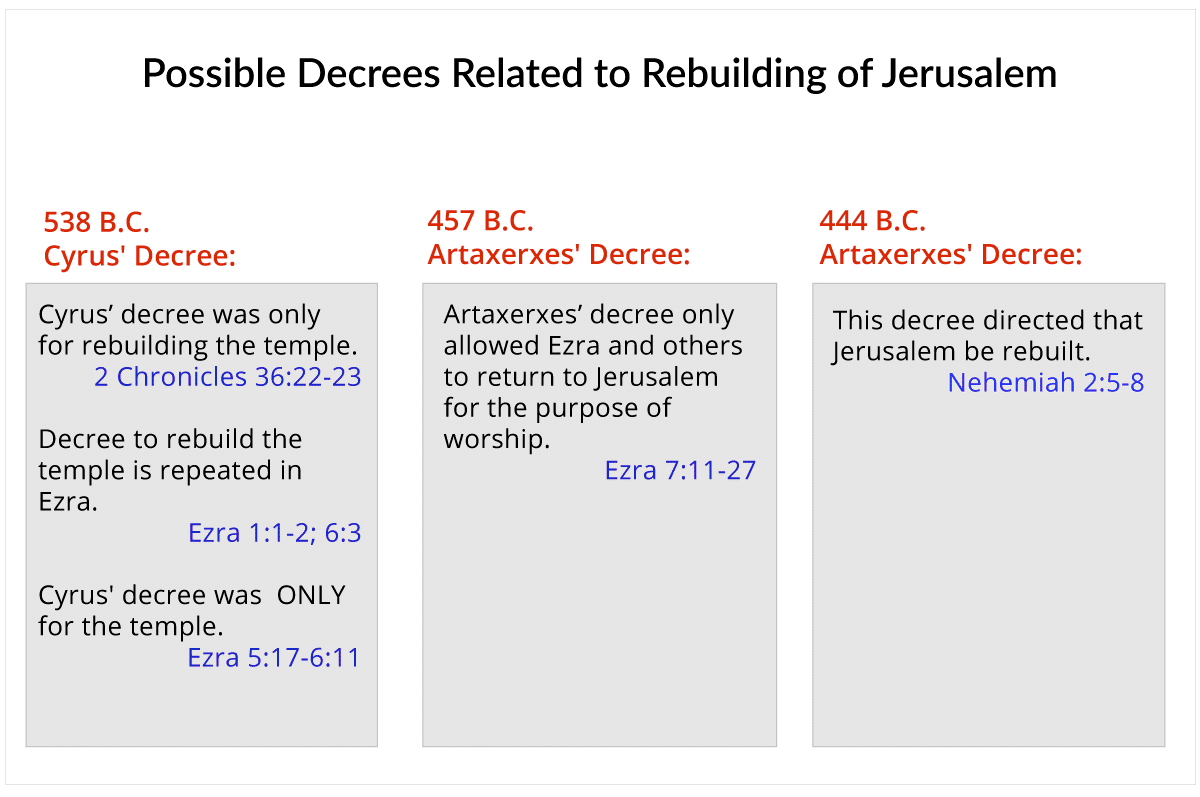
There are three possible decrees in scripture to be investigated. The first is Cyrus’ decree of 538 B.C., then Artaxerxes’ decree in 457 B.C. and Artaxerxes’ decree of 444 B.C. There are advocates for each view. We shall consider each separately.
Cyrus’ Decree of 538 B.C.
The decree of 538 B.C. was issued by Cyrus, the first king of Persia, during his first year as king (2 Chronicles 36:22-23). It should be noted that the decree as described in 2 Chronicles 36:22-23 does not include a directive to rebuild the city but only the temple. To believe that the city is included assumes facts not stated in the text.
Some advocates claim that Isaiah 44:26-28 supports the view that Cyrus’ decree in Ezra 1:1-2; 6:3 included the rebuilding of Jerusalem.
It is I who says of Cyrus, “He is My shepherd!
And he will perform all My desire.”
And he declares of Jerusalem, “She will be built,”
And of the temple, “Your foundation will be laid.”
Isaiah 44:28 (NASB)
But a careful examination of the verse reveals that Isaiah 44:28 only says that God refers to Cyrus as “My shepherd” and He will rebuild the city and the temple. The Holman Christian Standard Bible (HCSB) translated this verse more accurately,
Who says to Cyrus, “My shepherd,
he will fulfill all My pleasure”
and says to Jerusalem, “She will be rebuilt,”
and of the temple, “Its foundation will be laid.”
Isaiah 44:28 (HCSB)
Note that God is declaring His actions and not the actions of King Cyrus. There is ambiguity in some translations.
Isaiah 45:13 is probably the strongest passage supporting the concept that Cyrus’ decree may have included the rebuilding of the city, but the questions must be asked: What does “rebuild the city” mean, and when was the rebuilding to occur? At first this might appear to be an attempt to avoid the obvious; but it is very clear in Nehemiah 2:11-17 that the temple was built first and not the city of Jerusalem. Nehemiah 2:11-17 is important since it describes the city during the reign of King Artaxerxes who ruled after Cyrus (Nehemiah 2:1). In the passage we are told that the city is desolate and the walls are “broken down.” The Hebrew text in Nehemiah 2:13 states explicitly that the walls and gates were in utter ruin. Nehemiah 2:17 is also very significant since it states that Jerusalem is desolate and the gates were burned by fire. The Hebrew word for “is desolate” can also be translated as “to lay waste” or “to lay in ruins.” If Cyrus’ decree included rebuilding the city and the walls, why is the city in ruins during Artaxerxes’ reign? It is very possible that Isaiah 45:13 simply means that during the Persian rule the city of Jerusalem will be rebuilt. Therefore, Cyrus’ decree is rejected.
Artaxerxes’ Decree of 457 B.C.
Artaxerxes I reigned after Cyrus from 464 to 424 B.C. He was the sixth Persian king. Artaxerxes’ decree of 457 B.C. as given in Ezra 7:11-27 does not refer to a rebuilding of any city but to a decree allowing Ezra and others to return to Jerusalem for the purpose of worship. Some have claimed that Ezra 9:9 indicates that the 457 B.C. decree did include the rebuilding of the city, but once again a careful examination reveals that Ezra had a thankful heart for the Persian kings allowing them to rebuild the temple.
Artaxerxes’ Decree of 444 B.C.
Artaxerxes I issued another decree in 444 B.C. which is given in Nehemiah 2:1-8.
And it came about in the month Nisan, in the twentieth year of King Artaxerxes . . . And I said to the king, “If it pleases the king, and if your servant has found favor before you, send me to Judah, to the city of my fathers’ tombs, that I may rebuild it.” . . . And I said to the king, “If it please the king, let letters be given me for the governors of the provinces beyond the River, that they may allow me to pass through until I come to Judah, and a letter to Asaph the keeper of the king’s forest, that he may give me timber to make beams for the gates of the fortress which is by the temple, for the wall of the city, and for the house to which I will go. And the king granted them to me because the good hand of my God was on me. Nehemiah 2:1-8 (NASB)
Only Nehemiah 2:1-8 and the following verses within the book of Nehemiah provide solid evidence that this decree was issued for the purpose of rebuilding the city and the walls. Notice that Nehemiah 2:17 clearly states that the city was desolate.
Then I said to them, “You see the bad situation we are in, that Jerusalem is desolate and its gates burned by fire. Come, let us rebuild the wall of Jerusalem so that we will no longer be a reproach.” Nehemiah 2:17 (NASB)
Nehemiah 3 indicates that the Fish, Old, Valley, Refuse, Fountain, Water, Horse, East, Inspection, and Sheep gates and walls were all rebuilt. The rebuilding activity of the gates and walls are mentioned one-by-one. Nehemiah 4 describes the rebuilding of the wall and Nehemiah 6:15 says that the wall was finally completed. Then Nehemiah 11:1 tells us that the rest of the people were to be brought to the city so that it could be repaired.
Why would Artaxerxes issue another decree in 444 B.C. if one had already been issued in 538 B.C. or 457 B.C.? This implies that the 538 B.C. and 457 B.C. decrees were not edicts to restore and rebuild Jerusalem. Therefore, we must conclude that Nehemiah 2 and following chapters refer to the rebuilding of the city and the wall. In summary, Nehemiah 2:1-8 documents the decree of interest, the utter ruin of the city and dilapidated walls, and the rebuilding of the city and its walls.
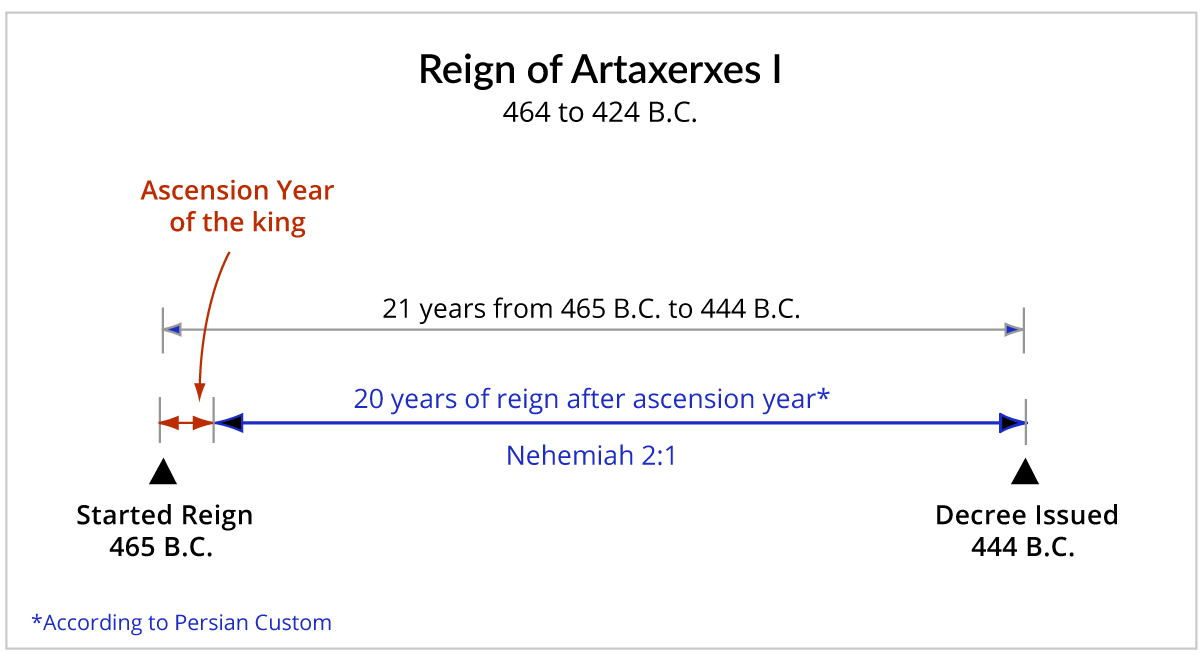
What is the date of Artaxerxes’ decree recorded in Nehemiah 2:1-8? To answer the question, we will start by noting that Artaxerxes started ruling Persia in 465 B.C. In reality the start date of his reign as king was 464 B.C. since the Babylonians and Medo-Persians referred to a king’s first year as the ascension year.10 Therefore, a king’s ascension year should not be counted as part of the official royal reign of Artaxerxes. Since Nehemiah 2:1 indicates the time is the 20th year of Artaxerxes, the start date of the prophecy is 444 B.C.11
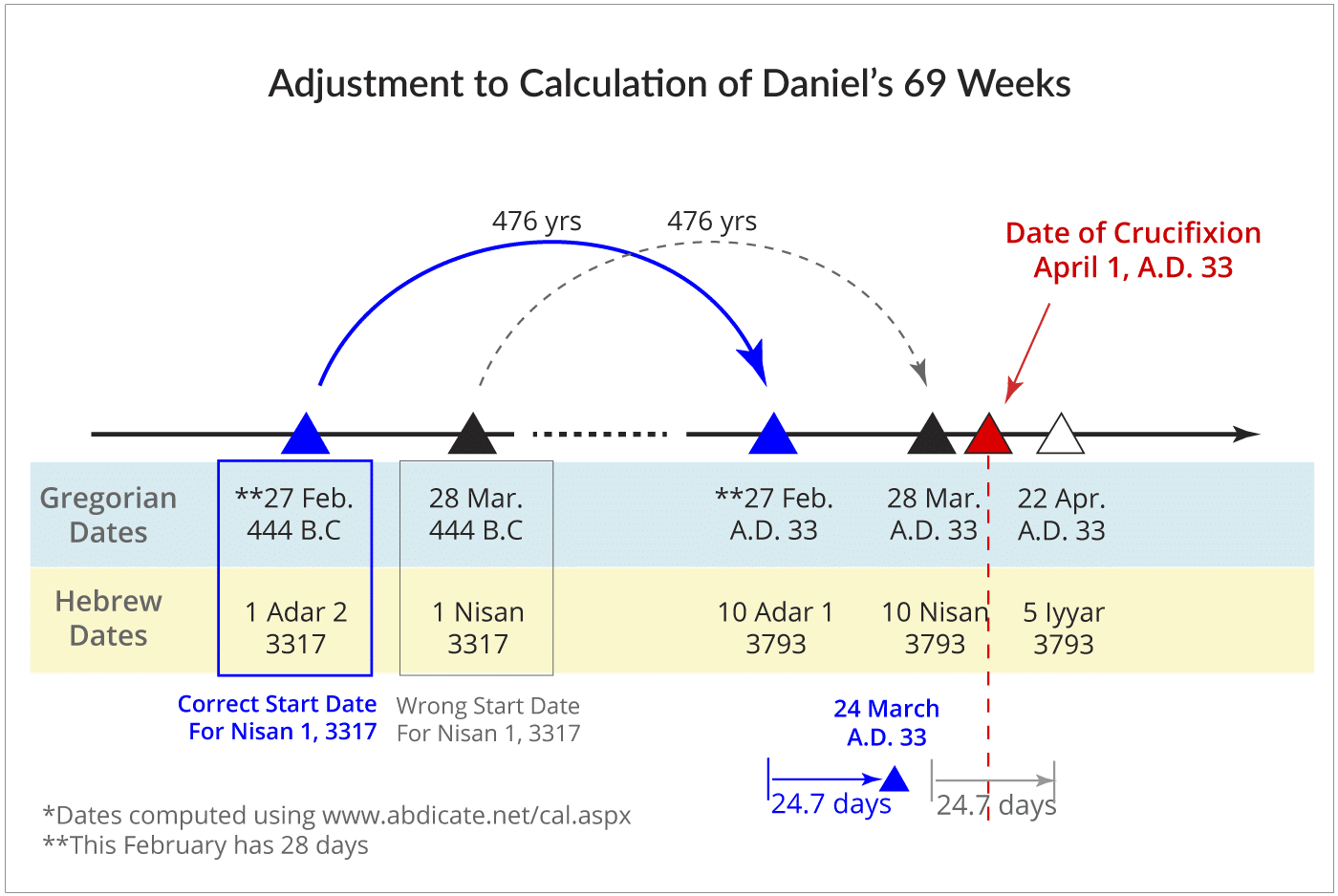
Therefore, when Nehemiah says the decree was issued in the 20th year of King Artaxerxes, it is actually the 21st year in which Artaxerxes ruled the Persian empire or 444 B.C. It is also important to note that when the day of the month was not mentioned, it was customary to assume the first day of the month. Therefore, Artaxerxes issued the decree that Daniel 9:25 refers to for the restoration and rebuilding of the city of Jerusalem as 1 Nisan, 3317, in the Jewish calendar, or March 28, 444 B.C. in the Gregorian calendar or April 2, 444 B.C. in the Julian Calendar.
Critical Issue With Hebrew Calendar
Now we must discuss a critical issue related to the Jewish calendar. That issue is how was Nisan 1 determined in the Babylonian and Hebrew calendar? The heart of the issue depends upon how the calendar was corrected to remove inaccuracies in the calendar. Since the Jewish calendar was based on the orbit of the moon and not the orbit of the sun, the Jewish calendar was a lunar calendar. What follows next is a necessary and important brief history lesson on the Jewish calendar.
Hebrew Calendar Before Babylonian Invasion
Before the Babylonian invasion of the Kingdom of Judah in 605 B.C. the Jewish calendar had twelve months and the first month of their calendar year was called Abib (Exodus 12:2; 13:4; 34:18; 40:2; Deuteronomy 16:1). The second month of the calendar was called Ziv (1 Kings 6:1, 37). The seventh month was called Ethanim (1 Kings 8:2). Bul was the eighth month of the calendar (1 Kings 6:38).
Hebrew Calendar After Babylonian Invasion
In 605 B.C. the Babylonians invaded Judah, defeated the nation of Israel and took many captive. 2 Kings 24:10-20 describes the invasion of the Babylonian army into the city of Jerusalem, Jehoiachin was taken captive and a new king, Zedekiah, was installed. The new king was the uncle of the Babylonian king (2 Kings 24:17). He was a puppet king. After the invasion the names of the months in the Jewish calendar changed. For example, in Nehemiah 2:1 and Esther 3:7 we discover that the name of the first month is now Nisan. The names of other months were changed, such as Sivan, the third month (Esther 8:9). Elul is the sixth month (Nehemiah 6:15). Kislev is the eighth month (Nehemiah 1:1). The tenth month is Tevet (Esther 2:16). Shevat is now included (Zechariah 1:7). Adar is the twelfth month (Ezra 6:15; Esther 3:7, 13; 8:12; 9:1, 15, 17, 19, 21). Note that Nehemiah 1:1 the Hebrew word that is translated as Nisan in the Bible was a word borrowed from the Babylonian month of Nisanu.12
In summary, the Jewish calendar changed as a result of the Babylonian conquest and captivity. This point is very important since the month Abib became Nisan and the month Ethanim became Tishri. That is, the Jews followed the Babylonian calendar.

Babylonian and Hebrew Calendars Compared – Similarities
Both the Babylonian and Hebrew calendar were lunar calendars and were off by approximately 11.2468 days in non-leap years in comparison to the solar year. Consequently, an additional month was added to the calendars periodically every two or three years to make the calendar more accurate. The insertion of this extra month, called an intercalary month, occurred in the 3rd, 6th, 8th, 11th, 14th, 17th and 19th years of the Metonic cycle.13, 14 This cycle is referred to technically as an intercalary cycle of 19-year years. It is composed of 12 common years and seven leap years. The additional months are added in the seven leap years.
A quick calculation demonstrates that over nineteen years the calendar is off by 206.775 days (11.2468 days/year x 19 years = 213.6892 days). By adding seven months of an average of 30 days the calendar is almost corrected (7 months x 30 days/month = 210 days). Then it was off by only 3.6892 days (213.6892 days – 210 = 3.6892 days).

Babylonian and Hebrew Compared – Differences
While the names of the months in the Babylonian and Hebrew calendars are identical, except the spelling, there were differences. First, Parker and Dubberstein have demonstrated from archeological data that the Babylonian lunar calendar started with the reign of Nabonassar in 747 B.C. in the month of Nisan 1.15
Hebrew Civil Calendar Used In Nehemiah 2:1
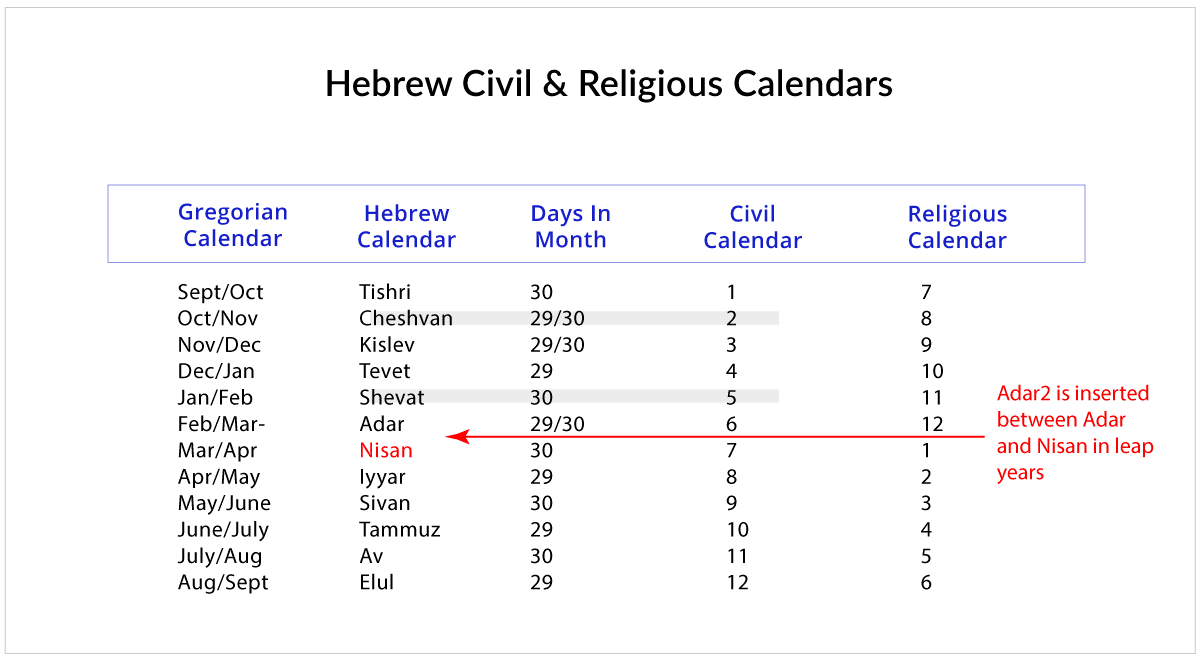
The Hebrews had both a civil and a religious calendar which were shifted by six months. The religious calendar started with Nisan 1 (Exodus 12:2; Leviticus 23:7). The civil calendar started with the month of Tishri 1. In the tractate, Rosh Hashanah of the Babylonian Talmud very explicitly states that the regnal year of kings began on Nisan 1.16 This may seem to be incorrect, but we must remember that Israel was a theocracy.
Observe that when Nehemiah 2:1 refers to Nisan as the date of the decree to rebuild and restore the city of Jerusalem, it is referring to the middle of the Jewish civil calendar since Nehemiah 1:1 states that the king was reigning in the month of “Chislev, in the twentieth year.” Chislev is an alternate name for Kislev. The twentieth year of King Artaxerxes occurred in both Chislev (Nov./Dec.) and Nisan (Mar./Apr.). That is, the civil year was Tishri-to-Tishri. The two calendars were offset by six lunar months.
This reveals that the author of Nehemiah is using the Hebrew civil year to track the reign of Nehemiah and not the Babylonian calendar.17 Therefore, updates to the civil calendar are what we are interested in.

Uncertainty Timing of Nisan 1, 444 B.C.
Parker and Dubberstein indicate that based on extensive archeological data that the Babylonian years of 445 B.C. and 443 B.C. were intercalary years or leap years in which the Babylonian calendar was updated by the intercalary month of Addaru II, just prior to Nisanu. Consequently, we discover that the Babylonians did not recognize the year of 444 B.C. was a leap year.18 That is, Nisanu 444 B.C. was not preceded by the intercalary month of Addaru II. The correction did not occur until the following year of 443 B.C.
It is highly unlikely that the Hebrew calendar differed from the Babylonian calendar since they were still ruled by the Medo-Persians and under the rule of King Artaxerxes I. This means the Hebrew calendar of 444 B.C. would not have had the additional intercalary month of Adar 2 inserted before Nisan. This is contrary to modern Hebrew calendar software which assumes that 444 B.C. is a leap year and adds Adar 2 before the month of Nisan. Modern Hebrew calendar calculations are based on a formal process that was adopted later.19 Consequently, modern Hebrew calendar software computes backwards into the B.C. era and concludes that 444 B.C. was a leap year, but the archeological data indicates that this did not occur.
Parker and Dubberstein provide a great amount of archeological data that proves there were some significant errors in the updates to the Babylonian calendar. Here is a concluding comment,
These letters also make it clear that no established system which fixed the seven interactions [intercalary months] at definite points within the nineteen-year period existed at the beginning of the Persian period . . .
In the fourth century — in 367 B.C. according to our scheme but possibly as early as 383 B.C. — the intercalations became standardized, and the nineteenth-year cycle thus came into being.20
Note that the standardization occurred after the year of 444 B.C. That is, we should not be surprised that irregularities occurred in the year of 444 B.C.
The Jewish Encyclopedia reports that inaccuracies also occurred in the Hebrew calendar.
Every two or three years, as the case might be, an extra month was intercalated. The intercalation seems to have depended on actual calculation of the relative lengths of the solar and lunar years, which were handed down by tradition in the patriarchal family. Moreover, it was possible to judge by the grain harvest. If the month of Nisan arrived and the sun was at such a distance from the vernal equinox that it could not reach it by the 16th of the month, then this month was not called Nisan, but Adar Sheni (second).
On the evening before the announcement of the intercalation, the patriarch assembled certain scholars who assisted in the decision. It was then announced to the various Jewish communities by letters. To this epistle was added the reason for the intercalation. A copy of such a letter of Rabbi Gamaliel is preserved in the Talmud (Sanh. xi. 2).
The country people and the inhabitants of Babylonia were informed of the beginning of the month by fire-signals, which were readily carried from station to station in the mountain country. These signals could not be carried to the exiles in Egypt, Asia Minor, and Greece, who, being accordingly left in doubt, celebrated two days as the new moon.21
The Sanhedrin tract of the Talmud reveals that sometimes Adar 2 or an intercalary month was skipped altogether and implemented the next year.
But we are not . . . to suppose that Nisan was always officially fixed by the strict astronomical rule just mentioned. The actual practice is . . . represented by the Talmudic tract Sanhedrin, 10b-13b, according to which the Sanhedrin, when considering whether to intercalate or not, might have regard to the state of the roads, the bridges, and the Passover ovens, to the possibilities of pilgrims who had already started arriving in time for the Passover, to the growth of the kids, lambs, and pigeons, of the corn and of the fruit, and to the number of days that had to elapse before the equinox. According to some rabbis, intercalation was to be avoided in a year of famine or in a sabbatical year, and a court might be influenced by the fact that the next year would be, or the last had been, a sabbatical year. We must, therefore, allow some margin of uncertainty in selecting the month which we are to regard as having been Nisan in a particular year.22
Today computers are used to calculate the correct month, day and year of events back into the 7th and 4th century B.C. based on mathematical algorithms. Those mathematical equations do not allow for irregularities in the actual updates to the calendar. Therefore, in a study such as this one, the mathematical equations will not give us the correct calendar information.
Jack Finegan captures the problem with this brief comment,
. . . caution is advised in the use of calendars and astronomy for chronological purposes.23
That is, sophisticated Hebrew calendars most likely will not give the correct calendar information about the actual day on which Nisan 1 occurred before the 4th century B.C. Therefore, it is an error to conclude that modern Hebrew calendar software can be trusted to accurately report what actually occurred in the year of 444 B.C.
Consequently, it is concluded that the Babylonian archeological data will be trusted and not modern Hebrew calendars to give us the start date of Nisan 1, 444 B.C. Further, we conclude that the Babylonian and Hebrew years of 444 B.C. were not considered to be leap years in that year. Therefore, the month of Nisan in the year of 444 B.C. was proceeded by the additional intercalary month Adar 2.

As a result, the start date of Nisan 1, 444 B.C. or Nisan 1, 3317 was declared to have started on February 27, 444 B.C. in the Gregorian calendar. The February 27, 444 B.C. date results from observing that the month of Adar 2 which contains 29 days must be manually subtracted from Nisan 1, 444 B.C. to obtain the correct day and month in the Hebrew calendar since the Babylonian and Hebrew calendars are off by one month compared to the modern Babylonian and Hebrew computerized calendars. Modern computerized Hebrew calendars assume that the month Nisan in the year 444 B.C. occurred per their algorithms. But the month of Nissan in 444 B.C. started 29 days earlier. That corresponds to the first day of the month of Adar 2 in modern computer algorithms. Therefore, to compensate we must use the date of 1 Adar 2, 3317 in the Hebrew calendar. This pulls Nissan 1 backward and the date corresponds to Nisan 1 is February 27, 444 B.C.

Conclusion
Since the length of the prophecy is 476 years and approximately 24.7 days, we will add 476 years to 444 B.C. and obtain February 27, A.D. 33, in the Gregorian calendar. Remember that there is only one year between 1 B.C. and A.D. 1.
Next we add 24.7 days and arrive at March 24, A.D. 33 in the Gregorian calendar, or Nisan 6 in the Jewish year of 3793.24 Note the month of February in A.D. 33 has only 28 days. The date of Nisan 6, 3793, corresponds to the Thursday before Jesus’ betrayal by Judas. Note that Nisan 6 began on Wednesday evening at 6:00 pm since the Jewish day started at 6:00 pm. So, Nisan 6 occurs during the morning and afternoon of March 24, and Nisan 7 begins at 6:00 pm. Nisan 6 may also correspond to the day the Chief Priest and Pharisees finally gave orders to report Jesus to them so that they could murder Him (John 11:47-53, 57).
Now the chief priests and the Pharisees had given orders that if anyone knew where He was, he was to report it, so that they might seize Him. John 11:57 (NASB)
Now we will check the accuracy of this date by checking the timeline of the last week before Jesus’ crucifixion.
The date of Nisan 6, 3793 or March 24, A.D. 33 corresponds to the Thursday before Jesus’ Triumphal Entry into Jerusalem. According to John 12:1 Jesus arrived at the home of Mary, Martha and Lazarus six days before the Triumphal Entry, or on Saturday, Nisan 8. The Triumphal Entry occurred on Monday, Nisan 10. Jesus died on Friday, Nisan 14.
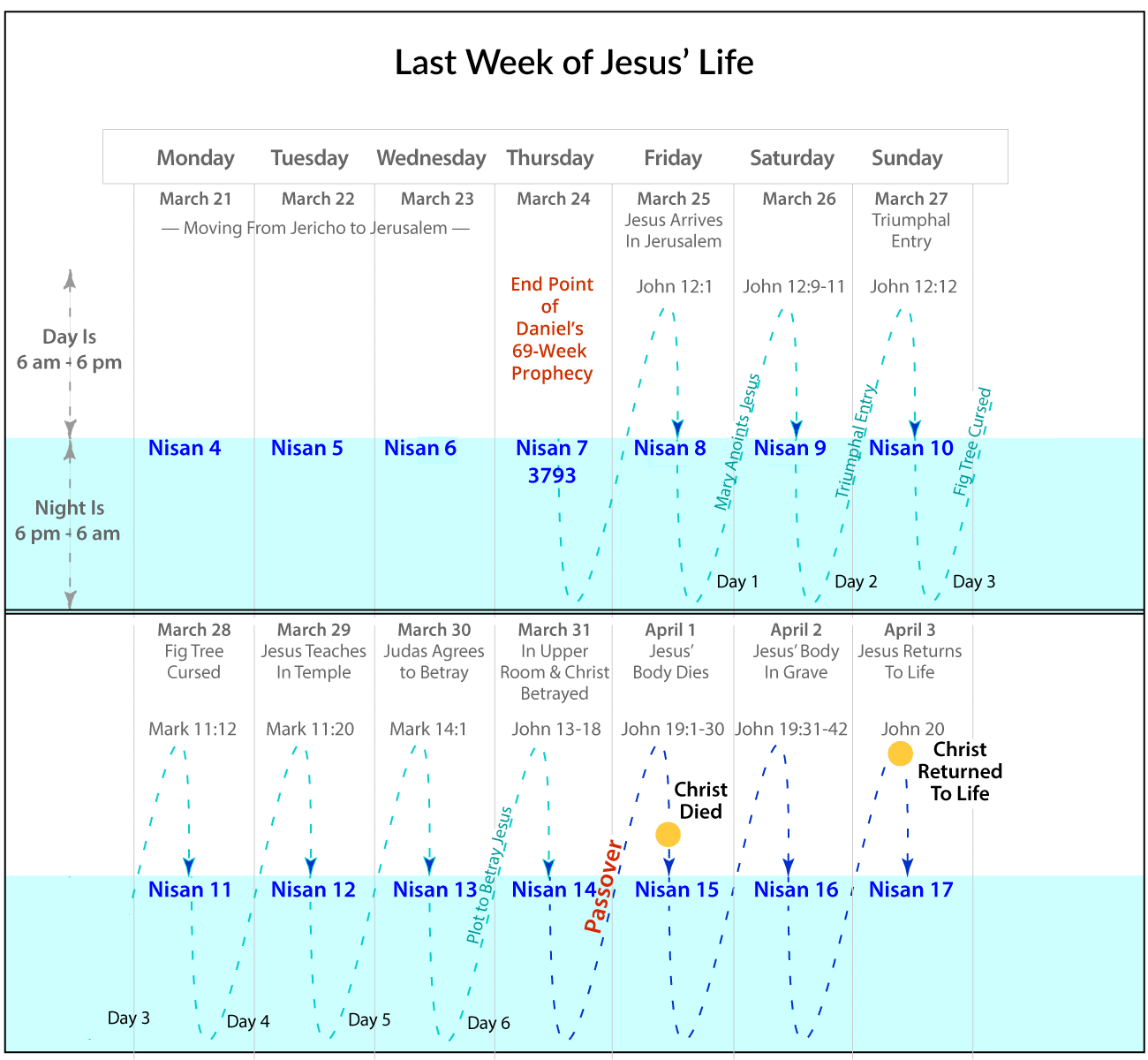
Friday (Nisan 7, March 25). First, we should notice that Jesus arrived in Jerusalem on Friday, Nisan 8, since John 12:1 states the Passover was only six days away (see chart “Last Week of Jesus’ Life”).
Saturday (Nisan 8, March 26). John 12:9-11 tells us that a large crowd of the Jews learned where Jesus was located and came to Him. We are not told what happened, except that now the chief priests knew where He was located.
Sunday (Nisan 9, March 27). John 12:12 tells that it is next day. It is the day of the Triumphal Entry of Jesus. That would correspond to either the evening of Saturday, Nisan 8 or Sunday morning of Nisan 9. Most likely the Triumphal Entry occurred on Sunday since there was a crowd with children. Jesus also visited the temple (Mark 11:11). That is also the general opinion of scholars.
Monday (Nisan 10, March 28). Mark 11:12 refers to the “next day,” on the morning of Monday, Nisan 10, after the Triumphal Entry. Mark says that Jesus cursed a fig tree and entered the temple .
Tuesday (Nisan 11, March 29). In Mark 11:20, we read about another “next day,” or the morning of Tuesday, Nisan 11. The fig tree is now withered and Jesus teaches in the temple.
Wednesday (Nisan 12, March 30). Mark 14:1 gives us some more time information. We are told there are two days before the Passover. Most likely this information corresponds to Tuesday morning, Nisan 12. Since the Jews counted part of a day as a full day, that agrees with two days before the last supper in the Upper Room on Thursday evening, Nisan 14.
Thursday Morning (Nisan 13, March 31). The teaching that Luke 21:37-38 describes probably occurred on Monday, Tuesday, Wednesday and Thursday morning.
Thursday Evening (Nisan 14, March 31). The last supper occurred on Thursday in the Upper Room. Jesus was also betrayed that evening, Nisan 14. Then on Friday afternoon, Nisan 14, Jesus, the Messiah, the Prince, was crucified and died. The Gregorian date is April 1, A.D. 33. The Julian date is April 3, A.D. 33. The date of Nisan 6, 3793 or March 24, A.D. 33 corresponds to the Thursday before Jesus’ Triumphal Entry into Jerusalem.
Friday (Nisan 14, April 1). In conclusion, the start date of the prophecy is Nisan 1, 444 B.C. The end date of the prophecy is the afternoon of Nisan 14, A.D. 33 or April 1.
Daniel prophesied that the Messiah would die about 500 years before it happened. Other prophecies predicted that the Messiah would suffer (Isaiah 53), be pierced with a sword, be scourged, die alongside thieves, and be buried in a rich man’s grave.
But He was pierced through for our transgressions . . . and by His scourging we are healed. All of us like sheep have gone astray, each of us has turned to his own way; but the LORD has caused the iniquity of us all to fall on Him. He was oppressed and He was afflicted, yet He did not open His mouth; like a lamb that is led to slaughter, and like a sheep that is silent before its shearers, so He did not open His mouth . . . His grave was assigned with wicked men, yet He was with a rich man in His death, because He had done no violence, nor was there any deceit in His mouth. But the LORD was pleased to crush Him, putting Him to grief . . . and was numbered with the transgressors; yet He Himself bore the sin of many, and interceded for the transgressors. Isaiah 53:5-12 (NASB)
All these things happened to Jesus just as this 500 year old prophecy predicted. Why did Jesus die? He died for our sins. But that alone is not what Easter or Resurrection Sunday is all about. Resurrection Sunday is about Jesus’ return to life after being dead. Another prophet predicted this almost 1,000 years before Jesus,
. . . Neither wilt Thou allow Thy Holy One to undergo decay. Psalm 16:10 (NASB)
Jesus was and is the Messiah!
Recommended Reading:
Why did the 69 weeks of Daniel 9:25 not end on Nisan 1?
Is it significant the 7 weeks and 62 weeks are separated in Dan. 9:25?
How does 483 biblical years convert to 476 Gregorian years and 25 days?
What is the correct calculation of Daniel’s 69 Weeks?
Did Christ die as the 70 weeks of Daniel prophesied? Were Julius Africanus and Phlegon correct?
Is there a gap between the 69th and 70th week of Daniel?
Why is Daniel’s prophecy in 9:25-27 so vital to understanding the future?
Did ancient Jews believe the Messiah would arrive in the first century A.D.?
References
1. Jerome. Commentary on Daniel. 9:25-27.
2. Julius Africanus. Chronography, 18.
3. Finegan, Jack. Handbook of Biblical Chronology. Hendrickson Pub., 1998, p. 301
4. Jewish Antiquities 17, 156-191
5. Verified with the astronomy software Starry Night.
6. Finegan. Ibid. p. 302-306. Take special note of p. 304, para 522.
7. Karl Georg Wieseler. A Chronological Synopsis of the Four Gospels. Tr. By Venables. Nabu Publica Domain Reprints. (Book was originally printed by George Bell & Sons. 1878. See pp. 105-150.) p. 150.
8. Verified with the astronomy software Starry Night
9. Jewish Calendar Conversions in One Step (stevemorse.org/jcal/jcal.html)
10. Edwin R. Thiele. The Mysterious Numbers of The Hebrew Kings. Kregel. 1983. p. 43-45, 180.
11. Ibid.
12. Francis Brown, Samuel Rolles Driver, and Charles Augustus Briggs, Enhanced Brown-Driver-Briggs Hebrew and English Lexicon. Clarendon Press, 1977, 644.
13. Judaism 101 (www.jewfaq.org/calendar.htm)
14. Hebrew Calendar (oer2go.org/mods/en-wikipedia_for_schools-static/wp/h/Hebrew_calendar.htm).
15. Richard A. Parker and Waldo Dubberstein’s Babylonian Chronology 626 B.C-A.D. 75 (2nd ed.; Providence, 1956, p.2, 26.
16. Babylonian Talmud. Rosh Hashanah. 1.1. Note the text reads, “There are four new years: (1) The first day of Nisan is the new year for kings . . .” Then in 1.2. c we read, “But if he ascended [to the throne] on the first of Nisan [itself]—they do not count a [full] year of his [reign] until the next first of Nisan arrives.” (Jacob Nuesner. The Babylonian Talmud. Translation and Commentary. Hendrickson Publishers. 2006. CD) Thus the king’s reign is counted from the first of Nisan.
17. Thiele. Ibid., p 53.
18. Parker and Waldo Dubberstein. Ibid. p. 6, 32.
19. Finegan. Ibid. p. 35.
20. Ibid., p. 2.
21. Jewish Encyclopedia (www.jewishencyclopedia.com/articles/3920-calendar-history-of)
22. J.K. Fotheringham, “The Evidence of Astronomy and Technical Chronology for the Date of the Crucifixion,” Journal of Theological Studies 35. 1934. pp. 146-62
23. Finegan. Ibid. Sect. 71. p. 35.
24. Note that when 24.7 days are added to February 27, A.D. 33 we obtain March 24, A.D. 33. February in A.D. 33 has only 28 days.
Revised September 2, 2022.
Suggested Links:
Searching For GodYear of Jesus’ Death Was Prophesied
Prophecy of Daniel
Bible Prophecy of The Future
When did King Herod the Great reign and die?