During our study of the church at Pergamum (Revelation 2:12-17), we saw one form of religious idolatry. Religion is not very different today. For example, the citizens of Pergamum worshipped Asclepius, who was the god of health. People would come from distant places for their health. “Health” included baths, theaters for culture, gyms for physical well-being, and the libraries for the mind. Culture, reading, the arts, and cleanliness were important. There are ancient testimonies of people who say that they were cured of blindness and ulcers. These ancient records reveal that hypnosis, diet, bathing, and various medicines were commonly used to help people feel better and to “heal” their diseases. The citizens did not live in a village of mud huts and straw shacks. They lived in an elegant city of roads, buildings, and temples made of stone and marble. They were living in a society that worshipped one or more gods in their temples, but not the true God. Religion was part of their daily lives, including their health.
Idolatry
Religion is not just a belief in a higher power. Your god is anything or anyone which occupies your thoughts and time more than the true God – more than the one who created us. That is the message of Colossians 3:5,
Therefore consider the members of your earthly body as dead to immorality, impurity, passion, evil desire, and greed, which amounts to idolatry. Colossians 3:5 (NASB)
This verse simply says that idolatry can even be the passions which control you. Anything that prevents you from being totally committed to God is idolatry.
Seven Trumpets
This study takes us to Revelation 8. Here we will see God start to destroy those things the people of the world prize, desire, want, and covet most – the gods of their life. In this chapter the first four of seven trumpets will be blown and God’s elimination of sin from the world and universe will begin. The seven trumpets are introduced when the seventh and last seal is broken by Jesus Christ. When Jesus breaks the seventh seal, there is silence in heaven for thirty minutes.
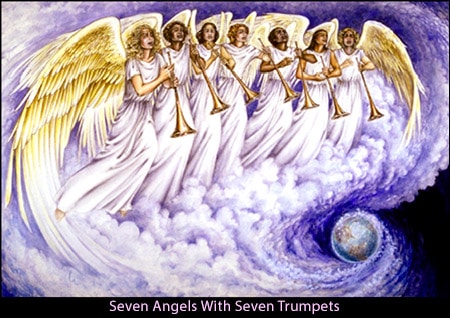
And when He broke the seventh seal, there was silence in heaven for about half an hour. And I saw the seven angels who stand before God; and seven trumpets were given to them. Revelation 8:1-2 (NASB)
It may be hard to accept the fact that Jesus has been breaking each of the seven seals which have brought so much pain, suffering, and death upon the world. If so, it is important to remember that Jesus is not just a God of love. He is also a holy God who has been warning the peoples of the world to turn away from anything that puts Him in second place in their life. His love has been shown in the death of Jesus Christ. In the end times, His justice will be evident in His punishment of sin.
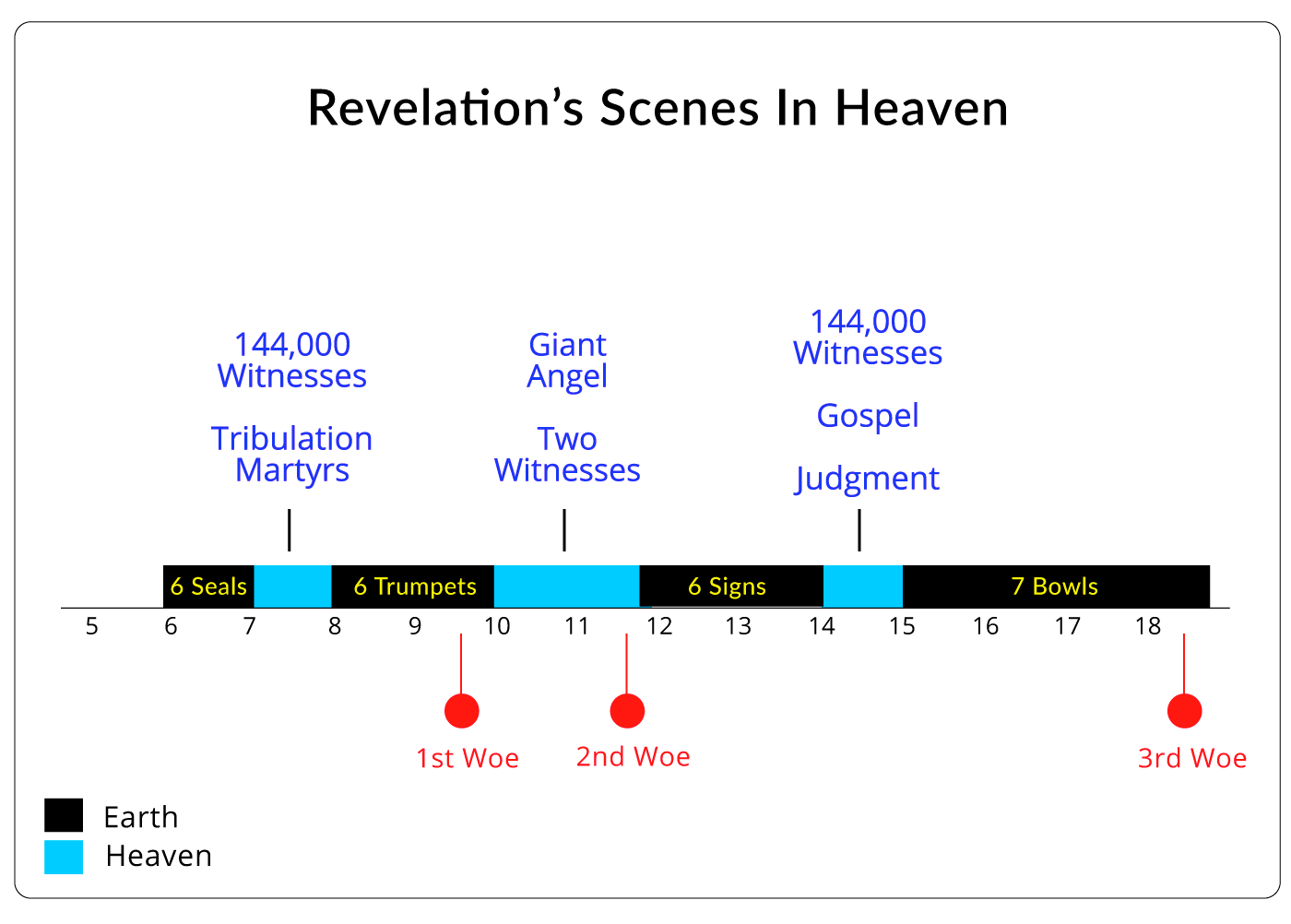
The seven trumpets belong to seven angels and they will start to blow the trumpets in a few verses. The first six trumpets will sound in Revelation 8 and 9. We will also see the first woe in Revelation 9:12, and then another scene in heaven unfolds in Revelation 10-11.
Prayers of the Saints
Before the first trumpet is blown, we are told that another angel comes and stands before the altar.
And another angel came and stood at the altar, holding a golden censer; and much incense was given to him, that he might add it to the prayers of all the saints upon the golden altar which was before the throne. And the smoke of the incense, with the prayers of the saints, went up before God out of the angel’s hand. And the angel took the censer; and he filled it with the fire of the altar and threw it to the earth; and there followed peals of thunder and sounds and flashes of lightning and an earthquake. And the seven angels who had the seven trumpets prepared themselves to sound them. Revelation 8:3-6 (NASB)
We are not sure, but it appears the altar is the altar of incense (Exodus 30:1-38). Throughout scripture, incense and the prayers of the saints are associated (Psalm 141:2; Luke 1:10-11; Revelation 5:8). Both the incense and the prayers of the saints will mingle together on the altar as a sweet aroma to God. What a wonderful thought: our prayers are pleasing to God! He likes them . . .
Then the angel takes the golden censer, fills it with fire, and throws it to the earth. In reaction there will be “peals of thunder, sounds, flashes of lightning, and an earthquake” will occur. The disaster will be beyond anyone’s greatest fears. It will be horrible. This seems to be God’s answer to the prayers of the saints that the wickedness and horror on the earth be stopped. God will answer their prayers. Some day God will put an end to the evil that is growing year by year. That day is coming.
First Trumpet
When the first angel blows his trumpet, hail, fire, and blood will come down out of heaven upon the earth, just as the golden censer was thrown down.
And the first sounded, and there came hail and fire, mixed with blood, and they were thrown to the earth; and a third of the earth was burned up, and a third of the trees were burned up, and all the green grass was burned up. Revelation 8:7 (NASB)
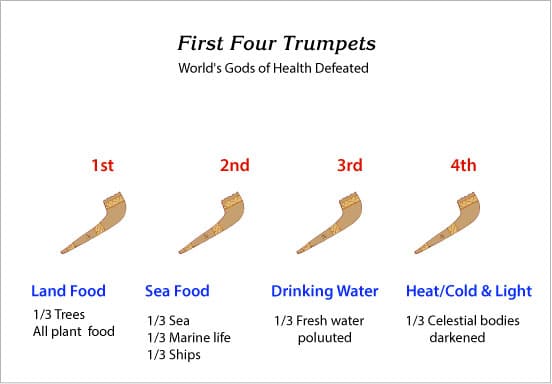
One third of the world’s trees and every green plant will be destroyed. Since plants convert carbon dioxide into oxygen, this will have a significant impact on the health of all living things in the world. By destroying all green plants, God will also temporarily destroy the vegetation which the land animals and humans eat. This will cause death, illness, and poor health until the vegetation sufficiently re-grows. God will show His power and superiority over the world’s preoccupation with health. I do not mean to imply that exercise, a good diet, or visiting your doctor is wrong, but when these things are more important than loving God and honoring Him – something is wrong.
Second Trumpet
When the second trumpet sounds, something like a great mountain falls to the earth.
And the second angel sounded, and something like a great mountain burning with fire was thrown into the sea; and a third of the sea became blood; and a third of the creatures, which were in the sea and had life, died; and a third of the ships were destroyed. Revelation 8:8 (NASB)
Notice that the Apostle says, “something like.” He is trying to describe it. We are not sure what it is. It could be a meteor or debris from space. Whatever it is, it kills one third of the animals in the sea and destroys one third of the ships.
God will not only destroy one third of the trees and all of the plants, He will also kill one third of the salmon, tuna, shrimp, lobster, oysters, grouper, halibut, sharks, whales, and clams, for example. The world’s ability to catch marine life will also be hindered. One third of the ships will be destroyed. There will be blood everywhere. God will show His power and superiority over the world’s god of health and food. There will be sadness in the world’s restaurants and food stores, and many will be hungry.
Third Trumpet
The third trumpet brings about more disaster.
And the third angel sounded, and a great star fell from heaven, burning like a torch, and it fell on a third of the rivers and on the springs of waters; and the name of the star is called Wormwood; and a third of the waters became wormwood; and many men died from the waters, because they were made bitter. Revelation 8:10-11 (NASB)
Once again, the Apostle tries to describe something he does not recognize. This time it appears that the object is a meteor or a comet. This celestial body will apparently break up into smaller pieces, scatter around the world, and pollute one third of the fresh water of the world. God will be capturing the attention of the world by attacking the earth’s water resources. God will be threatening life – the one thing almost every man and woman will fight to protect.
Fourth Trumpet
The fourth trumpet causes the celestial lights to be dimmed. The brightness of the sun, moon, and stars is dimmed by one third.
And the fourth angel sounded, and a third of the sun and a third of the moon and a third of the stars were smitten, so that a third of them might be darkened and the day might not shine for a third of it, and the night in the same way. Revelation 8:12 (NASB)
I can imagine some scientists, television commentators, politicians, and other individuals giving natural explanations as to all of the previous events that have occurred. But this disaster will be difficult to explain. How can the celestial bodies in the heavens be dimmed? God will have caused an event that one cannot explain away.
Conclusion
The effects of these four disasters will be significant to the health of every living creature and plant. God will have destroyed plants, land animals, sea and fresh water life, and severely impacted the temperature of the planet. We will see in the next chapter that the people of the world will finally know that these disasters are from God. Now they will admit that there is God. How do they respond to God? We will find out in the next study.
But for now, the Holy Spirit gives a warning,
And I looked, and I heard an eagle flying in midheaven, saying with a loud voice, “Woe, woe, woe, to those who dwell on the earth, because of the remaining blasts of the trumpet of the three angels who are about to sound!” Revelation 8:13 (NASB)
These first four trumpets are the first woe. There are two more to come. The world will be in serious trouble. It is a time when God shows that He reigns supreme. He will be reminding men and women of the world that there really is a God. They will discover that they have substituted health, food, and other things for the real God. God will make a direct assault on mankind. God will be calling them to Himself and they can respond if they will.
The god of this world is Satan (2 Corinthians 4:4) and he wants us to be preoccupied with the pleasures of this life and not with the true God. He wants us to seek anything but God. He whispers suggestions into our ear about things that will divert our attention and occupy our time.
A traveller to Pompeii was taken into the temple of Isis. The temple contained the statue of Isis through whose lips the credulous worshippers of long ago thought that they had obtained trustworthy answers to their prayers. But alongside the ruined shrine the traveller saw a secret staircase by which the deceitful priests would reach the back of the statue and while hidden, murmur the responses of the oracle. – G. G. Eckman
So it is today. The deceitful voices are many and the murmurs are soothing. But God is also calling us – to Himself.