How do we know that the Bible is the Word of God and therefore true? We know that we cannot trust our emotions. We cannot trust our politicians to be truthful and factual. We cannot trust science since it is always changing and seeking truth. Science has not yet arrived. An aerospace scientist recently stated that science is an imperfect discipline that is trying to understand what it believes to be true. It short, science is not what the common man thinks it is nor is it what some scientists want us to believe. Forbes’ ASAP magazine captured that truth in its feature article by James Burke in its October 2, 2000 edition. The author demonstrated that science is in constant change. Once the entire world thought the world was flat. We all know how that brilliant piece of science ended. Truth is not found in my experience, for I have discovered that my emotions vary with the day of the week, the time of day, and even my thoughts. Truth is not found in broken, worn out, and dusty books or in cultural philosophy. Truth is not found in television, UFOs, the occult, or in looking at earth worms.
Discovering Truth
So where do we find truth? Today we know a great deal about the present; but what about the future? Can you predict what next week will be like? How about next year or in ten years? How should we react about a book that contains prophecies that actually came true? If we can find a source that has accurately predicted the future, then we have found something that is dependable. And if it speaks to spiritual issues, then we can understand spiritual truth.
This study is about a long sequence of very detailed prophecies found in Daniel 11. They are incredible. They are a reason to believe the Bible! In this study you find a list of predictions that even the majority of the critics of the Bible agree are very detailed, extremely accurate, and without mistake.
Background
In Daniel 10, the prophet Daniel asked God for information about the end time and the anti-Christ specifically. In response, God sent an angel to Him and after battling some evil angelic forces, God’s holy angel finally came to Daniel. The angel proceeded to explain why he was late and then to answer his question. Daniel 11:2 is the beginning of his answer. This means that Daniel 11 is about the future and at the end of the chapter we will get a glimpse of the series of events at the end of the age.
This chapter contains the most detailed prophecy in the Bible. Dr. J. Vernon McGee had this to say about Daniel 11,
This prophecy is rather complicated and goes into prophecy a little deeper than the average person likes to go into it. Most people seem to like the exciting, sensational part of prophecy, but they do not want to dig down into the Word of God to see what it really says. However, if you are one who enjoys a deep and detailed study of prophecy, you will be thrilled by this section of the remarkable Word of God.
We trust that you are eager to dig into this detailed prophecy. Hold on! When you are done, you will be amazed. This is good news. A series of charts will be presented to help summarize the details of the prophecy.

Medo-Persian Empire
Daniel 11:1 should not be the beginning of this chapter since the angel is continuing to talk to Daniel from the previous chapter.
And in the first year of Darius the Mede, I arose to be an encouragement and a protection for him. Daniel 11:1 (NASB)
Here we are told that the angel told Daniel that he had helped Darius the Mede in some way, but we are never told how. Have you ever wondered if God helps non-Christians? He did here. God loves and helps even those who are non-Christians. He may be helping your neighbor, the policeman who stopped you, or the fellow employee next to you. God loves even those who reject Him. Just think how much more He helps those who are His own!
Early Persian Kings
First Prophecy
In Daniel 11:2, the angel introduces us to the first prophecy.
And now I will tell you the truth. Behold, three more kings are going to arise in Persia. Then a fourth will gain far more riches than all of them; as soon as he becomes strong through his riches, he will arouse the whole empire against the realm of Greece. Daniel 11:2 (NASB)
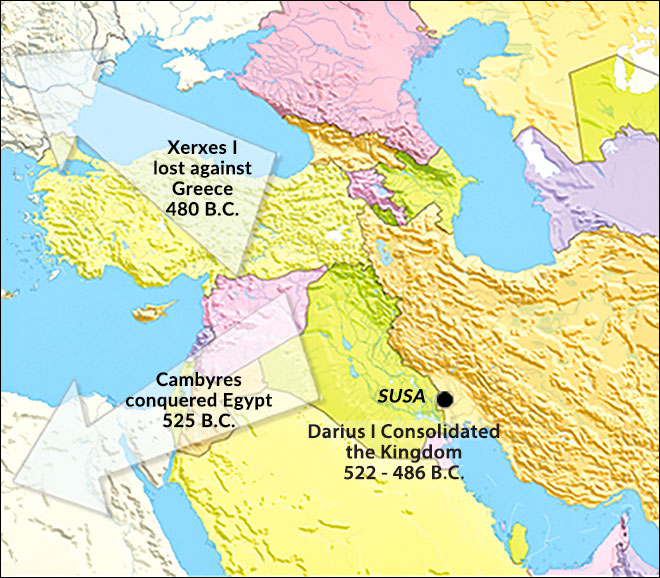
He tells Daniel that four more men will become kings in the kingdom. Since the angel is speaking during the reign of King Cyrus (Dan. 10:1), all that we have to do is count one, two, three kings after Cyrus and we discover that the fourth king is Xerxes (486-465 B.C.).
History tells us that Cambyres conquered Egypt in 525 B.C. and then was murdered his brother. He reigned eight years and was followed by Pseudo-Smerdis who reigned less than one year.
Darius I is the second king in the count. He was a cousin of Cyrus I. He organized the kingdom and imposed taxation on the people of the empire. This allowed him to attempt to expand the empire into Greece, but he was defeated. However, Darius I attacked Greece in 490 B.C. preparing the empire for Xerxes I.
Xerxes I became the fourth king in the count and was soon very wealthy as a result of his predecessor amassing great wealth through a taxation program. With a wealth of funds, Xerxes sought to defeat the territory around Greece. He gathered a huge army of one hundred thousand men, 120 ships, and an elite group of soldiers. Historians say this elite group was exotically and gorgeously dressed. They were armed also with bows, daggers, spears, and shields. He then attempted a military defeat of Greece in 480 B.C. but was defeated. This stopped the Medo-Persian Empire expansion into Europe and served as a warning to Greece of the dangers from the Medo-Persian empire. The rest of the Medo-Persian kings were ignored in the prophecy.
All of the other Medo-Persian kings are not important to this prophecy. Xerxes was important because he motivated Greece to come after the Medo-Persian empire. They were a threat. We will see next that scripture describes each of the kings of Greece and then stops at Antiochus IV Epiphanes.
Empire of Greece
After many years of conflict, Alexander the Great, a Greek general, finally punished the Medo-Persian empire for its repeated attacks on the Greece by defeating and subjugating it. Eventually, Alexander expanded the Greek empire south into Egypt and east as far as India. It was an enormous accomplishment and the Greek empire was at a zenith. But Alexander died at the height of his career. The next two verses predicted that the Greek empire would be divided among four generals, and history records that actually occurred. The reader should review the supporting study called Hooked By a Dream for the historical dating of the book of Daniel. The evidence reveals that the book of Daniel was written before these events occurred.
And a mighty king will arise, and he will rule with great authority and do as he pleases. But as soon as he has arisen, his kingdom will be broken up and parceled out toward the four points of the compass, though not to his own descendants, nor according to his authority which he wielded; for his sovereignty will be uprooted and given to others besides them. Daniel 11:3-4 (NASB)
The prophecy states that the four generals did not have the power and the skill of Alexander the Great, but they divided the empire into four parts and began to rule as kings. History tells us that the empire was divided among Lysimachus, Cassander, Seleucus, and Ptolemy. Lysimachus obtained Thrace. Cassander acquired Macedonia. Seleucus governed Syria, Babylon, Persia, and India. Ptolemy ruled Egypt, Palestine, Cilicia, Petra, and Cyprus. This prophecy and history agree.

Ptolemies and Seleucids
Daniel 11 now focuses on two generals, Ptolemy I Soter and Seleucus I Nicator, and the kings who will come after them. These two new empires will wage war against one another for about 200 years.
Ptolemy I Soter’s empire included Egypt. On Alexander’s death, history says this man stole Alexander the Great’s body and took it to Memphis, Egypt, and established himself in the years that followed.

Verse 5
Seleucus I Nicator was king of the upper northern regions of the old Medo-Persian empire. His empire included Babylon in 321 B.C., the northern part of Syria, Cilicia and access to the Mediterranean Sea. At first, Antigonus the “One-Eyed” general supported Seleucus I Nicator. But Seleucus’ authority was eventually subverted by Antigonus. Seleucus fled to Egypt to seek support from Ptolemy I Soter in 316 B.C. In return Seleucus I supported Ptolemy.
Then the king of the South will grow strong, along with one of his princes who will gain ascendancy over him and obtain dominion; his domain will be a great dominion indeed. Daniel 11:5 (NASB)
Daniel 11:5 predicted that “the king of the south will grow strong, along with one of his princes.” The prince was Seleucus I. Together, Ptolemy and Seleucus grew strong. Eventually, there was a battle in the Gaza region and Antigonus the One-eyed was defeated.
Consequently, Seleucus captured Babylonia and then Media, Susiana, and eventually the Indus region. Seleucus and Antigonus continued fighting until 308 B.C. Seleucus continued to expand his empire until it included most of Asia Minor. His empire was very large extending from Asia Minor on the west and into India in the east. Ptolemy’s kingdom was significantly smaller in comparison.
What did scripture predict would happen between Ptolemy I Soter and Seleucus I Nicator? Daniel 11:5 says that Seleucus would gain “ascendancy over him” and that is exactly what occurred. Seleucus was more powerful and his empire was larger than that of Ptolemy I Soter.

Verse 6
When we arrive at verse 6, Ptolemy I Soter, Seleucus I Nicator, and Antiochus I Soter have died and the two empires are in conflict once again.
After some years they will form an alliance, and the daughter of the king of the South will come to the king of the North to carry out a peaceful arrangement. But she will not retain her position of power, nor will he remain with his power, but she will be given up, along with those who brought her in and the one who sired her as well as he who supported her in those times. Daniel 11:6 (NASB)
In 250 B.C. Antiochus II Theos and Ptolemy II Philadelphus agreed to a peace treaty by an arranged marriage. Ptolemy II agreed that his teenage daughter Bernice would marry Antiochus II. The treaty required Antiochus to divorce his wife Laodice in order to marry Bernice. Within four years Ptolemy II died. Antiochus then decides to divorce Bernice and remarry Laodice, who then poisoned Antiochus, and murdered Bernice and those who came with her from Egypt.
What does verse 6 say would happen? The passage predicted that an alliance would take place. A peaceful arrangement would be carried out when the daughter of the king of the south went to the king of the north. But she would die later along with those who came with her. The king would die and her father – “sired her” – would die. This prophecy agrees with history very accurately.

Verses 7-8
The prophecy also accurately predicted the future events of these two empires.
But one of the descendants of her line will arise in his place, and he will come against their army and enter the fortress of the king of the North, and he will deal with them and display great strength. Also their gods with their metal images and their precious vessels of silver and gold he will take into captivity to Egypt, and he on his part will refrain from attacking the king of the North for some years. Daniel 11:7-8 (NASB)
History records that Bernice’s brother, Ptolemy III Eugeretes, became the new pharaoh in Egypt. He was so angry that his teenage sister had been murdered that he took military action against the Seleucid empire and murdered Laodice in revenge. He captured Syria for Egypt and plundered the northern empire of a vast amount of wealth and stole their gods. This was an insult to the Seleucid empire.

Verses 9-10
Time elapsed after the embarrassment of being defeated by Ptolemy III Eugeretes. In response, Seleucus II Callinicus regained control of Syria and attempted to enter Egypt later, but was unsuccessful dying in 227 B.C. This is the meaning of “the latter will enter . . . but will return to his own land.” History indicates that the following prophecy was accurate.
Then the latter will enter the realm of the king of the South, but will return to his own land. His sons will mobilize and assemble a multitude of great forces; and one of them will keep on coming and overflow and pass through, that he may again wage war up to his very fortress. Daniel 11:9 (NASB)
History records that Seleucus II Callinicus had two sons named Seleucus III Ceraunus and Antiochus III The Great.. The first son, Seleucus III Ceraunus became king for only four years and died in battle in Asia Minor.
He was succeeded by his brother Antiochus III The Great. The passage says that “one of them will keep coming and overflow and pass through.” The “one” is Antiochus. Antiochus gathered an army of 62,000 infantry, 6,000 cavalry, and 102 elephants. He brought his “great force” against Egypt. Egyptian control had extended up to the Seleucid empire including all of Palestine. History tells us that Antiochus’ army moved through Palestine easily. He waged “war up to his very fortress” refers to his campaign that was so successful that he recaptured the fortress at Raphia in 219 B.C. Consequently, he pushed Egyptian control back to the fortress at Raphia.

Verses 11-12
Ptolemy III’s death occurred between verses 10 and 11. Verses 11 and 12 are focused on Antiochus III the Great’s military campaign, and a new king.
Ptolemy IV Philopator became king over Egypt two years after Antiochus III the Great. He was a man given to comfort and a life of ease. Yet, history records that he sought to regain control of Raphia in a battle with Antiochus III at Raphia. But his army was unsuccessful. Then he and his sister-wife, Arsinoe, gathered a large army of 70,000 infantry, 5,000 cavalry, and 73 elephants and defeated Antiochus at Raphia in 217 B.C.
The actual Hebrew language, though awkward, gives us a better sense of what was predicted.
And shall become the furious the king of the south and will go out and fight with him, with the king of the north. And he shall raise a host great. And shall be given the host into his hand. (Literal Hebrew)
The phrase “his hand” refers to Ptolemy. Now we understand that Ptolemy was predicted to be successful against Antiochus. This agrees with history.
Ptolemy was happy with his great victory over Antiochus because he killed 10,000 infantry, 300 cavalry, and 5 elephants, and took 4,000 prisoners. He pushed Antiochus out of Palestine and then made peace. He had the advantage and did not secure his victory but decided to return home to comfort and his life of ease. History says that Ptolemy pursued a life of pleasure. He did “not prevail.”

Verses 13-15
During 212-205 B.C. Antiochus III greatly expanded his empire into the Caspian Sea and to the border of India. That is the reason he is called Antiochus III The Great. But Antiochus had avoided Egypt until he heard that the thirty-five year old Ptolemy IV Philopator and his wife had died and a four year boy, Ptolemy V Epiphanes, was the new king.
Antiochus considered this to be wonderful news. After he made an agreement with Philip V of Macedonia, together they brought their armies against Egypt. Some Jews had attempted to help Antiochus defeat the Egyptians, but they were defeated. After the battle at Panias, the Egyptian commander Scopas led his army to Sidon. There Antiochus used siege works to capture the city. Notice the comment about “much equipment” and “siege mound.” God not only predicted these events, He predicted the method by which this fortress city would be defeated.
Egypt was defeated. It was a crushing loss because the Egyptian commander Scopas was the best general Egypt had, and the troops he led were Egypt’s elite.
What a sad picture of the human heart. We have seen men and women killing each other. Now we see a man taking advantage of a child. When given the opportunity, men and women often do just what they want.

Verses 16-19
After Scopas surrendered at Sidon, Antiochus III was welcomed by the Jews in Jerusalem. The Jews were glad to be free of the Egyptians. The Seleucid Empire would keep control of Palestine until the Romans came in 146 B.C.
As part of his preparations for waging war against Rome, Antiochus made a secret peace treaty with Ptolemy V Epiphanes in 197 B.C. in exchange for a wife. The peace treaty gave some of Egypt’s territories to Antiochus III. Since the king was ten years old, the marriage did not take place until 193 B.C. when he was fourteen. His wife was Cleopatra – “the daughter of women.” She was not the famous Cleopatra of history. Antiochus III had hoped that his daughter would remain loyal to him, but history records that she did not. She was loyal to her husband and to Egypt – “will not stand for him or be on his side.”
Then Antiochus III pushed forward to Rome. He captured a number of Greek islands – “coast lands and capture many.” Hannibal from Carthage joined him and together they entered Greece. The Romans had warned him to stay out of Greece, but he ignored the warning. In 191 B.C. he was defeated by the Roman commander Lucius Cornelius Scipio. Rome demanded payment for the expense of defeating him, and Antiochus fled to Elymias. History records that he was murdered in a Baal temple in Suasa in 187 B.C. He died trying to steal the money he owed Rome.

Verses 20-23
When we come to verse 20, Ptolemy V Epiphanes is dead. Ptolemy VI Philometor is pharaoh in Egypt. Cleopatra is the queen mother. Antiochus III The Great is dead also, and Seleucus IV Philopator is king over the Seleucid Empire.
Seleucus IV inherited a great debt that his father did not pay to Rome for his failed invasion. So he “imposes taxes” to pay off the debt to Rome and sent his prime minister, Heriodorus, to Palestine – “the glorious kingdom” – to collect taxes. Seleucus IV died due to poisoning after a reign of only eleven years – “within a few days he shall be destroyed.”
Verse 21 refers to Antiochus IV Epiphanes who was in deed a “vile person.” Epiphanes means “the magnificent one” or “the illustrious.” He was not of royal blood and had no right to the throne. The throne belonged to Demetrius Soter who was in prison in Rome. So Antiochus made alliances with the king of Pergamos and others in the area as well as Rome. Rome helped Antiochus take the throne in Antioch and become the new king over the Seleucid Empire.
Antiochus IV defeated numerous coup attempts and attacked Egypt when he heard the king was planning to attack. Antiochus IV agreed to an alliance with Ptolemy VI Philometor to help Ptolemy claim all of Egypt. But the alliance lasted only while Antiochus was militarily weak.

Verses 24-28
Antiochus IV invaded Syria and stole wealth so that he could give to the poor, trusted friends, and politicians in order to win their favor. He was preparing for war against Egypt.
Apparently, Ptolemy VI had heard that Antiochus was planning to invade Egypt, so he raised a large army and prepared for war. Then in 170 B.C. Antiochus IV attempted to invade Egypt and attacked Pelusium, just east of the Nile River. The Egyptian forces were defeated, and surrendered in favor of a new alliance. But Antiochus IV did not plan to keep the alliance. The alliance was part of his plan to conquer all of Egypt. He had lied to Ptolemy VI about his intention in order to gain his allegiance.
Ptolemy VI Philometor had a brother named Ptolemy VII Eugeretes. Ptolemy VI ruled Memphis, and Ptolemy VII ruled Alexandria. Antiochus IV had hoped that Ptolemy VI would help him defeat his brother, Ptolemy VII, and then break the alliance and rule Egypt. But Antiochus IV was defeated by Ptolemy VII at Alexandria.
Verse 28 predicted that Antiochus would be moved against the holy covenant. History records that when Antiochus returned to Syria, he crushed a revolt in Jerusalem in support of Menelaus, the high priest. The high priest was his supporter.

Verses 29-31
About two years later in 168 B.C., Antiochus learned that Ptolemy VI Philometor and Ptolemy VII Eugeretes had made an alliance against him. In response he planned to attack Egypt. Two years earlier he had been partially successful, but this time when he brought his army against Egypt, he was surprised by a Roman emissary, Popilius Laenas.
Antiochus did not know that Rome had agreed to help Egypt. Chittim or “Cyprus” refers to the northeast part of the Mediterranean Sea, including Italy. The Romans had arrived in ships, When Antiochus came down to Egypt, Popilius Laenas told him that he could not enter Egypt. At first Antiochus refused to go back home, so Laenas drew a circle about him and told him that he had to respond before he stepped out of the circle. Historians say that after a few moments of humiliating silence, Antiochus IV agreed and left Egypt in a rage. On his way home, he released his rage on the Jews.
Conclusion
That was Antiochus’ place in history. Verse 21 calls him a “despicable man.” Two other Bible translations call him a “vile man” or a “contemptible man.” Did you think all of the men and women we saw earlier in the chapter were good people? Did you think that murder, divorce, revenge, anger, insults, and war were wrong, bad, wicked, or evil? If you thought that men and women could not be any worse, stop to think about Antiochus IV Epiphanes. He was a “despicable man.”
He had lied, murdered, and stolen his way into the pages of history. He was the king of a nation that deserved better. In fact, he should not have been king, because the man who deserved to be king was in prison in Rome. He had made alliances or agreements and then broken them in order to defeat them and expand his empire. He was an extremely wicked man as we see more in our next study. Antiochus IV Epiphanes is a picture of the coming Antichrist. This is the future of the world. It is not getting better. It is getting worse.
These evil men and women are a reminder of our world’s future. But it is also a great reminder of our future as Christians. It reminds us that some day Jesus is coming back. We will either see Jesus when we die or we will see Him in the sky when He returns. What a wonderful future for those who believe in Jesus!
There is also another wonderful truth in this chapter. Did you miss all of the detail in the verses in this chapter – details about sins and events? We have seen one wicked man after another. Each one seems to be worse. We have seen murder, war, lies, intrigue, anger, hatred, sex and divorce. We have seen defeat, victory, the murder of women, and money. Why did God put this chapter here? Yes, it is true that God put it here to answer Daniel’s question, but why all the detail? The answer is found in the following statement,
And you may say in your heart, “How shall we know the word which the LORD has not spoken?” When a prophet speaks in the name of the LORD, if the thing does not come about or come true, that is the thing which the LORD has not spoken. Deuteronomy 18:21-22 (NASB)
Daniel 11 is about God speaking to us. God has given us this remarkable passage to let us know that He has spoken. The words are His.
The Bible is truth because God Has Spoken!